Scientist Stories: Eva Nogales, Breakthroughs in Cryo-EM and Structural Biology
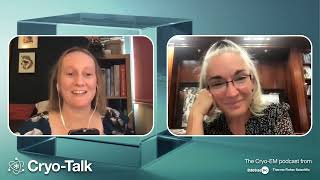
In this CryoTalk episode, host Eva Amsen interviews structural biologist Eva Nogales about her scientific path and perspectives on cryo‑electron microscopy. Nogales recounts her transition from an undergraduate physics degree in Madrid to a PhD combining small‑angle X‑ray scattering with cryo‑EM, a post‑doctoral stint in electron crystallography that yielded the first tubulin structure, and her subsequent focus on single‑particle cryo‑EM of microtubules. She describes a pivotal moment studying the massive TFII‑D transcription complex, where a dramatic 150 Å movement of a lobe revealed DNA‑dependent conformational changes. Looking ahead, she envisions cryo‑EM tackling increasingly complex, near‑cellular systems, including extracts and in‑situ tomography. The conversation also covers her current sabbatical in Spain, collaborations at CNIO and the Barcelona Center for Genomic Regulation, and a forthcoming review on single‑particle versus cellular cryo‑EM. The interview concludes with rapid‑fire personal questions—her love of countryside, cooking, reading (notably El Infinito en un Junco), music (Dire Straits), film (Roma), and advice for early‑career researchers emphasizing resilience, the importance of supportive colleagues, and choosing people over projects.
Chapters
Welcome to CryoTalk, a bite-sized bio podcast sponsored by Thermo Fisher Scientific, featuring conversations between your host, Eva Amsen, and experts in the field of cryo-electron microscopy.
Today on CryoTalk, we're joined by Evan O'Gallagher, distinguished professor of biochemistry, biophysics, and structural biology at UC Berkeley, as well as a senior faculty scientist at Lawrence Berkeley National Laboratory and Howard Hughes Medical Institute investigator. We're discussing some surprising discoveries in her research career.
And when this happened, it really took a turn to get us in the direction of finding something that was truly biologically meaningful.
Why it's important to work with people you like.
Going through those ups and downs, it is very important to be surrounded by people that you feel you can trust.
Her sabbatical in Spain.
And I am at the CNIO, the National Cancer Center in Madrid, so very close to my hometown.
And her love of music.
I actually have tickets for a rock concert here in Madrid, one of these massive things. I've never been to really one.
All in this episode of CryoTalk. Hi, I'm Eva Amtzen. Welcome to CryoTalk. I'm here today with Evan O'Gallagher. She is a distinguished professor of biochemistry, biophysics, and structural biology at UC Berkeley, as well as a senior faculty scientist at the Molecular Biophysics and Integrative Bioimaging Division of Lawrence Berkeley National Laboratory and a Howard Hughes Medical Institute investigator. So, Eva, how are you today?
I'm great, Eva. How are you doing?
I'm good too. Thanks for joining me here. So before we get started, can you tell me a little bit about your research background? So what did you do before you got to where you are today?
Yeah, sure. So I was an undergraduate physics student in Madrid, where I'm from, at the Universidad Autónoma de Madrid. And then, um, I was very fortunate to be able to do my PhD at the British Synchrotron, at the Synchrotron Radiation Source at Dassbury Lab with Joan Borders. And that was an opportunity for me to combine a small-angle X-ray solution scattering with cryo-electron microscopy to study tubulin assembly and effect of antimyotic drugs. And that in turn gave me the right background to apply for a postdoc that turned out to be the most fortunate thing in my career at the Lawrence Berkeley National Lab with Ken Downing. And with him and Sharon Wolf, we worked using electron crystallography to obtain the first structure of tubulin. Which is something that I've been working on since my PhD and I still work on. And that worked out very well for all of us and is what landed me the position at UC Berkeley where I've been ever since.
Great, and how did you get— you mentioned you'd used EM— how did you get from EM to cryo-EM and how have you used that in your work?
Right, right, so So, I was— when I refer to EM, I'm talking about cryo-electron microscopy, negative stain, a combination of both, but mostly cryo-electron microscopy ultimately. So, my first use of cryo-EM was very unusual because, as I briefly mentioned, I was doing small angle X-ray scattering and this was time-resolved. So, the idea was to have tubulin that was in the process of assembling or changing conformation, typically with temperature or something that we could vary and then see the progression in time. And X-ray scattering is a technique where it is not trivial to analyse because it's a single curve, decaying curve, and the meaning of it and the changes in some of the features we could interpret a little bit better by obtaining images of maybe one of the states that we could then Fourier transform, rotationally average, and compare with the sax data, believe it or not. And that allowed me to interpret where certain peaks in the scattering meant, and when they changed, I knew what parameter in the features of the object was changing.. But ultimately, he told me, you know, maybe I should concentrate on cryo-EM because it's a lot more informative and not throwing away information, but rather the opposite. So after that, where I was using somehow a quantitative use of the images, but not for three-dimensional reconstruction, which is what we now understand as cryo-EM, when I moved to Ken Downing's lab, what we did was electron crystallography, which is a special modality. Of electron microscopy, and that had really been developed at the LMB. And in particular, Richard Henderson had obtained in 1990 the structure of bacteriorhodopsin using such a methodology, and is one in which images of two-dimensional crystals are combined with electron diffraction. So for the aficionados, we will use the diffractions to calculate the amplitudes of the structure factors and then combine with the phases. Of the images and then combine many images to get back to the full Fourier space, Fourier transform back and get the structure. Long story short, electron crystallography used to be in the '90s kind of the technique, the ruling technique, if you wanted to obtain atomic structures with electrons using electron microscopes. But obviously, eventually The single particle methodology that people like Joachim Frank were able to develop took over, and the rest is history. Now electron crystallography is hardly used at all. There's a different thing that has to do with microdiffraction, which is probably not what I want to be talking about right now because it's not something that I use. But that was my path. You know, first a very esoteric use of the images for my particular means, then electron crystallography, and then single particle cryo-EM, the mainstream cryo-EM where you don't need to crystallize your sample of interest to obtain a three-dimensional reconstruction.
Yeah, and that not having to crystallize, does that make it easy to look at things like microtubuli?
Right, so microtubules are another example of the perfect sample for cryo-electron microscopy because they are polymers, they are large, they are repetitive, so cryo-EM is ideally suited for it. While on the other hand, they are a real impediment for crystallization. In fact, tubulin, which is the protein that makes up microtubules, has been also after we obtained the electron crystallography structure, which was of a rare, strange self-assembly form of tubulin that forms in the presence of zinc ions and kind of aberrant assembly. That was the kind of two-dimensional crystal that we were able to obtain. After that, 2 years later, there was an X-ray structure of tubulin in a depolymerized state where the assembly of tubulin tubulin has been inhibited. But because microtubules cannot, would not be crystallized, polymers cannot be crystallized. But they are indeed ideal. And many labs through the years have used cryo-electron microscopy from the pioneering days of Ron Milligan, Linda Amos, Dick Wade, for the study of microtubules, which my lab has continued to do pushed to high resolution, studied in many different conformational states, bound to antimyotic drugs, bound to different microtubule-associated factors. So ideal cryo-EM sample, just like actin and actomyosin filaments and things like that.
Yeah, that's really a perfect technique for looking at those long structures. And what are you most excited about seeing in the cryo-EM field in the next 5 to 10 years or so?
Right, I think the most exciting thing is to build up complexity. So, and this can be done in a number of ways. So right now when we think of cryo-EM, we are thinking of single particle cryo-EM and high resolution, and that starts typically with highly purified samples, just like as if we were going to do crystallography but without having to crystallize it. So with less in terms of requirements of amounts, for example, which is already a huge deal. But I think something that it will be very exciting is to make those reconstituted systems more complex, where we look at the interaction of many different molecular partners that will exist at a certain equilibrium, both composition in terms of composition and conformation, This is something that we're already starting to do, and I think the complexity can increase more and more. But obviously, the real complexity comes from looking at things inside the cell, in the real biological milieu where they are supposed to act. And what I'm also very excited about is anything that happens in between, because now there's a lot of people that are putting a lot of effort into looking at extracts of different types of cell fractionations. These are samples that have been very wonderfully used over the years for biochemical characterization of complex cellular pathways that I think we could also use. They are an intermediate between the single particle and the true cellular milieu that requires techniques for thinning, and where it's harder to manipulate the system. Where in, in something like an extract, you could deplete, you could add exogenous protein in excess, or a certain label, and things like that, and it still may mimic certain aspects. So building complexity so that we get at the regulatory mechanisms and true pathways, so we go from individual molecules to many that interact in a dynamic way, and in some cases even inside the cell where the contact, the cellular context of the position of the different organelles, is very relevant, is where all the excitement, I think it is for me. So a lot more complex systems to answer a lot more complex biological questions. Yeah.
Yeah, we're really getting much closer to actually like seeing what really happens like in the cell and between cells. It's not just the derivation, it's like really looking at it. It's very exciting. Now, you told us a little bit earlier about your research and your career. And has there ever been a moment where your research or career took a surprising turn?
Well, I, I remember one particular moment where something that had really puzzled us for a long time suddenly made sense and sent us on a path that ultimately have meant a lot of mechanistic insight that we, we were not, um, you know, expected to to be able to obtain and that it will go that way. Maybe there will be others, but this is the one that comes to mind first. And it had to do with the study of a very large complex that we started studying right after, you know, obtaining the structure of tubulin during my postdoc. I was working on other tubulin-related projects, but in the context of now my faculty position at UC Berkeley, I started collaborating with Robert Teegen, who is a world expert in human gene transcription. And he got me interested in a complex that is called TF2D. This is a very large 1.3 megadalton complex, extremely difficult to reconstitute. We have relied on endogenous material and is present in very, very small amounts in the cell. And when we started studying it, we You know, this was in the old days where cryo was still kind of in its infancy concerning single particle methodology. And we knew that it was made of 3 main lobes. So this huge thing, which is described as a 3-lobed complex, right? So this gives you an idea of the very low resolution that we had at the time. But we knew that this complex bound to, sorry, bound to DNA. This is one major thing that it does. And when we tried to visualize it bound to DNA, we could see it in two-dimensional image analysis that it was there, and there was a line that really looked like the DNA. But when we tried to do the reconstruction, it started from what we knew already of the complex without DNA. We never converged to anything that had DNA. And then eventually, through very careful analysis of two-dimensional class averages, my student Mike Chanfrocco, at the time— now he has his own lab at University of Michigan— realized that one of the lobes was moving very dramatically across the complex. So this was something huge, almost half a megadalton in size, and it was moving 150 angstroms. And that was amazing because we, we just, we didn't quite realize the three lobes were about the same, and we just didn't know at that time. And the most important thing is that when he added DNA, the population of where that particular lobe went shifted towards binding of the DNA. And this was kind of a revelation. On one hand, the complex had given us such a hard time, but being so flexible— I still know very few things that are that flexible that people have described so far— but it had to do with the binding of DNA. And eventually, you know, with the new detectors and the new methodology, we were able to push the resolution of the complex, obtain it in different functional states, and it told us a lot. But we really didn't give up. We were that very close because we thought it was an impossibly difficult project. And when this happened, it really took a turn to get us in the direction of finding something that was truly biologically meaningful. Yeah, wow, that's a great story. Nature is difficult, but once you get to understand it, it had a reason for it.
Yeah, that's a good, good lesson to learn. Now, we already talked a bit before recording, and I was going to ask you if you ever went back to Spain, but maybe you should tell people where you are now.
Yeah, yeah, so right now I'm in Spain. I'm taking a semester of sabbatical, and I have been first in Barcelona at the Center for Genomic Regulation just by the beach. It was really, really nice, and that was, um, actually, um, something that, uh, was facilitated by the Valley Foundation, who actually gave me a visiting professorship. So that was really, really nice of them. Now I'm also being subsidized, if you want, by another foundation, the Jesús Serra, and I am at the CNIO, the National Cancer Center in Madrid. So very close to my hometown from where I commute every morning. So having a great time talking to people here in the CNIO that also do cryo-electron microscopy like Oscar Llorca and Rafa Leiro. And it was also great in Barcelona where I had a chance to start a number of collaborations with, with people like Thomas Serre or like Luciano De Croce in microtubules and polycomb complexes. So, very truly fantastic sabbatical that has been, you know, very, you know, a great time to think and to start new things. Right now I'm concentrating on a review that was commissioned by a journal to Julia Mohammed and myself, where we are trying to see in which way single particle cryo-electron microscopy and cryo-electron tomography of cells intersect and what the future may depart or may bring us. And having a great time, you know, talking to Julia about this. Hopefully we'll get it finished on time.
Yeah, I look forward to reading that when it comes out. And I guess you must also just be having a good time being back in Spain if you still have friends and family there.
Yeah, yeah. So I'm actually, I'm actually with my mother, who's 86 years old. So, uh, really giving my brother a little break, uh, looking after her. And otherwise, just, um, spending time with, uh, with my brother and, and his family. And my husband and kids are going to be coming in August, and at that point my sabbatical will be over. But it will be a time to, uh, to do some traveling, both in England. My husband is from the UK. Uh, actually, we're gonna go to Wales, um, and, uh, and here in Spain, where we'll go to the north, escaping the heat.
Yeah, yeah, August will be a bit hot in the south. Um, so I've just got a round of quickfire questions for you, so just give me a rapid answer. Um, do you prefer the city or the countryside?
I love the countryside that is not so far away that if I want to go to a museum or a concert, I can take some public transportation on or, or a car. But otherwise, the rest of the time I'm in a place that is peaceful. I just, just realized that I'm in Madrid right now and tomorrow the NATO conference starts. They have told us to stay home because apart from anything else, Biden is going to come with 50 vehicles and he's gonna block the whole country in Madrid going up and down. So being back in my hometown, which is 20 miles north of Madrid, maybe telecommuting tomorrow. Yeah, that would be nice.
It's a good place to be then. Um, do you like to cook?
Yeah, I love to cook, and I can do Spanish food, I can do some Indian food, some Chinese, although I like eating, eating when other people cook even more if they're good cooks.
What's your favorite thing to make?
You know, I love making paella and Spanish omelette because I do it very well, but there's a chicken vegetable curry that I make for my husband that is also very good. But my favorite thing is to do a big roast, to roast the chicken and lots of vegetables and a lot of roast.
That sounds great. Yeah. Do you like reading and do you have any books to recommend?
I love reading and since the pandemic I've been reading more than More than— I wouldn't say more than ever because I really read a lot before I became a PI and a life and a mother and life just didn't give me much time, but during the pandemic I've been reading a lot and here during my sabbatical I'm still reading a lot. I've been reading a lot of Spanish literature, I have to, and also essays and things like that. So I do not know that everybody is going to be able to get it, but there is a particular book in Spanish called El Infinito en un Junco. So junco is like a particular type of growth, you know, like a bush of some sort from which papyrus The special pulp was used for making papyrus in Old Egypt, and it's about the story of books, how they came to be. So it's the history of writing and now how that writing, you know, was transmitted and how it changed in form, and is written in a beautiful way that really relates to things that are happening to us today, like the internet and how communication and information is transmitted. And then she relates it constantly to different other books, other essays, literature, movies. So I got to see the movie Wings of Desire, for example. I think in German and Spanish it's more translated like The Sky Over Berlin, but in any case, just And it just is something that you read it, you like it, but also it sends you in different ways that is very interesting.
That sounds interesting. Yeah. Yeah, my next question is actually about films. Is there a film or a TV show that you've enjoyed this past year?
You know, I just want to— I just watched a movie that I really loved. It came out in 2019. It's very unique, I thought. It's called Roma. Is actually a Mexican— it's a movie about Mexico City in 1971, and it tells the story of a middle upper class in Mexico City, but all centered around the servant, the people that are actually looking after the, you know, cleaning the house and looking after the kids. And it just seems to be made of memories maybe of the director, and it has a lot of events. It, you know, it tells the story of these people and the tragedies of life that they're going through, but also in the context of what is happening there. There was an earthquake, there was at a certain point there was a fire, there was a, you know, a student, university student's demonstration that ended up with people being killed, you know, in this demonstration. It's just beautiful, and it's done with these long takes where a lot is happening. And in today's filmography, you know, there will be lots of changes of cameras and things, and this is not— this is like recording live, very, very long takes where the camera doesn't move, but the true drama is there. And you don't need the camera to be telling you how to feel or anything like that. The camera is just there to to give it to you, and it's in black and white. That really takes you back to the 19— early 1970s. Yeah, it was really, really beautiful.
Beautiful. Roma. That sounds interesting. Roma. I gotta check that out then. Um, and do you like music?
Yeah, yeah, I love music. I love, uh, classical music. I also love pop music, um, and, uh, and having a mixture. So right now I'm listening A lot to Dire Straits, for example, a little kind of melancholic. That's also part of being in Spain. It makes me want to listen to things that I was listening when I was in, you know, a teenager or in my early 20s. But yeah, I love music. I actually have tickets for a rock concert here in Madrid, one of these massive things. I've never been to really one. Or maybe one Rolling Stones in the US many, many years ago. So I'm very excited, a little scared, but that is fun.
Yeah. And my last quickfire question is, if you were not a scientist, what would you be? Yeah, you know, alternate reality.
I find it incredibly hard to think of what I would be because I really, I love being a scientist. I had even a hard time when I think of my kids, the fact that they're not going to be scientists. Well, maybe one ends up being an environmental scientist, the other one is doing engineering. And it's hard for me to imagine. So it is hard, but maybe, maybe if I had the talent, I would love to be a writer. I just, you know, I do write things from time to time and is it gives me a lot of fun. Most of the time I'm writing, but it's grants, papers, letters of recommendation. But no, writing either— writing literature, either fiction or nonfiction or a combination of both. I think that would be the one thing that I can think of if I could do it right, that I could see myself doing.
Well, you could always try it as a hobby, as we heard from Joachim Frank last time.
Yeah, yeah. Joachim is very, you know, he's like a Renaissance man. He's a great photographer, he can write poetry. Yeah, I'm not that talented, I think.
Yeah. Well, before we end this episode, do you have any advice for researchers who are just starting out in their career?
Right, I don't have one, I don't have one big idea or, or advice that will, you know, make things easier or anything like that, but, um, just, just to make them aware that if they're not already, that things in science go up and down and that sometimes they're gonna self-doubt or they're gonna, they're gonna think that they're, they're gonna feel frustrated, they're not they're not good enough because things don't work out. And as I heard it said in a much more eloquent way than I, I could do, my friend Carlos Bustamante said, you know, this is the nature of what we do in science because we are constantly pushing the barrier of what is possible and what is known, asking questions for which the technology that we have around is barely capable of doing it. And if you're not doing that, you're not doing science that is really worthwhile doing, but it means that there's going to be frustration, so just be aware that this happens and that it is not you that are incompetent but that you are trying to do something that is very, that is difficult, and once you do it, it will have a real meaning, and otherwise surround yourself by people you are happy working with, both in your lab, your students, your postdocs, but also your colleagues, because going through those ups and downs, it is very important to be surrounded by people that you feel you can trust, you feel comfortable with, you want to go and see them every morning, and you can share the good times and the bad times, get good ideas, get good advice. That is very important. At the end of the day, it's always the human factor. It's your colleagues, your students, your postdocs. So just pay more attention to how you choose people than, or at least as much as, how you choose, you know, your project or your technique or anything like that. That is really very important. It's impossible to emphasize it enough.
That's good advice. So remember that it's also about people.
Oh yeah. Very much so.
Well, thank you, Eva, for joining us today, and that brings us to the end of this episode of CryoTalk. So thank you everyone for listening.
Thank you. Bye-bye. Thank you for listening to CryoTalk, a Bite-Sized Bio podcast sponsored by Thermo Fisher Scientific. To view all audio and video recordings from this series, please visit bitesizedbio.com/cryotalk.
More from Joshua







Scientist Stories: Hans Waterham, The value of phenotypic assays in peroxisomal disorders




Scientist Stories: Joel Zlotogora, Genetic carrier screening programs for reproductive purposes