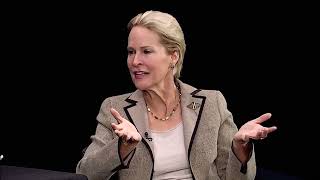
Nobel laureate Frances Arnold invented directed evolution, a method to redesign enzymes for new functions. Her technique is now used to make greener pharmaceuticals at Merck and enzymes for laundry detergents. She studied languages, literature, and economics at Princeton, and credits that breadth for her scientific creativity.
Chapters
I want to drill down on the actual work behind the Nobel. It was for the directed evolution of enzymes, and you describe yourself as a protein engineer, which, if I understand it correctly, means you kind of get under the hood of these proteins, these enzymes, and, and tinker with them to make them do something that they don't do naturally. Can you explain why anybody would want to do that? Why enzymes?
If you look at how biology takes that takes renewable resources, simple starting materials like carbon dioxide and sunlight, and converts that into life, into living organisms. The enzymes are the catalysts, the workhorses of life that do that magical transformation. So when I saw an enzyme for the first time and realized what a beautiful molecular machine this was, I said, That's what I want to engineer.
Your work started maybe 25 years ago or so. What has been the outcome in the last couple of decades?
These methods are sufficiently simple that they propagated to laboratories all over the world. For example, Merck makes some of their biggest drugs using enzymes that replace toxic metals that they used to use in chemical processes and really reduce the waste footprint of making pharmaceuticals. The enzymes you find in your laundry detergent that take stains off clothes. Nature never made an enzyme that likes to work in laundry detergents, but people bred them using my methods to work very well. Enzymes help you use much less energy, so you don't have to use high temperatures.
Why would a young person go into chemical engineering or bioengineering today? What might we see in 30 years as a result of it?
I personally would love to see a chemicals industry that's based entirely on clean, green, biological processes. Replace these factories with bacteria to make what we need in our daily lives and do it from renewable resources.
I'm gonna spin you back, if I can, a little bit to when you started here at Princeton University. What kinds of other courses did you take? I know that you're a linguist. For example?
I took a lot of language courses. I took also— I took Russian, I took Russian literature. Those were fabulous courses. I took economics, I took developing world economics, I took Marxist theory. I did all sorts of things that you wouldn't normally find on the engineer's docket, but it made an educated person out of me.
Yeah, but do you think it helped feed the creativity that ultimately made you successful as a scientist?
I can't imagine not being able to read and write and make these connections from literature and philosophy that have helped inform my understanding of evolution. So the answer is clearly yes.
Now and forevermore, you're going to be considered a role model for women in STEM. Is that something that you embrace?
So what I want to do is encourage women to take on this this incredibly exciting and fun challenge to use their brains for the benefit of humanity through science and technology. Don't let the guys have this. This is great, great career material.
You're right. Well, okay. With that, I'm going to say thank you very, very much for joining us, Frances Arnold.