Scientist Stories: François Jacob, Establishing the Rules of Genetic Transfer
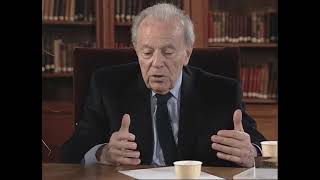
In this extensive oral‑history interview, developmental biologist Lucy Shapiro talks with Nobel laureate François Jacob about his fifty‑year career in molecular biology. Jacob describes the vibrant, overcrowded attic laboratory at the Pasteur Institute where André Lwoff and Jacques Monod led adjacent groups, and the lively exchanges with the phage community of Max Delbrück, Salvador Luria and others. He recounts his personal path from a wartime surgeon to a PhD student under Lwoff, his early work on lysogeny and the discovery of immunity and repression, and the debates with Monod over negative versus positive gene control. Jacob explains landmark experiments such as the “spaghetti” conjugation timing assay, the realization that bacterial chromosomes are circular, and the collaborative effort with Sidney Brenner that led to the first demonstration of messenger RNA. He reflects on the development of the replicon model, his shift from bacteria to mouse genetics, and his views on embryogenesis, cancer, and the future of genomics. The interview also touches on Jacob’s wartime experiences, his political disengagement, personal influences, and his literary approach to scientific autobiography.
Chapters
where I have been working for about 50 years.
And I am Lucy Shapiro, and I am a professor of developmental biology at Stanford University. I have some questions that I would like to ask you and to share with you. The first, which is something that all of us in experimental science know and understand, is that the laboratory environment in which we work is really critical for the interactions and things that happen in the lab. And this was certainly true for Morgan's lab at Columbia in his famous fly room, and it was particularly true in the attic at the Pasteur when you first joined André Lavoisier. And what was it like? What was the atmosphere in that laboratory like?
Well, I think it was a very exceptional atmosphere. It was— the lab has a special configuration. It's in the attic. It's a long couloir. And at one end was sitting André Lwoff with his people. And at the other end was working Jacques Monod with his people.
And there were—
it was overcrowded. There were much too many people for the for the place, and all the time people were coming out in the couloir discussing the experiment, trying to break the experiment of the other and to fight, and it was an extremely warm and pleasant atmosphere for many years. I think really exceptional.
One of the things that was very remarkable during that period in the attic— and the whole time of the very beginning of the phage groups was the phage church or the phage group led by Max Delbrück. And there seemed to be an interesting group of people at different parts of the world. So we had Max Delbrück and we had Salvador Luria and we had the attic. What was the relationship amongst these groups?
Well, they were very good. We were moving back and forth from one place to another. There was some discussion sometime about the exact subject of our work. For instance, we in Paris were working on lysogeny, which was some kind of a tradition at Pasteur where many people had been working on that. And in Caltech, Max Delbrügge decided that lysogeny does not exist. Oh, really? And I think Elie Wellmann, who was a member of our group, spent one year or two in Caltech, and one day he came to— he found one paper of his father, because his father has been working on that, on lysogeny, and written by Max with the hand, lysogeny doesn't exist.
Full stop.
So that was the kind— finally we arrived to an agreement.
Yes, but you know, it seems that there were many things that overlapped between what was happening with Max Delbruck and yours. And was there a lot of communication?
Yes, there was a lot of communication. There was no email at that time. There was no such thing as fax, but still there were letters and even telephone. So there was a lot of communication. And there was a lot of meetings almost every year. In the summer there was 1 or 2 or 3 meetings on Fage where people were discussing, arguing, and trying to more or less say what they were going to do and trying to avoid doing exactly the same thing as the next —It was a very special time.
And, you know, also adding to this, your role in all of this is that if I go through the time, you had two very significant collaborations. One, of course, was with Wallman. Yes. Which was very special. Yes. And the other, of course, was with Jacques Monod. Right. But Wallman and Monod were very different people. Very different. And so, what— can you compare the interactions that you had with each of them?
I mean, it was socially already different because Volman was of my age. Monod was much older, she had 10 years more. So with Volman, actually, when I arrived in the lab, I had done absolutely nothing. I knew nothing. I had to start from scratch, and I learned a lot of things of everyday life in the lab from him. With Monod, it was a bit different because he was clearly a senior. He was already somebody who had worked, who had produced a lot of papers, so the situation was quite different.
So when you were working with Wolman, you were also, of course, in Lwoff's lab. Yes. So what was the relationship of you and Lwoff?
Well, I was a student of both. Actually, as I said, I started very late. In fact, I wanted to become a surgeon before the war. Then I left France and went to join the Free French Army. I fought for 4 years. I was wounded the first time in Tunisia. Second time very heavily after the landing in Normandy. And then I couldn't be a surgeon because I have a bad arm, a bad leg, etc. So I tried to do almost anything. I tried to do journalism. I tried to become a movie actor. I tried a lot of things. And finally I decided that I was interested in doing research. In biology, I thought it was too late for me. But I have a friend or cousin of my wife who was in about the same state, had found a lab, was working, and was very happy. So I said, if he, why not me? And so then I learned that there were two good labs in Paris. And one— what I had understood is that probably something was going to happen between bacteria, genetics, and biochemistry, which was not so bad. Yes, I would say. So there were two labs in Paris, which were good labs, but one which was much more pleasant than the other. That was Woff at Pasteur. So I came and see Woff and asked him, may I work with you? He said, I have no room for you. And for a year I came every month asking No room for him. Finally, I think he said, well, you know, we have found induction of the prophase. And I just didn't understand what he was saying. I didn't know what induction meant, what prophase meant. So he said, are you interested? Yes, I am dying for doing the same kind of thing. So he said, okay, come in 2 weeks. So I went to a library, tried to find out the dictionary to understand what induction of prophase meant. It didn't mean anything. And finally I found out. But finally I went there, and I was a student of Wolf. I prepared a thesis on lysogeny under Wolf.
So you got a PhD then?
I got a PhD 3 years later.
So you have both an MD And a PhD. And a PhD. And your thesis was on lysogeny. That's right. Science thesis, yes. That's really very interesting. Did you ever expect to get a PhD when you started this thing? I mean, did you go to the Pasteur to get a PhD or just to—
No, I just to the Pasteur to try to do science, but then of course when you have to— when you want to do research, you have to get some kind of PhD somewhere. So even if I didn't go to do a PhD, it was really likely that I would do a PhD with Wirth.
What was Wirth like as a mentor?
He was a man very precise, very well-behaved. He wanted people speaking very good French. He didn't like people— speaking any kind of language. He liked to have good food, good drink. He liked good things in all matters. But he was— he had good friends and good enemies. He was very sharp. One day, a fellow— he was sitting in a committee. A fellow whom he didn't like at all was asking for money. The principle was when somebody was asking for money, the other was leaving— he was leaving the room and the other was discussing. So when his turn came, Lwoff said, "I would not give him any money." So the man came back and he asked his neighbor what was said. The VOF doesn't want to give you money. So after the committee, this man came to the VOF and said, I should kill you. What do you mean I should kill you? Do you want to do a duel tomorrow? So I send you my témoin. And the guy disappeared. Which means that committees can be very dangerous.
Yes, in France, clearly, they can be very dangerous.
This is to say that he had very good friends. And very good enemies, too. But when you were his friend, he did a lot of things for you. And he was extremely nice with me. He helped me a lot. And when I began to make some more bubbles, he always pushed me a lot. He did. He was a very, very special scientist. He was a special man.
A very special man. You know, in your books you often use a phrase, day science and night science. Yes. Which I love. Yes. And what does that really mean to you?
That means that when you talk about science, when you discuss paper, when you write a paper essentially, you write some kind of linear story which goes from one point to another point as if when you started you knew the end, you knew the answer. Well, in fact, my experience is that in many occasions you have absolutely no idea of what you are going to do, what you are driving at, but that's What you tell is not exactly the way it happens. That's true. You have to fight a lot with yourself and with the others, of course.
Yeah. During the time of the prophase and induction and the great excitement that the prophase told us, in other words, that DNA was coming in and out of the chromosome, And that it was a startling upset. The beads on a string concept, stable beads on a string concept, was really challenged. Yet in about 1956, in Cold Spring Harbor Symposium, Barbara McClintock has a paper on controlling elements in the gene in which she hypothesized in that paper that there are inhibitors and activators and things are moving. How was McClintock's work received and talked about and integrated at the Pasteur? Not much.
In fact, it was difficult to interact with McClintock.
Did you know her? Yes, very well.
Almost many times I went to Cold Spring Harbor and many times I discussed with her because she was very much interested in the prophage. And she was interested in the regulatory system. But reading her papers was not very easy, and talking with her was not easy either. So in Paris, we, I mean, we knew that she existed, that she had these mobile elements, but we didn't talk much about that. Yeah, that's a And even with her, it was very difficult to discuss and to understand each other. It was not easy.
When Andrei Lwoff first demonstrated phage induction and you were accepted into his lab, I've always wondered, when he did that experiment, was he already thinking about the concepts of repression of viral functions, in addition, of course, to the revolutionary concept of inserting foreign genetic material into the chromosome. Was this something that he had thought about before?
No, not at all. This came from what we called immunity of lysogenic bacteria. Immunity means that in lysogenic bacteria, you have the phage genetic material which is somewhere in the bacterium, in the cell, and we learned later that it was inserted into the bacterial chromosome, and the phage genes are not expressed. And not only are they not expressed, but if you superinfect these lysogenic cells with a phage of the same type, this phage cannot multiply and is genes are not expressed, and this we called immunité. I don't know whether it was a good word or not. But what I did, I think what I did mainly for my thesis was to understand what it was. And what, after a number of experiments, what I understood was that— and we had with Vollmann two models. Either there is a block because the prophage in the chromosome prevents expression of the incoming phage, or there is something else. And what I understood during this thesis was there was a cytoplasmic expression of immunity, that there was something which prevented expression of— this was called repressor some months later. —and it turned out that it was very similar to the lac system that Monod was working on.
Oh, yes. I mean, that was the big synthesis in putting those two things together. Another thing I was curious about at that time was in your initial discussions, in your initial arguments about gene regulation, particularly putting these two things together, did you consider positive control as an important possible mechanism as important as negative control?
Yeah, this was a big argument I had with Monod. It turned out that the first cases we studied, which was the lac system, the phage system lambda, and the tryptophan system that we worked with, with Cohen, with George Cohen, where we also got mutants gene, etc. And it was exactly the same. It was also repression. So Monod decided that with these three cases, repression was a general phenomenon. Yes. And I didn't really see any particular reason why it should be general, why there would not be also some positive regulation. And this especially when we thought of trying to apply these systems to differentiation and development. And I didn't see any reason why that should not be possible to use any type of system. And we had big arguments on this.
When was the Arabidopsis experiment?
That was many years ago. The Arabidopsis experiments were in— '70s? No, no, before that. It was in the '62s. 3, 4, 5. So there was positive regulation. Yes. And there was— the maltose was positive. And the fage turned out—
the pro-fage turned out to be positive. So why do you think Monod was so hard over on not having positive?
Monod considered that he was very logical, and he considered that nature had to be logical and that it had to have the same logic as he had.
So he was very strong on that. Did Manot eventually say, okay, yes, there's positive? Finally, but after many years, especially when Maxime Schwartz showed that maltose was positive. Another experiment from that time, actually one of my favorite experiments, is the one you did with Vollmann, the spaghetti experiment.
The spaghetti experiment. That was an idea of Wolman. What we wanted to understand, we had this business of conjugation when we have some strains which were donors and other strains which were recipients. We call the donors males and the recipient females. So you mix these two things with markers on on each side and then you get recombination. So we wanted to analyze the different steps and in particular to try to find out at what stage genetic material from the male was transferred to the female. So Eli had this very good idea to use the Hershey system that Hershey had used with phage. Hershey had shown that when you use radioactive phage labeled either with sulfur in the protein or with P32 in the nucleic acid, and then you infect your bacteria and then you shake in the Waring blender so you remove— and you can see that in the microscope— you remove the head and you know that the P32 comes in two and you find out that having the P32 inside the cell and removing the protein is enough for infection, which was demonstration, second time demonstration that DNA is responsible. But the idea was that with a blender you can remove something. So Eli had the idea to put these happy couples in the blender and separate them in a brutal way. And we followed markers and it turned out that when— the first marker we followed, you find at the beginning after they have mated, they have come together, you put that in the blender which separates, that there is no recombinant, and suddenly the recombinants appear, which means that the marker has come into the female. And the second experiment we did was with two markers which are not together, and it turned out that they didn't come at the same time.
Did you expect that?
Of course not. That was really a quite a shock. Yes. So then we did that with 5 markers, and it turned out that each marker came at a very precise time and that the time map was the same as the genetic map. And this was called the spaghetti experiment, which Elie was furious about. Oh, really?
Because it trivialized it.
Yes, it was easy to understand.
Done. But there's another part to this, which was, I guess, another surprise, and you found this, and that was that there was a circular permutation.
Yes. That was more complicated. There was this donor. There were two kinds of donors, the Lederberg strain, Lederberg who had found the recombination system, the mating system, and conjugation system in bacteria. With E. coli, he was very lucky actually because there are few strains which have the system for mating, and the strain he picked up in, I think, in your university.
At Stanford.
Stanford. Yes. Was the right one. Yes. Turned out to be the right one. But the recombinant was at very low frequency. There was about 1 recombinant per 10^6 parents. And several people isolated other strains which were called high frequency HFR strains because they produce recombinants about 1 in 100. It turned out that that these HFR strains were bringing the chromosome in the order which you could show in the blender experiment. You had A, B, C, D, E, which come out. A at 10 minutes, B at 15 minutes, D, C, and so forth. But we began to isolate several of these strains, and it turned out they were not the same. Another strain was injecting D, E, F, G, another one was injecting C, B, A, Z, and so forth. And you could explain that if you had made the hypothesis that you had the circular chromosome in which the sex factor which was responsible for this was attaching at a number of different points and then carrying the whole the whole thing over with it.
Was this readily accepted when you suggested that the chromosome was circular?
First, it was not accepted by Eley. Finally, he agreed. But I had a big argument in London with students of Josh who had just come back from Josh's lab, and we were supposed to give a talk both of us in a symposium of the Society for Bacteriology, an English-British society. So she gave a talk with— there were 3 or 4 or 5 chromosomes— and I gave the talk with the circular, and she was again furious because she said that there is no such a thing as circular chromosomes until Cairns showed that It was really circular.
But it was the genetic experiment that got everybody thinking. Yes, it was.
And I think you couldn't escape that, that it was really circular.
Yes, there was no other way. So we've been talking about a very remarkable time in science, and not just in the Pasteur Institute in general, but in science. And primarily we've been talking about of the experiments that you've done with Wolman and with Lwoff and the intense discussions, of course, that went on with other people who were in the attic at that time. Who was there at that time and how was it organized?
There were two groups, essentially the Lwoff group on one end where we were with Elie Wolman and another fellow. Pierre Cheffer, who was working on DNA and transformation by DNA of bacillus. And at the other end was Monod, who had a very good American collaborator, Mel Cohn. Yes. And two ladies, Anne-Marie Torriani who is now in Boston, and Germaine, who was going to marry Roger Stagnier. Germaine Stagnier. Yes, that was Germaine Cohen-Bezier. Germaine Cohen-Bezier, exactly, who turned out to be Germaine Stagnier afterwards. Well, that was— plus that was the basic people, plus a lot of students or postdocs and various people coming for a year or two years.
Wasn't there sort of a chain of people from the United States and the UK that came through and did work with you? Right. One of the series of experiments that led to new concepts were epitomized by the experiment in which you demonstrated erotic induction, which then became zygotic induction, but I like the first name better, and then of course the pajama experiment. And both of these, in addition to Manot's coordinate induction of beta-gal and the lac permease, led to that genetic units were more extensive than just the gene, and that regulation could be an on/off switch. All of these things came together. Yes. And different people were thinking about it, and you thought about it. But these were all hypothesis-driven. And they could have helped— the one concept could have helped design the other. Did in fact the erotic induction experiment help in the design for you of the pajama experiment?
Once we had the timing system of conjugation, we knew that Monod had been working on the lactose system and he had shown that there were at least these two genes lack what he called Z, which was responsible for the synthesis of the galactosidase, and Y, the gene Y, which was responsible for the permease. So these were closely linked, this we knew, and we knew that these two genes that lack region was coming at a given time with a particular HFR strain. So one of the questions we asked, the first question we asked was how much time does it take if we put the Z gene by conjugation into bacterium which is devoid by deletion of the Z gene, how much time does it take to express the galactosidase? And this was an experiment that we planned, and we planned also at the same time the experiment to understand what the relationship with the phenotype inducibility or not inducibility, to try to explain that and analyze that with the conjugation. So the experiment was The first experiment which was obvious was to put this Z gene by conjugation in a cell in which it has been destroyed by deletion and see how much time it takes. And at that time, Arthur Pardi came in the lab and we asked him to do the experiment, which he did very well because he's a very good experimenter. And it turned out that it started almost immediately at full speed. Which has a number of consequences as to the mechanism of how do you make a protein from the gene. So that was the first experiment which was called of the pajama series, Pardi-Jacob mono pajama, pajama, and so it turned out that it was immediately, within seconds, as soon as you can detect it, you get the enzyme, the activity. And the second experiment we did was to do the same thing with inducibility. I mean, the idea at that time, the idea essentially of Manu was that the wild-type E. coli K12, for instance, was inducible, but you could get mutants which were constitutive. So this was called I+ I-, and the idea to begin with that the constitutive strains were making an inducer which you could not detect, and that's why they were constitutive, because there was an internal inducer. And these are— so what we decided to do was to transfer either the inducible gene allele into the constitutive recipient or the reverse and see how it's going on. And it turned out that when you transfer the constitutive into an inducible, it doesn't make any difference, while to transfer the inducible into constitutive, it's stops after about 40 minutes. It stops the spontaneous production of enzyme and you can at this time induce and make as much protein as you want. So that proved that the active allele was not constitutive, I-, but the inducible, I+. And at that time you have to assume that that this I gene was making something which prevented the enzyme-making system of being expressed except if you had an inducer, galactoside. So that was the principle of this thing. Now the interesting point was that the fact that as soon as the gene was entering the cell, the cytoplasm, the enzyme was made at full speed was not in good agreement with the idea that people had about protein synthesis because it was known that the synthesis of the protein synthesis was occurring on small granules which were called ribosomes. And the idea at that time that each gene, grosso modo, one gene was making one kind of ribosome. In other words, the gene responsible for beta-galactosidase synthesis or structure was supposed to make a ribosome which was able to make beta-galactosidase and nothing else. And it was not very likely that you could make specific ribosomes, which are rather complex structures, protein, RNA, and so forth within less than a few seconds. So one had to assume that there was something else, that either the protein was made directly on the gene, which was rather unlikely because it was known it was made on the ribosome, or that there was something going from the gene to the ribosome to tell the ribosome what to do. And this, for a time, we call X. And this one day I was— I gave a seminar in Cambridge. It was not even a seminar, it was discussion in Sidney's room. Sidney was had a room somewhere, and we had a discussion with Francis Crick and one or two other people.
At that time, wasn't Sydney Brenner in the same room with Crick?
Didn't they share an office? Yes, but it was not in the lab. It was in one of the— one of the colleges. He was in a college where he had Oh, King's, probably. He was in King's. He was responsible for the wine. For the wine, really? So he had a room in King's. So we had this talk in King's in his room, and they were not very much interested in this kind of experiment where you inject. They didn't know very much about this lac+ Z+ Y-. They didn't like it very much. Francis was not very much interested. Actually, I told this story in Copenhagen 6 months before, in November or October of 19— one year before. And it's exactly the same story. Nobody reacted. And I said the conclusion was there was probably something going from this to that, from the gene to the ribosome to instruct the ribosome to make galactoside. Nobody reacted. We just read their newspaper. Jim was reading his newspaper. Yes, I bet. But at that time, they reacted and said, well, of course, it's the RNA described by— what's their name? You know, there were two American fellows who have described an RNA. Oh, yeah, Astrakhan.
Vulcan and Astrakhan.
Vulcan and Astrakhan, yes. And one of the difficulties also with the ribosome hypothesis was that the ribosome, the sequence of ribosomal RNA was different from the genes. And the Vulcan and Astrakhan RNA was similar as base ratio was concerned. With the phage sequence. So they reacted strongly and said, yes, your X is the Falkiner anaerobium. And of course they were right, and we were stupid in Paris not to have thought of that, but we were not very much interested by the Falkiner anaerobium RNA. So then it was obviously at a good point, And we decided with Sidney to try to prove that there was an RNA, which later on we called messenger RNA, which was produced by the gene and going to the ribosome to make galactosidase or to make anything else. And to prove that, we tried to use phage. Because in the infection with big phage T2, T4, and so forth, after infection, bacterial proteins stop being made and the machine makes only the phage protein. So the idea that if you can label the ribosome which are made before infection with heavy something, and if you can label the RNA which is made after infection with p32, then you should find that the p32 comes with the heavy ribosome. Yes. And that was the experiment which we planned, we came to Caltech to do with Matt. Sydney had been invited to spend a month with Matt and I, completely on a completely different reason. I had been invited by Max Delbrück. So we met there and we decided to do this experiment in which Delbrück didn't believe a word. He didn't believe a word on this messenger business, as usual. And for, uh, so we had one month sharp because both of us, we had engagement, we were supposed to go back to Europe after a month. So we started experiments in Caltech and it didn't work at all. And Matt was so disgusted that he left and got married. He went somewhere else and got married. And then we were left with Sidney. And it didn't work at all until Sidney had the very good idea that we had not put enough magnesium in the caesium tube because the caesium was competing with the magnesium. Yes. And instead of putting the usual amount of magnesium which is necessary for ribosome to join, if you put the ribosome in a solution of magnesium, you have to put much more magnesium, which we did, and it worked.
Did it work at the very, very end of your month?
Probably the last 2 days or 3 days before. And yes, and it's essentially Sidney who did the experiment. He was very bright at that, and it worked very well. And the P32 came exactly at the point we wanted it to be, that is with the heavy ribosome.
So this is the first demonstration of messenger RNA. That's right.
At the same time, François Gros had been doing an experiment in Jim's lab to show that the Volcán extractant RNA exists in growing bacteria, that you have this same similar turning rapidly RNA with the composition or the same base ratio as the DNA, not as the ribosomes. That was the messenger business, yes.
Yes, that was a really very beautiful experiment. You know, now there's this competing way of thinking and doing science, and the way all of this was done and the way in which we have all been working has always been highly hypothesis-driven research. We think about what it could be and then we test it, or we design an experiment to figure it out. But with full genome sequences, with these microarrays, with vast amounts of data, people are arguing that a new way of doing science, or an additional way of doing science—
I'm not sure it's a new way, but it's another way.
Another way is looking at vast amounts of data and not asking a question, just seeing if it gives you a pattern. That's very boring. It's boring.
It's extremely boring.
But do you think that things, insights will come from this boring way that you can then build into a hypothesis?
There are clearly things that will come out, I mean evolution. It's clear that if you want to know what's the difference between a chimpanzee and a man, you have some chance to find out by the sequence. I don't know how much you will know, but you will get a certain number of differences. And it's likely that for that, this will be— for instance, for the infectious bacteria, the bacteria which are how do you call that? Pathogen. Pathogen and non-pathogenic variant, you find differences and you can say that.
Yes, you can find a pathogenicity island or something. Exactly.
So there is a number of things that you can obviously find out very clearly and which are difficult to find otherwise. And probably for evolution, for many steps of evolution, it will allow a lot. Otherwise, I'm not sure that it— it probably will take a tremendous amount of time, especially because of the interactions of various genes or various proteins, which it will take years and years to understand.
Yeah, I think to me it seems most powerful if you can take these vast amounts of data in a genetic system that's well understood, because then you have the opportunity to test what these patterns are beginning to show you. Right after the work on the lac operon, Manot turned to allosterity. Yes. And you turned your attention to cell division and DNA replication in E. coli. What motivated that decision? Was it in part your interaction with Sidney Brenner, or was it based on something else? No, it was—
MONO started with— I was not very much excited in the protein work. So I was interested at the beginning because the repressor— allosteric was good for repressor. It explained how it worked. It explained that if you had a molecule which had affinity for lactose or these galactosides and for some DNA sequence. And the idea was that you had the affinity for the DNA sequence in the absence of the galactoside, where— and then the expression, the synthesis of messenger by the neighbor gene was blocked. Or when you add the galactoside, you change the structure, and then you have no longer affinity for the DNA sequence. What we call the operator. That was very nice. But the play with the protein themselves, I was not very much excited. But I was excited by one thing, was that in the experiment that I had done, when there was a transfer of some gene, either by conjugation or by transduction, of genes which were not inserted into the chromosome by recombination, these pieces of DNA were diluted out. They were not replicated. And this led me to the idea that probably there are structures which are replicated because they have some kind of regulatory system, which— that was the origin of the replicon business.
So that's what led you to do those experiments? —experiments.
Yes, that's right. And then it turned out that we had vacation together with Sidney, and it was on a beach in France on the west coast. And Sidney had 4 children, and I had 4 children, and in the morning the lady wanted to sleep, and we were supposed to take care of the 8 children. And while the 8 children were turning around, we were drawing structure in the sand, and we came to this idea that maybe it has something to do with membrane, that with membrane we could separate. So that was the replicon model. So that was the beginning of the replicon model. But the idea, the start of that was the fact that you cannot replicate a piece of DNA which is not part of a replicon.
Yes, because there were pieces lost. You know, when I look back over your career at that time, it's like there were two different lives. There was the life before you came to Pasteur and a very dramatic change in your life after you—
The life before was rather dramatic because it was just fighting with Panzer SS, which was not No.
But it was so very different from the rest of Europe.
It was completely different, of course.
So I have sort of two questions here. One was this very intense involvement in the war, in World War II, and your very intense feelings that you had to do something for France at that time. Then after you came into science, did you again get involved in politics or in your country? There are two questions here. One was, what impact do you think the time you spent, the four years you spent during World War II, in contributing to how you are, what you're like how you react to the world, that really did shape you. It had to.
Oh, yes, a lot.
Absolutely. And so how did it shape you?
And then did you come back to that again? Well, if you take a fellow who is 17, 18, 19 years old, living in Paris in a small bourgeois environment, Jewish small bourgeois environment, You take in the center of Africa with black people, the Germans, the Italians. So it changes you. I mean, it's completely different. So I think the war— and then so I had this experience. Then there was— we came from Brazzaville on the Congo to the sea and then on to Tunisia. You went right through the desert? Yes, yes. From the so-called Leclerc column. And then we reached the sea where we met with the 8th Army, the British 8th Army. And then we went to Tunis and we fought in Tunisia. It's a change of environment which completely changes the people. I was certainly completely changed by this. You had an interesting experience with a German soldier who you met out in the desert. Yes. I was sent— there was a company which was ahead of all the others and who wanted an MD, Actually, I was medical officer with 2 years of medicine, which means— and I was sent to join them and take care of the people who had been wounded. And I started with 2 African— how do you call them? Brancardiers, people carrying the brancard. And they just left. So I was—
You were alone.
Alone. And I knew about where I had to go. And suddenly I arrived at about 20 meters. It was black night. I saw a German fellow with his mitraillette looking at me like that and following me as I was moving with the mitraillette. I didn't know what to do. I had no arm. I had just a sack with Red Cross.
So you had no gun or anything?
No, I had no gun or anything. So I decided to go on. The guard, he looked at me, followed me, but didn't do anything. I never understood why he didn't shoot. Probably because he would have been found out himself. And it was probably better for him not to make too much trouble. Better for all of us that he did that. Sometimes by night I still see him. Really? Yes.
I would imagine that didn't leave. So then later on, the second question, have you remained involved in politics? Not at all, no.
When I came back, I didn't know what to do. When I came back, I had about a year of hospital after my wounds. I had my medical— I finished my medical studies. But you have to— in France, to become a respectable doctor, you have to go through a number of of concours externat, internat. My first concours was in 1939 and was suppressed. It was externat, and after that you have l'internat. So I asked the assistance publique to try to find the— to go through the internat without being expelled. Impossible. So I decided not to do medicine. And try to do something else. So I almost become actor. I told you, etc., and so forth. And finally I came to research. But at that time, I wonder, many of my friends were in politics. And I want to see a big shot in politics. I don't give you his name because you don't know him. Knowing him, and in half an hour he disgusted me completely, but completely. So I never went at all into politics. No, I had the impression that I had done two big stories, the Free French story and the molecular biology story. I think that was all right.
Well, then you entered a completely different And from what I can gather, you are still fascinated with gene regulation. Yes. But you wanted to understand it in a more complicated system. Right. And I think it was quite a leap to understand that you were going to use the same kind of regulation in something that was very complicated. And I always wondered— why you didn't turn to yeast, because here you had a eukaryotic system that was a microbe and you could do genetics and you could ask questions of cell regulation.
Actually, I didn't consider yeast because I wanted an organism which had eyes, which were looking at me, which had a soul and a lot of sex. And yeast has some sex, but no soul, no eyes. Finally, I hesitated a lot. I had discussion. I met with Sidney and Seymour, Sidney Brenner and Seymour Benzin in New York. I don't remember on which occasion, and they were just shifting Sidney to the worm and Seymour to the fly. And I discussed a lot, and I was very much interested by the worm and the fly. And actually, I tried the worm. I asked Sidney to give me a sample of his worm, which he gave me, and I worked for about 6 months to raise Cenorhabditis elegans. Sidney was not very happy. He didn't like very much me to play with that. Really? Finally, what I wanted also, I wanted to look for development and for differentiation, and for some reason or another, I wanted to have a cell culture system, to have an organism and a cell culture. And finally, I gave a seminar on Cenorhabditis, on the subject what you cannot do. And I hesitated with fly more seriously, but it was very difficult to bring the fly in Pasteur because to have a reasonable chance of doing something, you have to bring a number of people. And Pasteur, they are mainly infectious disease, bacteria, viruses, immunology, and so forth. While the mouse was obviously important for Pasteur because it's important for disease, for infectious disease, for immunology, and so forth. And that's why— that was the reason why I turned to the mouse.
So then, in effect, being at the Pasteur Institute had a large impact for this particular decision. Also, what else was going on at that at the Pasteur at the time that all the work on bacteria was going on? In other words, was the work of your lab and Monod and Lwoff central to what was happening at the Pasteur at the time, or were there other things happening that—
No, there were other things because they work on infectious disease and they have very good results on that. In the way bacteria infect cells and what you need on the genetics of bacteria and the genetics of cells. No, there was a lot of other things. But in fact, what I wanted to do was the following. At the time, they were asking the government by asking every 5 years what should be done in the next 5 years. And I did, and I wrote a paper on the Institute of the Mouse. The idea being that the success of molecular biology with coli was that people coming from all origin, from all discipline, began to work on the same organism and to help each other. This should be done with the mouse, and explaining that you have to put together the physicists, the biochemists, the geneticists, the bacteriologists, the zoologists, and so forth in one institute. And people didn't understand at all. They say he wants to have an institute built for him. Why the mouse rather than the frog? And so forth. And after 6 months of fight, I gave up.
But didn't they ask you to run an institute?
To be the director of an institute? No, but I thought it was stupid to build an institute for me. I think the idea was— it was an important thing, and I think if we had done that— it was in '70, 1970— we would have been in a much better position in France. In France for doing this kind of work than we are now. So you're sorry in a sense? They just didn't understand at all. Nobody, neither the minister nor the head of the CNRS. Did they understand here at the Pasteur? Yes, yes, Monod understood, but he didn't like them very much because he preferred to be at Pasteur working on bacteria, but he understood what it was, yes.
Now, one of the things that clearly interested you was embryonic development. Yes. And not only embryonic development, but also cell differentiation. Yes. Clearly this had to be highly regulated. Why did this pull at your imagination? Because it was clear that—
I mean, the beginning of gene regulation is the fact that you have an organism which has the same genome in all cells. In different expression in different cells. So Morgan actually was the first to say you probably have differential activation of genes for differentiation.
But there's another layer on top of that, which I know you think about, and that is embryogenesis lets you go from a one-dimensional or linear molecular biology to a three-dimensional structure. What do you see has been learned about translating information from a linear genome to 3-dimensional space? And has this come from work on embryogenesis and development?
This, we are just beginning to learn this type of thing, and at that time it was completely out of question. In fact, if molecular biology was so successful fully, it was because it was playing with one-dimensional structures.
Yes, yes.
So that was— it could not be more simple in this respect. And even the way protein folding occurs is not understood today, and the 3D interaction of cells is just very barely beginning to come, the cell-cell interaction, the action of small molecules on this. It's just beginning.
But this was something that was clearly in your mind when you started this.
Yes, sure, it was, but it was not much more than in my mind.
Also, but what was on your mind? Is behind really, I thought, your decision to turn to mice was the supposition that there was a close relationship between embryogenesis and cancer. Yes, that's right. And what led you to that at such an early stage? I mean, that was fairly prescient.
Because Because I think it— cancer was clearly a disease of regulation, and clearly cell regulation is the thing which makes embryogenesis and leads to the adult. So if you assume that you have a series of reactions which lead to the cell differentiation and formation of the embryo, And if you assume that cancer is a disease of regulation, then they are interacting, obviously. The question was where and at which level, and this also led me to play with this, with the embryonal carcinoma cells. Yes, the teratocarcinomas.
Yes. One of the concepts that you think about and write about a lot is a combinatorial system system composed of a finite number of parts.
Yes. And this— I think the whole world is built like that. Everything. Everything is built like that at any stage.
This whole concept has really led to a radical change in perspective in the 1990s based on all the other things that have happened. So let's say we are at a time when we know all the— that like engineers we have parts on the shelf, and it's how they're connected that's critical to make each individual different from another individual, or species different from another species. Do you think that the study of circuitry in a simple model cell, eukaryotic model cell let's say, will be of value in in understanding circuitry in a human?
I think you finally have to dissect. I don't think you can make simple models of that. You have the parts of the circuitry. You can build every kind of circuit you want, but you cannot predict which circuit will be operating in this or that part of the body. So I think you just have to find out and describe it.
Now, in your book, The Statue Within, you state that at the time you were working in the attic, you knew you were participating, and I quote, in one of the great adventures of the century.
Yes, that's the impression I had.
And now, in the embryology analysis of mammals and the post-genomic research that's going on, what do you predict are going to be the next what are the next great adventures, or have there been some?
There is one thing which is clear, and when you predict the future, you're sure to be wrong. You know that the future will not be like the present, but if you predict how it will be, you're sure it will not be like that. One of the most extraordinary things which was completely unpredictable 15 or 20 years ago is the fact that the molecules of bacteria are the same as the molecules of humans. I mean, the fact that the structure remains the same, or that you just tinkering a little bit with them permits all possible variations. This, I think, is really— it was unbelievable 20 years ago to think that the same that the same ox gene would act in a worm, in a fly, or in a human was unthinkable. Yes, it was amazing. Absolutely unthinkable.
And the other amazing thing, I believe, are the oncogenes.
Yes, it's a bit the same kind of thing, yes. Because these are— the oncogenes are genes which act in in drosophila in a different way, but they are the same. And once again, it's maintenance of structure all along evolution. This, I think, is really extraordinary.
So you've done very many remarkable things, and in anyone who's had the kinds of accomplishments that you've had, it's always interesting to try to understand who and what influenced you as you were growing up, as you were a student, and as you were an adult scientist. Were there people early on in your life that had an impact on you and how you worked and how you thought about your life would be?
Yes, I think probably my grandfather was a big influence. I mean, he gave me a lot of books choosing very precisely which or what book at what age. And I was fed with Greek mythology when I was very young, which I liked very much and I still like. And it gave me a lot, and I think it was very influential also for the behavior in life and for moral attitude. And also I was very bored at school. I found school very boring. Probably you are influenced by some teachers, and after, of course, the people with whom I work have been very influential.
Well, I'll ask one final question, and this is something I've been curious about, and it's not science. Of all the many books that I've read written by scientists, They're all very interesting, but none are as literary as yours. You are a remarkable writer.
Thank you. Are you going to do more writing? Yes, I think I should. What I find surprising in the books of scientists, and especially in the autobiographies, is that they seem to be interested only in what they have done and not in their life. That's right. And I think in the Sidney's book, for instance, we have some kind of autobiography, not very much, but he tells mainly about his experiments, and I found the more interesting part is when he tells the story when he was a boy in South Africa. Yes. That's not expected, while the other things are more or less known. Yes. But I think generally the scientists want to get completely pure, dehumanized people, which is ridiculous. Yes, it is ridiculous.
Well, I for one hope that you write some more. Thank you.
Thank you very much for this wonderful conversation.
More from Joshua







Scientist Stories: Hans Waterham, The value of phenotypic assays in peroxisomal disorders




Scientist Stories: Joel Zlotogora, Genetic carrier screening programs for reproductive purposes