Scientist Stories: Harald Hess, 3D Imaging of the Cell
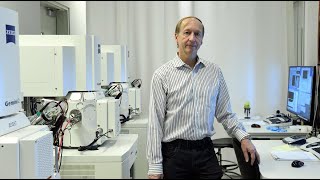
Harald Hess built scientific gadgets as a kid in Illinois, then bounced through physics, Bell Labs, and semiconductor imaging before returning to basic science. He teamed with Eric Betzig and biologists to develop super-resolution microscopy using blinking fluorescent proteins, eventually imaging an entire fly brain's circuitry at Janelia Farm.
Chapters
Okay, over to you, Jasmine. Thanks.
All right, I'm honored to introduce our next speaker, Harold Hess. And for the sake of time, I will just let Harold tell him—
tell us all about himself. Okay, thank you. It's a real pleasure to be invited to present a collection of my experiences that happen to form, you know, my own career trajectory that sort of goes from physics and over time eventually to biology. Like many, I got interested in science sort of early, maybe in middle school, and the setting of this was, you know, in a small town down in central Illinois. And so in high school, initially I was thinking about, well, okay, what's the large and then transitioned to what's the smallest, where atoms— and I always had an inclination to, to scientific gadgets and technologies and was into building model airplanes, rockets, got into cloud chambers, uh, in for the science fair. I really got into that. It was a sort of a formative part. Wanted to make a particle accelerator, and being in a small town, you learn to be very resourceful in terms of, you know, trying to make the most of what you have. So for vacuum pumps, went out to the junkyard, flip out a compressor out of a refrigerator, reconfigure it, and you got a vacuum pump. And do a little bit of glassblowing, etc. It was a lot of fun. Went off to the big city, the University of Chicago, and there I was lucky enough to team up with an effort which was trying to build 1 million volt electron microscope for biology. This was very much ahead of its time. It was actually an exciting time because at the same time Albert Froude was imaging individual atoms. These were the first individual high-Z atoms which were seen, and actually movies were made., and I thought, well, this, this is fantastic, getting down to the smallest quantum of real things in a way. From there, moved on, grad school, initially interested in particle physics. That was sort of a little bit too large of a scale. I was more interested in tabletop-type things, so I gravitated toward low-temperature physics, and I always like extremes, so getting fundamentally cold was cool, so to speak. Learned about a lot of different things, microwave electronics. The focus was on disordered systems like glasses, and for some reason to me this really wasn't fully satisfying or had a sense of fundamentalness of physics. So in postdoc, I went to the other extreme, trying to find what is the world's simplest system and was lucky enough to join an effort at MIT looking at the hydrogen atom. And there the idea was, can you collect hydrogen atoms, not molecules, cool them to make a Bose condensate, essentially getting the lowest temperature altogether? An initial attempt totally failed. It was sort of clueless where this could go after that, you know, sort of felt like, ah, My postdocs collapsed, but in desperation, you know, you come up with new ideas and sort of went off to formulate a direction for the field, but— and had a good start on it, but decided in the end I can't really stay in the field and left it. And it was painful, but I decided I would go to Bell Labs. And so now here, once starting off essentially in a new field and not knowing exactly what that is. That was uncomfortable, but at the environment— the environment at the time, people were looking into scanning probe microscopy, like scanning tunneling microscopes. They had just seen atoms this way, and superconductors, high-TC superconductors, were all the rage at the time too. So I thought, well, maybe I evaporate electrons from a tip into a material and at low temperatures, and so I went off and developed low-temperature probe microscopy, and I had a great run of that at Bell Labs, developing scanning tunneling microscopes, doing spectroscopy on vortices, seeing them with magnetic probes, even imaging things with single electron probes. I mean, beauty of Bell Labs, you just have a lot of wonderful people around, people around, and you sort of leverage on their skill. One example of that, final example from Bell Labs, was this fellow here, my good friend Eric Betzig. He was imaging sub-diffractive images with a near-field microscope. These are like first images of molecules, individual molecules taken by him, and we decided to team up and look at quantum wells at low temperatures. You know, they glow, there's some broad spectral stuff, And when we looked at detail, we could see the individual atomic-like spectra of individual centers in here, the quantum constituents of it. It was— it's sort of spread out in this z-direction by looking at spectra. Now, Bell Labs was entering the real world. It was no longer monopoly, and relevance of the technology and the science was really, you know, pressing on us. Essentially the message was, well, you're a bunch of smart scientists, why can't you drive the technology to make AT&T, or later on Lucent, you know, a very good company? And so I ended up really taking all of this to heart and trying to develop instrumentation to check parameters of quantum well lasers, or even looked at spectroscopy of fruit which was part of a business unit where we were selling cash registers essentially to grocery stores, and they had a problem with scanning barcodes on fruit because they don't exist. So maybe there are other ways to gather the data, but cool challenges there. But in the end, I decide, okay, I better leave. And this again was very painful transition. I had a lot of success. I could have gone to university but decided No, the real challenge wasn't necessarily in trying to do small measurements, nanoscale. The big thing was the mega, the large scale, or the giga, you know, there are millions of transistors. And I thought, well, I really need to get into that space, take that to heart and really understand it. And so went into industry, initially the hard disk drive industry. Developed interferometers to sort of really scan it very fast. It was like the coolest, fastest, fundamentally best instrument, but no customer wanted to buy it. So I really had to learn myself what it means to understand the concept of customer. This was again a little bit, you know, gut-wrenching, but, you know, it's an important lesson to learn. I transitioned later on to looking at semiconductor chips, you know, and using instruments like this, that industry has like the most amazing, you know, multi, you know, tens or hundreds of million dollars worth of instruments, you know, that can do this kind of high-speed, large-scale imaging. But for some reason, there are some cases where the research direction and the market direction just didn't feel quite satisfying me, and I had a yearning to get back to the basics. And so basically I decided to drop out from industry altogether, and my friend Eric Goetzik sort of was in a similar situation. So you could say, well, misery loves company. So we got together, tried to figure out new research directions, met with other friends, considered all sorts of possibilities— refrigeration, And over in Tallahassee, we met a person who just happened to talk about certain blinking fluorescent proteins. And for us, a light went off. This is very similar to if you go up and down the spectral axis, that looks like a blinking molecule. And we thought, hey, here's a way to get sub-diffractive resolution. We scrambled, put something together in my living room, found a real biologist. The name of Jennifer Lupencart-Schwartz and George Patterson. They told us what cells were, they let us into their lab, we worked for half a year and got the thing to work. And then this new place came out of the mud called Janelia Farms at the time, you know, by HHMI, and their mission was to innovate microscopes for understanding the connectome of neural circuits. And so I thought, well, here's a similarity between all of the circuits of a chip and maybe the circuits of a fly. Maybe we can sort of configure some microscopes to be able to be appropriate for that problem. And we spent about a decade fixing up these machines that could image, you know, the whole circuitry of a fly brain, and it has other implications too. Finally, in the semiconductor industry, there are these high-speed multibeam imaging systems which have been developed for them, and they are now appearing also in the biology side. And we're having a fun time also trying to bring in these, combine it with some surface science-like apparatuses and milling to be able to get three-dimensional images of biology on a scale that hasn't really been explored. Before. So if you step back and look at everything, I'd say, uh, there's a lot of, uh, things that connect, especially the longer you're around. You find different aspects can be recycled later, especially if you're lucky enough to sort of bounce around in diverse areas. And it really gives a lot of power to exploring new areas and a sense of freedom, which is really really cool and great. So finally, quick little— my own guiding principles, not necessarily good for anybody, but, you know, for me, the, the path is really goal— is the goal, not really the end of it. And for me, that path is I have a passion for the new technology and how it can impact the science. So I might be a person who steps back a little bit from the science itself directly, but just empower on the technology side. From my experiences, I've learned to be very resourceful. I think that's important. And, you know, it's great to seek out very diverse experiences. I mean, I usually tended to shy away from the next obvious step and then try to take something a little bit radically different. And again, it can be very stressful to do that, but in the end, it's really empowering. So don't let other goals deflect there. Sometimes security or other things can get in the way. Sometimes that's important. This is not necessarily a fully global principle. I tend to agonize a lot about meaning and relevance, and for me, I've been lucky enough to have a lot of dots to connect to, and I consider myself super lucky to be able to live this as a scientist You know, we're really, really privileged to be able to do what we love to do. Not many people have that. And finally, I just want to say a lot of these things that I do or we do, it's really shared. You know, a lot of people have visions of trying to understand, do microscopy with electron microscopes or other new microscopes, you know, for decades or maybe even centuries. So We're part of a big group, and it's a pleasure to be part of it. So thanks.
Thank you so much, Harold, for that really inspiring talk. I think Sri had a question that she wanted to ask, so I will pass it on to her.
Thank you so much, Harold. Thank you. That was a relentlessly inspiring talk. I am trying to gather my thoughts. You mentioned so much of the theme of the talk to me seemed to be a brave choice to leave the familiar and pursue the unfamiliar. And you had a great many points about elaborating on this on your last slide, but I wonder if you would tell us a little bit more about the loss of community that comes from leaving the familiar and how you kept some core community intact as you move through these different communities.
Yeah, I could say some of that's luck. I mean, when you do leave things and venture off into new areas, you know, there's nothing guaranteed. You know, many— in many cases, there could have been a good chance that we might I would not have been able to come up. I mean, I was lucky with Eric to be able to land on my feet again. And sometimes when making a choice, I'm trying to think hard about it, you know, okay, I could sort of continue in this direction that could be very productive, a lot of fun. For example, scanning probe microscopies. But what really bothered me is like, well, it wasn't connecting to this bigger thing in the world, which was the technology. And I thought, well, gosh, maybe the bigger principle, maybe not fully appreciated by the, you know, a lot of the academic world at the time, was really investing in the large numbers. I mean, that's really happening broadly right now, but back then maybe it wasn't fully appreciate, but certainly the industry was well on that path, and I just put myself into a place where here's an environment where I'll just breathe that kind of problem space and, you know, maybe benefit from it somehow. And for some lucky reason, you know, it worked, at least for me. No guarantees, but I got lucky.
Thank you so much.
Thanks so much, Charles. For the sake of time, I will pass it on to Charlie to
More from Joshua







Scientist Stories: Hans Waterham, The value of phenotypic assays in peroxisomal disorders




Scientist Stories: Joel Zlotogora, Genetic carrier screening programs for reproductive purposes