Scientist Stories: Howard Chang, Non-coding Genome in Cancer
Howard Chang explains how Xist, a long non-coding RNA that silences the inactive X chromosome, recruits antiviral proteins and may drive female-biased autoimmune diseases like lupus. When Xist is lost, X-linked genes reactivate, including TLR7, triggering atypical B cells linked to autoimmunity. In male mice, low-level Xist expression combined with tissue damage induces autoantibodies and organ damage that mirrors female autoimmune disease.
Chapters
I will introduce our next keynote speaker, who is Howard Chang, who is here visiting us from his home base in Stanford. And like Nari, needs little introduction for this particular audience. Suffice it to say that he is a serial pioneer in the non-coding RNA world, and not only the non-coding RNA world, there are many other contributions that he has made as well. But it is very much an honor to have him keynote this particular meeting. His talk will be titled Genome Regulation by Long Noncoding RNAs, and he will, it looks like from his abstract, touch on his recent work about the nexus between noncoding RNA biology and immunity. Howard.
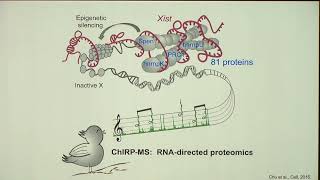
Thank you, Eric, for the very kind introduction, and really great to see everybody. The RNA world has undergone an amazing expansion. We now recognize that the vast majority of the human genome is transcribed in one form or another into RNA. And some of these landmark discoveries are depicted in this cartoon. Now if you'll indulge me, I want to organize kind of the field's advances into a couple themes. Really these are the special powers of RNA. In the first phase of RNA research, we found that the RNA is information, really the central dogma of gene expression. The production of mRNA and of course ribosomes and spliceosomes, these are RNA machines that make the central dogma possible. Then in the second phase over the last several decades, we learned about many other RNAs that are involved in gene regulation. You just heard this beautiful talk on microRNAs, so of course microRNAs, long non-coding RNAs that act on chromatin, and there are very many discoveries that are still unfolding. But a third and parallel power that I want to talk to you about today is RNA and immunity. Now, I'm not saying that just because we're all living through a pandemic caused by an RNA virus, and of course we're of course getting out of it with the help of an mRNA vaccine, but I want to posit that every RNA, no matter its function, needs to credential itself to the cell about its self versus foreign identity. And otherwise, it would evoke a powerful innate immune response. And so there's this very powerful link that I want to explore with you today. So let me then start with a very striking biological observation. That is that 4 out of 5 patients with autoimmune disease are women. And so if you're looking at this graph here, you can see that disease like lupus, the ratio is 9 to 1 female to male. Disease called Sjögren's, the ratio is 19 to 1. Some of you may know that I'm actually a physician scientist. I'm a dermatologist. Many of these diseases have a skin manifestation, and that's why these patients come to see me. And so, I've always been fascinated by this problem. And you may think that because it has to do with sex, it has to do with hormones. But in fact, it's probably really due to sex chromosome differences. So in patients with an XXY genotype, so-called Klinefelter syndrome, they're phenotypically male. They have testosterone, but they have a female-level risk of autoimmune disease. So that says that there's something special about that second X chromosome. Now, this is really a double-edged sword. Now, in the current pandemic, we found out that, of course, women do much better than men. Sex is probably the second most important feature second to age in determining outcomes. You can see that men are much more likely to end up in ICU, much more likely to die. And there, of course, by profiling sperms, important differences in T cells that we can recognize. So if we're thinking about sex chromosomes, I remind you that men have an X and a Y chromosome, whereas females have two X chromosomes. And so to make the gene expression from this giant X equivalent to this tiny Y, The strategy in mammals involves a long non-coding RNA called Xist. This is a 17-kilobase-long RNA that's only transcribed from inactive X. It coats inactive X chromosome as shown here. And actually it's very powerful. Just a few hundred molecules coats the whole chromosome and silences mostly the gene expression. And so there is a small number of escapees which then define differences between males and females in biology and disease. Now, to study X inactivation means that you have to follow two X chromosomes in the same nucleus. And so what we and others have done is to use a— what's called an F1 hybrid. That is a cell derived from an individual that is the offspring of two parents with very different genetic backgrounds. And so there are lots of single nucleotide polymorphisms, so we can tell the two alleles apart using allele-specific gene expression or chromatin analysis. So, for example, a few years ago my lab introduced ATAC-seq as a way to measure active regulatory DNA based on chromatin access. You can see that on this ATAC-seq map, the x-axis, this is all just genomic coordinates. The active X chromosome, the XA, has lots of accessibility, whereas the inactive X chromosome, the XI, has largely lost its chromatin access except for the genes or the elements that escape X inactivation. And this analysis taught us that X inactivation occurs in pieces. Just the promoters but not the enhancers escape X inactivation. This is really in fact a global 3D change in chromatin structure and nuclear structure. The inactive X basically coalesces, condenses, and moves to the edge of the nucleus touching the nuclear lamina. This is called the Barr body. There's also some contact with the nucleolus. So this is on the right is an image inside FISH analysis.. On the left is, this is APAC-seq data, which is a method that's location-specific transcriptome analysis. You can see that Xist is in the nucleus, it's touching the nucleolus, it's all over the nuclear lamina, but even though the nuclear pore is embedded in the lamina, the Xist will not go into the pore and therefore it's not exported and therefore excluded from the rest of the cell. Okay. And so it was long thought that Xist would have active protein partners and so many years ago my lab developed ChIRP-MS, which is an RNA-directed proteomic method. And this revealed that Xist has a large number of protein partners, 81 proteins, 10 of which through direct RNA-protein interaction and the remainder through indirect protein-protein interactions. Now she mentioned that Mitch Gutland's lab independently did this analysis using RAP-MS. Okay, and so the challenge then was try to figure out which of these 81 proteins were important, and there we had major help from genetics because we knew that among this 17-kb-long RNA, there's a small piece called the A-repeat that was absolutely critical for gene silencing. And so if you have A-repeat deletion, the RNA would still spread, coat the whole chromosome, but wouldn't shut down gene expression. And so we performed TRAP-MS in full-length wild-type Xist versus A-repeat deletion. And you saw that all these— so this is the peptide count. This is a scatter plot. So you can see that everything is on a 45-degree diagonal except 3 proteins whose peptide counts fall to zero. Okay, and so this showed us two things. First of all is that existRNA is modular. Different pieces of the RNA binds different proteins, right, so you can chop a piece off and everything else is fine. Secondly, that these three proteins, one of which probably would be important for gene silencing. And indeed, we found that this protein SPEN was critical for X inactivation as the key executioner, and but remember this in the second half. Of the talk. Okay. So, SPEN actually turns out to be originally discovered in Drosophila as a developmental mutant, but it's also present in plants where its job is to silence transposons. So, these are— this is a very ancient protein that has jobs beyond X chromosome inactivation. And so, the human SPEN actually has been biochemically characterized as a part of a protein complex that interacts with chromatin repressor complexes, histone deacetylase complexes, and the structure is really ideal. The N-terminus of SPEN has 4 professional binding RRM domains directly bound to the A-repeat, whereas the C-terminus has the spoctomy that interacts with these chromatin silencing complexes. Now, when we started studying this factor, Ava Carter in the lab, a very talented graduate student, was working with the SPEN knockout, so she confirmed that indeed the SPEN knockout cannot silence the X chromosome. But she also discovered that a large number of locations, elements in the autosomes also became active, gained accessibility in the SPEN knockout. Okay, so they require SPEN for silencing. And actually nearly half of these elements were from a single class of ancient viruses called endogenous retroviruses called ERVK. So we subsequently found that these ancient viruses that litter the genome, if they became active, they started making an RNA, SPEN would get on the job, recognize it with the RM domain, and shut them back down again. Now this is a critical clue because if you look at the sequence of SPEN, the A-repeat, which is critical for gene silencing, actually has a lot of sequence similarity to actually these ancient transposons. Which was previously recognized. And so this really led to a model that X-linked activation is an act of viral mimicry. And that is that there is a previously X-linked protein coding gene, the protoexist, which still exists in birds, but when this ancient virus jumped little sequences into this protoexist, it endowed the sequence the capacity to now recruit spec. Okay, and when this sequence amplified and mobilized itself, it allowed this new lncRNA gene, the exist, to now cause X inactivation. So in this model, exist is the device to trick a female cell into thinking that there's a raging viral infection going on on a chromosome. You can then mobilize this very powerful silencing machinery to accomplish the job of dosage compensation. So please remember this really as kind of an original sin in the human immune system. Okay, so I told you about establishment. What about sort of memory? Okay, so X inactivation happens very early on in the blastocyst stage in development, and then the memory of X inactivation, the chromosome is silenced, basically passes on in perpetuity to all the daughter cells for the life of the woman. Okay, so the dogma in the past was that Xist was required for establishment but not needed thereafter. But there's some evidence already going against that and one evidence provided by Jeanine Lee's lab was that if TNF-knockout exists in hematopoietic stem cells in a somatic fashion, this will lead to disease. And I'll show you there are other evidence in humans as well that in patients there is basically evidence of leakage of the system. So for example, if you look at B cells, cells that make antibodies, you'll see something kind of intriguing and that is that this exists cloud so-called BAR body, okay, is present in some stage in the common lymphoid progenitor, kind of goes away for a while, but then comes back with B cell activation. And furthermore, people have identified that in patient blood cells, that there's biallelic expression of Toll-like receptor 7. This is a cell surface receptor that recognizes RNA that activates the immune system. And so this is seen in female lupus patients. And this is specifically seen in a class of B cells called atypical memory B cells. We're gonna talk about this more in a second. But this evidence was all correlated to date. So to get at this question, Bingfei Yu, a very talented postdoc, set up a system where she can turn off Xist by CRISPR interference. So this is using dead Cas9 as a programmable DNA binding factor linked to a KRAB domain to shut down gene expression. So we were working in a human B-cell clone basically that is fully sequenced and phased and mapped. Okay, so what she did, so I'm gonna show you now two tracks, one track each for the inactive X or the active X. So in the control state, for example, toll-like receptor 7, it's only expressed in the active X, not the inactive X. If you add DNA methylation inhibitors, looks exactly the same. But if you shut down Xist, now toll-like receptor 7 is reactivated on the inactive X chromosome, showing that there's indeed an ongoing need for Xist for gene silencing. And it's not just this single gene. On the right is now a heat map, and there are actually hundreds of genes that basically in this allele score, D score, the white color means bi-allelic expression. There are hundreds of genes that require ongoing Xist for maintaining gene silencing. Okay, so what is Xist doing? We found that in fact Xist is needed to deactivate enhancers. So if you look at this enhancer-associated histone mark, histone H3 less than 27 acetylation, you can see that for example that it is actually active on the active allele but gone in the inactive allele. But if you take out Xist, then it's reactivation of these enhancers on the Xi. Okay? In contrast, there's no change to other marks, for example, the polycomb mark. We can also quantify that this is a predominant effect at enhancers, but less so at promoters. So this enhancer deactivation seems to be a principal job of Xist. So since we're now looking at this role of Xist in B cells, which previously not thought to have any function, we asked could Xist have same or different partner, protein partners in somatic cells. So Yan Yan Qi and Anshu Sappathy teamed up and conducted the ChIRP-MS experiment again in adult myeloid cells and B cells compared to ES cells. So we identified actually over 100 proteins which then we think really gave a parts list for all the functions that exist in each to carry out. And these include things like, for example, nuclear matrix attachment, RNA modification, chromatin silencing, gene silencing, and so forth. Now, we of course then ask, are these the same factors or not? So this is another scatter plot. So here on the x-axis is B cells, peptide count in the ChIRP-MS from B cells. On the y-axis is ES cells. So you can see that some proteins are present in both complexes. For example, SPEN is still very strong number 1 in both cases, but you can see that this set of factors, for example, TRIM28, is only an exist partner in B cells but not so in ES cells. And conversely, this PRC1 complex, RNF2, is only in ES cells but not the other way around. It's not only an ES somatic cell difference. If you look in, for example, myeloid cells versus B cells, again, you see that there are a number of cell type-specific partners. Okay, now to understand which of these factors mattered, Bingfei went on to silence every single one of these partners using CRISPRi and asked would they reactivate basically excellent genes. So this is a first allele-specific CRISPR screen. So he's discovered that indeed a number of factors including SPEN was absolutely critical as well as this factor TRIM28, okay? And so let me tell you a little bit more about that. So this is a B-cell-specific partner that's required for Xist activity. So TRIM28 is also known as CAP1. It's actually a very famous gene because it has a well-known role in ES cells for silencing endogenous retroviruses. We knocked out TRIM28 in B cells and indeed reactivated SOLOC receptor 7. As I'll show you, it actually silences X-linked genes with a slightly different mechanism than the enhancer mechanism I just talked to you about. So now if you look at, for example, another X-linked target gene, you can see that TRIM28 protein TRIM28 directly occupies the promoters of these genes, but both the active X and inactive X. But of course what's different is the activity. So if you look at, again, on these two tracks that look at RNA, it's only transcribed from the active X, not the inactive X. If you knock out TRIM28, now there's bi-lateral expression. So we worked out in fact that what TRIM28 is doing is activating— working on a step called promoter proximal pause. So RNA polymerase II will start on nearly every gene and transcribe about— for about 100 nucleotides and then stop. And then it needs another signal to keep going. Okay, and so we found is that these TRPM28-dependent genes have a high amount of pausing as evidenced by this classic experiment called GroSeq or Genome-Wide RNA Sequencing, more so than independent genes. And so the model is that these genes are pausing and then when basically when TRPM28 is already present, But if the Xist complex interacts with it, it activates the activity somehow and enhances this Pol II pausing. So this is a separate complementary activity, like a failsafe, right? If enhancer fires, promoter starts going, another step to stop the transcript from actually getting made. So by learning about the genes that depend on continual Xist activity for their silencing, we actually got some interesting clues. Because we can immediately ask, those set of genes, do we ever see them in any other aspect of biology? And we immediately noticed that those same gene set was activated, induced in a number of autoimmune diseases or inflammatory diseases, including inflammatory bowel disease, lupus, rheumatoid arthritis. And it's activated, for example, in lupus patients compared to healthy controls. We can also take this even down to a single cell level. So now we're noticing that in COVID-19 female patients that this is seen in B cells. So let me explain what's going on. First of all is that this is a UMAP. Every dot is a single cell, and these cells are being organized based on their similarity to each other. And second point is that we can see that there are naive cells that projected two orthogonal fates, one class of conventional memory B cells and a second class of atypical B cells. And it is these cells that become atypical B cells that have the highest exist escape score. Okay, so suggesting that somehow changing the exist status would affect this fate going to atypical B cells. So I have to explain what that is. So B cells are activated by B cell receptor antibody cross-linking and CD4D ligation. That's the canonical B cells. But these atypical B cells are activated by different signals. Toll-like receptor signaling interferon gamma. Interferon gamma. And so in fact, these atypical B cells, or ABCs, have been seen in autoimmune disease and have antiviral specificities. But importantly, in animal models, they preferentially accumulate in aged female mice rather than male mice. So this really links with our theme. And so these are the markers that we use to follow these cells. And just remember this CD11c positive sort of class is basically the ABCs. So indeed we can see these cells escaping X-inactivation in pathologic cells from female autoimmune diseases including for example in lupus, nephritis, these are the B cells infiltrating the kidney and seen especially again in CD11c-positive atypical B cells. We also see the same phenomenon in rheumatoid arthritis in the knee-infiltrating cells, B cells, again escape in atypical B cells more than conventional cells. So this is not seen in every sort of female disease state, right, actually rather selective. So that was a bit of again correlative evidence. So to directly prove that Xist activity is required to prevent the unleashing of atypical B cells, we carried out a primary cell genome editing experiment. So we obtained basically primary human B cells from the blood bank from female donors, and we developed a protocol to knock out Xist A repeat using Cas9-RNP. We can rest and then stimulate these cells with B cell receptor activation and TR7 agonism and ask, can we drive ABC fate? Okay, so as you can see in the bottom here that we can indeed expand, increase the population of these CD11c-positive atypical B cells. Moreover, these B cells undergo isotype switching. And so B cells start with IgM, they get switched to IgD and IgG. These are sequential rounds of maturation, and we see definitely a substantial gain of IgG-positive atypical B cells. Okay, so these studies then suggested that in fact the job of Xist was not done since early in development. And in fact, there's an ongoing role with somatic cell-specific existent partners. So in contrary to kind of that monolithic view of basically RNA protein complexes really exist, a long line coding has different partners. So this is more like transcription factors with coactivators, different partners in different cell types. And the specific role then in B cell release is that TR7 is a very important target gene. That exists acts to prevent naive B cells from turning into atypical B cells. And this is particularly important, we believe, in situations with RNA ligand like COVID-19 or actually lupus or these other diseases where there's autoantigens that have RNA and RNA-binding proteins. Now since we reported this work, just last month there's actually a report of rare patients with very severe lupus lupus that are born with gain of function mutations in toll-like receptor 7. Now these patients partly also have massive expansion of atypical B cells, so I think that really validates this pathway in humans as really, I think, an important mechanism to prevent autoimmunity. So these studies suggest really this role of the second X chromosome, right? If they become dysregulated, they might contribute to autoimmunity. But we believe that there's a further very intriguing insight. And that is that when we started looking at the proteins that we pull out of these exist-interactome, we noticed that many of these top interacting proteins are also autoantigens. That is that patients with autoimmune disease develop antibodies against these self-proteins. So these are the proteins that physicians use to actually diagnose and stratify individuals with autoimmune diseases. So almost half of these top-interacting proteins are autoantigens. These are very classic proteins like Ro and La. Some of them, Sandra's right in the front row, actually are in this part of this complex. And so this led to the hypothesis that maybe this exist RNA protein complex is a female-specific trigger of autoimmunity. You have this massive RNA, right, lots of repeats, 17 kb long, lots of copies of these RBPs. And this RNA now is sitting on a chromosome, right, again over and over again, this highly condensed structure and this kind of a polymeric repeating structure is the kind of complex that may be able to actually trigger the immune system. So that was the idea. So we first tested this idea to ask what would happen if you basically make cells die, right? If they lysed and they released antigen, what would this look like? And so coming back to our F1 hybrid cells, we can actually induce programmed cell death, apoptosis. You get DNA fragmentation. And then we can actually extract the DNA and ask, do these different genomes fragment in the same way or not, okay, as a proxy measure of this kind of condensation idea. So this is what the data would look like. This is basically the molecular weight ladders, positive control, like basically nucleosomal patterns of DNA. And then these are our cells, and we make an arbitrary choice of greater than 1 kilobase or less than 1 kilobase, okay. So we sequence. And indeed, we discovered that on the X chromosome, we see enrichment of the large fragments for inactive X over the active X. And this is actually depleted with the small-sized DNA fragments. Okay? Now, if you look genome-wide, looking at the small apoptotic DNA fragments, you can see that on autosomes, the ratio between the two genomes are exactly 1. All right, what do you expect? But looking at the loci that are silenced on inactive X, we see a depletion of the small apoptotic DNA fragments. But this is not the case for the escapees that escape X inactivation. So in a way, this almost looks like an endogenous version of a taxine, right? It's basically the nucleases that chop up the DNA basically have the same kind of boundaries or the same kind of parameters, and so that these inactive X is harder to chop up large fragments, lots of antigen. All coded together. Okay, so to really test this idea, we really thought that what we have to do, right, the most definitive thing is to basically make a male mouse and give it an Xist RNA protein complex and see if we can give this male mouse female level of autoimmune disease. Now this is a very hard thing to do. So if you express Xist on any autosome or any chromosome, it will silence gene expression from the entire chromosome and that is a cell lethal event. But now remember I told you that the A repeat deletion cannot silence, it will assemble a 99% exist RNP, all the proteins are still there. And so that's what we decided to do. So it turns out that Anton Witzen's lab had previously made an A repeat deletion tet operator conditional mouse. So we obtained this mouse from Anton and Diana Zhu, a very brave postdoc, took this on to develop this next round of story with the autoimmune model. Okay, so in this case, the Xist A-repeat deletion is knocked into chromosome 11 with a TET operator, okay? So when we turn on DOX, we can basically make a fake Xist RNP coding the whole chromosome. Let me just tell you that indeed there is a huge difference in Xist expression between males and females, okay, black and red, okay. Now our exist transgene is a little bit leaky, and so even without doxycycline there is a little bit of exist, but it's still 100-fold less than a real female cell. If you add doxycycline, now you get up to kind of the full level. And if you look in the organs, you can actually see these exist foci, the bar bodies start to form if you add, only if you add doxycycline. Let's keep going. Keep this in mind, okay. So now what do you have to do to get these mice autoimmune disease? So in fact, many mouse models of autoimmunity don't have sex bias. So we finally came to this particular model called the prostatic-induced lupus model, which in fact does show this female preponderance disease activity shown here. So it has autoantibodies and organ disease, multiple organs. And this requires a very special genetic background called Smith J. Lambert, and so keep that in mind. And so we're going to test the impact of Xist on resistant autoimmune genetic backgrounds. So when I say we, it's actually really Diana Du. And so she basically created all these cohorts. So basically we have our positive control female mice treated with Prostane. We have our negative control male mice either with or without Prostane. Then we have basically the treatment control with only basically Prostaglandin but wild type, and then finally the test case, male exist transgene doxycycline with Prostaglandin. Okay, and so I want to give a specific shout out to Diana because she was doing these experiments and then COVID hit. Everybody got sent out of the mouse room, and so there's many, many dark and lonely nights only by herself carrying this experiment on. She made this happen, and so I'm about to explain sort of 5 years of her life in in 5 minutes, so I really feel I need to give credit where it's due. Okay, so indeed, in this first, in this genetic background that's resistant to autoimmune disease, the C57 black 6 background, we treated the mice with PRISTAIN, is a non-specific tissue damage, and basically waited a whole year. There's no end organ disease, okay? But importantly, we noticed that this was actually enough to cause autoantibodies. Okay, so these are the measurements of autoantibodies. What you want to look at is the female versus basically the male exist transgenic. And importantly, both the doxycycline-induced male and just the male transgenic, very low levels of exist was enough to give autoantibodies. These autoantibodies go beyond the protein of the exist RNP, so which suggests a possibility of something called antigen spread. Once the immune system gets started, it goes to additional specificities. So since they're autoantibodies, we can also look into the rest of the adaptive immune system. So if you look at T cells from these mice, we can now notice that in fact there are differences in their genome regulation. This is looking at ATAC-seq CD4 cells. This is males, this is females. Just sort of a striking difference. Now if we actually then add on these different layers, we can see a partial reprogramming of the male chromatin accessibility pattern to resemble a female-like state. Now this is really a change in cell type composition. Once we do the DNA cell deconvolution, we really realize that the difference was really a high frequency of naive CD4 cells and a change to a higher frequency of memory CD4 cells between males and females, and that's being transformed also in our male example. This transgenic. So now, I should also add that there are also, of course, RNA differences that change in the pattern. For example, toll-like receptor 9 is now also flipped from low to high resembling the female state. And this is a toll-like receptor gene that's in T cells rather than B cells. So now moving on to the exact same genetic studies but now in the systemic SjL genetic background, we once again see after Prostain treatment autoantibody induction. But now, so here you want to look at females. These are the male controls. And the green over here is basically males with exist transgene dogs and Prostain. The difference now is that instead of waiting for a whole year, now this happens in just 16 weeks. And the titer is much, much higher. So the y-axis used to be just a few hundred. Now this is tens of thousands, and so it's a much stronger kind of response in this genetic background. And now moreover, we can actually see that there is in fact actually full-blown in-organ disease. Now we're looking at on top at kidneys. This is the glomerulus. And in the middle row, this is the liver. So our pathologist has helpfully put on these little black arrows to show us where the pathology is. So you can see that the you can see for example the liver, these basically vacuolation is the result of autoimmune damage. On the right-hand side is the total pathology score scoring all the animals together. You can see that indeed basically females have very high level of the disease. Males much less so, but with the transgenic, exist transgene and Prostain basically can now convert to a female-like level of autoimmune damage. Disease. And so this now we see an organ disease at kidney, liver, lung, and spleen, basically all over the body. All right. So what I've told you then is that we really think that this Xist RNA protein complex is a driver of female-specific autoimmunity. And it really can do this at multiple levels. At the beginning, it can just really start with making autoantibodies. This is then also associated with T cell chromatin changes, but these are not necessarily gonna cause disease. Only in the context of the right kind of genetic insult background or further tissue damage could you lead to full-blown autoimmune disease and organ damage, okay? Now I should mention that this pattern of behavior is very reminiscent of some of the things we see in human autoimmune disease. So there are these amazing studies from the Army where people get their blood drawn when they're first enlisted. And they get their blood drawn all the time subsequently until eventually they're discharged. Now, a subset of these individuals will get autoimmune disease when they're in the Army. And you can go back in time, look in their blood and say, when did they first start having autoantibodies? When did they first start having disease? And the answer is that you can actually get autoantibodies years, sometimes a decade before you get autoimmune disease. Okay, so this is a known phenomenon in human biology and I think very interestingly that this mouse model is recapitulating this phenomenon that you start with this kind of break in tolerance, T cell subset changes, and finally tissue damage. Now I think for men, they don't have Xist, so they are missing some of this push, but that doesn't mean that they can't end up with the same problem. So other RNAs or other kinds of drivers would basically have to basically push this process along, and that might actually really suggest that this whole disease process is actually fundamentally different because it's driven by different causes. Okay. So I want to acknowledge the folks who did some of this really, I think, really interesting work. The work that I told you about for exon activation and viral mimicry was done by Ava Carter. Bingfei Yu led the work on exist memory. In B cells, and Diana Zhu led the work on Xist-RNP as a driver of immunity. I gratefully acknowledge my collaborators, especially Edith Hurd and PJ Utz at Stanford for that last study, and I gratefully acknowledge my funding sources. Thank you for your attention. Okay.
Hi, that was really great. So I guess question about the first part, so that the classical evidence that exists is not important for maintenance. Is that coming, I guess, from MEFs? So I guess the question is, are the B cells the exception or are they the rule in terms of other somatic tissues?
Yeah, I think that's going to be the rule. I think the earlier studies were done looking at small number of genes without modern technologies, right? And so once we have the resolution ongoing with modern-day allele-specific tools, you can clearly see these escapees that require ongoing Xist, right? And what we also learned is that the prior dogma was not wrong. Basically, the number one predictor of needing Xist is basically the low DNA methylation at the promoter. So basically, if you have no DNA methylation, then the only thing you depend on is Xist. And so that makes perfect sense.
Hello. Did you also investigate the differences between female CD8 T cells and male CD8 T cells? Because as they recognize antigens on the cells expressing HLA-1, I think they should be at least as interesting as CD4 T cells.
That's right. I agree, yes. So we're doing all kinds of single cell, everything right now, every kind of cell in the immune system. So we'll see. So yes.
I'm looking forward to it. Yeah. Hi. Very interesting talk. I was interested in the part where you told us that the retroviral, endogenous retroviruses are important as part of the X-inactivation. I was wondering whether in your mutants in the B cells, you see upregulation of endogenous retroviruses, and if so, whether this also contributes to the autoimmune phenotype that you see.
That's a good question. Yeah, so in fact, we— OK, so two things. One is that in the B cells, we knocked out or inactivated XIS, which obviously only acts on the X chromosomes. Now if you knock out SPEN in the animal, there's in fact a strong B cell phenotype.. And so whether that is purely because of SPENS' role on gene regulation and/or due to endogenous retroviruses reactivation, that remains to be seen. Yeah.
Josh. Great talk, Howard. The transgene that expresses Xist, what else does it have? I mean, how sure are you that it is the sequence that's coming from Xist? You know, it is a foreign transgene that is in the chromosome. Well, it's an exist cDNA, but is there other stuff? I mean, there's a TET operator, that's not enough.
A TET operator, that's right, but obviously that's controlled by the fact that you only get a phenotype if you add DOX, right? So it's not a foreign sequence because even in males they have an active X chromosome, they have exist, they just don't express it. Everybody has the same genome, males or females, they all have Xist DNA.
I guess it does come on though later, right, in a time when it's— I mean, it is like a— in the sense that it's only expressed later in your mice.
Right. Well, I was— no, no. So I mean, I think that I showed you this example of the B cells where the Xist goes away for a while. That's actually kind of the The exceptions are most female cells you can detect exist expression, right? It's the number one thing that separates males from females, right?
So yeah.
So just a related question. Why do you think exist is special in this way? What's special? I mean, there are other long RNAs that assemble RNPs. So what is it about exist that makes it particularly adept at triggering this kind of response?
I think that's a very interesting question. I don't think we really have the answers, but I'm gonna speculate, okay? So I think there's two things going on, right? One is that I told you about this idea about the X in activation is biomimicry. So that entire system was set up to basically deal with foreign viruses, right? And now you're using it in this way for chromatin silencing, right? So all those components, all those kind of signals basically just tells the rest of the cell like something bad is going on, right? That's one. Sort of idea. The second idea that I'll talk to you about is the biochemical one, and that is that this is a very special structure. Like no other RNA has a chromosome-wide territory, makes the whole chromosome condense, right, into this structure. And in a way that basically when you try to kill the cell and release antigens, like basically the antigen release pattern will be different, right? You end up with much larger molecular weight complexes. So those are the two things, but can some other RNA do that? Possibly, very possibly. I don't see why not. Thanks. Yeah. Sandra has a question in front.
Go ahead.
Go ahead. Hi. Nice talk. Have you looked in patient samples to see if the XIST levels correlate like you're suggesting, like in female autoimmune patients? Yeah. So XIST level in female autoimmune patients actually do all kinds of really interesting and different things. So I told you about this biallelic escape. So sometimes you see that the Xist cloud is not there. Sometimes people think that there is some other kind of problems with gene silencing, but you don't really see more Xist in female cells from autoimmune patient samples.
So you didn't mention interferon at all. Where does this fit in?
Sorry, can you say the question again?
You didn't mention interferon, which we know increases when a lot of RNAs accumulate. I can mention work from Nari Kim and Nick Proudfoot on monogenic interferonopathies.
That's right. Yeah, I only briefly mentioned interferons in the context of atypical B cells, and that is that they can get activated by interferon plus toll-like receptor signaling, bypassing the need for CD40 ligation and other co-stimulatory signals. So if you're asking about whether there are changes in interferon levels, like for example in the Xist mice, we don't know yet.
I actually have another question. So one of the autoimmune diseases is subacute cutaneous lupus erythematosus, which you probably know about. As a dermatologist, which I think is not female skewed.
Can you comment? OK, this is a very, very detailed question. Yeah, so there are different flavors of lupus. So this is one such flavor. I always thought that that disease had more of an infection association, like bacterial infection association. Yeah, yeah, that's true. And right, it's basically drug-induced like haptin, right? So that's very common as well. That's right. So I think that subset— I think the broader question is, okay, if this is a pathway, is this the only way to get autoimmune disease? And clearly that's not true, right? There are many, many other ways.
That's correct, correct. All right, well, a lot of great discussion. I wanted to let it run, but I think we're over time now, so we will thank Howard one more time.
More from Joshua







Scientist Stories: Hans Waterham, The value of phenotypic assays in peroxisomal disorders




Scientist Stories: Joel Zlotogora, Genetic carrier screening programs for reproductive purposes