Scientist Stories: James Nunez, Programmable transcriptional memory by CRISPR mediated editing
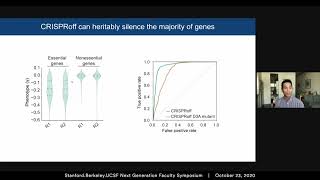
James Nunez describes CRISPR-Off, a tool that silences genes for months through epigenetic marks rather than cutting DNA. A single pulse can keep genes off for up to 15 months in cell lines, and turning them back on requires a separate enzyme. Screens across 20,000 genes show most can be durably silenced, and the approach works through cell differentiation.
Chapters
All right, thank you for that kind introduction. And also I would like to thank the organizers for putting this together and everyone involved. It's been a very inspiring meeting so far, and I'm very grateful to be involved in this. Thank you. So my career has thus far centered on CRISPR. I started as a graduate student at UC Berkeley in Jennifer Doudna's lab, where I was studying how bacteria naturally use CRISPR to remember the viruses that infect them. So I'm not going to have time to talk about that, and I transitioned into a postdoc at UCSF in Jonathan Weissman's lab, where I'm now using CRISPR to engineer memory into mammalian cells. So today I'll be talking about a technology that I developed in the lab called CRISPR-off, and this is a method to modulate gene function by turning off transcription in a manner that doesn't involve DNA cutting, but instead uses the rules that we know about epigenetics. So part of this work was really inspired by a number of studies that have been presented in the past few years that show that despite the power of CRISPR, and it is a very transformative tool, for some applications there are some concerns, such as that toxicity in some cells, like in stem cells, that cause a drastic loss in cell viability due to the cutting of DNA. And two, after cutting DNA, the DNA repair that follows is largely unpredictable and difficult to control. So we've been motivated to come up with alternative ways to come up with ways to modulate gene function that doesn't have to involve DNA cutting. So we and others are interested in epigenome editing. So essential to this is a catalytically dead form of CRISPR-Cas9 that has a couple mutations that prevents it from cutting DNA, but instead we use it as a DNA binding platform to which we can directly recruit histone and DNA modifying enzymes that can change the local epigenetic marks of the targeted gene. And for the vast majority of these tools, the biological output that we're trying to achieve is to turn off transcription in order to modulate that gene's function. So the beauty of these technologies is that we're not changing the underlying DNA sequence at all. We're not cutting DNA. And these are shown to be highly specific to the targeted gene. And for some of these, they can be reversible. So when I started my postdoc, I was really inspired by this work that had just come out that identified 3 different epigenome editing domains. These are DNMT3A, DNMT3L, and the CRAB domain, that when you transiently pulse them into cells targeting a single gene, the cells somehow remember that gene to be in the off state for a very long time. So this is plotted here on the right, where in the course of 50 days, the gene remains off here in the black plot, even though these epigenome editor domains are only pulsed for a few days. So somehow the cells memorize this form of gene silencing over the course of their lifespan. However, the technologies that were reported here were a bit cumbersome because you had to express 3 different DNA binding modules to express these proteins. So it was difficult to implement, and 2, it was unclear whether they would be useful for any gene of interest in the human genome. So I took an engineering approach to essentially simplify this technology and come up with a way to make a single fusion protein that encodes this information that we know about using these as building blocks and be able to program this to wherever we want in the human genome and really to answer basic gene regulation questions such as how many genes are amenable for this and really add it to the CRISPR toolbox as genetic medicines for therapies. So to this end, I engineered a single fusion protein called CRISPR-Off. So this is a dCas9 molecule that encodes the three different modules that I talked about, the KRAB domain, DNMT3A, and DNMT3L. And these are just two different versions of the molecule that have different orientations of it. And what we do is we transiently pulse them in cells that normally divide every day, and you can see in the dotted plot here, the CRISPR-off molecule is only present for about a week. However, the gene that we're targeting remains off for a very long time, and for reasons I won't go over, our version 2 is our optimized construct where a single pulse of this protein is enough for the majority of cells to turn off that targeted gene for a long time. And you can see here, each dot is a single cell on the right, that for over 90% of the cells that were treated by this, the gene is very, very off, and only a few cells have leaky expression of this. So it's quite robust. And we've taken out this experiment for over a year, for 15 months. We followed 39 single clones, again, that divide every day, and you can see that almost all of them have retained that gene in the off state throughout the duration of this experiment. And the cool thing is that you can toggle between the on and off states of transcription, where we can treat these cells that have been turning off that gene for over a year with dCas9 fused to this other enzymatic domain, Tet1, that removes the DNA methylation marks, and the gene turns back on and turns on for a long time as well in the form of memory. So we can toggle between the two different states. So, with this simplified form of epigenome memory, we then used it to target the protein basically to the majority of the human protein coding genes. So, we performed CRISPR screens targeting over 20,000 protein coding genes to figure out which of the genes that we're targeting are actually amenable to this kind of gene silencing. And what we found was quite surprising in that the genes that we expect to have a growth phenotype upon knockdown are also showing growth phenotypes upon CRISPR-off treatment, really suggesting that this tool can turn off the vast majority of genes, as shown here on the left, where the negative phenotypes mean that those cells are essentially coming out of the CRISPR screen because they've been turned off by CRISPR-off. And we're quite excited by the various applications of CRISPR-off, sort of fast-forwarding a bunch of screens and a bunch of data that we've shown how robust this tool is. And one of the applications that we sort of toyed around in the lab is in cell and tissue engineering, where we would like to generate custom-made differentiated cells. And in this example, we're creating neurons that are derived from iPSCs, where in iPSCs we treat them with CRISPR-OFF targeting a specific gene. And this example, we've done this for a number of genes, and this example is cool because MAPT encodes for a protein called tau. It's been implicated in a bunch of different neurological diseases. And I'm showing this example because MAPT is naturally turned off in stem cells. It's not expressed. But when we turn these cells into neurons, you can see in this plot that MAPT is expressed in a high abundance. So, there's a lot of epigenetic reprogramming in the locus in order to turn this gene on. So, what we did was we treated CRISPR-off in iPSCs to repress MAPT, and when we differentiate them into neurons, we look to see if any cells have retained MAPT in the off state. And that's essentially what we see on the left here. You can see that CRISPR-off-treated cells still look like neurons. They're very healthy. And then we can isolate neurons that have the tau protein repressed throughout this differentiation process, really signifying that we're overriding a lot of the natural rules and natural epigenetic pathways that would otherwise turn this gene on. So really reprogramming the cell to remember a specific memory that we will remember for a while. So we're quite excited by the various applications of this. I've shown you an application, just a small piece in cell and tissue engineering, but really using this as therapies and personalized medicines. And as I'm sort of getting ready to launch my own independent lab, what I've been really obsessed with is really using CRISPR-off as a way to discover chromatin biology and discover how genes are naturally turned off. So, one of the questions that I would like to pursue in my own lab is really to figure out how does this work. I'm a biochemist in training, and I think about basic principles and basic pathways of gene regulation. So, one of the ways that I would like to do this is to essentially screen for factors that are important for this process to occur. And this is a natural process that's adapted from what happens in early mammalian development to turn off certain cytotoxic elements such as endogenous retroviruses, transposable elements, DNA repeats. So really with this now simplified tool where you can program it to work in a cell, we can begin to dissect what actually happens during these really critical stages of mammalian development. And two, sort of a long-term thing is, again, asking the question of how does this work is, When are these memories naturally programmed in our bodies, in our cells during development? So the idea that I have is to essentially do CRISPR-off epigenome editing at different stages of mammalian development and see at what stage are the memories established and are those memories persisting through a developmental stage into a developing mouse. So again, these challenges have largely been bottlenecked by the availability of tools in order to do these kinds of experiments that I'm really excited to pursue with this technology. So with that, again, I'd like to thank the organizers and everyone involved in this lab, in the Weissman Lab and Luke Gilbert's lab at UCSF, and I will take it over to Pauli.
More from Joshua







Scientist Stories: Hans Waterham, The value of phenotypic assays in peroxisomal disorders




Scientist Stories: Joel Zlotogora, Genetic carrier screening programs for reproductive purposes