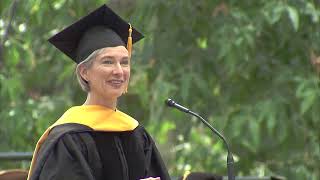
In this commencement-style speech, Jennifer Doudna thanks the Pomona community and reflects on her personal journey from a nervous high‑school graduate in Hilo, Hawaii, to a pioneering scientist at UC Berkeley. She describes how a work‑study lab position at Pomona sparked her love for research, leading to graduate work at Harvard, a postdoc in Colorado, and ultimately the discovery of CRISPR through a curiosity‑driven collaboration with Emmanuelle Charpentier. Doudna explains the basic premise of CRISPR—bacterial defense against viruses harnessed as a precise, accessible DNA‑editing tool—and highlights its adoption in classrooms from high schools to universities. The address concludes with advice to graduates: identify your passion, pursue it relentlessly, and turn challenges into opportunities, emphasizing persistence over external doubts.
Chapters
Wow, this is really amazing, an amazing moment. I want to start by thanking Professor Olson for that very kind, very generous introduction. Thank you. And then secondly, I want to say congratulations, graduates and fellow Sagehens. So proud of all of you. And thirdly, I I want to say to President Starr and the Board of Trustees and faculty and colleagues here, thank you so, so much for including me in your special moment. It's just a real thrill for me to be here. Now, I have to be very honest with you. So the first time I gave a speech at graduation, I was 17 years old. And I was graduating from high school in Hilo, Hawaii, where I grew up. And I was incredibly nervous. And I was so nervous that I got up in front of the crowd and I kind of froze. And I really— I didn't know what to say. And I feel, you know, a few years have gone by since then and a few things have happened since then. I feel nonetheless the same sense of anticipation and excitement today for all of you because of what you're about to embark on in your journey. So, you know, I had an extraordinary experience here at Pomona because I came here, I was quite young, I was 17. I came from Hilo, Hawaii, and I came by myself. My parents were faculty at the University of Hawaii, but didn't have a lot of money and didn't have the means to come and visit the campus beforehand. So they literally put me on a plane by myself, and I arrived here in Claremont. I checked into Mudd Hall, where I lived freshman year. Some of you may know it. And what happened was that it just turned into an incredible experience for me because it opened the door to so many opportunities. When I was growing up in Hilo, I was kind of a nerdy kid. You know, I loved, I loved science and math. I knew I loved chemistry thanks to Miss Wong, my high school chemistry teacher. Wherever you are, Miss Wong, thank you very much. And I knew I wanted to study biochemistry, which was one of my attractions to come to Pomona, but I didn't I didn't know how to do it. I didn't know how to get into a laboratory, and fortunately, the work-study program here gave me that opportunity. I had a chance to do things like water orchids and wash glassware, and I was thrilled to do it. You know, I was so excited just to be in a real research laboratory for the first time, but eventually, I got to do what I really wanted to do, which was I really wanted to work for a summer in the lab of my biochemistry professor, Sharon Panasenko, and she gave me that opportunity to come and do a real research project with her where I learned amazing things. We were studying bacteria and how they, how they respond to starvation, and what I learned for the first time about myself was that I could, I could do this, you know, I could do experiments that weren't written down anywhere, they weren't there wasn't a right answer to get because nobody knew the answer. And that's really what research is all about. And after that summer experience here at Pomona, I was absolutely hooked, and I realized that this is what I want to do with my life. I want to be a scientist. But the big question was, you know, could I really do that? I didn't know. And when I left Pomona, so I graduated in 1985, which probably sounds like maybe ancient history to people here, but 85, I had, you know, I had the opportunity to go to— first I went to Boston, to Harvard for graduate school, and then I went to Boulder, Colorado, where I trained. I did my postdoctoral work. And then my path eventually led me to the University of California, Berkeley, where I'm very proud to work at a public university that where we really, like a place like Pomona, we really try to open the door to everyone. That wants to come and study and learn and give them opportunities in their life. And through that experience, that led me in various directions in my research, but eventually to CRISPR, which began, as you heard a little bit in the introduction, as an extraordinary but frankly very small curiosity-driven collaboration with another scientist, Emmanuelle Charpentier. And together with our students, we started researching something that seemed very esoteric at the time, namely how do bacteria fight viral infection. And that led to an understanding of the chemistry of that process that allowed us to harness it as a powerful technology for altering the DNA in any cell and doing it with a level of precision that wasn't possible before. And importantly, the technology is not it's not so difficult to use that people can't readily adapt it and adopt it. And as you heard, and I'm so pleased to know this, that it's now been woven into not only colleges and various kinds of institutional and company operations, but also high school teachers. We've been working with the Berkeley High teachers in our own town and many other teachers around the country who have been able to adopt CRISPR as a technology that they can use with their students as a teaching tool and to give students a handle on, you know, the sort of the real way that scientists are now manipulating DNA in the lab and in, as you heard, also in important applications in the future. So I just really want to share with you that, you know, I think in my experience in life, I think that, you know, probably the most important thing— I've met a lot of people that are a lot smarter than me, believe me, But I think, you know, what I've observed, and I observe this now in the students that I work with in my own lab, is that I think that, you know, real success comes when you identify what you're passionate about doing, and then you do it 110%. You just really go after it. If I could tell you how many times people told me, oh, that'll never— that experiment will never work, or that's kind of a silly idea, or, you know, even my high school guidance counselor telling me girls don't do science. You know, if I had listened to that, I probably wouldn't be here now. So I think having a degree of persistence is really important. I think we heard that from both of our wonderful student speakers this morning. And I would just encourage all of you to think about that as you go forward. We all face challenges in our life, in our personal life, in our professional life. And that's just a part of living. It's a part of being human. But I think what sets apart those that really are successful in whatever they want to do is just embracing those challenging moments and turning them as much as possible into opportunity. And again, I really appreciated that message that we heard from our student speakers this morning. So thank you, thank you. Congratulations, everyone. I'm thrilled to be here to celebrate with you. Congrats.