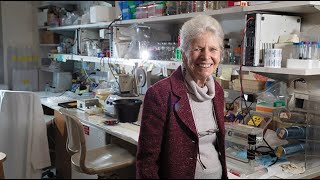
In this interview, Cold Spring Harbor editor Richard Sever talks with Joan Steitz, Professor of Molecular Biophysics and Biochemistry at Yale, about her lifelong contributions to RNA biology. Steitz recounts her first exposure to RNA during an undergraduate stint in Tübingen working on an RNA bacteriophage, followed by ribosome work in Alex Rich’s lab and graduate research on RNA phages in Jim’s lab. She describes how early studies of translation initiation led her to appreciate RNA‑RNA interactions, foreshadowing the later RNA‑world concept that emerged in the early 1980s. The conversation then shifts to the serendipitous discovery of small nuclear RNAs (snRNAs) and snRNPs that form the spliceosome, sparked by autoantibodies from patients with mixed connective tissue disease and the challenges of generating antibodies against conserved hnRNP proteins. Steitz reflects on the rapid expansion of non‑coding RNA research—from ribosomal and transfer RNAs to snRNPs, microRNAs, and a myriad of regulatory RNAs. Finally, she outlines her current focus on viral non‑coding RNAs, explaining why certain viruses produce such RNAs, the difficulty in assigning function, and a recent breakthrough where a viral ncRNA was shown to enter the microRNA pathway after 24 years of investigation. Throughout, she emphasizes the role of curiosity, serendipity, and evolving methodologies in advancing RNA science.
Chapters
Hi, I'm Richard Sever, editor of Cold Spring Harbor Perspectives in Biology. With me I have Joan Steitz, who is the professor of molecular biophysics and biochemistry at Yale. Joan, welcome to Cold Spring Harbor.
Thank you.
Now, I was looking at the program, and I was excited to see that you're going to be talking about viral RNAs later in the week. And the reason I found that exciting was it struck me that every major advance in our understanding of RNA, you seem to have been at the heart of. I mean, we talk about translation initiation, ribosome binding, splicing, the spliceosome, SNURPs. You were there every time. And I—
That's very kind of you to say that. But yes, it's been pretty exciting.
So what I wanted to do first was just if we could sort of rewind back to the time when you were first working on RNA. At that time, did you have any sense of the multitude of roles that RNA may play in the cell?
Certainly, absolutely not. So my first experience with RNA was when I was an undergraduate and I had gone to Tübingen, Germany and worked in the Institute for Virus Forschung. And we were working on a brand new bacteriophage that contained RNA as its genome. And that was my first exposure to RNA viruses and RNA, and it was very exciting. Actually, well, before that I had— I forgot— I had actually worked on ribosomes in Alex Rich's lab. So that was the first exposure to RNA and ribosomes, and the viruses came a year or so later.
And when it got clear—
And then I was a graduate student in Jim's lab. And I worked on the RNA phages, which was what I had originally worked on in Germany. And at that point, we knew there was tRNA and ribosomal RNA and messenger RNA, and we had all these questions about messenger RNA. One of the things— stories I love to tell, when you think about knowing the 4 billion base pairs of the human genome, that a co-graduate student of mine in Jim's lab wrote his entire thesis on one base, which was at the 5' end of the RNA phage RNA. We had to start somewhere. Nobody knew anything. So you start at one end of an RNA that you can get a hold of and purify. And that was the state of things when I was doing my thesis.
And then when you started on working on translation and presumably—
That was sort of the next obvious step because everybody had questions about translation and what were the signals in the messenger RNA that enabled the various stages of translation.
And at what point did it become clear to people, or the thinking start, that perhaps this was reminiscent of an RNA world, that this was something that had gone before? We tend to think of that as more recent.
Yes, I think the thinking about an RNA world really came in the very early 1980s with the discovery of catalytic RNA, Tom Cech and Sidney Altman. But when I was working on ribosomes and how ribosomes initiate translation in bacteria in the— throughout the 1970s, which was my major focus at that time, I remember beginning to think that it was the RNA-RNA interactions that the ribosome engaged in that were really the important central things And I recall once being invited to give a seminar in Berlin in front of Wittmann's lab. Now Wittmann was the person who isolated all the ribosomal proteins and determined their sequence from the bacterial ribosome. And it was a huge tour de force. And I remember talking about RNA-RNA interactions, the binding of the, region upstream of the initiator AUG to the 3' end of the 16S RNA, and concluding my talk by saying, "And ribosomes aren't just a place to hang— or the ribosomal RNA isn't just a place on which to hang the ribosomal proteins." And then I sort of went, "Oh!" thinking that here I was talking to the person who had spent his entire life and devoted his entire lab to these ribosomal proteins, and I was trying to say that it was really the RNA. That was the thing that was important. So I think that realization grew and grew, and what's been really spectacular is our appreciation of non-coding RNAs. I mean, obviously we had the ribosome, we had the tRNAs, we've known about those for a very long time, but then the next ones were the RNAs and the SNPs that form the building blocks of the spliceosome. And then all these other things have come along, and now non-coding RNAs have just exploded with microRNAs and all the other types of controls that RNAs are involved in.
Boy, it's interesting because you managed to pass over very quickly the sort of discovery that in many senses you're best known for, which is the SNURPs and the spliceosome. And I wanted to ask you about that because I read somewhere that the One of the initial stimuli for this was that you read a paper about connective tissue disorders and that this was important on that route?
Yes, yes, yes. Okay, so the story there— this may get too long for this— the story there is by the time— okay, so during the '70s I worked on RNA message mostly, but also ribosomal RNA. In bacteria, structure, function, et cetera. By the mid-1970s, when we had our first sabbatical, it was becoming clear that strange things were going on with RNA in higher cells. Everybody— this was before the discovery of introns. And everybody just thought they were more complicated. But what was known was that there was too much DNA for the number of genes in mammalian and all higher eukaryotic cells. And it was also known that most of the RNA got degraded in the nucleus after it was made, and only about 10% got out to the cytoplasm. What was known about the nuclear RNA as it was coming off the chromatin template was it immediately got coated with proteins, the proteins that we now call hnRNp proteins, which are a very abundant nuclear RNA binding proteins. And I was interested in trying to switch and in this problem of how did the cell decide which RNA to send out and which RNA to degrade in the nucleus. We've got the same problem now because we've got all these non-coding transcripts that have to be degraded. And I decided that if I could make antibodies to these hnRNPs proteins that they would provide tools. I didn't know how I would use them really to try to study this problem. And so I spent most of my sabbatical— this was with Klaus Weber and Mary Osborne in Göttingen— trying to actually raise antibodies against these proteins. They're very non-immunogenic because they're very highly conserved, and only much later Gideon Dreyfus figured out how to make antibodies to them by a trick. But I failed in that, and that was the year that splicing was discovered, and it immediately became obvious it was an RNA processing event, and everybody wanted to know what the machinery was. And what happened was, yes, a paper arrived in Nature that mentioned autoantibodies in the sera of patients with mixed connective tissue disease. And the reason that that was significant was while I'd been trying to make antibodies against these nuclear RNA binding proteins, Several people had said, well, you know, I think I've heard of a disease where patients make antibodies against nuclear RNA protein complexes, and maybe those are the ones that you're trying to make. And I hadn't known where to go, but then when this paper arrived, I had this brand new MD-PhD student in the lab, and he said, oh, I'll go across the street to Hardin, who was the head of the rheumatology section at Yale Medical School. To school, and that very afternoon he came back with little vials of blood. Right. And he started working with it, and then it took a year. So we knew it was against something that was abundant, that had RNA and protein in it, and was— seemed to be highly conserved. And we figured that whatever it was, it would be important to figure out what it was.
Right.
So he started working with it with great frustration for about a year. And I mean, the sobering thought is that if that happened today, you'd have to spend weeks, if not months, filling out human investigation forms and getting them through university committee to get, you know, that much blood from a patient and be allowed to work on it, that this wouldn't have happened. But it did happen in 1977 or '76. '78 we started. And then it took a couple of years and there were other pieces of serendipity like the discovery of protein A so that you could pull out antigen-antibody complexes and look at what was there. And that was what eventually we saw that there were these small nuclear RNAs, one or two of which had been characterized and we named and characterized the rest, complex with proteins that were this antigen in these patients with autoimmune disease. So it was all very serendipitous. And I love to tell the story, so that's why you've got me.
Well, thanks for telling it. And so that was the small nuclear RNAs. And then, as you know, we fast forward almost 30 years and there's a plethora of non-coding RNAs. And the ones you're going to be talking about at this meeting are viral.
RNA. Yes, yes.
That doesn't seem a new thing that viruses have RNA. What's peculiar about these particular RNAs?
Well, viruses, like host cells, use all the same mechanisms, and obviously they very often, you know, get the idea, pick up pieces from their hosts, and do things that are to their advantage by making slightly different combinations of what's found in the host. And actually for a very long time and in a very challenging set of studies, we've been trying to figure out why certain viruses make non-coding RNAs that they make either during the lytic phase of the virus or during the latent phase of the virus. It must be doing something for the virus or helping it evade the immune responses that the host mounts against the virus. And we have hardly any functions. And what I'm going to be talking about is a function that we finally have after 24 years when this particular viral non-coding RNA was discovered. So it's quite exciting.
And this is— is this mimicking an endogenous RNA?
We don't know. That has to be looked right, but since what this RNA does is to feed into the microRNA pathway, this couldn't have been discovered until microRNAs were discovered, and that, of course, wasn't until, you know, the '90s, there were one or two, and 2001 microRNAs were discovered as a class. So there are some things that take a long time to get there, and, you know, part of my pleasure being at this meeting is I think some of these other lingering problems that have been there even longer than 24 years. Are going to be solved using methodologies that people are talking about here. So I'm very excited that we may make progress on some of the others. And I will sort of briefly show a list of all of our challenges at the beginning of my talk and then tell about our one triumph.
Okay, well, we wish you all the luck in trying to solve the problem. Very nice talking to you, Joan.