Scientist Stories: K. Barry Sharpless, Pioneer in Click Chemistry & Synthesis
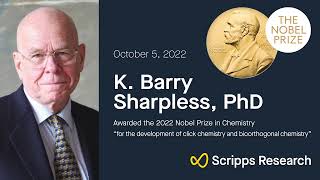
In this Scripps Research interview, Executive Vice President Jamie Williamson introduces Nobel laureate K. Barry Sharpless, the only other scientist besides Frederick Sanger to win two Nobel Prizes in Chemistry. Sharpless recounts waking up to the Nobel announcement, his pragmatic view of prizes as non‑motivators, and his lifelong compulsion toward risky, fast‑acting chemistry. He explains the genesis of click chemistry: a desire for reactions that complete in hours rather than days, the pursuit of “perfect” reactions with no side‑products, and the pivotal copper‑catalyzed azide‑alkyne cycloaddition (CuAAC) discovered through a late‑night experiment by student Luke Green. He describes the reaction’s extraordinary compatibility with biological environments—water, oxygen, cells, blood—enabling diverse applications from drug development to materials science. Sharpless shares anecdotes about collaborators such as Joshua Elkington and highlights the influence of mentors Eugene Van Tamelen and George Bucy, emphasizing their advice to avoid obvious projects and focus on a few high‑quality papers. He discusses his scientific philosophy rooted in “strong inference” and the continual destruction of hypotheses. The conversation also touches on the rarity of dual Nobel laureates, comparing his experience to that of Fred Sanger, and concludes with gratitude toward Scripps and the scientific community.
Chapters
My name is Jamie Williamson. I'm the Executive Vice President here at Scripps Research, and it's, it's a real honor to introduce you to Barry Sharpless, the winner of the 2022 Nobel Prize in Chemistry. What's really remarkable is that Barry is one of only two scientists in history who have won 2 Nobel Prizes. So this is his second. His first Nobel was in 2001 for looking at chiral catalyzed oxidation reactions, and this present Nobel Prize is for developing click chemistry. And I think rather than have me repeat the citation of the Nobel Committee, I think maybe we would give Barry the chance to tell us about his inspiration And we're going to be taking questions from this group, and I would just ask that you type it into the chat or the Q&A, and then I'll lead the discussion with Barry and we can get your questions answered. So Barry, it's been— it must have been a remarkable day so far. How did you hear?
Well, thank you, Jamie. I was, yeah, woken up at 2, about 2:30, I guess. And, and, uh, and, and, uh, Jan had held a computer in front of me with 3 faces on it.
And Jan is your wife? Yes.
Yeah, my wife Jan. And so after that, then, uh, I was lucky I got to go back to sleep for a while, and she just handled things herself. And she— so I was— but anyway, I was amazed that I could sleep some more, but I had I must admit that I've been teased about this for a long time because the click chemistry was popular area, at least as popular as anything I've done. And so I expected something might happen, but I knew that it was, there are a lot of other people that are in line to win Nobel Prizes. So you kind of think, well, don't take it too seriously. Anyway, the reason it may be interesting for people to know is that prizes, I mean, for me, prizes, it's, they kind of, I don't suit them very well 'cause they don't change me at all. And they give me a, they don't help me make more money either, except that I convinced Richard to hire me. I guess that's how I got more money for, out of the prizes. But prizes aren't what I'm doing science for, for better or for worse. So I have to do it. It's kind of a compulsion. It's kind of a risk-taking operation. And I like to find an area where the ideas can be, can lead you into something more dramatic. And well, nothing like Einstein, but Einstein said it well, and that is, if at first an idea, the idea is not absurd, then there's no hope for it. But that wasn't his, he was a nice guy. He didn't say things like that very often, but we understand what he's saying. Where you get E equals MC squared from is not even worth talking about for most of us. But that's kind of, thing that I found, if I quit doing chemistry in an area, which I had done by the long before I started, I started with click chemistry, started long before I got a Nobel Prize and for the other reaction. So I was already working on click chemistry and trying to see where it could go and it didn't. Take long, but I got really lucky. A lot of things happen, but lucky is something which I've been all my life. I, I just don't know. I mean, because I'm not too good at communicating, and, uh, but I get excited and I run into the lab and we have to do it tonight. We have to prove it's wrong tonight. And, uh, that's, that's the kind of things I like to have, something where I can shoot it down. And it's the idea of shooting it down.
Barry, one of your, uh, one of the papers that the Nobel Committee cited was really this— it was almost a position piece saying, I have this idea for click chemistry and this is what it should look like. And then the next year, it was when you had a particular reaction. What was the aha moment?
Well, the aha moment— I guess I've always been impatient. I like to go in the lab, mix up some things that work and I go on from there. If I have to wait a day or two, I just can't. That's not good. So I'm trying to create a chemistry that moves in hours instead of days. And, and, and so the aha moment— yeah, no, you know, I can't quite go that far because, uh, we didn't— yeah, we started— uh, it's gonna be a hard one.
Okay.
Yeah, I'm sorry.
No, that's right. It's good. It's all good. We just want to We just want to hear how you think.
I wish I could tell you that because I get asked that a lot over my life. My friends ask me, and I'm sitting in groups where after a conference and we're taking a recap of the conference, they say, okay, okay, fine, but where do you get more ideas than other people? And that can be interesting. And I say, God Almighty knows. I just know that I get excited when I see something that doesn't fit. Like anomalies, and I collect anomalies my whole life. And I, some of these anomalies point to each other. And when that happens, then you have a way of possibly doing something that can address whether that thing is possible in the real world. And I'm, one of the things that's most dramatic about humans is that we're so impressed by ourselves and we think we have so many things we can do. Well, I mean, it's a miracle we can do anything in the world of biology and, and I mean, In the chemistry world, the molecules that we need to manipulate are the size of a grain of sand. I mean, size a grain of sand. And my hands are the size of a small Earth or small moon. I mean, we're trying to do something that doesn't make any sense. And we know that we can think about it, and we think we can think about it, but honest to God, we always fall or default to drawing things on blackboards This is what we think the molecule is, right? And that's our brain is not gonna worry about it too much. That's the best we can do. Well, I don't think it's the best we can do. I think we have to let the molecules worry for themselves. And we have to, I worry for the molecules so much about every little thing that goes into the reaction. What the molecule's gonna think about that. And that's, I'm smart enough to know you cannot think like a molecule, but I find it very helpful to think of like a molecule. And then I can get through life much easier that way—chemistry synthesis.
So we'd like to hear some of the questions from the attendees, so please type into the chat if you have something particular that you'd like to ask. So Barry, maybe let me ask you what, you know, what kinds of things, you know, you invented these click reactions that could snap molecules together, so what are some of the applications? What have people been using this for? And because it's not enough to just invent an interesting reaction, it has to have an impact on human society. So what are people using the click reaction for?
Well, I think that's a story that has a nice lecture to go with it, but just to say quickly, we hoped for better reactions. There is no such thing as a perfect reaction, and nature doesn't care about perfect reactions. She can fix what doesn't go right. But we can't do a damn thing about something goes wrong. So if we don't have a perfect reaction, what, what is a perfect reaction? That means you put the ingredients together and you correct, collect the product 100% pure from the drain hole of the bathtub. So you poured everything in, stirred a bit, and out comes the pure product. Why don't we have more of those? Well, most everything we do causes side products. Nature makes side products too. You can't have even one side product. No side products, you got a perfect reaction if it's driven. So the copper reaction dropped into our lap, and it came from working with Palmer Taylor and MG on making an in situ click reaction go. That would have really surprised us. But we didn't have the two isomers of the triazole. We only had a way to make a mixture. And one of the students said, well, let's try to find a way to make the pure ones. So Luke Green went in the lab that night and we found, we had found that we needed the other one because the syn, because life makes the syn in our enzyme, didn't make the anti. And Luke did the CuAC reaction and it was over in a minute. He thought it was starting. He analyzed it. Oh, that's the starting material. It was a product. And the QAC reaction cannot be stopped. I mean, it'll go 100% every time. And you can have it urine, you can have it in minestrone soup, you can have it in acid or base. It's, it's just some sort of weird happening, right? I mean, it's an immortal. Yeah.
You know, one of, one of the things that's most remarkable, you know, is that, that this reaction is compatible with biology. It's compatible with cells and water and oxygen. And you can, you have these two groups that you identified and you can put them into cells and then they'll do the reaction, but they're completely tolerated by biology. They don't do anything to cells until you click.
And that's the thing. If I had a graphic I could use here, I would take a picture of the Earth over the Pacific from one of the shuttles that went out. And that would be the metaphor. That we're an ocean planet. It's all blue out there in the Pacific and there's oxygen and water. If you can't be happy with oxygen and water, you shouldn't be playing with humans who think they can control the molecules. Things we do should be happy like us in oxygen and water. That's, it doesn't sound very sensible, but looking, we found another one. And then the fellow in China, my student, uh, Joshua Elkington, who's now a famous professor, he found another one. And you know, once you start looking for perfect reactions, maybe they're not so hard to find. And what is a perfect reaction? Well, it goes 99.9999 plus. And when you start running trouble with a perfect reaction, it loses a few of the nines. But even if you do it 20 times, it's still in the 99 category. Whereas if you have a 99% yield reaction, we love as chemists, 99% already you're down to some ridiculous number by 50 reactions or 10 reactions. You're in deep trouble making high products. So this is another story. It's just that it sounds a little bit arrogant, but I didn't realize how important it was not to make, to have a really great reaction. And we found, so now we're looking for those. Nobody could have guessed they could exist. I didn't think they could exist. But now with QAC, they can, they go in blood, it goes in blood, it goes in, acid, it goes— it's just a weird reaction. CuAc is the copper acetylene azide. It just click and yeah.
Okay, so Barry, we have a question from one of the attendees here, and can you discuss what it means to be one of two people that's gotten two Nobel Prizes?
I didn't know the other gentleman, Sanger, Fred Sanger, I think. Englishman, right?
I think he got it for DNA sequencing and protein sequencing. Yeah.
DNA. Yep. See, that guy wanted to be useful. That's very important. I mean, he got rewarded for being useful too, right? Being useful. Everybody wanted to know what the sequences of our incredible mixed up molecules are. And that was awesome because he was in the right place at the right time. And I really admire— I know those two things, that's enough for another Nobel Prize, right? You do one, you do the other. Next thing you know, you sequence the brain, how it thinks, and then that'll be a good day.
But, you know, your first Nobel Prize was really this holy grail of chemistry, which is, can you make asymmetric molecules at will? And that was a clear— that was a tool that was a very clear goal of chemistry. And so, but this, the second tool that you came up with, it was a bit more whimsical. It was more born out of an idea that, oh, you know, we should be making molecules, you know, like with little magnets and click things together. So it seems to me you've got this really creative spirit that you've harnessed to think about chemistry and come up with two really transforming kinds of reactions that change the world.
Well, thank you, Jamie. I think the most important part of what you're saying is that Well, you know, this thing written in Science by, I forget his name now, Strong Inference. It was written in the 1960s and it came from Chamberlain before that, where the idea of multiple working hypotheses. You know, if you, I mean, Chamberlain and others who wrote about this, they said you ought to be able to destroy one of your hypotheses in the shower once a week or every other day, or, you know, you should constantly be trying to destroy your own working with your, but keeping everybody's multiple working hypotheses up there to the extent they're worth it. And that is so powerful. If you can just say, why am I wanting to do that? See, we love our children and our ideas. And so they become like, our children, and then we can't— you can't kill your children. I mean, you don't know— that makes no sense in any way you think of it. And so we— but we want to do that with our ideas. If you can't do that— and, and it feels like chemistry, there's so many things you can't anticipate. So if you cover a lot of ground, you got a much better chance in a short life to hit some really good ground where things aren't at all the way we were taught, because The, the things we're taught, the limitations that look to appear really going to stop you in so many ways, all the ones that don't fit your idea when you started with this idea that's absurd, by the time you get further in, they all come down in a house of cards. Once the idea switches and you find that you run that, now you run the control experiments and you see why the other things couldn't have worked. It was just our set of, of views on how they're lined up. And yeah, I guess, I don't know.
Yeah, so are they going to have live ceremony in Stockholm?
Hmm, what kind of live you mean?
Yeah, I mean, it's not going to be virtual.
I mean, oh no, yeah, definitely it's gonna— unless something really goes wrong, I guess that right now they're saying it's live.
Good, that's great. I mean, uh, as you— as Many of you know we had a happy occasion a year ago where Ardem Patapoutian won the Nobel Prize, and we had a local ceremony. They were not doing the full King of Sweden treatment. So I think, I hope you get to go to Stockholm. It's going to be, that's always a real, well, you've been.
Ardem is going to be there because he gets the ones that didn't get it. Oh, okay.
They're going to catch up. That's terrific. Well, listen, Barry, I think we're really proud of you. I hope everybody got a sense for, you know, your free-thinking spirit that has enabled you to just be one of the thought leaders of chemistry. We have one other little quick question we can go into. This is a good question. So who helped you on your scientific journey? So, you know, who were your mentors that shaped how you think about chemistry?
That is a good question. Yeah, very good. Yeah, Van Tamelen, Eugene Van Tamelen, he sort of retired a bit early, but he was the most creative chemist of his generation, in my opinion, and he was Very unusual.
He was a Stanford professor.
Yeah, he came from Wisconsin to Stanford. He was just the year I arrived. It was an amazing year. All the— Sterling had gotten money for Stanford. Stanford suddenly just bought everybody they wanted, and everybody came. 3 or 4 chemistry profs were stolen from the Midwest. And so, uh, and, and Van Tamlen, well, he His advice to me right away, to all of us, don't do anything. First rule of good thinking in science is don't do anything you know you can do. Now that goes against what all the guys like me and worried about getting an academic job, getting tenure, we're thinking, what kind of things can we line up that will just seem to have a lot of papers in the first few years? But no, that's not the way it works. In fact, you shouldn't even worry about papers. George Bucy later told me that, He said, Barry, don't worry about papers. Just try to publish a few good ones. Oh, he was my Swiss grandfather. Just try to publish a few good ones. That's a really good one. The chairman, you as the leader of this place, you have to worry about what? Numbers, right? We all have to worry about numbers.
A few good ones is really good if they get you the Nobel Prize.
Yeah, what else? Yeah, like you triggered some other thoughts, but, but, but it was, um, yeah, it— and I just really was lucky to have a photographic memory, uh, and love the periodic table. And actually, I'm really an evolution— I love evolution, and I, I love evolution. I don't actually believe in Darwinian totally. I need the entropy term. I need the dissipated thing. And so I can use— oh, I better not get into this. It might go on. Yeah, yeah.
But okay, yeah, let's, uh, Barry, I think, I think at this point we'll, we'll take a pause and we'll, you know, thanks for, uh, taking the time. I'm sure your— the phone is ringing off the hook. You've got emails, but Thanks for going bing, bing, bing up in my corner. Yeah, we, we're, we're glad we could have this opportunity to have a chat with you. Um, you know, it's, it's great for you. It's great for Scripps. We're thrilled to have you as our colleague. So thank you everybody for, for coming in and, and, uh, sharing a little time with us on this happy day.
Thank you. Bye.
More from Joshua







Scientist Stories: Hans Waterham, The value of phenotypic assays in peroxisomal disorders




Scientist Stories: Joel Zlotogora, Genetic carrier screening programs for reproductive purposes