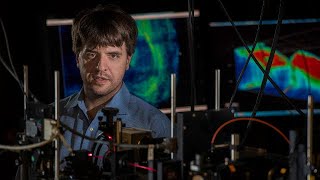
In this interview, neuroscientist Karl Deisseroth reflects on how Erwin Schrödinger’s clear problem‑posing style shaped his scientific thinking, emphasizing the importance of precise questions. He describes his laboratory as a deliberately cross‑disciplinary environment where engineers, biologists, clinicians, and physicists collaborate, with Deisseroth often acting as the translator between fields. Deisseroth outlines his research agenda: understanding how individual brain cells give rise to complex cognition, sensation, and action. To achieve cellular‑level control in the intact brain, his lab developed optogenetics—harnessing a light‑gated ion channel from algae, inserting it into specific neurons, and delivering light via fiber optics to turn cells on or off while observing behavior. He discusses the future impact of optogenetics and related tools over the next decade or two, anticipating deeper insights into brain dynamics, information storage, free‑will questions, and psychiatric/neurological disorders such as anxiety, addiction, and depression. Finally, he underscores the value of gatherings that bring together diverse scientific perspectives, noting that such “dream‑days” spark inspiration, collaboration, and big‑picture thinking.
Chapters
Carl, first, can I ask, has What Is Life or Schrödinger in any way influenced your career as a scientist?
Well, his writing had a certain clarity to it that was influential for me. It's a mark of, I think, physicists particularly, and particularly great physicists, is that they can pose problems very well, very precisely.— and in any realm of life. You know, although I'm not a physicist, I've always been friends with physicists. In college, all my friends were theoretical physicists, and I learned a lot from them, I think, about how to pose problems well. And Schrödinger was very clear in What Is Life? and his other writings. He tackled the complex mysteries of biology in a very clear-headed way, phrasing questions about how is the unitarity of consciousness arising from the plurality of cells, noticing that and framing it as a problem ahead of his time in many ways, and it was very influential.
I never thought about that actually, is that it's the clarity of the problem posed by the physicist that's really beneficial.
Yes.
So speaking of sort of the benefit of having physicists involved in conversations, Are there aspects of your research that involve people from different disciplines coming together to work on the same problem?
My laboratory is— that's absolutely the essence of it, is this cross-discipline interaction. I have— I'm in a bioengineering department. I'm a neuroscientist. I'm not an engineer. But I've learned, just like I've learned a lot from the physicists, I've learned a huge amount from the engineers. And so we have the engineers in my lab side by side with biologists. Side by side with doctors. And it's a wild place. The lab meetings, there's a lot of translating. You have to translate among the different groups, which I think falls on me to do a lot of that. And I learn a lot in the process. But everybody comes out of our lab meetings, everybody feels like their mind has grown an order of magnitude. It's just very uplifting and expanding.
Could you describe the research that you do?
What I do is I study the brain and I'm interested in how the parts of the brain, the cells, give rise to its complexity of function, of sensation and cognition and action. What are the principles that underlie how the cells give rise to the property of the system? And to do that, we've had to build tools to control the individual cells in a specific way, turn them on, turn them off, while keeping everything intact. And in a behaving animal, so we really know what we're doing matters. And also observing the activity of those same cells and then getting very detailed information on those cells in terms of how they're wired up and what proteins they make, what genes they express. So all this while keeping the system intact, because, you know, like many systems, if you disassemble it, you lose the essence.
Is it challenging to take those individual units that you study and then build that back into the really complex model we have for understanding and explaining how the brain works?
Yeah, that's the essence of the challenge, is how do you get this cellular-level resolution in the intact state? And what we do is we've used optical tools quite a bit. We've been able to harness light in many ways to play in information and to read it out. We developed something called optogenetics, which is a way of controlling individual cells, and we do that by taking a gene from algae. They make a little protein that sits in the membrane of their cells that when a photon hits it, it opens a little pore, a little hole in the membrane, and ions rush across it, charged particles, so it creates a little current, electrical current. And the algae does that for its own purposes. It's got to move to find the right light level to survive. But what we did is we took that gene and put it into neurons, and using genetic tricks, you know, we can put it only in one kind of neuron or another kind of neuron or brain cell, and then we can deliver light with fiber optics even deep in the brain, and that's the essence of it. Then we get these little currents that turn the cell on or off, and we can see how the animal remembers, thinks, acts differently.
I mean, you say you developed something called optogenetics. It was massive, and it's had a huge impact on our understanding of the brain. How do you think it will continue to contribute to our understanding over the next 10 or 20 years?
The brain is a mysterious place. I think there are many mysteries. There are some small ones, some big ones, some medium-sized. I think maybe some of the biggest ones will take many decades to resolve. These very deep questions about the true nature of the subjective sense that we have and really addressing head-on and framing well the question of free will.. And so we need Schrödinger back to help us frame these questions even better. But we're doing our best. Along the way, we are discovering the answers to the small and the medium-sized mysteries. And so what I think in the next 10, 20 years, we'll understand the brain more as a complex system. What rules govern the dynamics of it? How does it regulate itself? How do different parts of the brain that represent different viewpoints, as it were. How do they negotiate with each other and come to a unitary, crisp, singular conclusion and action, which you have to do? You know, it's— these are going to be fascinating questions. You know, how is information truly stored in the brain? That's another thing that we're starting to make headway on. And these are the sorts of things that are very much accessible. As a psychiatrist, I think we'll know— we already know for some symptoms, how they can be reflected in altered neural dynamics. Certainly anxiety, drug addiction, social behaviors, many neurological diseases, even depression. We have toeholds on these complex questions now, and I think we'll start to understand these more deeply in the coming decades.
Do you think there's a benefit to days like today where you have people from lots of different scientific disciplines gathering to discuss the same ideas and themes?
Well, one thing, if you collect people who are trying to think as broadly as they can and you put them together, they can definitely stimulate each other further. It can be inspiring. Certainly collaborations and things like that can arise, but I think even more than that, just, you know, it's nice to have a time when we give ourselves license to truly dream. You know, a lot of life we have to solve the day-to-day details, which is fine and that's important, but days when you can think big and you feel good about it, those are special. Thanks.
That's a good place to leave it. Thank you so much for speaking with me.