Scientist Stories: Kole Roybal, Synthetic biology and drug development
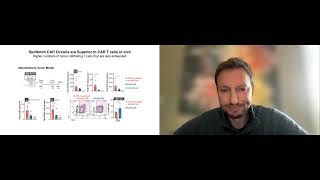
In this talk, Dr. Kole Roybal outlines his laboratory’s synthetic‑biology platform for engineering immune cells to treat solid tumors. He begins by describing the synthetic Notch (synNotch) receptor—a transcriptional‑based, ligand‑induced cleavage system that can be retargeted to any surface antigen. Using synNotch to sense a tumor‑specific antigen (ALPL2) and then locally up‑regulate chimeric antigen receptors (CARs) against secondary antigens (e.g., MCAM, HER2, mesothelin) creates a dual‑antigen circuit that improves tumor specificity, reduces off‑target toxicity, and enables tumor clearance at lower T‑cell doses. Pre‑clinical mouse models of mesothelioma, ovarian cancer, and glioblastoma demonstrate higher tumor‑infiltrating T‑cell numbers, lower exhaustion markers (PD‑1, CD39), and sustained central‑memory phenotypes compared with conventional CAR‑T cells. The second half of the presentation focuses on engineering the receptor itself for clinical translation: systematic truncation of the extracellular domain, identification of compact, high‑expression designs, and a library of transmembrane and juxtamembrane motifs (Notch, calcitonin, alkydine) that confer robust γ‑secretase cleavage. Humanization efforts replace non‑human transcription factors (Gal4) with human or synthetic zinc‑finger domains (e.g., HNF1α) to create fully human SNIPR circuits. Sensitivity assays show the optimized receptors detect as few as ~8,000 ALPL2 molecules per cell, addressing antigen‑loss escape. The talk concludes with a roadmap toward clinical manufacturing, emphasizing size reduction, expression, regulatable activity, and safety through multi‑antigen logic.
Chapters
So the last talk of this morning session is from Cole Roybal. He's an associate professor in the Department of Microbiology and Immunology at UCSF. He received his doctorate in immunology from UT Southwestern and was a Jane Coffinchild Memorial Fund postdoc fellow in Wendell Lim's lab. He's currently a member of the Parker Institute for Cancer Immunotherapy, the Helen Diller Family Comprehensive Cancer Center, and a Chan Zuckerberg Biohub investigator. He is also the deputy director of the UCSF Center for Synthetic Immunology, recently funded by the Cancer Moonshot Initiative, and his work focuses on harnessing the tools of synthetic and chemical biology to enhance the therapeutic potential of engineered immune cells. So take it away, Cole.
Thank you, Stacy. Hopefully everyone can see slides and hear me.
Looks good.
All right. Well, I first wanted to thank the organizers for putting together this great symposium. It's an honor to be part of this institute. I really want to thank Alex for bringing us all together. I feel like UCSF is really on the precipice of being able to take all this exciting early-stage technology and knowledge of the immune system, which UCSF has been great for, for a long time, and take it all the way to developing therapeutics. Today I'll talk about— my lab really focuses on building new technologies to control and enhance immune cell function using synthetic biology. And I'll talk about the various ways in which we are trying to bring that towards the clinic.
So my lab—
this slide really gives an overview of what my lab does. We think about how do we improve cell-based therapies. I'm an immunologist by training, and then synthetic biologist, so we mostly focus on engineering immune cells, but a lot of what we do also applies to other sort of cell-based therapies as well, because we tend to build platform technologies. But in the case of at least immune cells, we're looking at how can we have them traffic into disease sites. For the most part, we work on cancer at this point. How do we sort of tune their activity and get them to better recognize either tissues or disease sites in the body? How do we control their activity once they're in that disease microenvironment or that tissue where there may be damage? And there's different ways of doing this. I'll spend a lot of time talking about how do we tune sort of activity of cells so that they persist and last over time in patients. How do we get them to better recognize tumors and other sorts of disease sites? Because there can be a lot of toxicities. And then how do we use cells essentially as therapeutic delivery agents? So cells may be much better than giving something systemically. Thinking about how do we have cells localized in a titratable way, use various types of biologics at the site of disease. So we think about this as far as, how do we take a cell? How do we build new sorts of receptor systems to allow them to sense their environment or sense active disease in the body? How do we engineer it in that sort of second layer under sort of the sensing, which is the signal transduction layer? And then if we sort of have control over these two layers of activity in cells, we can have control over the therapeutic response. I'll talk about a receptor that we developed a while back called synthetic Notch receptors on the coming slides and all the next generation we've worked on in this category, but this is a transcriptional-based receptor that we can have cells essentially recognize either a tissue or a disease site and then upregulate various therapeutic programs, and we'll talk a lot about that today. So this has been out for a while, but when I was a postdoc in Wendell Lim's lab, we developed this new receptor type. A lot of people know about chimeric antigen receptors, but this is a new receptor type that we can utilize in cell-based therapies, and it's based on the Notch receptor. Notch functions in a very different way. When it binds its ligand delta, it undergoes cleavage and release of a transcription factor. So it's a very direct mechanism to regulate gene transcription in cells, and a lot of people know the Notch receptor from it being studied in developmental processes, but it's used throughout many cellular systems. What we were able to do is really orthogonalize it, meaning that we can retarget these receptors, get rid of the natural ligand binding capability, and have them sense a molecule of interest. It could be a target molecule on a tumor, and then we also change out the transcriptional regulators, so we actually have control over what these receptors see and then what gene program is turned on in the cells. And this is amenable to many different sort of cell types. So this is a platform technology that can be used in immune cells, neurons, stem cells, and this is out in the literature. But the way it works is that we can build a cell to sense some niche in the body or disease site, turn on a gene program, and we can use these not only for therapeutic purposes, as we'll talk about today, but people are using them for reading out sort of cell-cell contacts, let's say with neurons, taking stem cells and inducing differentiation, so you could potentially repair tissue. Wendell at UCSF has done a lot of work on using these receptor systems to build sort of artificial tissue development. And the other thing is we can build sort of logic in the cells, so cells can read out multiple inputs in the body and sort of better control their behavior depending on what sort of cues they see, which is something our natural cells do, and it helps sort increase the safety of our cell-based therapies. So this first part of the talk, I'll sort of quickly go over a story that was published in the last year where we're using these sort of receptors to now build therapeutics for ovarian cancer and mesothelioma, and it's something that's rapidly moving towards the clinic. And this is sort of one of the ways we've utilized these receptors, at least for therapeutic purposes, and that is to build these multi-antigen sensing sort of cells, and this proof of principle work was done about 4 or 5 years ago, but how they work is that we can build in these sort of circuits into T cells where a T cell can recognize a primary antigen, let's say on a tumor designated by this green square here. The synthetic Notch receptor sees this antigen, will activate and then upregulate receptors that can activate the T cells, such as a chimeric antigen receptor, to a secondary antigen. And the idea here is that the cell now can localize to the tumor and then activate locally rather than at these off-target tissues in the body. So what we've done since that early-stage work is spend a lot of time trying to determine what sort of antigen cues we want cells to sense on tumors. So this is work with Ben Lu, where we identified this antigen AOPPL2, which is alkaline phosphatase member. And it turns out that this is a highly specific antigen that is on various solid tumors, including ovarian, in ovarian cancer, as well as mesothelioma at high levels. And that's mostly what I'll talk about today, but it's also on other tumor types as well. And the nice thing about this antigen is it's on the tumor at high levels, but for the most part, it's only seen on placental trophoblast, so it's highly specific. But another aspect of these highly specific tumor antigens is they're often somewhat heterogeneously expressed on the tumor. And that's somewhat true for AOPPL2. However, there's various other antigens such as— and this is a list here— MCAM, mesothelin, HER2, which are actually, for the most part, homogeneously expressed on some of these tumors, but they also tend to be on other off-target tissue. So what we've decided to do is build these cells with a circuit where they have a synthetic Notch receptor that can sense AOPPL2, which is highly specific, and then they upregulate these chimeric antigen receptors, which can activate the T cell locally within the tumor to these more tumor-associated antigens. Antigens, which if you treated patients with these CAR T cells, there's more chance for toxicity. So we built these circuits into T cells, and what I'm showing here is that we do, like we did in the proof of principle work, actually, we can get very highly specific sort of dual antigen recognition. This is a mouse that has a mesothelioma tumor with a dual antigen signature, a single antigen signature. What we're looking at is that when we infuse our cells with our circuit that I showed you on the previous slide, we actually get clearance of the dual antigen tumor, and the single antigen tumor grows out naturally. So we get the specificity, but what we've been excited about over the last couple of years is that we treat mice with these various solid tumors, and this turns out to be true for mesothelioma tumor models, glioblastoma, which we published recently, as well as work in ovarian cancer, which I'll show you, what we see is is that if you treat mice with these tumors with either CAR T cells to mCAM or ALPL2, you get a lot of tumor relapse when you treat them with lower levels of the T cells. However, you treat these mice with our cells with the synNotch circuit, we get full clearance of these tumors, and this is actually a very robust finding that these cells are more functional at lower T cell doses. So what's happening here? If we start to now look at these cells, so either the CAR T cells or the cells with our regulated CAR circuits, our SynNotch CAR circuits, at later stages within the tumor, so this is infusing T cells and looking at about day 33 within the tumor, what we have seen is that there are higher numbers of the cells with our SynNotch mChEM CAR circuits, in this case for mesothelioma, within the tumor, so the tumor-infiltrating T cells, And then if we also look at peripheral sites, the peripheral blood as well as spleen, we also see this as well. And then not only that, if we start to look at— and this is true for both CD4 and CD8 tumor-infiltrating lymphocytes— if we look at various markers of exhaustion like PD-1 and CD39, cells within the tumor that have our circuit topology actually have lower exhaustion markers. And this is sort of a rudimentary analysis, but we've done much more analysis to show that these cells are more functional. Functional within the tumor. So not only are we getting better specificity, but we're getting longer-lived cells in vivo, and they're persisting over time. And I'll show you this in ovarian cancer model as well. And as I said earlier, it's also true in glioblastoma. So this is a SCOV3 tumor model for ovarian cancer, and these are circuits in which we're sensing ALPL2 and HER2, which is found in ovarian cancer. And what I'm showing you here is a primary tumor. In which we treat with either HER2 CAR T cells or cells with our ALPP2 synNotch to HER2 CAR circuit. And what you see is that with this primary tumor, for the most part, both of these sort of cell products can clear these tumors. But you do see some relapse happening in the HER2 CAR setting. However, if we provide a secondary tumor, what we call a rechallenge, at a later stage, and this is a very fast-growing tumor, and it's hard to clear by these cells, What we see is that our cells that have— or mice that were treated with our SynNotch CAR circuit cells can keep that tumor at bay, whereas the HER2 CAR T cell-treated mice, you can see that this grows out. And it's pretty clear at these later stages in vivo that the HER2 CAR T cells, or the CAR T cells, are for the most part gone from these animals if you look at the peripheral blood, whereas our cells that have our regulated CAR circuit are persisting. What's happening here? What we've known in the CAR T-cell field for a while is that these chimeric antigen receptors, when they're overexpressed at least in T cells, have some degree of what we call tonic signaling. They have low-level signaling that what it can do is drive what we call exhaustion of the T cells. The activity of the receptor just being expressed in these cells can cause allows the T cells to differentiate to these terminal effector cells, and these are not as long-lived in patients and then also in these preclinical models. But what's happening with our regulated circuits is that the cells actually don't express these CARs. They only express them once they enter the tumor. So what we're finding, we think, is that we're getting enhanced specificity. We're increasing sort of the stimness and quality of these cells, as I'll show you, and reducing exhaustion. So this is some of the data that substantiates this idea. So these are various T cell reporter lines where we can read out whether those cells have activated these different transcriptional pathways, which are important for T cell activation. If you simply express a CAR in these various cell lines, what you see is that with this CAR, which has a 4-1BB cosimulatory domain, that you see activity through the NF-kappaB pathway even prior to these cells being activated. And it turns It turns out if we put a circuit into these cells, we completely abrogate this sort of tonic signaling. And then on top of that is, after we engineer these cells with either our circuit or a CAR in this case, we can also see that we maintain this stem cell-like memory T-cell population, which has been correlated with better efficacy of these T-cell therapies in patients. So we're keeping these cells from differentiating along this path towards exhaustion, as well as terminal effector states, which can be problematic and lead to short-lived products in patients. And then finally, this is essentially the same cells where we're looking at exhaustion markers. So these are the cells that we would be infusing into a preclinical mouse model or into a patient. And what we see is that with CAR expression, you get a lot higher levels of the exhaustion marker, whereas when you're regulating CAR expression, they have lower levels of exhaustion before treatment of the mice. And this is to show you that if we now sort of think about cells that are going into solid tumors that are getting chronically stimulated by these antigens, and we're asking the question, well, how does the T cell population evolve over time as they get chronically stimulated? How does the CAR T cell perform? And how do our cells with the regulated CAR circuits perform? What we're looking at here is over a 2-week period of stimulus. And what I want you to focus on is the central memory T cells as well as these effector memory T cells. What you can see is that during this culture where they're being stimulated, if the cells have the circuit, you get a higher level, you maintain these central memory T cells compared to CAR-Ts, and you sort of reduce sort of this transition to these effector memory and more terminal effector sort of T cells. So we think by regulating dynamically CAR expression over time and essentially the activity of the T cells, that we're controlling how those cells evolve in the preclinical models and theoretically in patients. So just to wrap up this part of the talk, what I want to show you is that what we see is that the CAR T cells are more exhausted and have toxicity potential because you're going after single antigens. And this is especially true for certain targets like MCAM or potentially HER2. ALPBL2 CAR T cells may more specific, but they tend to get exhausted more easily. So now with our circuit topologies, what we're seeing is that we can get better specificity and then also reduce exhaustion over time. So we are actively sort of pursuing this in various settings— ovarian cancer, mesothelioma, prostate cancer, renal cancer at this point— and it's exciting to see sort of the pipeline we're trying to develop at UCSF to really bring these things forward. In the second part of the talk, I want to go over how we're sort of bringing these synthetic Notch receptors towards the clinic by really trying to understand how to build these specifically for clinical applications, and this is sort of a tour de force work by postdoc as well as MSTP student listed here. So, as I said, the Notch receptor sort of— it works by binding its ligand in a cell-cell interaction, and the unactivated Notch receptor here, the way it works is that you have this region of the Notch receptor that includes a proteolytic cleavage site. In this case, we're modeling antibody-based sort of ligand binding domain, and then what happens upon ligand binding on, let's say, the target cell, is that you open up this receptor, and then you allow for proteolytic cleavage of the receptor in two places, in the extracellular domain and intracellular domain. So we want to understand a lot about how do you build a receptor that functions like this, that undergoes this sort of induced cleavage upon ligand binding. And we've made a lot of headway here, and we think it helps to move these receptors forward in the clinic. So we've had a few goals. We wanted to build receptors that are highly expressed in T cells, so we can easily manufacture cells, a very compact receptor design, something that's regulatable, and then also humanized, We have broken down these receptors into the various pieces. We have extracellular domain that is involved in the regulated cleavage, the transmembrane domain that is cleaved by this enzyme called gamma secretase, and then various portions of the intracellular domain that we are finding to be especially important for the activity of these receptors. And we built sort of large numbers in which we sort of learned the rules of how do you build these so we can sort of make good on these designs. Sort of goals that I've listed here. So, if we look at the original receptors that I built years ago when I was in Wendell's lab, these are quite large, almost 2.45 kb in size. You have this bulky extracellular domain that I just talked about, and what we've asked is, can we sort of break it down and ask what are the— what's required on the extracellular domain to get this regulated cleavage? So, we've changed out these domains to use other force-sensitive domains. We've done deletion analysis, analysis to see a minimal domain that can be utilized to activate the receptors. And what we found is that we— the landscape of receptors that can function like this is much larger. So, we can use a lot of different sort of features on the extracellular domain. We can, in fact, utilize different force-sensitive domains and get activity of these receptors in response to ligand in this case, so we get strong transcriptional activity of this reporter, and then what we found surprisingly is that we can delete pretty much all of the extracellular domain and still get ligand-induced activity. And what we decided to do once we knew this piece of information is to utilize other sorts of extracellular domains, sort of find the rules and sort of minimal features that we need, and it turns out that we can use sequences that are utilized in clinical-grade chimeric antigen receptors, like these hinge domains, and we can even use sort of synthetic linkers out here. But one thing we found over time is that we can delete all these regulatory sequences on the outside, but it turns out, at least in the case of T cells, that if you activate the T cell through the T cell receptor, you get activity of the receptors without ligand. So we found that we do need extracellular domain to get regulated activity. In this case, we're showing strong activity of these hinge domain receptors, and then when you have TCR stimulation, you do not get activity, and you get robust activity here. So what we found is now we can build receptors that are almost a KB smaller in size, and then on top of that, they're much more highly expressed in human T cells. So this is a large receptor, and we haven't gotten very good expression. However, these new receptor designs, we get very strong expression of these receptors in T cells, which makes for easier cell manufacturing. If we look at the transmembrane domain of these receptors, what we've done is now take a library of different transmembrane domains that are derived from receptors in the genome that undergo cleavage by gamma secretase, and what we've done is build about 100-some-odd receptors with the different transmembrane domains and ask, what are the features of these transmembrane domains that are required for proteolytic cleavage of these receptors. And what we found through these transmembrane domain alignments is that the ones that are highly functional tend to be in the Notch family, and then this other family of receptors called the calcitonins, as well as the alkydines, and all of them tend to have this glycine-valine sequence here that's very close to the transition from the transmembrane domain into the cytoplasm, and that's required for very robust cleavage. So now we can even build synthetic transmembrane domains that have these features and build a regulated receptor. So, we've understood the sort of features of the transmembrane domain, and then surprisingly what we found is that this sequence that is at the transition from the transmembrane domain to the cytoplasm, called the juxtamembrane domain, which is, is highly enriched for basic-rich amino acids, is also quite important for the activation. So, we built a series of receptors that have different juxtamembrane domain features, and these are all derived from these receptors that undergo this cleavage in the genome— that exist in our genome. What we found is that Notch is actually middle of the road here. We are able to now build receptors with different juxtamembrane domains from other receptors that are much stronger in their activation features. So now what we've done is take this knowledge, where we now understand what a transmembrane domain, extracellular domain, as well as juxtamembrane domain needs to look like to get strong activity of these receptors, and now what we can do is build these receptors from the ground up. We understand that the features of extracellular domain that are needed to get regulated cleavage, with ligand binding. We have a list of transmembrane domains that are functional within the receptors that we can choose from, as well as juxtamembrane domains as well. So, now from a synthetic biology perspective, we can build these receptors from the ground up. So, if we, if we look at the, some data here to show that we really understand how these receptors function, This is an example of a receptor based on Notch, in which we use the hinge domain, and the transmembrane domain, and juxtamembrane domain from Notch, and we get strong activation of these receptors. However, now we can build complete sets of receptors without using Notch sequence. So, this is using this calcitinin transmembrane domain, as well as various juxtamembrane domains, that we know are functional within this receptor. And what I'm showing you now is that we have novel receptor formats we call synthetic receptors that undergo inner membrane proteolysis, or SNIPRs, that have titratable activity, so different levels of transcriptional activity depending on how we build the receptor. And, and because we have this sort of knowledge, I want to show you, um, essentially what we can use them for. Now that we can control the activity of these receptors based on how we design them, we can now control, let's say, the production of a biologic. So this is cells that have these receptors regulating production of a cytokine like IL-2, and what we see here is that depending on how we define design the receptor, we can get different levels of IL-2 production here. And then what this says is now we can control T cell biology with these various receptor designs such that the cell will produce different levels of IL-2, and in this case, we can drive different levels of proliferation. And this is shown with this dye that dilutes out in the cells as they proliferate. Rate. So what I'm showing you is that now with our synthetic biology approaches, we don't have a one-size-fits-all receptor. We can change the receptor design to now have dose control over these cell-based therapies. Now, these new receptors that we've developed, we've also compared their ability to sense antigens like ALPL2. So a lot of people have asked, well, how sensitive are these receptors to low levels of antigen? Because that can be very important for these cell-based therapies, because a lot of tumors will downregulate antigen. And what we found is that our new designs for these optimized receptors we called SNIPRs show very sensitive activity in response to ligand. So in this case, we built cell— target cells that will express different levels of ALPL2, on their surface depending on how much of a drug we titrate in. We can see that our new receptor designs are very sensitive to even low levels of ALPL2, about 8,000 molecules per cell. Now, the last piece of this that I want to talk about is how our new receptor design, because they are so sensitive, we're now being able to move on to utilizing other sorts of transcription factors. What I hope to show you is that the original synNotch receptors, because of their sensitivity characteristics, it was somewhat difficult to utilize other transcription factors beyond things like Gal4 and other transcription factors that are very potent in their activity. And these can be very problematic to utilize in humans because they're derived from non-human sequences. So these are transcription factors from yeast, So now I want to show you how we can now build in human transcription factors into these receptors, or even synthetic zinc finger transcription factors as well, which can be utilized for other purposes. So this is an example of building a new sniper receptor in which we utilize the human transcription factor DNA binding domain called HNF1-alpha, which is utilized in hepatocytes. So this is a a transcription factor that is not utilized in T cells. So we built these receptors with this human transcription factor, we put them in the T cells, and we can read out the ability of these receptors to activate in response to ligand. So they react robustly, and then in the case of if you put this transcription factor either on the original synNotch receptors or humanized synNotch receptors, they actually don't function. So all this sort of synthetic biology, as well as engineering that we've done, has allowed for us to utilize this type of transcription factor when it hasn't been possible in the past. So this is to show you that we now can build these sort of circuits that are fully humanized into human T cells. This is a circuit that recognizes CD19 and BCMA, that it's on B cells. Malignancies, and what you can see here is that we get dual antigen sort of recognition. So this is a model in which we have the dual antigen tumor on one flank and a single antigen tumor, and what you can see is that these new humanized sort of circuits can deplete a dual antigen tumor very robustly, and it works just as well as sort of these previous versions of the receptor that use non-human components.
Components.
Now, recently, we've worked with Alex Morrison, and I think this shows the excite— or sort of the potential of this approach for moving forward therapeutically. And that is because we built very compact receptor designs now, we can put these entire multigene circuits into the genome at the TCR locus non-virally. So now we can express our sniper receptors and our integrated CAR circuit in the cell without utilizing lentivirus, which is the traditional way in which these cell therapies are being built. So we, when we use this nonviral process, we can get really robust expression of the SNIPR. So this is after we've done the nonviral approach with Alex, we get SNIPRs expressed in the T cells, and this is the expression off of TRAC. So this is single integration of our circuit circuits, and then we can start to monitor the activity of these dual antigen sensing circuits and testing them in vitro, and we'll be soon moving these into in vivo settings as well. But what I'm showing you here is that we get really robust induction of these circuits that are inserted at the TRAC locus in response to CD19, and then in the case of the dual antigen signature cells, we get robust robust activity of those T cells and then robust killing of those targets. And you can see that it's really high fidelity because we get no killing when it comes to either of the single antigen expressing target cells here. So now we have circuits that are very clinically relevant and very amenable to manufacturing without utilizing viruses. So what I've hopefully showed you in the second part of the talk is that we've been to fully humanize these receptors. We can get high expression in the relevant cell types. They're highly sensitive to antigen. We can tune them based on how we build the receptors and the different pieces of the receptors that we engineer in, and then they're very compact in size, so now we can use other approaches to insert them into the genome besides using lentivirus. So with that, I just want to thank everyone for attending, as well as the postdoc Axel Whitston, who did all the work in the sort of first part of the talk, and then Ray Lu in Iowa, who did all the work to build these next-gen receptors that are likely going into people within the next year and a half or so. So thank you, and I'll take any questions.
More from Joshua







Scientist Stories: Hans Waterham, The value of phenotypic assays in peroxisomal disorders




Scientist Stories: Joel Zlotogora, Genetic carrier screening programs for reproductive purposes