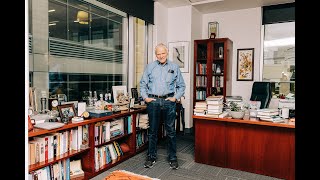
In this interview, Dr. Leroy Hood reflects on how Erwin Schrödinger’s book What Is Life? inspired his appreciation for clear scientific communication, though it did not directly shape his research trajectory. He emphasizes that scientists have a duty to return knowledge to society, highlighting the Institute for Systems Biology’s extensive K‑12 outreach: four modules on systems biology using Halo bacteria have reached 2.4 million students across all 50 U.S. states and over 100 countries. Building on that success, Hood is developing new modules to teach the principles of P4 medicine—predictive, preventive, personalized, and participatory—and scientific wellness to students, adults, and health professionals worldwide. He explains systems biology through a Rube‑Goldberg analogy, describing it as a holistic, cross‑disciplinary effort to map components, connections, dynamics, and functions of complex biological systems, with the goal of perturbing them back to health. Hood provides concrete examples of interdisciplinary collaboration: (1) assembling a team of a computer scientist, engineer, chemist, and molecular biologist to pioneer four‑color automated DNA sequencing; (2) creating a multimodal Alzheimer’s program that integrates lifestyle, nutrition, exercise, sleep, imaging, and blood‑based biomarkers, achieving an 85 % reversal rate in an observational trial of 200 participants; and (3) applying a similar systems approach to Lyme disease, yielding rapid progress within a year. Throughout, he stresses that effective communication, shared language, and collaborative fun are essential to solving complex biomedical challenges.
Chapters
Lee, first of all, could I ask you, has Schrödinger or What Is Life influenced your work in any way?
I would say reading the book was an enormously pleasurable experience. He's really an excellent writer. I can't say it's really influenced my career except to inspire me as to what a truly superb scientist is. Namely someone that is articulate, forward-thinking, clear writing, and has the ability to communicate to the general audience the most sophisticated of ideas. And it sounds like he was a superb lecturer. And in that sense, I think he has been an inspiration.
Do you think that communication process is really important for scientists, whether it's with each other or with members of the public? Is that something that's important to you?
It's really important to me because My argument has always been society pays for us scientists to have really a good time, and it's our obligation to bring back to society that which we learn and to bring to society understanding of that which we're doing. And the institute I started in the year 2000, the Institute of Systems Biology, has had always as a major effort K-12 science education. And to give you an example of the things we pioneered, we put together 4 modules on what systems biology is around a simple microorganism, Halo bacteria. They've gone out to high school students in all 50 states. They've been used in more than 100 countries now. 2.4 million students have seen systems biology through those modules. So what I'm doing now is setting up again a series of 4 modules about what this medicine that's predictive, preventive, personalized, and participatory is all about. And we hope to hone them on students, but then to optimize them to bring to adults and to healthcare professions just what P4 medicine is, what scientific wellness is, and the revolution that's coming. Because a key part of the new medicine is the individual patients are going to participate in the decision-making process about their own health.
And so you must be able to communicate with them effectively if they're to do that.
It's essential. And, and so what we want to do is train in high school students who will go on to college and other professions understanding what the new medicine can do for them. And demanding and expecting that it will be capable of doing so.
Where do you hope that that will go?
I hope it'll go all the way across the world, just like we did with systems biology.
Well, that was my next question. So systems biology is obviously an exciting and a really dynamic area. It's a field, it's a field that's changing lots of other fields around it. When you're talking to those young people, how do you explain what it is?
The simplest analogy is, think about a Rube Goldberg device where he used 14 connected little complicated pieces to cool his tea. And if you took a systems approach to understanding that, one, you'd define all the components, two, you'd establish how they're connected, three, you'd establish how they move dynamically to cool the soup, and finally, you'd come to understand how the components led to the specific function. And that's exactly what we do with systems biology. We take a holistic global view of whatever it is, Alzheimer's, and we ask, what are the components? What are the systems? What are the networks? We try to understand their dynamics, how they're interrelated to one another, and ultimately you want to be able to perturb those systems to move them back into a normal fashion for a given afflicted individual. So I think systems biology is a global, holistic, cross-disciplinary, integrative approach to understanding the knowledge of life.
And obviously the field in itself does this, but in your work where you bring clinicians and you bring, you know, people from lots of different scientific disciplines together, what happens when they're in the same room having a conversation?
Well, I'll give you two examples. When I worked for about 3 years on automating DNA sequencing, totally unsuccessfully, and in thinking about it, I realized that I hadn't put together the skills and expertise we needed. Within a few months of putting together a computer scientist, an engineer, a chemist, and myself, a molecular biologist, we'd figured out the basics of the four-color automation of DNA sequencing. It was bringing all these people with different points of view together, thinking intensely about it. We solved it. It took another 3 years to formally provide a demonstration that it would work, but it was that integration of expertise that made a difference. More recently, we're very interested in Alzheimer's, and what's striking about Alzheimer's is In the last 12 years, there have been 400 clinical trials, zero have worked. So all of pharma and many academics really have this utterly mistaken idea Alzheimer's can be cured with one drug. And in fact, Alzheimer's is a disease where you have to deal with lifestyle, you have to deal with nutrition, you have to deal with exercise, sleep, you have to deal with some drugs probably, but you, you have to integrate together this multimodal approach toward Alzheimer's and refine it to a place where you can convince patients to practice it. And that required bringing together clinicians, bringing together people with expertise in brain imaging, bringing together people that were experts in the biochemistry of blood analytes, of exercise, of sleep, of And putting all of those people together, I think we've come up with a very powerful unified approach that in its first observational trials took 200 people and 85% of them were switched over to normal within a year to a year and a half. So bringing together people that have all of these diverse views of complicated problems is not only essential, it's enormously fun. It's fun. You learn to communicate in one another's languages. You learn to work together effectively as a team, and you solve really hard problems.
That must be a really rewarding process to bring all of those people together and help them collaborate on those ideas.
It's really exciting. We recently did the same thing with Lyme disease, and in a year, we've had just spectacular progress in doing that. You know, the systems approach is really required for most complex biological phenomena. And the sooner we get to it, the sooner we're gonna have solutions for some of these challenging problems.
Well, I think that's a lovely place to leave it. Thanks so much.