Scientist Stories: Lingyin Li, Chemical Biology of Innate Immune Checkpoints
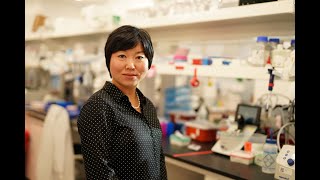
In this seminar, Lingyan (Lingyin) Li recounts how her personal experience with breast cancer shaped a chemistry‑first investigation into innate immune sensing of tumors. She explains that cancer cells export the second messenger cyclic GMP‑AMP (cGAMP), which activates the STING pathway in host cells to trigger interferon production and attract cytotoxic immune cells. The extracellular enzyme ENPP1 (ecto‑NPP1) degrades cGAMP, blunting this immune activation. Using activity‑guided purification, mass‑spectrometry, flow cytometry, and mouse models, Li’s lab demonstrated that ionizing radiation induces extracellular cGAMP, that ENPP1 expression correlates with poorer survival and higher metastasis in breast cancer patients, and that ENPP1 is expressed not only by tumor cells but also by stromal and immune cells, influencing macrophage polarization, dendritic cell presence, and T‑cell exhaustion. Genetic knock‑in of enzymatically active ENPP1 promotes lung metastasis, while ENPP1 loss or selective inhibition restores STING signaling, reduces metastasis, and improves immune infiltration. The talk highlights the development of ENPP1 inhibitors and a cGAMP‑specific neutralizing antibody, both moving toward clinical trials, and underscores the need for agents that selectively block cGAMP hydrolysis without affecting ATP hydrolysis to avoid side effects such as joint calcification.
Chapters
I'm Paul Michel. I'm an Institute Scholar here at Seraphim Chem-H and a colleague of our next speaker, Ling-Yin Lee. A personal story, when I first came to Stanford 2 years ago, I was talking to our beloved and sadly departed colleague, Chris Walsh, and he said to me, you need to meet Ling-Yin Lee. What she's doing is really important, And Chris was right. I think we're going to hear something really, really interesting. By way of background, Lingyan did her PhD at University of Wisconsin, where she really began to work on chemical biology. And then she went to Harvard Medical School, Tim Mitchison's lab, really at the interface of chemistry and biology. And I think that served her very well, because her work right now is shedding new light, actually, on the immune system, really taking a chemistry-first approach. We're learning something quite fundamental, actually, from Lingyan's work that really promises to transform, I think, our understanding of some of the processes of evading the innate immune system that goes on in cancer and how to circumvent this. She's won a number of awards already early on in her career, including a Talented Twenty from Chemical and Engineering News, an NIH New Innovator Award, and the Eli Lilly Award in Biological Chemistry. Pleasure to introduce our next speaker, Lingyan Li.
Thank you, Paul, for bringing us back to the Chris Walsh era, and without him I wouldn't have been here, and it was his vision and Chaden's vision that I was hired. I remember when I was hired, my postdoc advisor Tim Mitchison was He was so proud and surprised, he said, kudos to CAMH, a person named Lin Yin Li is getting a job. So it's a curse to be a chemist because we can work on any biological problems. So for me, I didn't have a set vision when I started at my postdoctoral position. I wanted to study the brain, I wanted to know how learning occurs and how neurons fire, and I was interested in neurotransmitters, thinking a chemist could do something about neurotransmitters. And then I was diagnosed with breast cancer myself when I just turned 30, so that sharply focused my own research and now my lab's research. So if you find my focus incredibly narrow, I'm sorry. So I'll just say that this was 12 years ago now. And as you know, breast cancer patients, what you get is debulking, okay? So surgery. For anyone, right, who is experiencing this, I would recommend surgery, no doubt. It's not medicine, right? And then after that is whether it's cytotoxic drugs or targeted therapy, debulking is definitely the number one. I'm not going to say let's try immunotherapy. But after you've tried all that and you still wanna do better, That's when we wanna try immunotherapy because immunotherapy holds the hope to clear the very last cell, just like how we clear viruses. So of course I asked my oncologist, my doctor, whether I could benefit from the drugs that just came on the market at that time, Keytruda as well as Yervoy, and she said, no, they don't work in our breast oncology ward and we don't know why. So now, of course, it's known knowledge that, common knowledge, that most solid tumors, breast cancer, pancreatic cancer, glioblastoma, prostate cancer, they simply don't have these green-blue cells infiltrated, so you can unleash their power all you want with Keytruda, they're not going to work. So then our question, was how do you infiltrate these killer cells? So the understanding is that cancer cells are fundamentally different. So how can we just let them attract these blue-green cells? Is there an innate immune signal, which is the most upstream of immune detection of any abnormality? So long story short, this is not our research at all. This is the collective effort of the whole field of cancer biology, immunology, biochemistry. We now know that a cancer cell is fundamentally different in that they cannot keep their double-stranded DNA in the right place. And the mechanism is very long and including chromosomal instability or the mechanism that is elucidated by our own Paul Michel and Howard Chan that acts chromosomal replication of oncogenes. So when double-stranded DNA is detected in the saddle cell, it is then turned into a second messenger called cyclic GMP-AMP simply by cyclizing ATP and GDP. And cGMP then binds and activates a protein called STING, which stands for Stimulator of Interferon Genes. Which by its name activates interferon production, which is a very potent attractant by itself to the brain blue cells. Okay, so when cGMP was discovered at that time, 12 years ago now, immediately people think, you know, let's use cGMP to activate human immunity against the cancer. But there's a problem because cGMP is a second messenger and all second messengers are degraded very quickly. So I purified, doing what chemists know how to do, using activity-guided purification, purified its dominant hydrolase, and turns out to be a known protein called ENPP1, and E stands for extra, ecto, or extracellular. So that created a problem because cGMP is intracellular and its dominant hydrolase shouldn't be extracellular. So an easy explanation is I was wrong. That's very possible. Alternatively, it is because cGMP is exported out. Because I was thinking about neurotransmitters, so it was not difficult for me to hypothesize that cGMP is pumped out by cancer cells. And Stanford Chem-H is one of the very few places that gave me opportunity to test this hypothesis. And Jackie Carrozza, our first-year CBI student who was sent to me by Chen Kosla saying, you got to give this young professor a try. So she used a mass spec to definitively show that cancer cells indeed pump out cGMP. They not only always make cGMP, they then pump it out at a rate that every 2 days they clear all the cGMP they make. And great, so cGMP is detected. So what? We're showing that— sorry for summarizing her work in just one little figure here. She showed that ionizing radiation, which can reliably cure a substantial amount of tumor-bearing mice, is doing so by generating extracellular cGMP, because when you remove the extracellular cGMP, which jumps from the blue line to the red line, then all the curative effect we can observe in mice disappears. So this tells us that now perhaps ionizing radiation can be combined with immunotherapy because it is activating cGMP production. Activating the downstream STAT interferon production. So now if natural cGMP pumped out by cancer cells is already detected, is sufficient to be detected by the host, which host cells? Again, using a chemistry approach, we simply ask, we know the host cells when they're detecting cGMP, it has to phosphorylate its STAT, has to phosphorylate its downstream. Transcription factor and interferon, then if we remove cGMP, which cells no longer do so? This is one example of a cell type, which is the M1 macrophage. You can see when you remove cGMP, in the red dots, you see a decreased Sting phosphorylation, decreased phospho-IRF3, decreased interferon production. So with this type of chemical approach coupled by just flow cytometry, we were able to find out these are the direct responsive cells to extracellular cGMP, macrophages, tumor vasculature, T cells. And then if you do a time course in a few days, they then infiltrate the blue-green cells I was showing in the very first slide and activate them. Overall, cGMP, produced by ionizing radiation is able to give you that immunologically hot tumor that should respond to the current immunotherapy. So this is great. Then why doesn't ionizing radiation work in people just as well as it does in mice? It occasionally does have curative effect, and when it happens, it's called Oposcopo effect, named after Dr. Oposcopo. But it's so rare. So maybe I'll skip this. The reason is because that 50% of tumors overexpress EMPP1. And the more metastatic they are, the higher EMPP1 they would express. So now EMPP1 is perhaps the reason some cold tumors are cold. Here are some human data, not our data, publicly publicly available, whether you can mine it on Biomatic, you can mine it in TCGA, you can see that patients, this is breast cancer patients, patients with high ENPP1 expression live on average 5 years shorter. Their disease-free survival is much shorter. And what that means for breast cancer patients when they have primary surgery, that means metastasis. So then we looked at EMPP1's role in metastasis. And you can see that these are the breast cancer staging. In stage 4, EMPP1 level is the highest. So this is human data. It's difficult to do experiments in humans. Can we do it in mice and mirror the results, the phenomenon we're observing in people? And the answer is yes. So, Sonam in the lab, she overexpressed either live ENPP1 or enzymatically dead ENPP1 in the blue curve. And you can see that primary tumor growth, there is a little bit of difference. It's not earth-shattering. What is earth-shattering is metastasis. Only breast cancer cells overexpressing enzymatically live ENPP1 metastasize into the lung. Which is a common place for mouse models at least for breast cancer metastasis. So then this is when you're at an institute where just being a chemist and just being a cell biologist, just being a immunologist is not going to move the needle for human health. You actually need to now do single-cell seq. So we performed single-cell seq analysis of the primary tumors as well as the metastasis to see what is the cellular or signaling explanation of this metastasis promoted by live EMPP1 expression. So I don't mean that you should look at the dots, But here, just to summarize, that tumors expressing live EMPP1 primary tumor-wise as well as metastasis have less T cells infiltrated, have less B cells infiltrated, and have less T cell activation marker. So that just bulk cell count. And then if you look at what signaling they're doing, you can see that when the tumor is overexpressing EMPP1, that's wild type, that's the pink bars you're looking at, violin plot you're looking at here. They overexpress arginine 1, for example, and arginine, arginase, arginase 1. Arginase chews up arginine and arginine is important for T cell metabolism and killing. So this is how they dampen T cell function. EMPP1 wild-type expressing breast tumors also have less dendritic cells and less antigen presentation. And as a result, they have less T cell activation shown in the first two T cell activation markers and have more T cell exhaustion shown in the next two T cell exhaustion markers. That seems to be in line with their ability to degrade cGMP and therefore dampening interferon. So this, so far we're focusing on cancer in NPP1. In our single-cell analysis data, we also noticed that not just cancer cells express NPP1. The stromal cells and infiltrating immune cells also overexpress, also expressing GBE1 and in an inducible fashion. So for example, fibroblasts, which is known to perform a wound healing kind of role for cancer and promote tumor growth, has a lot of EMPP1, as well as macrophages. And we noticed a stepwise increase of EMPP1 in macrophages from the most immunostimulating M1 macrophage to the most immunosuppressive M2 macrophage. You see their EMPP1 increase and their interferon signaling decrease in the same way. So that seems to tell us that they are directly internalizing cGAMP, and how much EMPP1 they have is their gatekeeper of how much cGMP they internalize and how much STAT interferon they turn on. So this is exciting to us because that seems our original hypothesis that host cells, immune cells take up cGMP seems to be shown here. How does this happen in all the host cells? So remember, this is single-cell data. So we could look at every single cell and look at their EMPP1 expression level and then look at how much interferon they make. And you can see that this is when EMPP1 is highly expressed in a cell, their interferon-stimulated gene IFITMs are the lowest expressed gene. So this seems to be— is exciting to us for every single cell, how much EMPP1 of CQ1 they have dictates how much cGMP and how much STING they activate. So I'll just say that the slide I skipped over was a part list over the years that my lab put together, is, for example, all the transporters of cGMP. And every single one of them was painstakingly tested, and of course, using chemistry and biochemistry tools. I have to skip that. But then now with this single-cell data set, we can look at each transporter and can look at their roles. And everything seems to be checking out. So it was quite an emotional day for me to see our transporters being mapped onto the recipient cell types. But this tells us that the host ENPP1 plays just as a big a role as tumor ENPP1. EMPP1 themselves. So then it's true. If you now count EMPP1 in the cancer, the tumors, primary tumors decrease a little bit. Now count out in the host, decrease a little bit. Now count in both, tumor is the smallest, but still not earth-shattering. What is earth-shattering to me is metastasis. What you're seeing here is at the end of the experiment, we take out the lungs. And then we would kill all the normal cells. The cancer cells are drug resistant, as always. So what you are seeing here is drug resistant cancer cells. When you inject wild type cancers in wild type animals, but if you now count EMPP1 in the mice, you see less lung metastasis. You now count EMPP1 in cancers, you see less metastasis. You knockout in both, you do not see metastasis. So now this is great, right? But there is a problem. EMPP1 knockout animals do have a phenotype, and that is artery calcification and joint calcification. They get skinny over time. So when they have a smaller tumor or when they don't have lung metastasis, Is it because they have super immunity, or is it because they're simply too skinny to grow tumors in their lungs? So you do have to rule out that possibility. EMPP1 has two different substrates mainly. Even though I discovered its role in degrading cGMP, therefore dampening STING signaling, EMPP1 was known to degrade extracellular ATP. Okay, so we need to differentiate these two functions. So Jackie and her undergrad Yasmin identified a mutation that renders EMPP1 not able to degrade CAMP but still has full function otherwise. And Anthony made a mouse. This mouse does not have joint calcification, suggesting it's not— it's cGMP hydrolysis activity that causes the phenotype. So now this mouse runs freely, gets just as healthy and as fat as a wild type, so we can study its ability to fight metastasis. Wild type, you see metastasis. STING knockout, you see metastasis. So some people start to say, oh, STING doesn't play a role in metastasis. It's because there is EMPP1 that degrades all the CAMP. In this mutant mouse that EMPP1 cannot degrade CAMP, you do not see metastasis. When you now cause STING, metastasis comes back. So this tells us that it's really the CAMP hydrolysis activity of EMPP1 that is promoting metastasis. So I will skip over— I cannot skip over this. I'm sorry. The single most important slide. Everything else I said is not necessary. So, chronologically, this was the first thing that happened to us. So when I started at KMH, I was sent— Daniel Fernandez was sent my way and Mark Smith was sent my way. I thought I was attracting them. No, I'm pretty sure the leadership is sending them my way and saying, you've got to help this helpless person. So with their effort, we developed EMPP1 inhibitors. And this inhibitor actually helped our analysis of extracellular cGMP along the way. This is our secret sauce. Without it, we would not be able to detect cGMP. And this inhibitor is going into clinical trials. But maybe I'll just last say that now with Haoqing Wang's help, we were able to develop in collaboration with Jim Wells a cGMP-specific neutralizing antibody of ENPP1. Showing here that it only inhibits cGMP hydrolysis, does not inhibit ATP hydrolysis. And indeed, it is behaving just as well as the total EMPP1 neutralizing agent. So this antibody itself is not going to be a therapy. It has many problems, but it just shows that it is possible to develop such an agent. Moving forward, the vision is that when a cancer patient's metastasis can be treated, then the patient would be on this therapy for decades, hopefully. So we really need something that's very clean, only targets cGMP hydrolysis, doesn't give breast cancer patients calcification on their joints, so that we can all live happily ever after. So thank you all. Sorry about overtime. Yeah. I might not have time.
Do we have time? Sure. Okay. One question. That was a wonderful talk. Question. Great. You got one shot.
This is such an epic story. And one question that comes to mind is that ENPP1 is membrane-associated, right? So it's on the surface of cells. And do you know anything about its, like, turnover dynamics? And also, is it shed? And do you find it free in circulation ever? Yes, it is. It is not shed on the cell membrane. It is— 50% of ENPP1 is actively secreted into the plasma. Which does control the systemic metastasis. So that also needs to be controlled. Yeah. W.E. What about concentration in lymph nodes? Do you know about that? Concentration of EMPP1 in lymph nodes. It's high because it's the highest EMPP1 expressor is actually B cells. Yeah. Okay. Thank you.
More from Joshua







Scientist Stories: Hans Waterham, The value of phenotypic assays in peroxisomal disorders




Scientist Stories: Joel Zlotogora, Genetic carrier screening programs for reproductive purposes