Scientist Stories: Luke Lavis, The Chemistry of Color
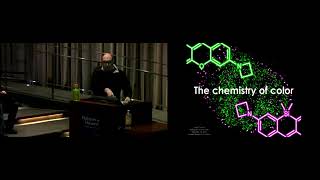
In this Janelia Farm "Dialogues of Discovery" lecture, chemist Luke Lavis recounts the origins, chemistry, and modern applications of fluorescent dyes. He begins with a personal introduction, then explains what fluorescent dyes are—molecules that absorb one wavelength of light and emit another—demonstrating the phenomenon with a UV lamp. Lavis traces the historical development of synthetic dyes from natural sources (indigo, alizarin, carminic acid) to William Perkin’s accidental synthesis of mauveine, linking the drive to replace quinine (an antimalarial) with synthetic alternatives to the birth of the dye industry. He describes how John Herschel observed fluorescence in quinine and how George Stokes formalized the concept of fluorescence and the Stokes shift. The lecture then moves to the impact of dye chemistry on pharmaceuticals, food colorants, and histology, highlighting early drug discoveries such as methylene blue and Prontosil. Lavis shifts to contemporary biology, showing how modern fluorescent dyes enable cellular imaging, and explains the limitations of traditional organic synthesis for dyes like rhodamines. He presents his lab’s strategy of converting cheap, easy‑to‑make fluorescein into a library of rhodamine derivatives using a simple two‑step sequence pioneered by John Grimm, and how structural tweaks (e.g., adding a strained four‑membered ring) dramatically increase brightness and photostability (up to 30‑fold). He showcases bright new fluorophores (Janilia Fluor series) and vivid microscopy images of labeled cells. The talk concludes with future goals: creating dyes that last hours in live cells, exploring untouched chemical space on classic scaffolds, and integrating dye development with advances in microscopy. Audience questions touch on stereochemistry, medical relevance, infrared and radio‑frequency dyes, and safety of food colorants, which Lavis answers with a mix of scientific detail and personal anecdotes.
Chapters
It worked.
Good.
Good evening. Welcome to tonight's presentation in our Dialogues of Discovery series. I'm Jerry Rubin. I'm the director here at Janelia Farm. On behalf of the Howard Hughes Medical Institute, I'd like to welcome you. You should have all gotten one of these little booklets that describes Tonight's speaker Luke Lavis's background. And I'm not going to read all this, tell you where he got his degrees and what he works on. You can read it for yourself. I'll just say that Luke comes from rural southern Oregon. It's a very informal place. So when he gets up here and you say, wow, this guy didn't even bother to get dressed up to give this big lecture, I want to assure you that's not true. As evidence, I can say that in the 7 years that Luke has worked here, this is the first time I've seen him wear real shoes. He would normally be wearing sandals. He did get dressed up for this lecture. It's going to be fascinating, and we're all going to learn about the chemistry of color.
Luke. All right. Well, thank you, Jerry, for the kind introduction. You know, I feel a little self-conscious now, but oh well. You know, as a chemist, you have to be careful what you wear because if you wear nice clothes in the lab, they end up having holes in them. So, you know, you get used to wearing the same thing over and over again. So it's really a pleasure to be here tonight to talk about science and an honor to be part of this seminar series. And I wanna echo what Jerry said and welcome everyone to Janelia this fantastic place of science that I've had the privilege to call home for the last 7 years. So tonight I'm going to tell you a story that's near and dear to my heart, because it's the story of the genesis of the field of fluorescent dyes, a field that I've been working in for the last decade and a half. And so the first question is, what is a fluorescent dye? So all dyes absorb light. That's what gives them their color. But fluorescent dyes have a unique property. And that they absorb one color of light and they emit a different color of light. And you can see this by eye. So I have a sample fluorophore here. I brought my UV lamp from the lab. And if I shine this long wavelength UV light, this black light, this light that we can't see with our own eyes, on this sample, you can see— whoa— you can see that it glows with this nice green color. So the dye is absorbing this light, and then emitting this green color. So you can make pretty things in a bottle, but you can also do cellular imaging. And so the slide here shows two dyes that have been developed in my lab, as well as a picture behind it. And this is an image of a cell nucleus, where my colleague Brian English has taken these two dyes, labeled two different proteins. And shined light on them using a fluorescence microscope. And then the proteins glow. You can image them. You can watch them move. And you can do really fascinating biological experiments. So that's what we do. We make dyes, and we use them for cellular imaging. Now, fluorescent dyes are a little obscure corner of organic chemistry, and one question that I get asked often is, How'd you fall into this? So as Jerry mentioned, I grew up in a little town called Rouge in Southern Oregon. My parents were hippies, bona fide hippies. They moved from California to escape the mainstream. And I think maybe some agricultural opportunities there as well. So I'm a proud product of public education. And so as a first-generation graduate student, I went to Oregon State University. Where I majored in chemistry, and I got to work with a professor named James White, who was doing natural product chemistry. Chemistry, building molecules that were interesting, found in exotic animals and plants. And so I really loved the work, but I didn't like the molecules we were making, because we were just making them because they had interesting structures. They actually weren't very useful. So after my undergraduate work, I went and actually worked in industry. And I remember walking into a little company called Molecular Probes, which was in Oregon, and having the chemists describe to me what they do. They get to build molecules that aren't just interesting, but they're actually useful. They could go into cells. They could report back to us changes in the cellular environment. They could stain different cellular regions. It sounded like a lot of fun. And so that was my first experience with fluorescent dyes, and I've really never looked back. So I then went to Molecular Devices in Silicon Valley, worked there for a little while, and then went to graduate school at the University of Wisconsin-Madison, another public university, where I worked with Ron Raines to develop dyes that we use to track the movement of proteins inside cells. And then after my graduate work, I wanted to go to a place that would be the absolute best place to continue working on fluorescent dyes. And of course, that place is Janelia, where we have the best microscopists and the best biologists.. And so we get to play in this area making fluorescent dyes to make beautiful images like this and learn more about complex biological systems. Alright, so that's my sort of zigzaggy thing to Janelia. And I really fell in love with chemistry. And I think that's often a rare sentiment. So I know everyone in this room is probably not an organic chemist. You might have horrific memories of organic chemistry classes. And so what I thought I'd do before we get into this story is give a brief refresher on organic chemistry. And so the way I think about it is that chemistry is simply a different language. So I've shown a couple structures here. You might look at these and say, these just look like weird pictures. And that's exactly what they are.. And just like humans have been doing for a long time, using pictures to convey meaning, chemists use pictures to convey meaning. And so, because I know the language, I can read this. This is TNT, the explosive agent in dynamite. This is Tamiflu, which a lot of us have probably taken this year. This is dopamine, an important neurotransmitter in the brain. Amoxicillin, an antibiotic. Nicotine, which is found in cigarettes. Bisphenol A, BPA, which used to be used in a lot of plastics. This is fucitol, a sugar alcohol. You have to be a little careful pronouncing this because it could come out wrong. This is aspirin, a common pain reliever. Coumadin, a blood thinner. Triclosan, this is what makes antibiotic soaps. Aspartame, an artificial sweetener. And fluorescein, this dye here, which is also the green color in antifreeze. Just like any language, we have an alphabet, and it's the periodic table. Chemists tend to hang out around this area. Carbon, of course, is the center of organic chemistry, and we build molecules out of these non-metals, which are separated from the metals by this line. And we use the metals to often affect chemical transformations. Now, we can string together these elements into words, into the chemical structures. That we use, and we've developed a fairly efficient way to represent complex 3D structures in 2-dimensional space. So if you think about the structure of aspirin, what it really looks like is this. This is the 3D structure of aspirin. But this is a bit hard to draw and really hard to see what's going on. You really can't tell where the bonds are. Carbon's black, hydrogen's white, oxygen's red, but it's a bit difficult to see any detail. So, you can simplify this by doing a ball and spoke model. And, again, this gives you a little bit more information, but this would be difficult to draw. Chemists aren't always artists. So, we can simplify this further, put chemical elements instead of the atoms, and use simple lines for the bonds. We can condense this, simplifying it a little bit more. And then, what the heck, let's just get rid of the hydrogens because we know they're there. And then, because organic chemistry is built on carbon, we can just draw simple shapes and assume that each corner and each line is a carbon atom. And so we go very quickly from a complex 3-dimensional structure to a 2-dimensional structure without losing a lot of information. And so these are the sorts of structures that I'll show you, but remember there's this 3-dimensional structure buried underneath. We can take these chemical structures, string them together into chemical equations. These are the sentences of our language. So here's the synthesis of fluorescein, this molecule here, which starts with resorcinol and phthalic anhydride, and you cook it together with some acid for a few days. And then really the heart of organic chemistry is this multi-step synthesis, these paragraphs that are made up of individual reactions. And this is really what we do all day. We mix things together. We get something, we purify that out, and then we do the next step. So, we can take fluorescein, make this derivative, and then take this derivative and make a new dye. This is a dye we call Genelia Fluor 549, developed here at Genelia. All right, so that's my little spiel on organic chemistry. Now you're all experts, and you can understand the rest of the talk. So, let's talk about color. So, the story of fluorescent dyes has two other associated stories that are intertwined in history. The first is pretty obvious. It's the development of synthetic dyes in general. And this began in 1856 with the synthesis of this molecule, mauveine, by a young British chemist named William Perkin. And here's a sample of an original, or here's an original sample of mauveine prepared by Perkin himself. Now the other story is not so obvious. It's actually malaria, which is a disease caused by a Plasmodium parasite that infects our red blood cells and is transmitted by mosquitoes. And this is an electron microscopy image of this Plasmodium parasite in the gut of a mosquito. And as I'll tell you, malaria, the drive to cure this disease, ultimately led to the discovery of the first synthetic dye. It led to the discovery of fluorescence. And it also drove the development of instrumentation that we needed to measure fluorescence. So let's talk about dyes. So synthetic dyes are a common part of modern life. You probably ate some today. I hope you enjoyed the Jelly Bellies. You're probably wearing something that is dyed with a synthetic dye. And as a guy from Oregon, I feel compelled to show you an example of my native garb. They're also used in science, so you can use dyes to make lasers, finely tunable lasers that are useful for spectroscopy experiments. And of course you can use them to make biological probes, like the ones I showed in the title slide, or this example where the cell is stained in 3 different colors. But this always wasn't the case. Before 1856, all colors were from natural sources, and I show 3 examples here. Indigo, alizarin, and carminic acid. So, here are the chemical structures of these dyes, and these are what the dyes look like after they've been isolated and purified from their natural source. Indigo is a blue dye. It's the blue in your blue jeans. It's still used today. Alizarin is a red dye. It was what the British used to dye the coats of their soldiers during the Revolutionary War. And carminic acid is also a red dye., and it's been used in a variety of different applications, and it's still used today in cosmetics like lipstick, and also in some food. As I mentioned, these all come from natural sources. So, indigo comes from a plant called true indigo, so named because it has the highest concentration of indigo. Indigo is also found in a couple other plants like woad. Alizarin comes from the roots of this madder plant, and carminic acid actually doesn't come from a plant, it comes from an insect. This cochineal insect, which thrives on cactus that is infected with a particular type of fungus. And so in Mexico there are plantations with this, these cacti infected with fungus, and you can just pick off the insects and then extract out the carminic acid. So just as an aside, if you're a vegetarian, you might want to avoid this stuff, because it's actually coming from an animal and not a plant. Now, once people figured out how to isolate these molecules from their natural sources, they still had to figure out the way to dye cloth with these sorts of compounds. And for indigo, this was actually a problem, because indigo is not soluble in water, so it's very difficult to make a solution and then dip your cloth in that solution. So some early chemist figured out that you could reduce indigo, you could do a chemical reaction on indigo to make something called leukoindigo, or indigo white. This is colorless, but more importantly, it was water soluble. And you could then make a solution of this, dye your cloth, excuse me, dye your cloth, and then hang it out to dry. And then the oxygen in the air would reform this blue color, reoxidize the dye. And the insoluble little dye particles will be trapped in the fibers of the cloth. Now, this was before common chemical companies, so they had to be a little creative in the reducing agents that they would use. They'd use bacteria in some cases, iron or arsenic salts, or other things that they had in abundance. And they would do this. And when you go to the American History Museum on the National Mall and look at the Star-Spangled Banner, The blue portion of the flag is dyed with indigo that was probably grown in a plantation in India and then dyed using this process. So we've been doing this for a long time. All right, so what changed? And what did malaria have to do with the development of synthetic dyes? So the reason malaria drove synthetic dye production is a molecule called quinine. So quinine is a natural product. It's an effective anti-malarial treatment, and it's found in the bark of cinchona trees. So this was discovered by native South Americans and later imported to Europe by the Jesuits. It works most likely by inhibiting the formation of something called hemozoin. So these small parasites are chewing through our red blood cells. They're eating hemoglobin, which is the protein in our red blood cells that is responsible for carrying oxygen and also gives it its red color. And part of hemoglobin is a molecule called heme, and that's toxic to the Plasmodium parasite. And what it does actually is it biocrystallizes it. It sequesters it in these crystals shown here. And what quinine does is inhibits this biocrystallization process. This results into a lot of free heme. And the parasite dies. Now Europeans have been using quinine for centuries. And if you're a European power trying to expand into the far reaches of the world and establish colonies, it might be a good idea to give your citizens large doses of quinine. And so you dissolve either the bark or later the quinine into water, and you take it. And that's where tonic water comes from. And then of course it doesn't taste very good. Quinine's bitter. And so for some reason they decide gin is a good idea. So they mix gin with tonic water and the gin and tonic is born. But I'm sure that the tonic water that they used to drink to ward off malaria is a little bit stronger than what we can pick up at Wegmans. So you have this interesting molecule. It was important during this colonial age. And it was grown in plantations half a world away. And so people started wondering, do you think we could make quinine instead of grow quinine? And in the mid-1850s, this started to maybe become a possibility. So the Industrial Revolution was in full swing, and a byproduct of this effort was a substance called coal tar. So a byproduct of coke and natural gas production. Was this gooey substance, a mixture of complex organic molecules. And so what chemists started to do is take this stuff, which was readily available, and distill out interesting molecules, either to study on their own—many were novel—or to do a new type of science, chemical synthesis, to combine these molecules and make new molecules. Now, a major proponent of this effort was Van Hoffmann, who was the president of the Royal College of Chemistry. And he really pushed for this idea and started thinking perhaps we could make quinine from stuff we could get from coal tar. And so he had a young student in his lab named William Perkin, 18 years old, and he basically dared Perkin to try and make quinine out of stuff he could get out of coal tar. And so here's the proposed synthesis that they tried. And to a modern chemist, this seems very silly. There's actually no way this would ever work. But back then, they didn't have the nice structural information that we have. They don't have— they didn't have the analytical tools. And all they really had was chemical formula. And so from that perspective, it kind of makes sense. You could take two molecules of this N-allyl toluidine, add some oxygen, and you would get the molecular formula for quinine plus a molecule of water. So Perkin tried this. It didn't work. He just got a bunch of black sludge. But for some reason, and it's really unclear why, he kept thinking about this reaction. And so he went home, he had a chemistry lab set up in his parents' attic, and he kept trying to oxidize these molecules that he was distilling from coal tar. And so he tried to oxidize aniline, His aniline sample was dirty, it wasn't very clean, it had these other toluidine molecules in it. And he made this weird purple dye. And he made a solution of this, dipped some silk in it, and said, "I might be onto something." And the fact that this dye, called mauvine, was purple is particularly important because dyes from natural sources that were purple were very rare. So the best purple dye was Tyrian purple. This is an indigo derivative with these bromines on it that give it its purple color. And this is found in very small amounts in these venomous sea snails. And so it would take a lot of sea snails to get enough dye to color even a single garment. And so in antiquity, purple was often associated with riches or royalty. Now, in the 1750s, another purple dye was developed, orsine. This was called poor man's purple, and it could be made by taking lichens and boiling them up with ammonia and letting that solution sit for a few weeks, and you would get this dye. It was an okay dye, but it bleached very quickly in sunlight. So suddenly Perkin had this dye that he could make from coltar in large amounts. It was much more stable than orsine. And so he did what I think is a very smart thing. He dropped out of school, pissed off Van Hoffmann, applied for a patent because he had done these experiments not in Hoffmann's lab, but in his parents' attic, and then started a company making synthetic dyes. So this discovery changed everything. Before Perkins' synthesis of mauveine, chemistry was more or less a curiosity. It was something that professors did in universities, but it had no commercial value. Now, organic chemistry could make molecules that people would pay money for. And so thousands of dyes were synthesized and characterized in the following decades. And I show a few of them here. So methylene blue was synthesized in 1876. I'll talk a little bit more about this dye later. Coomassie brilliant blue in 1896. This dye we still use to stain proteins in gel electrophoresis. Poncier's 6R in 1878. This is a stain that's still used by pathologists today. And fluorescein, this molecule here, which was first synthesized in 1871. In addition to these novel dyes, people started looking at existing dyes that came from natural sources, and wondering if they could synthesize these molecules in the lab. And so alizarin was synthesized by Perkin himself in 1868, more or less simultaneously with a German group. And unfortunately for Perkin, he filed his patent one day late, and so the German group got the intellectual property. And then indigo was also synthesized in 1878. And that means that most likely the blue in your blue jeans didn't come from a field in India, but from a chemical plant somewhere else. Now, you can look through some of these old promotional materials where these dye companies were popping up all over the United States and Europe. So here's a picture of a dye. They were usually near a river, and the legend goes that you could always tell what color they were working on because that's the color the river would be. And, you know, you can look through, and people would have booklets of swatches of cloth, showcasing these new dyes. And this really changed fashion, it allowed colored clothing to be available to the masses, and it also did something else. If you look carefully here, it's actually hard to see on the screen, these are some dyed feathers for hats or something. But if you could read this, you could look at the company that was putting out these dyes, and it would seem familiar. It's actually Bayer. And so in addition to really starting a flurry of activity in organic chemistry, many of these early dye companies morphed into companies that we hear about today, including pharmaceutical companies. So, AFGA, ICI, BASF, all started out making dyes and then moved on to other chemicals. As well as Bayer, Ciba, and AstraZeneca, companies that we associate now with pharmacological agents, started out making dyes, and then later moved from dyes to drugs. The food colorings that we still use today also came out of this effort. So here's the structure of yellow number 5, red number 40, and blue number 1. And I just want to point out that there's actually nothing especially interesting about these dyes. They're not a particular class. They were just molecules that were part of these thousands of dyes that were synthesized, and later found to be stable to food, baking, and also deemed safe by the FDA. Now, biologists weren't just sitting around watching this happen. Suddenly there were a lot of molecules to play with. And so biologists literally started throwing these dyes at tissue to see what would stick. And this spawned the field of histology. Where you can take dyes that are sometimes very old and then stain tissue with them to look at different types of cells or different regions of tissue. And this is MSB staining that shows connective tissue in blue, red blood cells in yellow, and fibrin in red. All right, so biologists would take this one step further and ask the question, okay, we can stain tissue with different dyes, could some of these dyes actually be effective drugs themselves? And a major proponent of this was Paul Ehrlich, who won the Nobel Prize in 1908 for his work on immunology. He was also one of the founders of histology and spent a lot of time throwing dyes at different tissue samples. And one of his favorite dyes was methylene blue. And what he noticed in some of his experiments is that methylene blue would stain the parasites that cause malaria. And so he wondered, maybe this staining means that the dye would actually like the malarial parasite, and maybe this would be an effective treatment. And it was. And methylene blue is considered to be the first synthetic drug. Paul Ehrlich was also the man that coined the term "the magic bullet" based on this work with methylene blue and work with other dyes. This idea that you could make molecules that would target specific cells. Methylene blue has since been used in photodynamic therapy, for psoriasis, and other things. And it's also an effective antidote for cyanide poisoning. It's also used in another capacity, practical jokes. So this survives the body, and so you can put it in someone's tea or coffee, And they will get a surprise a little bit later. So for the high schoolers in the audience, yes, this is that stuff, and no, I don't have any. Now another person who realized that these dyes could potentially be pharmacological agents was Gerhard Domagk, who won the 1939 Nobel Prize in Physiology or Medicine for this work. Unfortunately, Hitler said you can't accept the prize. And so he didn't get his certificate until after the war. And by then, I guess time had run out, so he forfeited his prize money. But he was head of research at Bayer, and he decided let's screen all of these wonderful dyes and see if any of them have antimicrobial activity, if any of them could be antibiotics. And they found one dye, Prontosil, this red dye, which showed good antibiotic activity, and it's considered to be the first antibiotic. Now it's not the antibiotics that we often take today, beta-lactam antibiotics. It's called a sulfa drug. And it's actually a prodrug, so in the body this is broken down and the actual antibiotic piece is this. Now Prontosil and other sulfa drugs were replaced by beta-lactam antibiotics like penicillin, but with the resurgence in antibiotic resistance now, this is getting a little bit more interesting and people are starting to take a second look at some of these sulfa drugs. All right, so that's the story of how malaria gave birth to synthetic dyes. But malaria also played an important role in fluorescent dyes. And the reason for this is the same molecule as before, quinine. So quinine's not just an effective antimalarial agent, it's also fluorescent, and it was the first small molecule fluorophore ever described. And the person who first observed the fluorescence of quinine was John Herschel. So John Herschel came from a crazy family. William Herschel, his father, started out as a composer and then got interested in astronomy and ended up discovering the planet Uranus sort of randomly. And John Herschel followed in his father's footsteps and made important contributions to astronomy, but also dabbled in chemistry. And so In this wonderful paper, and I just have to read the title because they don't write titles like this anymore. He writes this paper saying, "On a Case of Superficial Color Presented by a Homogeneous Liquid Internally Colorless." Basically, he writes a very long paper describing one experiment where he said, "I took some quinine, I put it in solution, and there's this weird blue color coming off the top." And then he goes on for pages and pages trying to explain the possible reasons for this weird blue color. And it didn't really make any sense, because the solution's colorless. Is it some sort of refraction? What's going on? And we can actually replicate his experiment. I just bought a bottle of tonic water last night. And if I take my trusty UV lamp, you can see that I didn't doctor this at all, but this tonic water glows with this nice blue color that Herschel observed. So, no one knew what was going on, but this caught the interest of another British chemist, George Stokes, who ended up working out the process of fluorescence. And in this paper called, entitled On the Change of the Refrangibility of Light, which is like 100 pages long, he describes a series of experiments that showed that fluorescence is really absorption of one color of light, and emission of another color of light. And because he had discovered this new process, he decided he should name it. And so this is the name he gave it, dispersive reflection. And if this name had stuck, we'd be talking about dispersive reflexophores, and we'd be doing dispersive reflection microscopy, et cetera. But in a footnote, right after he proposes this name, he says this, I confess, I do not like this term. I'm also inclined to coin a word and call the appearance fluorescence. And that's the name that stuck. And I'll just show you one schematic of his famous experiment that showed that fluorescence was actually absorption of one color and emission of another color. So this is legend. This is maybe how he did it at first. Later he did it with colored glasses in his own lab. But the legend is he went to church with a bottle of quinine, and he set the bottle of quinine on a table. And there was sunlight passing through a blue stained glass window. And then he had a goblet of wine, and he could look at the light emanating from the solution of quinine, and it would pass through this goblet of wine. This was acting as a yellow filter. But if he looked at the blue light coming through the window, it would not pass through this filter. It would be absorbed. And that's how he knew that it was absorption of one color and emission of another color. And in Stokes' honor, we call the difference between the absorption maximum of the dye and the emission maximum of the dye the Stokes shift. All right. So, that's how fluorescence was discovered using quinine. And malaria would then play one more role in the development of instrumentation to measure fluorescence. So during World War II, Imperial Japan controlled much of the cinchona tree plantations, leading to a shortage of quinine for the Allies. And so the U.S. started the U.S. Malaria Program in New York, which sought replacement antimalarial drugs. And their idea was, well, quinine's fluorescent, and some of these other compounds are gonna have similar structures, they'll probably be fluorescent. What if we use fluorometry to test concentrations of various drugs in the blood? We need to make sure that these drugs are getting to where the parasites are. And so they went ahead, improved fluorescence instrumentation. This resulted in improved dosing of a molecule called atabrine and discovery of new antimalarial compounds such as chloroquine. Interestingly, fluorometers were later commercialized by some of the companies involved in this U.S. malaria program. And before the war, there were maybe 3 or 4 fluorometers in existence in the world. And after the war, these things became commonplace. And in fact, in my lab, we have 4 fluorometers. And in some cases, I've had more fluorometers than people. So that's the story of— fluorescence and dyes. Now, what we try and do in my lab is take some of these old dyes and tune and tweak them for specific applications. And you might ask the question, Luke, you just told us that these dyes have been around for 150 years. People have been doing dye chemistry longer than any other chemistry. Hasn't all the work been done? And that's a valid question. I have colleagues that ask me that question all the time. And the issue is this: dyes are very useful, and the fluorescent dyes that have persisted through history end up being basically the best dyes. We've been working on this for a long time. These dyes have been known for 100 years, and we keep using them because of their fantastic fluorescence properties. But the problem from an organic chemistry standpoint is that the chemistry that we use to build these dyes is often very old. And so one of the things that we do in my lab is try and use modern chemistry, bring modern chemistry to bear on some of these old dyes, and that allows access to new structures with improved properties. So in other words, what we like to do is teach old dyes new tricks. So here's one old dye, fluorescein, my favorite dye. I really love this guy. Fluorescein was first synthesized in 1871, as I mentioned. Here's the original paper, and this was done by Adolf von Baeyer, who would later win the Nobel Prize in 1905 for his work on fluorescein, as well as other dyes. He was the first person to synthesize indigo. Now, fluorescein is very easy and cheap to make. It's the green color in antifreeze. It's also fairly safe to ingest or inject. So you can inject patients with fluorescein and then use it to image retinal blood vessels. It's the yellow drops that you get when you go to the eye doctor to look for corneal abrasions. It's also used in cultural events. It's the dye that used to be used to dye the Chicago River green during St. Patrick's Day. They say they changed it, but I don't believe them. You can also play jokes with fluorescein. So a few years ago, a river in British Columbia ran green for 3 hours because some pranksters threw some fluorescein in the river. And you can actually do this for scientific reasons as well. So this is a picture off the coast of Oregon where some scientists are using fluorescein to trace ocean currents. And so here's a boat. And this is a large spot of fluorescein that was made just by putting a couple hundred grams into the water. This ability of fluorescein to make a very large spot was also used in ocean rescue. So this is a picture that I took at the local Air and Space Museum down by Dulles. And this is a life raft. And then here is a sea dye packet that's full of fluorescein that would be used to locate stranded sailors. And it was also used in the space program. So every capsule that we sent up had a bag of fluorescein on the top. And this is Gemini 5, and you can see this trail of fluorescein coming out, and this would aid in the location of the capsule after splashdown. And of course fluorescein can also be used as a biological probe, and fluorescein was one of the first dyes ever used in fluorescence microscopy. So, fluorescein is this great, cheap molecule. But the problem is it's green, and it's really difficult to change the color of fluorescein. Now, a related dye that's almost as old is the rhodamine dyes. So, here's rhodamine. It has a very similar structure to fluorescein. Instead of these oxygens, it has nitrogens. And it was first described in the patent literature in the 1880s. By a Swiss chemist named Maurice Sersol. Now, rhodamine dyes are fantastic. You can tune or tweak these dyes to a variety of different colors. So, here's the simplest rhodamine, rhodamine 110, which has very similar properties to fluorescein. But if you add carbons onto these nitrogens, you can shift the wavelengths to a yellow dye. If you further rigidify the structure, it can go even a little bit further. And then if you replace this oxygen with different atoms, you can get redder dyes still. So if you put a carbon there, you get an orange dye, and if you put a silicon there, you get a red dye. So it's a really beautiful structure. The problem is the chemistry kind of stinks. So usually how you make rhodamine dyes is you cook together an aminophenol and a phthalic anhydride. And usually when you do this, You basically melt these two things together with some zinc chloride, another solid. So you grind these things together, you heat it at very high temperature, it sort of melts, and then you get this glassy solid. And then you usually have to break your flask, get out your hammer, pound this stuff out, and then try and extract out a little bit of rhodamine dye. So it's a very difficult way to make dyes. And this has really limited the exploration of different substituents on this dye, what they do, et cetera. So a few years ago, we had this simple idea. Well, fluorescein's really cheap and easy to make, and it has a similar structure. What if we could turn fluoresceins into rhodamines? And so this is the work of John Grimm in my lab, a very talented chemist who I poached from Merck. And we figured out a way to take fluorescenes and just in a couple steps make a wide variety of rhodamine dyes. And John has made now dozens, if not hundreds, of rhodamine dyes using this simple synthetic sequence. So one of the cool things that we can do with this chemistry is make dyes that were never accessible using previously used synthetic techniques. So in a project that we started about a year and a half ago, we wanted to make a better version of this tetramethylrhodamine, this dye that has been widely used in biology for the last 30 years. But it's just not bright enough for what we wanted to do. So we had sort of a silly idea. We thought, what if we change these things out, these dimethylamino groups, with this small 4-membered ring? So that was the idea. We had some quantum mechanical calculations that suggested that this might be the case, but to be honest, we didn't really think this was going to work, because if there's one thing that you remember from organic chemistry, it's ring strain. And this just looked like too strained of a ring to work in this sort of system. But with our chemistry, we could actually make this. And what we found is just by adding these two carbon atoms and cyclizing this thing up, we made a dye that was twice as bright and twice as stable as the parent dye. And so we thought we should try this on other dyes. And so it turns out— oh, we call this Janilia Fluor 549. So we thought we should try this on other dyes. So I showed you that rhodamine dyes get twice as bright, but it also works on blue dyes. So this gets 4 times brighter. This one gets 28 times brighter. This one goes from non-fluorescent to fluorescent. This gets 2.5 times brighter. This gets 4 times brighter. This gets 30% brighter. This gets 40% brighter. And this one gets 3.5 times brighter. So overall, this very simple substitution that we found on the rhodamine dyes is a general strategy for making a wide variety of fluorophores much brighter and much better for cellular imaging. So I just want to end with a pretty picture. So this is a movie taken by Wes Lagont of a cell, and the cell is labeled with 3 different dyes. The nuclear membrane is labeled with a fluorescent protein, and it's in yellow. And then the DNA in the cell is labeled with a dye that we've developed, Junilia-Fluor 546, that's bound to a DNA binding motif. And then the cyan is another dye that we've developed that binds intracellular membranes. And so you're going to see a Z-stack through the cell. So this is DNA. You see the nuclear membrane. And then you can see this wonderful reticulated structure of the mitochondria and the endoplasmic reticulum. And so you can see actually that mitochondria have their own DNA, and we can actually image that, which is kind of cool. And so this is the sort of thing that we love to do. We build dyes, work with our microscopist friends to make lovely images, prove this as a viable imaging technique, and ultimately use this to answer biological questions. So I'll just end with some acknowledgments. So here are past lab members, present lab members, So all the work that I talked about was done primarily by John Grimm in my lab and Joel Slaughter, along with some help from Tim Brown. And then we have some key imaging collaborators. So the early image that I showed on the title slide was done by Brian English. And then that last movie was done by Wes Lagombe in Eric Betzig's lab. And there's many, many other people to thank. This is an amazing place to work. It's a fantastic place to do science.. And I'm thankful for these people for their hard work and you for your attention.
And I'm happy to answer any questions. Thank you. So I know that some chemicals or molecules are left-handed and right-handed and it makes a big difference in medicines.
Is there any left-handed, right-handed with color molecules? Right, that's a great question. So when I was working in that natural products lab, that was a big deal, right? We always cared about stereochemistry. And then when I went to molecular probes, it's like, oh yeah, we don't care about that, because everything we do is symmetrical. And so if you think about it, all these rhodamine dyes usually have the same groups on both sides, so there's a plane of symmetry in between. Between. Now we're starting to be able to mess with these dyes and put different groups on either side, and then that becomes an issue. We're going to make right-handed and left-handed molecules. They might have different properties, especially when we attach them to a protein. And so, yeah, we'll have to deal with that, but right now we're sort of cheating and just making symmetrical molecules when we don't have to worry about it. Have you made any discoveries related to medicine? Have I made any discoveries related to medicine? So in projects that I didn't talk about, one thing that we've been doing is we've been taking this lovely dye fluorescein, and we've been making different enzyme substrates. These are molecules that would be turned on by by various enzymes. And so in collaboration with the National Cancer Institute, we've been screening a library of these enzyme substrates against different cancer cell lines. And we've actually found a couple substrates that are only unmasked, or only activated by one or two of these cancer cells, cell lines. And so we think maybe we found something where we could perhaps target different dyes or even drugs to these particular lines. But it's very early. We've just got this data back recently. So you've talked about light dyes. I'm wondering if there are dyes from other parts of the spectrum, like an infrared dye or an X-ray dye or radio frequency dye. Right. That's a great question. So we— For infrared dyes, there's a possibility. So our red dyes are getting close to 700 nanometers, which is basically the boundary between red and infrared light. And we have some further red dyes that absorb at 700 or even further. It's a little bit difficult. That's sort of at the edge of where these rhodamine dyes can go, but there are other dyes that have a potential for absorbing light. For radio frequencies and stuff like that, I think you start to run into the issue that there's not enough energy in the radiation to actually promote an excited state of the molecule that can lead to fluorescence. So, that's—
I don't know of any radio frequency fluorescent dyes. Oh, yeah. Hi, as a mom of two little kids who love, love food that are really bright, bright blue ice cream and bright candies, and I'm sure that a lot of them are synthetic colors, and so I just have this nagging worry.
So should I worry? I'm gonna take a drink. All right, so I'm not a toxicologist, so I don't qualify, but I will say that I usually stay away from these things, not because I'm worried about toxic effects, but because when I was in high-throughput screening at Molecular Devices, we would sometimes use these food dyes as reagents in some of our kits. And so I just remember clearly one day we had a big bottle of tartrazine in a lab, in a chemical container, and I was scooping this stuff out, and I said, "Oh my gosh, this looks just like the macaroni and cheese powder." And so that sort of turned me off forever on yellow powdered stuff. So I know that doesn't answer your question, but, you know, that's why I don't eat that stuff. [Speaker] Hi, I wanted to ask you about quinine because you mentioned all its medical properties including antibiotic properties. Just wondering whether they think that's why quinine evolved, or what does the cinchonan plant use quinine for? Yeah, that's a great question. So a lot of these compounds, these are called alkaloids, they contain nitrogen, were probably, you know, probably evolved as more or less insecticides, right? So even nicotine, which is, you know, one of the most widely used drugs by humans, really evolved because it's an insecticide, and the plant was just trying to ward off insects. And so it might just be an accident that these dyes also have other, or these compounds also have other pharmacological effects in other species.
What is your life's dream? What would be the biggest and best thing you could do that would make you the happiest?
That's a great question. I have a 4-year-old, so maybe getting them to bed on time? No. So, you know, our goal is, you know, what I'd really like to do is figure out how these dyes work. And once we know how they work, I think we can make dyes that will last much longer in imaging experiments. And that's really my goal. Right now, you know, we go from an existing dye that lasts maybe a second to a dye that lasts 2 or 4 seconds. And for biologists, that's actually a significant advance. But I'd like to have a dye that lasts for hours, so we can track molecules very long-term inside living systems. So that's my goal.
That's what I'd like to contribute to science. So my question is related. I was going to ask you where do you see this field going in 10 years. I guess the question I have now in response to what you just said is, is the instrumentation where it needs to be for you to realize those kind of goals so that the fluorescence can— you can see it over a longer period of time because of better instrumentation?
Certainly instrumentation is important, and I think what we're doing here at Janelia is or what we can do at Janelia is actually iterate, right? So we— my colleagues can say, I have this new microscope, and we try these dyes, and then we say, oh, it'd be really nice if we had a different wavelength, for example. And so we make another wavelength dye, and then they say, oh, that works pretty well. And hey, I had this idea for a microscope, or, you know, an adjustment. And so then we sort of track along this way to try and improve. The imaging. In 10 years, I don't know. I mean, I get this question a lot, because again, we've been doing dye chemistry for so long. How much more is there to be learned? And I'll just mention that in the rhodamine case, even though we've been messing with this dye for 130 years, for example, We've never actually put anything there. Okay, there's an entire position on the rhodamine dye that has never ever been explored. And so we're just starting to put substituents there and just see what happens. And actually, in some cases, we've made just one compound and it actually ends up being a bit more photostable. So, you know, there are entire sets of molecules that have yet to be synthesized.
Q: In the case of rhodamine, when you add the carbon atoms so that you can close the four-sided ring around nitrogen, does that increase the intensity or does it change the color? And the other question is, is the reason ring strain isn't an issue with that because if you had four carbon atoms there'd be too much ring strain, but you've got three and a nitrogen?
A: That's a great question. So, you're right that perhaps the ring pucker because of the nitrogen, it could be pyramidal. But we don't think it's pyramidal based on the calculations. When we look at this, model this, these rings are planar. So they're true 90-degree angles and it looks pretty strained. But surprisingly, it's very stable. The first thing I did when I got this dye and looked at it and said, oh my gosh, this is really bright. Is I threw it in with a bunch of thiol, which is found in high concentrations in cells, to see if it would open up the ring, and it was perfectly stable for days. And your other question—
oh yeah, remind me of your first question. Is that the functional group that increases the intensity or affects the color?
Oh, right, right, right. So the cool thing about this system is we don't actually change the spectral properties of these dyes. Actually is only changed by 1 nanometer in terms of the color that it absorbs and the color that it emits. It actually does go up in intensity, so it absorbs light with greater efficiency and is also more fluorescent. So, it absorbs more light, and then it converts more of that light into fluorescent light. So, it's overall about 3 times brighter than the parent compound.
I think they want you to record it for posterity. Thanks. I wondered if glow-in-the-dark paint, for instance, how that's different from fluorescence?
That's a great question. Fluorescence is more or less instantaneous. So the molecule absorbs the light and then emits a photon within nanoseconds. The glow-in-the-dark paint is another related phenomenon called phosphorescence, and there the excited state, the molecule is sort of in this high-energy state for longer, and so that's why it lasts long. But fluorescence, it's usually nanoseconds. Or maybe a little longer for some dyes, but it's very fast. Is one color more durable than another? That's a great question. I think for cellular imaging, redder is better. With cells, some of the blue light that might excite fluorescein can also excite other things in the cell. And we're doing this at pretty high intensities, and so the cells sometimes aren't happy. So in terms of durability, red dyes are usually preferred for cellular imaging, because the light that we put into the sample is much less toxic. So the dyes may not be more durable, but the, The cell is a bit more durable under those conditions.
If phosphorescent molecules give off color longer, why are they not used for staining in biological materials?
That's a great question. They could be, but the problem is now you're talking about there'd be another sort of time delay, right? So you'd be exciting your sample, and say you want to watch a molecule moving around. Now there'd be this weird time delay where you don't know, you know, where was the molecule when it absorbed a photon versus where it emitted. And the beauty of fluorescence is that it's very fast. So when you get the photon out, the molecule doesn't have very much time to move. Phosphorescence, it would sort of, this would all be involved and it would be a little bit more complex. Please join me in thanking Joshua Elkington.
More from Joshua







Scientist Stories: Hans Waterham, The value of phenotypic assays in peroxisomal disorders




Scientist Stories: Joel Zlotogora, Genetic carrier screening programs for reproductive purposes