Scientist Stories: M. Madan Babu, Biological Systems at Different Scales of Complexity
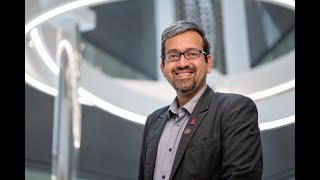
In this commemorative talk given at the 20th anniversary of the Teichmann Lab, M. Madan Babu reflects on his journey from an Indian undergraduate to a PhD student under Sarah Teichmann at the Laboratory of Molecular Biology (LMB), and later as a tenure‑track group leader. He recounts how Sarah advocated for his admission despite formal eligibility rules, arranged meetings with senior scientists, and fostered an inclusive, collaborative lab environment. Babu describes pivotal career advice Sarah gave during a long phone call that encouraged him to apply for a tenure‑track position, highlighting the importance of stepping out of one’s comfort zone. He also shares personal anecdotes illustrating Sarah’s kindness beyond the lab—hosting family meals, offering relationship advice, and supporting his personal life. The talk emphasizes Sarah’s broader impact on scientific policy (e.g., maternity‑leave reforms), her role in building a lasting scientific community that resists entropy, and the collective memory of early‑2000s computational biology pioneers. The presentation concludes with gratitude, a photo of a historic lab dinner, and a hopeful outlook for future achievements.
Chapters
Okay, we're now going backwards about a dozen years, um, and to the, the very first PhD student who's been mentioned earlier today, um, and also from, from the US now for the last year or so. Over to you, Madam. I think, I think you might be on mute. Oh no, no.
Sorry, can you hear me now?
Yeah, we can hear you now, but now we can't see the slides anymore.
Can you—
now it's perfect.
Okay. Thank you so much, Sarah. And good morning. Good afternoon. Good evening, everyone. It's a real pleasure for me to be here and an honor to be able to talk to you all today on this very special occasion, the 20th anniversary celebrating the Teichmann Lab. And just to briefly introduce myself, I was one of Sarah's first group members, and I did my PhD with her from 2001 to 2004 at the LMB. I then joined the LMB as a tenure-track group leader in 2006 and also overlapped with Sarah until she moved to the EBI. I recently relocated to the US last year, and I'm currently directing a center for data-driven discovery at St. Jude Children's Research Hospital. So when I was actually invited today to give a talk, I was contemplating what I should really talk about. Should it be about science or something a bit more general? And after some critical thinking, I just decided that I will treat serotiterin as a phenomenon that we all know, particularly as a multi-dimensional time series dataset, perform some dimensionality reduction, and discuss some of the major components of this phenomenon. Okay, so I can talk about each of these components for hours, but I thought I'll briefly touch upon some of the key highlights, particularly from some personal experiences that has really revealed to me how bold, brilliant, and kind Sarah actually is. So I did my undergraduate degree from India. I So this was in 1999 and about 2001. And then I wanted to apply for a PhD. I mean, I had read Sarah's paper, her PNAS paper on Mycoplasma genitalium structural assignments to the protein-coding genes of this bacteria. And then I had also read an influential review in Current Opinions in Structural Biology about advances in structural genomics. And Sarah had done her PhD with Cyrus. And her postdoc with Janet Thornton, both of whom are who's who in computational structural biology and bioinformatics more generally. So I was very anxious and nervous when I had actually, you know, traveling to the LMB to come and see her for an interview. But then I was very pleasantly surprised how kind she was as a person and how approachable she was as a person. You know, I mean, I just wanted to recount a couple of anecdotes that really highlights how special a person she is. When I had a 4-year undergraduate degree from India, and I was technically not eligible for obtaining a studentship from the LMP. And Sarah didn't leave things there. I mean, she really fought for me because she actually wrote to the LMP PhD studentship committee to basically make an exception and at least interview this person. And that was really such a critical step because It really changed almost everything for me from that point onwards. And not only did she fight to bring me there for an interview, but she was so kind that she actually arranged for me to meet so many other scientists from this long trip from India at the time, which is also an expensive trip at the time that was covered by the LMP. But still, having come all this way, it just made sense to meet all these other scientists who were there working in the field of computational biology and bioinformatics. I didn't know any one of them, I couldn't approach them, but Sarah kindly actually reached out to them on my behalf and arranged for meetings with people in the biochemistry department, for instance, with Tom Blundell, or in UCL with like Christine Oringo, and I couldn't meet Janet at the time, I think she was traveling, and then I was also visiting the Sanger and EBI, and it just left such a special impression on me because here's this person who's applying from India and, you know, she's never met me or seen me, and then she's taking all this effort to be able to make these opportunities and provide these opportunities to connect with people and learn about the science that is going on in Cambridge. So I think at that point it just left such a strong impression that Sarah was a very special person. And after that, I joined her group as a PhD student, and we had a really very productive time. And so we had a number of key publications from the time working on the structure dynamics and various aspects of gene regulatory networks in bacteria. And it was a very electrifying time with Christine Vogel there, Sarah Comerfeld there, Mark Morera, Julian Gough, really at the helm of what I would call computational biology at the LMB in the early 2000s. And that was also the time that Cyrus was is slowly winding down. It was just great to see the momentum, the energy, and the positive attitude and spirits in terms of fostering a group of people who are interested in applying computational tools and methods to study some very important problems in biology. Now, after my time as a PhD student, I went on to do a postdoc at the NIH. And then I was contemplating what I should be doing for my next steps in my career, because I was like in half minds about should I go back to India or should I just continue to be where I feel happy and like work in areas and directions that I was very excited about. And that was a time when I had a very long phone conversation with Sarah. Now I was in the US, she was kind enough to call me And then she spoke with me for over an hour, giving me some really critical pieces of advice. I mean, that was a time when they had opened up a position for a computational biology tenure-track group leader position at the LMB. And I just felt I was not ready for it. And then after speaking to Sarah, I mean, she just said, Madhavan, you just have to try. And what can be the worst thing that can happen? You don't get the job. If you don't try, you never get the job. And that was such a powerful message because it just highlighted the importance of getting out of your comfort zone, really reaching out to people. Of course, you have to give your best effort, you know, you have to work hard to make sure that, you know, you are taken seriously. You just don't want to make random attempts at things. But nevertheless, to have that courage to do that was a very critical piece of advice that I got. And I think that was another very important milestone in my life because that really gave me the opportunity to come back to the LMB and work with Sarah and other people at the LMB and in Cambridge more broadly and to be part of the bigger intellectual ecosystem that was happening there. Now, I just wanted to also highlight another aspect of Sarah, not just as a mentor and a colleague, but really also as a very caring person. Sarah has gone through many difficult things, not personally, but professionally, because she had to make things happen for the first time. You face pitfalls in computational biology. At least in the early 2000s, was met with a lot of resistance. I'm sure some people might have faced it themselves at a much earlier time in their own careers. But definitely at the LMB, there was some sort of a resistance, and she had to break new grounds. She had to make things possible. And the amazing thing about her was like, she was so kind to share her experiences even without asking. And that is very special again, because You, it really highlights how much she cares for people who come after her, people who walk the same path, just to make sure that they don't make the same mistakes, they are aware of potential pitfalls, and they know what they should be doing to be able to successfully walk such a career. And I think that is again a very special trait that Sarah has because it just shows a kindness and compassionate behavior in terms of what people should be able to do, especially from the lessons that she has learned and pass it on to junior members who are walking similar paths in their lives and career. And again, another important aspect was she was just so kind with her own group members and the kinds of group members that we all formed a big intellectual community. For instance, I had the opportunity to work with Subhajyoti Dey and Jörg Schöner, who are officially part of Sarah's members. But it was with some of these members that we had the first key papers from my own lab on genome evolution and disordered protein. And it just highlighted to me the importance of, you know, not having these barriers and have a more productive collaborative environment where you have, you know, the opportunity to do good science. And most importantly, what was also key is like Sarah is someone who always shared credit. You know, she always assigned credits. She always made sure that people receive the right credit. And this is such an important trait so that people all feel valued and at the same time are able to uninhibitedly kind of work on collaborative and joint projects. Now, these are some aspects that I thought reveal some very special qualities of Sarah as a mentor and as a colleague. And more importantly, Sarah has been a great friend. I mean, throughout my PhD, throughout my postdoc, and after I started as a group leader, one person who I would be able to talk about anything under the sun was Sarah, okay. And when my parents visited, she hosted them for lunch. When my sister visited, she hosted them for like, you know, dinner at her place. And, you know, she just made people feel very special. And that's because she really values deeply, not just you as a person, but also you as a member of a broader family, especially coming from a very different place. And, you know, at least in the 2000s, this was one of the first times that I left, you know, India and the country. So it was all very new to me, and just to make someone feel at home is a very comforting feeling. And beyond that, after I became a group leader, you know, I was single for a very long time, and she was the one who actually encouraged me to go on eHarmony, and I met my wife through, you know, through some of these key initiatives that she asked me to take. And when I was dating Ambika, you know, she again took the effort and time despite a very busy schedule to come for dinner, have a chat with me and her, and really give me an offer, some, you know, unending advice about like how I should actually approach romance in life. You know, it was very, very special to have someone like a sister, you know, giving you advice on what you should be doing in terms of a broader picture about life and actually taking many of these things more seriously than what I was doing at the time. You know, I mean, she has been like my elder sister for a very long time. So I feel that, you know, that's another aspect of Sarah that I very much value. And I don't have to go into the details of this, but, you know, Sarah has been and is a leader, and she has been a major influencer of science, the scientific landscape, and policy in many different ways, from changing policy in workplaces, like what she did for treating maternity policies for tenure-track group leaders at LMB, to various aspects of science and technology. And she has gone strength to strength, the actual science, from providing insights into individual proteins and single cells to the periodic table of protein structures and the Human Cell Atlas, So I'm not going to go into much details about this, but just highlight that that's another really powerful facet and aspect of Sarah. The last point I wanted to make is, like, you know, Sarah really spends a lot of energy and, more importantly, care to fight entropy. It's very easy to let people go through your lab, then everyone goes on to do their own things, and then, like, you know, life progresses as usual. But I can only imagine how much energy it takes to keep a scientific family such as ours together. And the fact that we are all here today for this 20th anniversary celebration really tells a lot about Sarah, both as a person as well as a scientist. I just wanted to show one photograph, or like two photographs really, from one of my first years as a PhD student here. So this was a very special event in my life that left a mark. Okay, so this was a dinner that Sarah and Felix hosted. So that's Christine Vogel there and Raj Sashidharan on the other side. Cyrus, Eugene Koonin, and Alexei are all here. I mean, they're all who's who of also computational structural biology at the time. And in that dinner, it just showed one very important aspect of Sarah. How you treat your junior people tells a lot about you as a person in front of other senior people. And she values people for who they are. She sees potential in everyone, and this is really a very, very special superpower that she has. So I just wanted to conclude by saying, Sarah, if not for you, I would not be here in my life in terms of where I am professionally and personally. So thank you so much. Thank you for your kindness, friendship, and for letting me be part of your life and for all the support and inspiration over the years. I really look forward to many more achievements and things to come in the future. Thank you very much.
That was an amazing presentation, Madam. It was, was unique. Thank you so much for, for it. And, um, yeah, I'm blown away. I'm speechless. I don't know what to say. Um, I'm gonna ask, uh, everybody to switch on your— if you can, on the, on the Zoom in the remote, if you're happy to switch on your camera. I want to take a screenshot just so that I can get a snapshot. We obviously normally we would take a photo of ourselves together. We obviously can't do that. So I'm going to see if I can do this.
It was not scientific, but I thought it was important. But I know it was an opportunity to, to really like, you know, share. Yeah.
No, I mean, people are also interesting. And I'm sure you could have talked about the amazing GPCRs and— OK. OK. Oh, that's cool.
Now this is great.
I think I got you. And Sarah Sansom also. Yeah, thank you. Now, thank you again, Madam.
Thank you.
So, so kind.
It was great. It's a great journey, and I think it's going to be an even more awesome journey.
Valentina, you don't have to put your camera on. You're scaring me.
Me too.
I feel like driving, you know, like in the car.
Yeah, it's great to see everyone. So many familiar faces. Yes, yeah.
More from Joshua







Scientist Stories: Hans Waterham, The value of phenotypic assays in peroxisomal disorders




Scientist Stories: Joel Zlotogora, Genetic carrier screening programs for reproductive purposes