Scientist Stories: Matthias Mann, Single Cell Proteomics and Precision Medicine
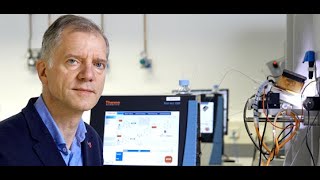
Matthias Mann surveys how mass spectrometry and deep learning are transforming proteomics from bulk tissue to single cells, enabling precision medicine. A 40-protein signature identifies Alzheimer's disease across patient cohorts. Proteomic signatures now outperform traditional biomarkers and imaging for liver disease.
Questions this video answers
Yes. Whenever we have a PTM (or a differentially regulated isoform) we immediately map it onto the AlphaFold‑predicted structure. This lets us see, for example, a regulated phosphorylation site located in a hinge region between two domains, suggesting that the modification could trigger a conformational rearrangement and activation of the protein.
Indeed, many PTMs depend on specific metabolites (e.g., acetyl‑CoA for acetylation, SAM for methylation). By integrating metabolomic data with our proteomic and AlphaFold‑based PTM maps we can start to infer which metabolic pathways are supplying the substrates for the observed modifications in disease contexts.
Chapters
First have Matthias Mann, then we'll have Martin Borg-Jensen on Zoom, and then we will have Alex. Thank you very much. So it's a great pleasure for me to introduce the next speaker, who is Professor Matthias Mann from University of Copenhagen.
Okay, so I start my countdown now. Okay, thank you to the organizers for inviting me to give this talk. It's not exactly my field, but we are kind of technology people in the proteomics space, and we have worked on aging, and I believe our technology and work is relevant to this field. I still see that half of the audience is still talking there and eating, so maybe you could come here. So I'm in two places. I should first say this disclaimer, so I'm going to mention this company that's actually a Danish startup company making some of this single-cell work possible. So, but I say it also when it comes to that. So my group is in two places, and one is just 5 minutes from here with a bicycle, and the same place where Ian Hickson is basically, so next to the Maersk Tower though. And the other place is 1,000 kilometers from here, it's at the Max Planck Institute in Munich. So that's the place where the Oktoberfest is in case you need to plan. Replace it. And so we are working on proteomics, so basically technology-driven group. And we've worked on that for many years. And why is that interesting? Because we can do the same as gene expression can by transcription, but except we're looking at the proteins. And then the proteins are the actual actors in the cell, so you're one step closer to the function. And you can also study many things related to where are the cells and how do they turn over, how do they signal, you know, what are their post-translational modifications, and so on. So we try to— so it's basically old-fashioned biochemistry on steroids, right, because we're looking at everything all at once. So that's what I want to do, and how we do it is shown here. We do that by mass spectrometry, so there are also different kinds of proteomics with antibodies. Or binders, but we do it by mass spectrometry. So we have to do 3 things. We have to extract the proteins from a source, and that could be even dinosaurs or whatever, or it could be stool, whatever. And we extract the proteins from that, and then we digest them to peptides because we can better analyze them in the mass spectrometer. And for a protein, we might get like 30 different peptides that tells us a bit about isoforms as well. And we can, so we use two different platforms. One is the Bruker platform and the other one is the Thermo platform. And we now use something called data-independent acquisition, which has given a big boost to the reproducibility of the data. Once you have the data, this could be gigabytes, you have to analyze them like other omics technologies to find correlations, outliers, and and so on. So our group is working mainly in these three, in these four quadrants here. So we do a bit of, quite a bit of bioinformatics development. And I'll just show you quickly that that's also going in the direction of deep learning and so on because that's relevant to this audience. Then hardcore MS technology development. Post-translational modifications, which are also very important in aging, but I won't have time to talk about it. And then, last 5, 7 years, increasingly we try to go into the clinic. So that's kind of what that means for us. So we do mainly plasma or tissue proteomics with mass spectrometry, and that's to phenotype humans and better understand diseases. Finding new and better biomarkers. This could be prognostic, for instance, or diagnostic. And this is from a review a couple of years ago where we— it's now 5 years ago in Molecular Systems Biology, and that's where we described why that had been difficult at that point. And now there's many more successes, as I'll show. So we have actually worked over the years in aging, and this is, just dug this up for this talk from 13 years ago. So this is, I thought it was a good paper. It has made absolutely zero impact on the aging field. And that's mainly also because it was in a specialized proteomics journal. But so we have different models of aging, In the mouse, it's kind of hard for me to tell how old they are. In C. elegans, it's quite easy to tell. And then we have a human model, and it's also quite easy to tell for us whether they are old or young. But what we did in that paper 13 years ago is that we could measure quite accurately 4,000 proteins in either C. elegans or in humans. So the C. elegans curve is the blue one, so it shows you quite a spread because the old C. elegans looks a bit decrepit, and that also goes along with the deregulated proteome. That's why the curve is broad. But for the mouse, we took 3 brain regions and heart and kidney. We could hardly see any significant changes. So what we took from that is that in the mammalian, like the mouse, mouse keeps a functional proteome to old age and not actually that easy to see significant changes. But that was also with the technology from many years ago. So we work a lot on this technology. So there's some of my students that work on this mass spec platform. We work together with Bruka. And I don't want to go into the details here, but But we're using a high mobility device in front of the mass spectrometer now, or it's the first stage of the mass spectrometer. And then that gives us now a huge increase in sensitivity that leads to some of the advances that I'm gonna allude to. So this is the setup at the Max Planck Institute in Munich. So there's quite a number of these mass spectrometers. Unfortunately quite expensive. And so we have like, it's a bit like a sequencing facility in the old days, except we have a lot of mass spectrometers. So what can you then do? So this is from 2 years ago. So we took actually kingdom of life, like we took 100 different proteomes across the kingdoms of life, and then we we could, and with our fancy workflow there, best workflow at the time. And we, so apart from the genome, so they all had their genome sequenced, we now can say what is the expressed proteome quantitatively. And we could see some common themes across all forms of life. And also kind of interesting that we, in that one publication, we doubled the number of proteins that there was actually experimental evidence for since the beginning of time. And I should also say these two students, they just did this as a hobby project. Okay, anyway, so we, as I said already, we do a lot of software development. I just wanted to get this in that in this field, as in any other field, we believe it's very important to follow open science, and particularly as you get fancy with the with the machine learning. It has to be all open source in our view. And that's what we try to do. And now there's the tools for that. So it's actually also the best way to develop software. It's not only the most ethical way, I would say, but— or responsible way, but also the best way quality-wise. So we work on a lot of things. We also call them alpha ecosystem. So this is for analyzing the mass spec data with deep learning. So that's coming into our field. But you can also do other things with it. And I just wanted to put this in here. So our community has found a lot of post-translational modifications on proteins. So the function of most of them is completely unknown. But with the AlphaFold now, what we could do at least is that we can take, so now every protein, the moment you have the sequence, you can actually get a pretty good model from AlphaFold. And then on the other hand, there's databases of hundreds of thousands of modifications. Now we can put the two things together so we can place all the modifications in the 3D context as shown here. And then that gives you a lot of times a handle on the function, or at least some idea. And we're also happy then there was just recently the 1-year anniversary of the original tweet about the AlphaFold. And they had now highlighted 8 things that people had done with this. And we were one of them with this paper here that came out in PLOS Biology earlier this year. And this is AlphaPEP Deep, so we can do deep learning for proteomics. And just want to highlight this, so don't pay attention to the details, but this is a fast-changing field. But we just put this on bioRxiv, and we have a model shop. So take-home point here is that this doesn't need to be complicated. So when you take this, you can predict anything from the peptide from the sequence, mainly for mass spectrometry. But also for other things with just a few lines of code. So that's becoming very democratic, and here's an overview of where we think that's going, not only in our field but also for biomarker development, which is of interest to some in this crowd. Okay, but now closer to home, what can we do with proteomics? We can, of course, there has been, that has a long and controversial history, the of Theranos. So we can take a finger prick of blood and then we can see whether that's a good measure of phenotyping the human. And the cool thing about mass spectrometry would be, or proteomics in general, would be one test for all, right? Like, if I could quantify a lot of proteins in the blood very accurately and very specifically, that wouldn't only be a test for liver disease. It could be cognitive decline. Decline, it could be aging, it could be anything, right? So that's easy said and very difficult to do. But we started again with that 5, 7 years ago, and this is kind of the idea that you build up this knowledge base. And again, the advantage of mass spec here is that it's very specific because the data is very digital and it's very quantitative. So this is a workflow we described a number of years ago. So I should say, yes, it has all these advantages. The big disadvantage is that we cannot go very deep into the plasma. But we kind of hope to go deeper. There's approaches now to do that. And again, we can make it up with being very quantitative. So this is now, so now we're focusing on liver disease. And so what we then get is that— so we have studied NAFLD and also ALD. And what we get is these volcano plots where we can say something is a new biomarker. We actually did find new biomarkers here. And we get these gigantic correlation maps where we can see, you know, what ends up together and predicts something like. And we find that the proteomics levels are actually a lot of times more informative than the clinical data. But you can use them all together. And they predict each other. So this is now a very recent thing. So that Lili New did here in my group in Copenhagen. And we're looking at— this is an unmet clinical need. You know, when fibrosis begins and starts to be irreversible. And we have all these plasma samples we have paired. Biopsies, so we can say where do the biomarkers actually come from. And the heat map shows you also there's some time delay for some of the biomarkers before they come into the plasma. So, and this is also very complex, but what this shows is that, so this is predictive value by machine learning algorithms, so predictive value of The proteomics is in blue, and all the other measures like ultrasound and liver enzymes in the blood, they are the other ones. So we compared against all of them, and now for the first time ever, proteomics came out on top. So we are better at same level or better than the existing methods that are used in the hospital today. So we're quite proud of that, and that was in collaboration with the group in Odense here in Denmark. And of course, the mass spec is on quite a trajectory. So this was published in Nature Medicine just a few months ago. And Lee made these cartoons about the liver and what you should do. OK, so that was— and then there's a lot of— that was also alluded to. There's a lot of ethical aspects to this because you may not want to know. That you're getting Alzheimer's in 14 years, right? So we have to see, do we extract the maximum knowledge or what does the patient actually want to know and what does the physician need to know? So we also have some publications about that if you're interested. And this doesn't only work on plasma, but it works on CSF as well. Actually works better on CSF and urine because there we can go quite deep. And we have already had Alzheimer's study, and we're now measuring through another CSF study that's 6,000 patients. So there we can just a few microliters and we can quantify very well 1,200 proteins. And we got in that case the 40-protein signature of AD across 3 different cohorts. And what's gratifying to me then, you know, without putting anything in, tau in the CSF came out on top, and that's a good positive control. And, yeah, so I have to rush through this. So now, rest of the talk will be single-cell proteomics and specifically how we can look in tissues. So we have focused on cancer, of course, but you can just substitute senescent cells in your head for that. So, the omics community is generally going into the tissue direction, and as opposed to just cell culture. And these are some different ways how you can get single cells. And usually they disaggregate, which is actually very harsh. And then you need to sort of not lose the single cell. And that applies to transcriptomics as well as to proteomics. There's some different ways how you can not lose a single cell. And then you need to measure it by proteomics in a certain way. So we worked with a mass spectrometer vendor to make the instrument more sensitive. And that's this company I mentioned initially. So we got a factor of 10 by slowing down the flow rate. And we have to have a very small reaction volume to do this. So then we do all this. And we can only measure 40 single cells per day.. But this can be done now, and we can actually do— so this is a proof of principle, came out earlier this year. We can find proteins that are involved in the cell cycle, and it's very quantitative. So it's actually much more quantitative than transcriptomics. That's because every single cell has a complete proteome, but it has very few transcripts per— for all the genes, especially in post-mitotic tissues. Because the cell just doesn't need these transcripts for anything. So that's the leg up. So, and then last, in closing, last story, that's where we put most of our energy, and this also happens to be the COVID of Nature Biotechnology this month, and that's single-cell type tissue proteomics. So what is that? So previously in the cancer context, we looked in, like this is ovarian cancer, and we looked at the cells versus the stroma. We found some biomarkers that could be dragged. So that was good, but there was still 5,000 cells. And of course, we want to resolve this tissue heterogeneity like this. And then this is the team here in Copenhagen and working with Peter Horvath, AI in Hungary. So ideas to use like digital pathology, so you do high-content imaging of your tissue., and then we use the AI to define the cells and cell types. And now we cut it out, and then we use the autosensitive proteomics to actually see what is the proteome, and that is a proxy for the function of these cells. So this is an example. So this is melanoma. So we have all these different regions, and we can actually in the different regions follow the melanocytes all the way to the melanoma cells. So this actually then a big deal, so you can get a lot of data out of a single slide. So this same slide after the AI and staining for some proliferation markers. And then we can get cell type-specific proteomes., and then we can do gene set enrichment, map that back on the picture, and we know what all these cells are doing. So for instance, when the melanoma is very superficial, it's good, and if it's gone deep into your skin, it's very bad news. And, but we can also say what do the melanoma cells do at the surface and what do they do further down, so For instance, further down, they break down the extracellular matrix, as an example. So, and now we are getting towards also single cells in the tissue. And this is just showing, cutting out just a few cells and analyzing, in this case, in liver with fibrosis. Okay, that, yeah, and if you wanted, so we also just recently wrote a review for the 25th anniversary of Molecular Cell.. So if you want to know how we think this fits into the omics, spatial omics. So with that, I'd like to thank our collaborators, and I'd like to thank you for listening to my very rushed talk.
Thank you very much, Matthias. So a question?
Yeah.
This is really wonderful. Have you taken any of the proteomic analysis of your diseases and then applied your AlphaFold and PTM analysis just to see if there are any PTMs that would be enriched or the pathways in those top hits that you find in the diseases?
Yeah, that's exactly what we do. So we, like, whenever we have a PTM now, and it's not only PTMs, but also differentially regulated isoforms, right? So you can immediately put them on the suggested structure. And there's some really cool things. So for instance, you have regulated phosphorylation site or it's known for kinases but also for instance solid carriers. It can be in a hinge region between two domains, right? And then that's what's very likely is that you put the phosphorylation at the hinge region and you have a rearrangement, now it gets active, right?
So it can really lead you in some cases to a function of the protein. I was thinking if there are some metabolites that would be enriched in regulation of those disease-related proteins? Metabolites? Yes, like that are used for the post-mitotic modifications.
Yeah, so that's a good point. We haven't done that yet, but there are mass spec techniques for these metabolites where they sit on the protein. Yeah, we have the last question. So I wonder what your thoughts are on using proteomics as a standard clinical diagnostic tool. Will it remain a discovery tool, or do you think there could be really a routine use in medical diagnostics? Yeah, we actually think it can be routine. So it is actually routine for small molecules like cyclosporine. Vitamin D is always mass spectrometry. And we think this can be the case for plasma proteomics as well. So we want to bring the cost down and make it much more robust. And there's no reason it has to be expensive then. And yeah, we have actually a mass retromer in the hospital here, the biggest hospital, as well as similar in Munich. So that's what we're going to do, but it's a lot of hard work still. Thank you very much, Matthias.
More from Joshua







Scientist Stories: Hans Waterham, The value of phenotypic assays in peroxisomal disorders




Scientist Stories: Joel Zlotogora, Genetic carrier screening programs for reproductive purposes