Scientist Stories: Michael Elowitz, Genetic Circuits in Living Cells
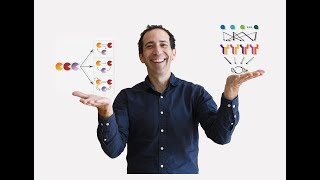
Michael Elowitz describes synthetic genetic circuits that create multiple stable cell states and how natural BMP signaling uses promiscuous ligand-receptor pairing as a combinatorial addressing system. His lab engineered a circuit achieving hepta-stability (thousands of possible states) and discovered that just two BMP ligands can signal to eight distinct cell types by context-dependent receptor combinations.
Chapters
So it's my great pleasure and treat to have the opportunity to introduce our second keynote speaker, Michael Elowitz, who is a Howard Hughes Medical Investigator and Institute Medical Investigator and professor of biology at Caltech, and one of the pioneers of the field of synthetic biology. So Michael did his PhD in physics at Princeton University, but like, I think, physicists of a generation or a few generations before him, took a detour into biology that ended up unlocking some really new territory. The culmination of his PhD around 2000— this is one of these things where I can, like, I can remember the day I read the paper— was a synthetic oscillatory network of transcriptional regulators he called the Repressilator. And this was one of two concurrent papers that essentially founded the field of synthetic biology that has blossomed in the two decades that followed. So just a few years later as a postdoc at Rockefeller, he published seminal work showing that gene expression is intrinsically noisy, and perhaps more importantly, kind of how this noise can serve a purpose, a biological purpose. And again, I think this work once again opened up kind of entirely new areas of inquiry in a second direction. And then his own lab over the last 15 years or so has done pioneering work in a host of other areas, opening up new avenues in areas including intracellular computation, cell-cell communication, cell fate control, and developmental recording, and generally all along the lines of kind of a build to understand synthetic approaches in mammalian systems. And all of this work has landed in many accolades, including the Nakasone Prize, a MacArthur Fellowship, a Presidential Early Career Award, and— most recently the 2019 Sackler International Prize for Biophysics. So just on kind of a more personal note, you know, so I think so for the entirety of my career, Michael's work has been a source of inspiration for me, not only for its pioneering nature, but also for what I would call remarkable clarity of thinking and writing. If for the trainees in the audience, if you want to master a course in how to write a crystal clear paper, I strongly recommend reading papers from his lab. So I'd actually, you know, I admired the work, but I'd actually only never met— I'd never met him until, you know, maybe 5 years ago. But we ended up meeting and then deciding to write some grants together and co-leading a large center together these last few years. And so this is like one of these very intense experiences where you can emerge from it either loving or hating someone. So I'm happy to report that at least I have emerged with Michael not only as one of my favorite scientists, but also as one of my favorite people in science.. And that clarity of thinking and writing and presentation that I referred to earlier that you only see on the paper or the talk. And it's been fun for me to see it, how it can emerge from what seems like noise and chaos only 24 hours before. And I only realized in kind of trying to craft this introduction that that clarity from chaos to some degree mirrors the systems that he actually studies and builds. Anyway, so I'm confident we're due for a wonderful talk and very excited to have Michael here. And I will pass it over to you. Sorry.
So thanks, Jay, for that really unbelievably generous introduction. Sorry, I'm just trying to do the screen share. And yeah, I would say the feelings are entirely mutual. It's been really fun working with you. And it's great to be here. Also at this meeting. So let me just share this here. So I was having some trouble. OK. Hopefully that works. OK. So yes, thanks. Yeah, that was really, I think, the nicest introduction I've ever had. And I really appreciate it. So thank you. So anyway, what I wanted to do today really was talk about work we've been doing, really new work, to try to understand principles of circuit design but specifically principles of circuit design that apply to multicellular systems. This is kind of a, I think, just a really fascinating area, like what kinds of circuits actually enable multicellularity, the ability to make lots of different cell types that talk to each other in specific ways. And this work, and really everything that Jay mentioned and everything in my lab, really, I think, stems ultimately from this seductive, tantalizing picture, this iconic image of the cell as a collection of circuits. This is— this image is from Hanahan and Weinberg's 2000 review on the hallmarks of cancer. And what we've been doing over the years really is kind of two different and I think complementary things. You know, you can kind of look at this, at these, at the cell and try to ask, you know, what are— what's going on with these circuits? What do they do? Why do they use one design instead of another? And so that's kind of an attempt to analyze natural circuits in cells. And we also try to go the other way, as Jay mentioned, try to build our own synthetic circuits and plug them into cells and see if we can program new behaviors. And the fundamental premise for me, or the, you know, which may or may not totally be true, but I think that the hope is that there's really a common set of circuit design principles that both explain why we have specific kinds of circuits in the cell naturally, and also will enable us to program cells in more predictable ways. So that's what we're sort of always trying to kind of head towards. Now for this meeting, I really wanted to focus, as I mentioned, on multicellularity. I think this is an amazing moment right now in biology where, for the first time, thanks to single-cell RNA-seq techniques, including Jay's work, we're able to get maps, really atlases, of all the different cell types in an organism. And thanks to spatial transcriptomics techniques such as SeqFish and others, were able to map where those cell types are in tissues and organs. And thanks to a collection of new editing-based recording approaches, including Gestalt from Jay's lab, Memoir from ours, and others, we're actually even able to kind of look at cells and say a little bit about what their lineage history is and what's happened to them in the past. So we actually know a lot about what cells, you know, what cells are there, where they are, where they've come from. And then in parallel with that, there's been a huge amount of work in regenerative medicine to try to understand how can we steer cells into particular fates. And I think that's summarized in this really beautiful diagram from 2012. A lot's been done since then, but I think one of the themes that's emerged is that, you know, a core set of signaling pathways can direct cells into this huge variety of different fates. So we actually know quite a bit about what's out there and how to push the cells around into different fates. And yet, and yet, the thing that seems so frustrating is that if you ask what are the circuits that establish these fates and allow cells to control which fate they get into, I think that circuit level has been kind of unclear. And so today, what I want to do is talk about two projects, two recent new projects that kind of try to address those questions, one from a synthetic point of view and one from a natural point of view. In the first part of the talk, I'll talk about a synthetic cell fate control system that tries to address the question of what kinds of circuits can establish multiple fates in a cell. And in the second half, I'll talk about what kinds of principles of signaling pathway design allow cells to talk to one another in a very specific way. And so those are the two parts. And I'm going to start here with the first part, which is a system that we call multi-fate. And this is a project that was really led and driven by just a brilliant, spectacular grad student named Ron Zhu. And what Ron started to think about really early on was, okay, if we're going to have a sulfate control system, like, what kind of functions would that sulfate control system have to provide for the subspecies? So the very first thing it has to do is it has to be able to establish multiple multiple states or fates. And what do we mean by that? Well, we mean, you know, if we think about the state of the cell as established and encoded by the concentrations of different transcription factors, let's imagine here there's two transcription factors, A and B, then there should be attractors in the space of transcription factor concentration. So these are points, and if you perturb the cell away from them, it will come back. In other words, there's some kind of feedback that establishes these as attracting points, and therefore you can have multiple states for the same cell. Now that's not enough. We also need to be able to switch cells between those states. That's something that happens in natural systems. And more subtly, you know, there's a lot of properties of natural self-controlled systems that are kind of also really important, and one is that many transitions can be irreversible. So for example, exit from pluripotency is an example. And you also have a lot of hierarchicalism, so things where you have kind of successions of binary fate decisions. So how can you also have a system that enables those kinds of behaviors as well? Third, there's also— we'd like— this is kind of a high-level property— whatever— the circuit should be expandable. That means that once you have this cell fate control system, you ought to be able to add new transcription factors, like imagine a third one, C, here, and expand the number of states. And that kind of mirrors something that happens naturally during evolution, where we go to more complex organisms and they have more and more states. So we tried to ask essentially what kind of synthetic circuit could give you all of these different properties. And to address that question, instead of just making something up, Ron decided to look at what's known about kind of natural cell fate control circuits, and many of them have been extremely well studied. And there were two themes that Ron noticed here. One is that many of these systems— and I'm giving here the examples of myogenesis and pluripotency, but there are others as well— many of them involve promiscuous dimerization of different transcription factors with, with themselves and with one another. So for example, here, MyoD can dimerize with this other BHLH factor, E47, and then activate its own expression, but it can also heterodimerize with an ID factor and become inactive. Okay, so dimerization is important. And of course, the other theme, which is not surprising in a cell fate control system, is there's lots of positive autoregulatory feedback in these systems where these genes tend to regulate their own expression. And so based on that, Ron kind of abstracted the simplest circuit that kind of embodies those two features, and we call this Multifate. And we call this, this particular one Multifate-2, because it has two transcription factors, A and B. So I'll try to quickly describe what's going on here. So let's imagine we have transcription factor A. A can homodimerize, and those homodimers can activate expression of A itself, positive autoregulatory feedback, but in a dimer-dependent way. The same exact thing would be true for B. It can activate itself, but only from these homodimers. Now there's one other feature here, which is A and B, in addition to homodimerizing, can also heterodimerize, and we're imagining that these heterodimers are inactive, they don't do anything, and that allows the two transcription factors to effectively cross-inhibit each other, get to, as you can imagine, giving you the potential for exclusive fates, but to do that at the protein level. The nice thing about this circuit is it's simple enough you can write down equations to describe it that are, that are relatively simple, a set that describes just the dimerization of the proteins and another set that describes the autoregulation by the homodimers of each of the two factors. And if you analyze that system, you can get situations like this. So what's shown here again is the concentrations of transcription factor A and B, and these black— three black dots are stable attractors. So what's going on here is this system in this regime is tri-stable, and any— if you put the cell at any of these three points, it will remain there stably. These other arrows indicate kind of what would happen to the cell if you put it if you put the concentrations of the transcription factors at other points. So just to clarify, make sure it's really clear, the three states here differ in the concentrations and dimerization states of the two proteins. So here you're mostly B, here you have mostly A homodimers, and here you have a mixture. Okay, now what about that third property of expandability? So what we like about this design is that if you plug in a third transcription factor, that also dimerizes promiscuously with the other two, then you can form lots of these different inactive complexes, and you, you can make a system that has more states, as I'll show you, but without having to re-engineer the existing genes. So that's what we mean that it's expandable. Okay, now can you build something like this synthetically? Well, what do you need? Well, first you need some transcription factors that are active only as homodimers but can inhibit each other as heterodimers, And ideally, you'd like to be able to have a little bit of external control with various small molecule inducers so you can manipulate the system. So what Ron did is he went back to the zinc fingers. So there's been decades of work on these proteins, and in particular on engineering them to recognize specific DNA binding sites by stringing together different fingers in succession and programming DNA binding specificity. And so he designed a system in which the zinc finger is fused to an activating domain to make a transcriptional activator, but the binding sites for these are 9 base pairs, which is not really sufficient for them to activate. So the monomers by themselves don't really activate efficiently. Now, if you add a homodimerization domain such as a leucine zipper from the protein GCM4, then they dimerize, and then those dimers now have double the DNA recognition sequence, and then they can activate efficiently. And to show you what this looks like, here's an example where the homodimer activates much more strongly than the monomer. Ron was not satisfied with this, so he added arginine to alanine mutations, which got rid of this residual activity almost entirely of the monomers. So now we have a transcription factor that can activate only as a dimer. Okay, now to add some external control, he swapped out the dimerization domains for FKBP, so you can control dimerization with the molecule, the small molecule drug AP1903, and he added the degrons, which we represent as these little black bullseyes, and these degrons could be inhibited by the drug trimethoprim. So now you can control protein stability, and so in this circuit you can see this is a positive autoregulatory loop, and you can see that the cell, that the gene turns on, which is, by the way, read out by this mCitrine fluorescent protein controlled by an IRIS, it turns on only when you have both the drug, both AP1903 to dimerize and TMP to stabilize. Now, if you try and take that similar circuit, transfect in a different zinc finger that has the same dimerization domain, it can inhibit activation. So you can get inhibition through heterodimerization. So with that, we have kind of the key ingredients for this circuit. And so Ron built the two constructs for the multiplex II circuit and then stably integrated them into CHO-K1 cells using piggyback. And so different clones then have different numbers and positions for integration, and therefore potentially different properties. So I'm going to focus here on just one of the clones that's kind of one of our favorites, and let's take that one. If we, if we analyze it by flow cytometry— by the way, I should have said here that there's two different fluorescent proteins in green and red for the two different transcription factors. So we can then analyze it by flow cytometry, and if we leave out those drugs, the proteins are unstable and don't dimerize, everything's off. But if you add them and wait 3 days, you can see that the cells go into these three distinct states, okay, which are indicated by these three fairly tightly clustered sets of points. And this hopefully will look fairly— resembles fairly closely what we expect in this regime of the model that I already showed you, kind of 3 fixed points. Now it's one thing to say you have 3 states, it's another thing to say that they're actually stable. So to check that, you can fax out each of the states and then culture them continuously for extended period of time. So here it's going out to 18 days, and you can see that each of those 3 states remains stable over time. I think a more interesting and fun way to see, visualize this, is to just make a movie And so here, each of the three— sorry, the two fluorescent proteins is labeled either red or green, and if you're expressing both in that double positive state, then you're yellow. And what you can see in this movie, I hope, is that cells that start in one of these states, as they grow into microcolonies, they maintain those states over time. Just the same thing I just showed you by flow, but hopefully in a more direct way. Okay, what about that property of expandability? That's kind of the one we love. Because it means that this is more than just a tri-stable system potentially. If you add a third transcription factor in the model, you go not just beyond 3— sorry, you go beyond 3 states, and actually with the same exact biochemical parameter regime, you would get 7 fixed points. So the single positive states, the double positive that are on for 2 transcription factors, and a triple positive state in which all 3 transcription factors are on. So that's kind of a prediction of the model. And so to test it, Ron then built this multiphase 3 circuit with 3 transcription factors. Now we're going to look at flow cytometry in a 3-dimensional space, and to make that simpler, we represent it in these hexagons. So here, each of the circles, the color of the circle represents the percentage of cells that are in one of those states. So this is the A-only state, the B-only state, C-only state, the double positive states here, and the one in the middle is the triple positive. Okay, so what you can see here is that if we do that same experiment, which is fax out cells in each of the 7 states and then culture them for 18 days and look what's happened, again you can see the stability. So if you take the triple positive state at day 0 and look at day 18, all the cells are still in that state, and the same for the other states. The only state that's unstable, of course, is the off state where everything is off, and, and that's of course by design. Okay, and once again, let me show you that as a movie. So now we have 3 real colors, which are red, green, and blue, and then different combinations of those give you 7 different colors here. And you can see that cells that start again in any one of those states, they retain and remember that state as they grow into colonies. So this is again a way to see that what we now call septa or hepta stability. Depending on your favorite prefix. Okay, and this is the same thing, just zooming in on the columns. Okay, just love those movies, so I keep showing them in too many different ways. Okay, so we've now looked at this out to more than a month, and the different states really are stable. So again, coming back to some of the more interesting properties of natural cell fate control systems, we were thinking a lot about work on, you know, that suggests irreversibility in many of these cases. So Jim Farrell has done beautiful work showing on the circuit that gives rise to irreversible transitions when you add progesterone to immature xenopus oocytes and turns them into mature oocytes. And there's also, as I mentioned earlier, this process of pluripotency exit as well, irreversible. So something like that can happen in this circuit as well. If we start in this tri-stable regime, and we simulate— these red dots are individual cells— and if we turn down the protein stability, we can control that with trimethoprim in the experimental system, you can see you go from the double positive state to the single positive states, and then if you restore trimethoprim to its high levels, the cells stay in those single positive states. That's obviously a simulation, but if you actually do that experimentally, you see something like that. If you start in the double positive here and then lower the trimethoprim, cells exit, go into the single positive states, and then they stay there if you restore high trimethoprim. Now, the other aspect here is hierarchical differentiation as immortalized in this Waddington diagram and seen in many different systems. Systems. And something like that can also happen here if you progressively reduce the trimethoprim. So here's the 7— the septostable regime again. We go down a little bit in trimethoprim, you can destabilize the triple positive but leave the other states. And if you go down a little more, you can destabilize the triple positive and double positive but leave the single positive. So what you're doing is hierarchically destabilizing the more multipotent states and going to states that are characterized by fewer and fewer transcription factors. So this kind of resembles that behavior. Okay, now how scalable is this design actually? Well, you know, I showed you 2 going to 3, and we didn't have to change any parameters to do that. In the model, you can of course take it as far as you want, and this is just a plot to show you that in principle, this design actually, if you increase the number of transcription factors, you know, to 10 or 11, you can start to get to thousands of different states. So we think for that reason that this, this design really has some, some nice properties. Okay, so just to summarize this part of the talk, what I told you is that multi-fate is a naturally inspired synthetic circuit design. So again, we sort of made it up, but we sort of didn't. We sort of stole it from, from nature. It gives you controlled state switching, irreversible transitions, a lot of properties that are reminiscent of natural sulfate control circuits. One of the things that's most striking to me is the degree to which this simple model can actually predict the behavior of the experimental circuit, which really shows that the core principles that it's working through are pretty fundamental, pretty basic, just basic to the architecture itself. And of course, the design scales, and for that reason, we think it could be interesting to use as a basis we're starting to build really more complex synthetic multicellular systems. Okay, so now I'm going to switch to part 2, and having established multiple states, a natural question is how do you get those different cell states to talk to each other in a specific way? And I think, you know, over the years, a striking result in development is that across many different developmental processes, there is this handful of signaling pathways—many people have remarked on this—BMP, Wnt, Notch, FGF, Hedgehog, and so on—that seem to be used again and again and are also major, major modes of control of cell fate in stem cell biology. And so when you, when you think about that, I think to me the perplexing mystery here is how is it if these same pathways are used everywhere, you know, all— most— many, many cell types are able to receive these signals. The ligands are found in many different places in the organism. How do you get such specificity, such really tight control? Another way to say it is, how can you get addressing— how can a cell address one of these pathways or signals to a specific cell type and not get a lot of kind of confusion about who's supposed to receive which signal at which time and in which place? Now, if you were— you and I were going to design an addressable signaling system, I think what we would do is we would have a system where we just have molecular specificity. So we'd have a collection of different ligands, each of which could address a different receptor, and then if I want to address cell type A, I'll use ligand A, and so if I want to address cell type B, I'll use ligand B. This is very reminiscent of the SynNotch synthetic system that Wendell Lynn's group has developed, for example. The problem is that this is not the way natural systems seem to work. So if we look at BMP or notch or Wnt or FGF, we always see this, this kind of completely opposite behavior, in which you have, you do have multiple ligands, and you do have multiple receptors, but you do not have a one-to-one relationship. You often have a many-to-many relationship where, you know, the ligands and receptors are kind of promiscuous in terms of their specificity. Specificity. And furthermore, it's not that only one ligand or only one receptor is used at a time. It seems like the ligands appear in combinations and the receptors are coexpressed in combinations as well. So I want to talk about this in the context of one of our favorite signaling systems, which is BMP. That stands for bone morphogenetic protein. It's named for, for bone because, you know, these were discovered through their ability to ectopically induce bone formation, but They're not bone-specific. Like all of those pathways, they operate in many different contexts. If we look at the BMP system, there's a collection, depending on how you count, of about 20 different homodimeric and heterodimeric ligands, and those ligands can interact with a combinatorial set of receptors. The receptors are really each composed of 2 Type I and 2 Type II subunits chosen from a menu of 4 Type I and 3 Type IIs. And the mystery that got us into this is that why is it, you know, that you would have this crazy design given that all of these different ligand-receptor combinations seem to do the same thing? They seem to activate downstream effectors called SMADs, so it seems like you're losing information here, and, and we were wondering why, you know, what purpose this design could possibly serve, and that's where Yaron and Tebi came in. So Yaron is just a brilliant was a brilliant postdoc, now he's a brilliant, even more brilliant, PI at Weizmann with his own lab, and we started looking at, kind of, what happens when you combine pairs of ligands together. So, here's a double titration of BMP4 and BMP9, and you can see that as you vary the doses of these two ligands together, they interact in the most boring possible way, they're additive, so that, that means it's as if they're really the same thing.. But in other cases, you know, here's BMP4 again on the x-axis, here's GDF5, you find more interesting interactions. So for example, GDF5 can inhibit activation by BMP4 in a dose-dependent way, giving you a kind of ratio metric response. Or you can get situations like this where either ligand can activate, but the two together neutralize each other's effects. So I'm going to go kind of fast through this just because we've already published it. But the basic idea is we could explain these sorts of computations. So the way in which the pathway computes a response to multiple ligands, in terms of the independence of the affinities for binding and the activities of the resulting complexes. So, for example, consider this imbalanced behavior. Imagine two ligands, a blue one and a green one. If the blue one prefers to bind to this receptor on the left, the green prefers to bind to this one on the right, but if you bind to your preferred receptor, you're only weakly active in terms of your kinase activity. If, on the other hand, blue had bound to its less preferred receptor, it would be more active. So, in that regime, you can have, you know, if the cell is exposed to only one ligand, it can make a mixture of weak and strong complexes for either of the two ligands individually, but when exposed to a mixture, the affinities can cause the ligands to sort out and make predominantly the weaker complexes, and that's how you get— can get a dip, for example, at intermediate mixtures. So, in that way, we can kind of understand how these functions could come about. So that was the first kind of first observation. The second observation is that the functions are not fixed. So different cells, if you perturb which receptors are expressed in the cell, you can convert one response into another, either by knocking down receptors or by ectopically expressing them. So these functions are kind of programmable and can change depending on receptor expression. And we were excited by that idea because what we started to think about was that if cells that have different receptor profiles respond to different ligand combinations, then maybe different ligand combinations could selectively activate different cell types. These are essentially the same statement, just written in opposite ways, but I think if you write it the second way, you start to think about it as an addressing system. And one reason to think something like that might be happening is if you just take cell lines— these are 3 cell lines that we had in the lab, there are 2 of them are derivatives of our favorite line of mammary epithelial lines from NMUMG perturbed with different receptor perturbations. The third one is mouse embryonic stem cells. Each of these heat maps is just like the heat maps I already showed you. It's just a double ligand titration, but they've just been thresholded and false colored in red, green, and blue so that I can overlay them. If we do that, what you can see is that depending on where you are in the space of the concentrations of these two ligands, you can activate mainly one line, the other line, those two, or all three. So with two ligands, you can kind of address four different ligand— sorry, four different cell types or cell type combinations. So that's suggestive, but it doesn't really explain what's going on. So at that point, Christina Su, who's really a brilliant MD-PhD student, decided to try to think about this mathematically. So she made this very minimal mathematical model of the circuit, in which you have parameters that are the affinities for binding for each of the possible ligand-receptor combinations, and you have activities for the resulting complexes. And then she asked on the computer whether it's possible, like, how powerful this could be as an addressing system. In other words, how many different cell types can you individually activate with just two ligands? Okay, you know, if this was a one-to-one system, the answer would be kind of 2. But here, you know, what we do is on the computer, we just, we just make a kind of tic-tac-toe board in ligand space, and we ask whether we can identify biochemical parameter sets and a set of receptor expression profiles for 8 different cell types such that each one will light up only at one space and not overlap. So if you do that, you can kind of, you can perform this optimization on the computer, get these receptor profiles, and then get these heat maps that selectively respond at the target place— locations in ligand space, more or less, not perfectly. Okay, so what's shown here really is that two ligands can independently address about 8 cell types in this example. So what I'm showing you here is that with this promiscuous architecture, you now have this kind of specificity or addressing mechanism, in which combinations of ligands are the messages. Those are what address specific cell types, and the cell types are defined by combinations of receptors. So it's a very combinatorial view of this kind of addressing property. So this is attractive, but I've really mainly demonstrated this to you just using a very, very simplified model, and so we really started to want to think about this in the real system. We kind of forced to go to understand the actual collection of real ligands that really exist. So this cartoon just shows examples where some, in some different organs, where some of the different combinations of ligands that are known to be present in these systems. And so, you know, we wanted to know kind of how do the actual ones behave, and we focused on this set of 10. It's incomplete, but it covers a lot of the most studied ligands, and This is where Heidi Klump comes in. She's like just an absolutely fantastic grad student, and she was, you know, trying to think like, how do we think about this whole system of ligands? It's very complicated, and it has just a lot of components, and she was inspired by work from Roy Kishony's lab, looking at a totally different context of antibiotic interactions, and they showed that if they looked at pairs of antibiotics together and classified them by their— the synergy or antagonism of their interactions, they could classify the antibiotics into groups that actually corresponded to their biochemical mechanisms of action. In other words, just by looking at interactions, you, you could learn a lot about the system as a whole. So could we do that with ligands? So I'm going to skip a huge amount of work that Heidi did to kind of set up the system and pipette automatically all kinds of combinations of ligands and come up with a scale for synergy that's appropriate to the ligands, and receptors. I'm skipping all of that. So here's a matrix for NMUMG. So what's shown here in the black in this column is the strength of individual ligands when you just add them individually, and in the matrix what you're seeing are the pairwise interactions. So the fact that there's a lot of gray in this matrix means that many of the interactions in this cell line are additive or kind of neutral, but you also see these red and black squares. Those represent antagonistic or even suppressive interactions. Now, at that point, we don't want to just stare at matrices, so we tried to think about a new representation that would allow us to think about what's going on a little bit more clearly, and we call these equivalence groups, and we write them— we write the ligands around the edge of this donut here, and the idea is that ligands that are in the same equivalence group are effectively equivalent to each other. They interact additively with each other, and they have the same kind of interactions with the other ligands. And so what you can see here is that you can break the set of 10 ligands up into 5 equivalence groups that are just defined by, again, differences in individual activity and interactions. Okay, so that's already kind of a simplification. Now, what's really interesting is that these equivalence groups are not universal. So if we do the same exact thing, but in a different cell line, in this case mouse embryonic stem cells, you start to see different kinds of interactions. So I should say, mouse embryonic stem cells differ from NMUMG cells, which I just showed you, in that they have less expression of ACVR1 and BMPR2, two of the receptor subunits, and more of ACVR2B. So they differ in three receptors, and we can see that now we start to get synergistic interactions. These are these green ones lighting up, and we still have a lot of additive interactions, but we've also lost some of the antagonistic interactions that were present in NMUMG. And so if I compare the two to each other, I just want to highlight the fact that whether two ligands are equivalent to each other really is context dependent. So here in NMEOMG, BMP9 was equivalent to 5, 6, and 7, but here in ES cells, it becomes non-equivalent because, of course, it has these synergistic interactions. Similarly, GDF6 was kind of in its own group in the NMEOMGs, but here it's kind of merged in and become equivalent to GDF5 and GDF7, and that's because it's kind of lost this inhibitory or antagonistic interaction with BMP10. So what I'm trying to say here is that if you want to think about these ligands as a system, we can think about them in terms of equivalence groups that are contextual, that depend on the receptor context. And Heidi went and actually did this now for a total of 7 different cell contexts and counting, and you can see a lot of variability, and in particular, you can start to kind of rationalize some of these changes. So if you knock down ACVR1, that moves you from NMUMG to kind of one step closer to the ES cells, and you can see that ACVR1 in NME MGs was effectively masking these synergistic interactions, because when you knock it down, they start to light up. So we can start to kind of connect receptor profile with, with ligand— effective ligand interactions. Now, does this tell us anything biologically? So one of the things that we're kind of interested in is understanding whether we can use this representation of the system to make sense of sometimes confusing observations that people have. Here's one example from literature where BMP9 and BMP10— these are actually the most similar ligands by sequence, but it was shown that if you knock BMP9 into the BMP10 locus, then it could replace BMP10 functionally in the case of vasculature formation, but not in heart development. Okay. So it's— they're equivalent in one context but not in another context. Again, this is from developmental studies. And that kind of— we can kind of rationalize that potentially in with these equivalence groups, because if we look, the endothelial cells express this receptor subunit ACVR-L1. If you add that, you find that that kind of puts BMP9 and 10 into the same equivalence group. So it kind of makes sense that they would be able to replace each other. In NMUMGs whose receptor profile is similar to that of heart progenitors, you find that 9 and 10 are different because BMP10 has acquired all of these antagonistic interactions. Another example is like in joint formation, where GDF5 has this property of being able to kind of activate cells, you know, in these kind of distal region, but inhibit BMP signaling in the proximal region. And those two regions are different in terms of which receptor subunits are present. So if we look up what's going on with GDF5, you know, when we add BMPR1B compared to without BMPR1B, we see that GDF5 becomes active with BMPR1B and it loses its property of inhibiting activation by BMP2 and BMP4. So this is just to say that we can start to hopefully explain some of the behaviors that people have seen. And I think as we build out these equivalence groups more completely, we might be able to kind of more rationally predict what these ligand combinations are doing in different contexts. So towards that end, what really the dream is here, for me anyway, is now that we have these cell atlases, it would be nice to be able to make a model that would actually predict how any cell type, any cluster here, would respond to any ligand combination based on the receptors and other components that it expresses. So in other words, you could take a cluster, see what receptors it expresses, and then predict what kinds of ligand combinations might selectively activate it. And I think that's exciting because it might suggest that we could manipulate cells ourselves using principles of combinatorial control that may be present naturally. Okay, so just to conclude the second part, what I told you is that these promiscuous ligand-receptor systems are computational devices. They're actually computing functions of combinations of ligands, a little bit like a very shallow neural network, if you want. That in the model, ligand combinations can selectively activate specific cell types, so it's a kind of a combinatorial addressing system. That we can start to make sense of this confusing zoo of different ligands and receptors by using this representation in terms of equivalence groups and interactions. And most of what I told you here in this section really is not that specific to BMP. I think that's important, because a lot of these other pathways also have a lot of the same features of multiple ligands and receptors that interact promiscuously, and so we're, we're interested to find out whether we can generalize some of these principles. Okay, so both of these stories are on bioRxiv— actually, all three that I told you about. And I think that the larger conclusions here for the whole talk would just be— I just kind of emphasize how, you know, a lot of circuit designs in nature are really not intuitive immediately, but they can be understood, and maybe they can even be borrowed or stolen to give us better rational design of synthetic circuits to start to program new cellular behaviors. And I think the other big frontier here is whether we can start to combine these modules to really start to program more complex pattern-forming formation and multicellular development ourselves. Okay, and with that, let me just thank everybody. So as I mentioned, Ron Zhu really, really developed that multi-fate system from scratch, just a phenomenal student. And we had a great collaboration with Jesus, a summer student, and Jordi Garcia-Ojalva, our longtime amazing collaborator. The addressing Computational addressing was done by Christina Su, and the equivalence was by Heidi Klump. All of this was done in a close collaboration with Yaron Entebi and with James Linton, a fantastic senior scientist in the lab who's been working on all of these projects, and through a collaboration with Arvid Morgen. So thanks very much.
Amazing talk, Michael. So, so I'll just encourage people to post questions in the Q&A and reminder to put your training level, if that's okay. And so I'm just— we've already got a bunch of questions there, so I'll just start in here. So this first question is from Jose Fabricio Lopez, a PhD student at the Sowers Institute. How does noise interfere with determining a synthetic circuit? Can it provide lagging that inhibits irreversibility?
Right, so this is a great question. It's like, you know, these circuits are— everything in biology is stochastic to some extent, and the point of the self-made control circuit is in a way to force cells, even despite stochastic fluctuations, to come back to these attractors. And so the nice thing with the multi-phase design is that it's pretty robust to noise. In other words, those attractors are fairly tight and fairly stable. They are not perfect. You still can have cells escaping from those cells at very low rates. And you can, as you tune the parameters, you can take advantage of that to kind of control the rate at which cells may transition from one state to another.
Right. Great. Another question from Abel Jansma, PhD student at Edinburgh. With respect to the equivalence groups, how are these 4 different classes of interactions put on a 1-dimensional scale from -1 to 2?
Oh, great. So this— yeah, the question is about how you should define epistatic interactions, and this is a much longer discussion. It's in the paper, but very briefly, what we try to do to make the experiments tractable and kind of compress what could be a complex response to multiple ligands into kind of a one-dimensional scale, is we look around a rim, a contour of high total ligand concentration, but varying the relative levels, and then we essentially just look at how much the maximal or minimal response deviates from what you would expect given the individual ligand concentration, or the individual ligand effects, and Yeah, I mean, this is a really long discussion, unfortunately, but I'd be happy to talk about it more. But yeah, it's a little bit confusing because you're at saturation. I'll tell you the subtlety: you're at saturation for the individual ligands, so to see a synergy or an antagonism, it means it has to go beyond saturated value or dip below it. So anyway, that's— I'm just making it more confusing. I'm happy to talk about it offline.
Yeah, so everybody can contact Michael if you want to talk about it further. Question from Giancarlo Benora, Yiposaki Udeb: Do you think that the combinatorial nature of ligand addressing based on the different concentrations of ligands applies to how morphogen gradients in early development work, for example, early developmental syncytia in the fly?
Have you thought about looking at this context? Yeah, this is a beautiful question. I think it gets to exactly what's going on. So these— I really appreciate that you pointed this out. So these BMP ligands are morphogens. They're produced at one site, they diffuse and spread. And in many natural contexts, it's just almost always the case that there's multiple BMP ligands that are present in the same area at the same time. So the way we're thinking about that is what it means is that if you imagine you're a cell and you're there in the tissue, and you're just sensing the local ligand combinations, if different ligands diffuse at different rates or are secreted from different locations, what might be most informative about your position is not the absolute concentration of ligand in your neighborhood, but really the relative concentrations of multiple ligands in your neighborhood. So the idea we like is that what cells are trying to do is tune in to that relative concentration information and use that as the— that's the thing that carries the information. So that, I would say, is sort of speculative, but that's kind of the idea that we think is interesting. And it's something that, yeah, that I think potentially explains why you always see multiple ligands. But that's a speculation, just to not get in too much trouble.
Questions keep coming. Question from Jake Young, postdoc. Would there be information in the noise of your system by analyzing the fraction of cells that managed to escape escape the attractors?
[Speaker:JOSHUA ELKINGTON] Yes. So yeah, that kind of connects to the earlier question. So yes, cells can escape. And depending on the parameter regime you're in and also— so for example, if you make the circuit more asymmetric by changing the relative gene dosage of one component relative to another, then you can make states that are kind of, let's say, marginally stable. And then those transition rates are telling you something about the basin of attraction of each of the attractors relative to the magnitude of the fluctuations in transcription factors.
So yeah, I think the answer is yes. Well, Eileen, you want to ask the next question? I see your hand's out there.
Yeah, great talk, Michael. So I guess it's related to kind of two questions ago. So the combinatorial gradients and the encoding in this molecular, let's say, promiscuity that you showed us. I'm just wondering, have you also put into the model, because you know, this is happening like downstream of all of these signalling cascades is the transcription factor, you know, like phospho-SMADs, and they are typically also have heterogeneous partners and have cooperative interactions, as you know very well. So I'm just wondering, you know, because it's, you know, it's very interesting to think that this is happening at the ligand level, but this is also happening at the nucleus level, and if you combine that level of combinatorics and promiscuity, you know, what do you get at the end?
So have you put that into your model? Okay, I agree completely. We have not really— I mean, we focused, like you said, on that ligand-receptor interaction level, but I completely agree, and there's additional, you know, first of all, there's multiple SMEDs that could be doing different things, as you know, and we kind of ignore that. That's important. And then second of all, you can also, you know, once you get to the nucleus, you can integrate signals from Wnt and BMP and, you know, cross pathways. And so I think the spirit of what we're trying to do is just kind of very minimal bottom-up, but I, you know, in real life, of course, all of those things probably matter. So I don't have a good answer for you. I think what we're trying to do is keep it as simple as possible until we run into something we cannot explain and then and see what we have to add. But I think what you're saying is completely right. Thank you.
So many great questions here. I'm definitely not going to get to all of these, but I'll try and get through a few more. So a question from Ben Hitz, language question. This is a good question, though, I think.
What's the difference between fate and state? OK, I knew that was— I was trying not to stumble into that trap. Yes, I know. I mean, this— I've seen there's been a few pieces in different journals about kind of having people discuss what's a state and what's a fate. I don't— for our purposes here, I don't want to get into it because I think states somehow people think of as kind of smaller differences and or maybe less stable. And fates, I think, more like, you know, I don't know. Particular liver cell type or something. But I think for our purposes, I'm trying to just define what I mean in terms of these attractors and stability properties. So I can imagine you have states that are stable that act like this or larger fates as well. But I think the nomenclature is not totally clear, at least to me.
Interesting question from Maria Gutierrez. Arsoulis from faculty at Boston Children's. In transcriptomic datasets, we are often encountering cell states that are better defined as a continuum. And this— I actually had a similar question about the first part of the talk about whether there are kind of like semi-stable versions that you can live on some part of the overall graph without being in a hole. So I guess, yeah. So have you thought about models that lead to this continuum?
Yeah, I would say I think I completely agree that that's important. It's a real feature of real systems. It's not present in multi-fade as we've defined it, but it is something we should probably try to look at and think about. And yeah, I think that's important, but we don't really have anything on it.
I know we're a little bit over. Why don't we just have one more question? The rest we can kind of punt over for answering offline. So this question is from Mingyi Song. Who's a PhD student at University of Toronto. How do you see the cell intrinsic cues working together with cell extrinsic cues and cell lineage specification? Do you think effectors of signaling pathways form heterodimers with lineage-specific TS, or they act independently, sequentially, feedback loops, but not directly interacting in the context of cell fate specification?
Well, it could be system— let's see, what do I want to say about that? That's— how do I think about it? Well, I'd say starting functionally, I mean, what we know empirically is you, by controlling the signals, you can certainly steer cells into different fates. So that's kind of at the high level. Now, I think what you're asking is mechanistically, how does that come about? I think, you know, if you take a look at transcription factors like the HES genes, for example, like Notch, as you know, activates HES, HES1, A1, HAL, all of these BHLH transcription factors, and then those become regulators of cell fate. That's just a very, you know, so that's an example where I think to answer your question, the signal goes through a transcription, you know, then activates a transcription factor which can then control fate. However, you know, the signal terminal, the pathway terminal entities like the SMADs and Notch intracellular, those are also transcription factors themselves. So they can also cooperate. But I don't have a good answer, as I guess you can tell, to that in general. But I think it's a really good question that somehow to map out that decision-making layer downstream of the pathways.
There are more great questions in the Q&A that I won't be able to get to because we're over time, but maybe I think those will automatically get punted over to the Slack and hopefully we can pick them up there. But I'll just on behalf of organizers, Hopi, Christina, John, and myself, again, just thank both Edith and Michael for two really remarkable and inspiring keynote talks and two very different topics, but really pushing our minds here on how things work and how they can work. So thanks again. And I think we've got a little break here. And if
More from Joshua







Scientist Stories: Hans Waterham, The value of phenotypic assays in peroxisomal disorders




Scientist Stories: Joel Zlotogora, Genetic carrier screening programs for reproductive purposes