Scientist Stories: Neville Sanjana, New Frontiers in Pooled CRISPR Screens
This content was created by Joshua Elkington. This content was uploaded by Joshua Elkington. This is a YouTube recording (title: "Scientist Stories: Neville Sanjana, New Frontiers in Pooled CRISPR Screens") of a conference talk given by Neville Sanjana (New York Genome Center / NYU) at AGBT. Recorded/created 2023-01-20, the presentation reviews genome-wide pooled CRISPR knockout screens and follow-up validation, a SARS-CoV-2 host-factor screen and approaches to translate hits into therapeutics (drug repurposing such as amlodipine and inhibitor testing), multidimensional phenotyping (e.g., Excite/CITE-seq) to uncover shared mechanisms (cholesterol biosynthesis), and RNA-targeting CRISPR (Cas13) screens and guide-design models for transcript-level perturbations. The excerpt includes a short moderated Q&A with the host (John) and mentions key contributors (postdocs Jarko Danilowski, Tristan Jordan, Harm, Alex) and related collaborative work (e.g., hemoglobin/CRISPR therapies).
Chapters
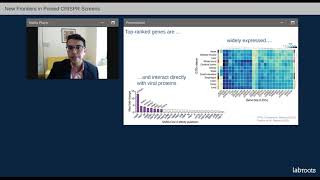
Hi, I'm Neville Sanjana from the New York Genome Center and NYU, and I just want to thank the organizers of AGBT for inviting me here to present some recent work from our lab on new frontiers in CRISPR functional genomics. So just kind of to have a 10,000-foot view, A lot of the work in our lab is just geared around one question, which is how can we efficiently identify which regions of the genome drive disease? So in human genomes with, you know, 3 billion letters with 20,000 genes, how can we sort through those genes in an efficient way, or non-coding regions in an efficient way, to find drivers of cancer or genes involved in neurodevelopmental disorders? These are the kind of questions that we're interested in. And the tool that we've been using for almost the last decade now has been genome editing-based tools, and in more recent years, CRISPR-based tools, which act as programmable scissors to target specific regions of the genome and edit DNA. And the reason why there's been so much focus by our lab and many, many other labs on CRISPR-based tools is is because of their inherent programmability. For example, Cas9, the well-known CRISPR DNA editing enzyme, targets specific regions of the genome by a short guide RNA or a single guide RNA. And so for example here, the bases that are shown in blue, Cas9 uses these to find homology to a region in the genome and can make a cut in this region that is then traditionally repaired in human cells by non-homologous end joining. And if that cut happens in a protein coding region, that can result in targeted gene knockout. If it happens in a non-coding region, it can result in a small indel mutation with some mutagenesis. And what's really nice about this RNA-guided system is that these short RNAs are quite easy to produce. We can take advantage of decades of advances in oligonucleotide array synthesis technology to just print out thousands, up to millions of these guide RNAs to target them to regions all around the genome. And so what we did now 6 or 7 years ago, what I did as a postdoc in Feng Zhang's lab along with Ophir Shalem, who's now at UPenn, are genome-scale CRISPR knockout screens. So to print out these CRISPR libraries of guide RNAs that target Cas9 to all of the 20,000 genes in the human genome to create loss-of-function mutations in those genes and let us kind of explore whether those genes drive different phenotypes and different diseases. And most of this work has been published, and so I won't go into too many details, but the initial work really started with some questions around drug resistance and specifically therapeutic resistance in cancer and also looking at synthetic lethality, so gene-by-gene interactions in cancer growth. But these kinds of phenotypes are not just limited to things we can do with human cells in a dish. We also have organismal phenotypes, things like metastasis that require different organs, or looking at multicellular interactions, things like immunotherapy response. So how do mutations in a tumor cell affect its interactions with members of the immune system like T cells. And in recent years, we've also focused heavily on things outside of genes, so not just looking at targeting specific genes, but targeting non-coding regions that we think might be regulators of specific genes and trying to understand how those interactions happen and the mechanisms behind them. So today I'm going to focus on two different frontiers, as I call them, for pooled screens. One of them is something that's affected a lot of us. It's a project that focuses on COVID-19, and it is a genome-wide CRISPR screen for host factors for COVID-19, but really focuses on one aspect that's something that we've been wanting to do for many years, which is how do you take these target genes from genome-wide CRISPR screen that you identify and quickly move them through a drug discovery pipeline? And I'm going to show you two different ways that we've gone about this to identify new COVID-19 therapeutics. And then in the second half of the talk, I'm going to tell you a little bit about something that's different using CRISPRs that don't target DNA but instead target RNA and using them for high-throughput transcriptomic screens. So starting with the COVID work, of course, you know, it's, everybody I think is very optimistic at this point with lots of hope with different vaccines that all have very, very high efficiency at preventing serious disease. But even with these vaccines, we still have a lot of people that are coming down with COVID-19, and we still need more effective therapeutics to treat them. And so some work that we started really at almost the beginning of the pandemic was to understand the key host factors. So viruses, of course, don't just— they're not free-living organisms. They need a host to be able to replicate and carry out their life cycle. So we wanted to understand which human genes of all 20,000 genes in the genome are important for that viral activity. And then we wanted to take those genes and translate them into actual therapeutics. And also to look whether, you know, even if there's different host genes that seem to be unrelated do they function through common pathways and are there common mechanisms underlying resistance? And this work was led in my lab by a very talented postdoc, Jarko Danilowski, and co-led also by a talented postdoc, Tristan Jordan, in Ben Tenuver's lab at Mount Sinai. This has been a really awesome collaboration we've had with the Tenuver lab. So here's kind of what the screen looks like from beginning to end. So we took one of the genome-wide CRISPR libraries that we made, a second-generation library that we had made a couple years ago that can knock out all human genes. We went ahead and we packaged this into a lentivirus. We transduced human lung cells, A549 cells, that overexpress ACE2, the receptor for SARS-CoV-2, and I'll show you in a second why that's so important. Then after we've given a few days for CRISPR to have its effect, knock out the gene and deplete protein, we went ahead and challenged these cells either with SARS-CoV-2, and this is a virus that was isolated from a patient in Washington, so it's a full-on replicating virus, either challenge it with the virus or with a control, and then we just want to see what genes come out that are like, say, this yellow gene here, which are enriched, which when you knock them out, they allow the cells to thrive even in the face of the SARS-CoV-2 virus, which normally is going to kill these lung cells through its cytopathic effect. And the reason why we chose to use these lung cells that overexpress ACE2 is because work done early on in the pandemic had already shown how important ACE2 is for viral— for effective viral infection and entry. So this is staining for the N or nucleocapsid protein of the virus. You can see really only these human cells that strongly express ACE2 is the virus able to get into. And if you have cells that don't really express ACE2, you don't really see entry by SARS-CoV-2. So this was the one kind of positive control that we knew about going into the screen. And of course, coming out of the screen, we get this ranked list of all the 20,000 genes. And I'm just showing you here on this slide the top 50 of those 20,000 genes and kind of trying to place them within the life cycle of the virus. And one thing that's really nice to see is you can see ACE2, which was ranked number 8 out of 20,000, is an essential gene, as we'd expect it to be, because it's involved in this earliest stage of binding of the spike protein to the human receptor. But what you can also see is that there are certain pathways and certain complexes where we actually see a lot of genes with similar names, like all of these ATP genes, for instance, which are all members of this vacuolar ATPase family. And so this is really nice because it, even though we didn't know at the, initially we didn't know too much about these genes, it was very reassuring to see multiple genes that work together in pathways like this ATPase or retromer and endosome or the commander complex, that we would get either multiple members of the family or all members of this protein complex family. Some other just very quick things to note about these top-ranked genes is that most of them, but not all of them, are widely expressed across human tissues. This is data from GTEx using about 10,000 different individuals' tissues with RNA-seq data, and also with looking at viral interactome data. So this is mass spec proteomics from Nevan Krogan's lab at UCSF. We were able to see that many of our top-ranked genes also directly interact with some of the viral proteins, having protein-protein interactions. So that gave us some further reassurance that we were on to something. Something here. Of course, the screen is really just a first step, and it lets us test a lot of hypotheses very quickly, but now we wanted to go into detail and really understand, you know, what was the degree of resistance that was conferred by knocking out these specific genes. So here we turn to a specific imaging assay where we would just image the nucleocapsid protein of the virus after infection, in either cells that have received a control perturbation or that were targeting some of these top-ranked genes. So here's how this data looks. So we selected 30 genes— this is the entire dataset— from the top 200 genes. And these were selected based on both rank and then just kind of looking at some interesting genes. And what was really remarkable is that all of them, to at least some degree, reduce antiviral entry. And here we selected new CRISPRs. These were not the same CRISPRs that were in the library, so we kind of try to avoid any sort of off-target effects by having a new set of 3 CRISPR constructs different from the original 6 CRISPRs we used for each gene in the pool screen. And so we were able to see some with very, very strong antiviral effect and others with somewhat less effect. I'm not going to show you the data here, it's in the paper already, but we also did an orthogonal validation using pools of siRNAs. Of course, finding these gene hits and validating them was very important, teaches us something about the required host genes and the virus-host interaction, but again, our major focus coming into this was saying, you know, we want to learn about the host genes, but we want to be able to quickly translate these, how can we use these to find new therapeutics for people that are suffering right now from the pandemic. And so one thing that Jarko did is he looked at the top 500 genes from the screen. So these are the genes that when you knock them out, they confer the greatest degree of resistance to SARS-CoV-2. And he looked to see— he intersected these with a database of drugable genes and was able to identify for a significant number of them existing inhibitors that we could purchase and test out in the lab. And so we went ahead and did exactly that. So we selected about 10 of these genes, and for wherever possible, we tried to get multiple inhibitors so that, you know, that we would be able to focus on, you know, the best possible inhibitor within each class. And what you can see here, so here I'm showing you a change in SARS-CoV-2 RNA. So this is a very sensitive qPCR-based assay. And we can compare it here with remdesivir, which is a drug that targets the viral polymerase. And you can see remdesivir has a very, very strong effect, many orders of magnitude. But you can see that some of our top-ranked genes, when we find inhibitors to these genes, we also get a very strong effect beyond 100-fold reduction. And you might be looking at this data and think, well, none of this is really quite as good as remdesivir. I think in this assay, certainly that, that is true, but Remdesivir does have some pretty significant toxicity. So it might be actually a better thing to do is to think about a cocktail similar to what's used with other viruses like HIV, where maybe we can lower the dose of one drug and also try to prevent escape mutations by putting together a cocktail with multiple drugs that target multiple different dependencies between the virus and the host. So this was kind of one very direct way to find novel COVID therapeutics was let's just inhibit those top genes that we know are important for the virus. Another way was a little bit more subtle. So here there were some genes where we really didn't know the mechanism. We didn't understand the mechanism and we didn't have a direct inhibitor of some of these genes. So here we turn to this technique called ExciteSeq, which we had developed in collaboration a few years ago with the New York Genome Center's Technology Innovation Group. And what this allows us to do is profile changes in cell state in the transcriptome and the cell surface proteome upon perturbation with a particular CRISPR guide RNA. So if you look at this dense heat map down here, you can see every column is a different cell, and the guide RNA or the gene that's being perturbed is actually listed at the top, and every row is a differentially expressed gene. So you can see that different cells that receive the same perturbation, like this one for ACE2, they have a pretty similar differential gene expression profile. And some of them, like these two members of the ATPase, have very, very similar differential gene expression, even though we're targeting different genes here. So of course, these are a lot of differentially expressed genes. So one thing that we did is we used some pathway analysis to collapse the gene level view down to a pathway level view. And here we were very surprised to see that across several different genes that we had not previously associated together, we can see that the top upregulated pathways had to do with cholesterol biosynthesis. And because of this, we thought, well, okay, maybe this, this is something that is a shared mechanism between these different genes. So we went back and we used some of our CRISPRs and we measured intracellular cholesterol, and indeed we were able to see an increase in intracellular cholesterol with all 6 of these genes. So now we thought, okay, let's forget about the genes in particular, let's just target this phenotype. Let's use something that we know in the literature is already advertised as increasing intracellular cholesterol. So here we turn to amlodipine, which is an FDA-approved heart medication that's been given for almost 30 years. And you can see, as expected from previous reports in literature, it pretty significantly increases intracellular cholesterol. What we next did is challenge these same cells with SARS-CoV-2, and you can see in a qPCR assay, a plaque-based assay, and RNA-seq, you can see an orders of magnitude decrease in SARS-CoV-2 after pretreatment with amlodipine, which, as I said, many folks take for years and is one of a class of these calcium channel blockers used to reduce cholesterol in the blood but increase of cholesterol in cells. So, you know, I think what we've learned from this is actually two different complementary approaches. One is we can take the top-ranked genes from these kind of CRISPR screens and directly inhibit them. And the second thing is when we don't have good guesses about a mechanism or we don't have a particular inhibitor, we can use this kind of multidimensional phenotyping like CITE-seq to look for common mechanisms and cell state alterations that can generate new hypotheses for targetable phenotypes and mechanisms. So just before leaving this, I wanted to say that this doesn't just have to be about small molecule inhibitors. We can also use these kinds of high-throughput genetic screens to find new kinds of therapies. So things like gene therapies. And here we have an example from a few years ago that we participated in. With Stu Orkin and Dan Bauer's group, where we designed a non-coding CRISPR screen, so not to target genes but to target regulators of genes that are involved in hemoglobin production. And literally the guide RNA from this screen, so forget about moving from CRISPR to finding a small molecule inhibitor, but the exact guide RNA has now been used in the clinic, as described in some of these articles. And folks like Victoria Gray, who's the the first person treated with CRISPR-based therapeutic has now been many years free of sickle cell disease. And so this can be really a game changer. There's multiple ways we can think about therapeutic discovery in these types of screens. And I'll just mention that we have a paper that just came out 2 weeks ago, not about host genetics but about viral genetics. And if you're interested in how mutations in the that the spike protein can increase infectivity without altering the affinity for that ACE2 receptor, I encourage you to take a look at this paper. I don't have time to cover it here in the talk, but we come up with a very, I think, useful system for making isogenic mutations in the spike protein with kind of a very simple cloning approach. So in the few minutes, remaining minutes I have left, I want to tell you a little bit about some exciting work on using a different CRISPR enzyme that we've recently completed work by Harm and Alex, two postdocs in the lab, published in Nature Biotechnology a few months ago, to do massively parallel transcriptomic screens. And this came out of a desire with non-coding, interrogating non-coding regions, where we had a few years ago used CRISPR-A and CRISPR-I based approaches, so CRISPR activation, CRISPR inhibition, to target non-coding RNAs like emersary, and when we were targeting non-coding RNAs like emersary, we often found situations where there's coding mRNAs that are nearby, like this MOB3B gene, and it's difficult to distinguish the effects when you're targeting at the DNA level. If you're repressing or activating genes, normally you activate or repress everything that's nearby. So could we instead take advantage of say an RNA-targeting CRISPR to target non-coding RNAs directly. And that's exactly one of the applications that is possible with Cas13, which is an RNA that processes a guide array like many other CRISPR proteins. And when you have this guide RNA that's loaded onto Cas13, it can use it then to bind to a target RNA and degrade that target RNA. And some of the Cas13 proteins also degrade bystander RNAs, which can be useful for things like making Cas13-based diagnostics. So what we did in our initial work is we actually profiled a few different Cas13s, Cas13B orthologs and a Cas13D ortholog, and using a GFP-based reporter assay, we were able to find that Cas13D with a nuclear localization sequence resulted in the greatest amount of GFP knockdown. Again, this is RNA-level targeting, so we're looking at loss of GFP. So we thought, okay, great, we've got this working at a small scale, let's scale it up. But unlike with Cas9, there's not really great rules about how to design Cas13 guides. So we made a large tiling library that could target GFP and also some endogenous proteins that either had guides that perfectly matched the target, like GFP's transcript, or that had small mismatches between the guide RNA and the target. We did a very similar screen to what I showed you before, but here we use a human cell line that expresses Cas13, and then we deliver just these guide RNAs. And using either intrinsic fluorescence or antibodies, we can sort cells by their expression and look for these guide RNAs like the red one that result in efficient knockdown, so that result in low expression after this transcriptomic perturbation. And one thing we found by looking at these mismatched guide RNAs is we were able to identify a critical seed region centered around nucleotide 18 of the guide RNA. This is very similar, reminiscent of something that we find with Cas9-based guide RNAs. They also have a seed region, but in a different location. And here it doesn't really matter what the mismatch identity, base identity is between the guide and the target, but really the location seems seems to be the most important thing. If you look at the perfect match guide RNAs, there's also something quite interesting here. They're not equally efficient. They don't all knock down GFP well. Some of them, like these 1, 2, and 3, have very strong GFP knockdown, and some of them, like this 4, 5, and 6, have much less GFP knockdown. So to understand the features that underlie this, we put together this dataset into a machine learning model, and then once we train this model, we saw that it had a very nice correlation to some held-out data that was not included in the training. The real testing we did by looking for— by targeting genes that we knew were essential, and you can see that if you do this with picking— without the model kind of showing you what are the high-scoring guide RNAs, you don't really see any depletion effect. Only these high-scoring guide RNAs deplete out, as we'd expect from targeting essential genes. Like RNA polymerase or something like that. You know, there's a lot else you can say. I just want to show one little kind of neat data point that we got from targeting endogenous genes. If you target across these intron-exon boundaries, you can see that right at the exon-intron junction, you can see a decrease in Cas13 targeting efficiency. And this is a really cool thing, I think, that Harm and Alex observed, and shows us that probably Cas13 Cas13 might be competing with the spliceosome for other RNA-binding proteins. So I think there's many directions we can take RNA-targeting CRISPRs, you know, similar to the early days when we had just started doing Cas9-based screens. I think Cas13 screens are just in very, very early days right now. One obvious thing that we're very interested in is to profile non-coding RNAs and their function. And just like I showed you with the Cas9-based screens, we'd really like to identify identify novel non-coding RNA therapeutic targets. We'd also like to develop chemically modified guide RNAs similar to what's in the vaccine, in the COVID vaccine. So we'd like to use chemically modified guides to target difficult-to-target cells like primary cells, extend Cas13's lifetime. Also, we're interested in in vivo delivery, combining RNA perturbations with multi-dimensional phenotyping, things like ATAC-seq, RNA-seq, and also to understand transcript localization within a cell. Can we capture the microenvironment of proteins and RNAs near a transcript, and can we also perturb the localization of the transcript? For those interested in using these tools, we have some online resources like this website that both has pre-computed Cas13 guide RNAs and also allows you to do interactive design online for any target you want. We have some new work where we target both coding and non-coding RNAs in a few different model organisms too. The plasmids are available on Addgene. And with that, I think I'm a little over time, so I'll skip the summary slide and instead just thank the folks in the lab who did the work. So this is some of the members of our lab and our great collaborators, including Tristan and Ben on the COVID work. If you're interested in this, please feel free to reach out, or you can follow me on Twitter. Thank you.
Thank you, Neville, for a great talk. Oh, we have a little echo. Yeah, I'm not sure where that's coming from, but we'll have to bear with it. Okay, good, good. Okay, just— yeah, that was the fault. Just before we go to questions, I just want to remind viewers that the Braun-sponsored workshop starts at 1:30 and ask that people please attend that and show your support for our sponsors. All right, so we have a few questions in the, in the box here. Here's one that related to your SARS screening. So given that the top hits are expressed widely in human tissues, would you be concerned about side effects or off-target effects if these gene inhibitors are used as drugs?
Right, okay, great. Sorry, I'm just looking at the box with the question here. I think that's a great question, and I think, you know, it depends. You know, with drugs like amlodipine, I don't think there's a lot of worry because we know there are folks who take these drugs, you know, for years. We have a lot of, you know, we have a track record kind of use. For other drugs that are not approved, I think, you know, you have to do the same due diligence you would you would do with any novel compound, right? You'd have to do a small-scale trial first. Certainly I think we can do some preclinical work to better characterize those off-target effects. We've done none of that so far. We're thinking about these as the next steps. Also, I should just mention that we tried most of these compounds at really one dose. Ideally, you'd like to do some much more precise dose-response.
Work too.
That's a great question.
Sort of a somewhat related question, I guess, is the, if you're taking cholesterol drugs, are they protective, myself included, of course, on cholesterol drugs?
Yeah, I get that question a lot with amlodipine. So amlodipine is a, there's a larger category of these drugs that are, several of them are on the market, these calcium channel blockers.. And there are two, to the best of my knowledge, and we discussed this in the discussion section of the paper, there's two observational studies that have been published, very small-scale observational studies, that have indicated a protective effect of the drug on COVID, with having less incidence of COVID and I believe perhaps less severe COVID. But these are, it's just worth it to say that these are very small-scale studies, and I don't think they certainly aren't the gold standard, which would be a randomized controlled clinical trial. But I think the early evidence that we have, clinical evidence, they're from two different countries. I guess one good thing about a global pandemic, they both seem to be suggestive that there is some effect.
Just skipping to your RNA targeting CRISPR screens you did, can you use this to study splice isoforms and knock down specific transcripts?
Yeah, that's, I think for the genomics crowd, that's a very exciting application for Cas13. So that's a great question because Cas9 has difficulty with that, right? So often you might have different splice isoforms, but they originate from the same transcription start site. Not always, but often that's the case. And so if you think about using something like CRISPRi, CRISPR inhibitor, or CRISPR activators, you know, you're going to shut down all the transcripts at once. Or if you If you put an indel mutation in a constitutive exon, that's gonna shut down all transcripts at once. So I think being able, I think this is really one of the best applications of Cas13, and something we're excited with, we're trying to start working on a project like this too, is that we can now target and slice and dice out what is the role of this isoform of this gene I think there's a lot of runway here. We're just seeing the beginning of this.
Another question just came up. One risk factor for severe response to SARS infection is high blood pressure, even when well controlled. Are patients taking, I can't even read that, amlodipine for high blood pressure also in this risk group?
Yeah, that's a fantastic question. So just to restate the question maybe a little bit, amlodipine might have a protective effect, but there might be the reason they're taking the drug might actually be kind of a comorbidity for COVID-19, right? So what's the net effect? And I think this is exactly why we probably need to do a little bit more work on all these therapeutics, especially looking to go into the, toward a clinical study as quickly as possible, because that's exactly the kind of unintended thing when you're just looking at a particular gene or a particular drug target that needs to be taken into account.
Great, thanks very much. We've come to the end of our time. I want to thank you again for a great talk and remind people to please join the, the Braun-sponsored workshop. Thanks again, Neville.
Yeah, thank you, John, for the invitation.
More from Joshua







Scientist Stories: Hans Waterham, The value of phenotypic assays in peroxisomal disorders




Scientist Stories: Joel Zlotogora, Genetic carrier screening programs for reproductive purposes