Scientist Stories: Nicole Gaudelli & Alexis Komor, Inventing CRISPR Base Editing
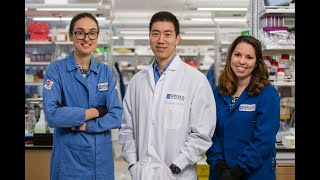
In this FYI podcast episode, ARK hosts interview Nicole Gaudelli and Alexis Komor, the co‑inventors of CRISPR base editing, about how the technology was discovered, the scientific and personal challenges they faced, and why their chemistry backgrounds gave them a unique perspective. Alexis recounts her “aha” moment in 2014 when an in‑vitro gel showed a tiny band indicating a uracil edit, and Nicole describes the later realization that base editing is essentially chemistry on the genome—an orthogonal reaction performed by a deaminase fused to a programmable Cas9 R‑loop. They discuss the demanding lab environment in David Liu’s group, the pressure to publish quickly, and the iterative, sometimes frustrating, evolution of adenine base editors (ABEs). Both emphasize how thinking like chemists—considering protecting groups, orthogonality, and reaction mechanisms—shaped the design of the editors. The conversation then shifts to defining base editing versus traditional Cas9 HDR, its advantages (precise single‑base changes without double‑strand breaks), and potential therapeutic and agricultural applications, including disease‑targeting, T‑cell engineering, and flavor‑improved crops from Pairwise Plants. Finally, they compare career trajectories: Nicole moved to biotech (BEAM) to accelerate therapeutic development, while Alexis pursued an academic faculty position at UCSD, describing the practical considerations (location, timing, funding) that guided their choices. The episode ends with reflections on future directions, next‑generation editors, and the broader impact of base editing on medicine and biotech.
Chapters
Welcome to FYI, the 4-Year Innovation Podcast. This show offers an intellectual discussion on technologically enabled disruption because investing in innovation starts with understanding it.
To learn more, visit ark-invest.com.
ARK Invest is a registered investment advisor focused on investing in disruptive innovation. This podcast is for informational purposes only and should not be relied upon as a basis for investment decisions. It does not constitute either explicitly or implicitly any provision of services or products by ARK. All statements made regarding companies or securities are strictly beliefs and points of view held by ARK or podcast guests and are not endorsements or recommendations by ARK to buy, sell, or hold any security. Clients of ARK Investment Management may maintain positions in the securities discussed in this podcast.
Hey, welcome to FYI, the For Your Innovation podcast. Today we are extremely excited because we have the two inventors of base editing and women who've done so much more since then. So we have Alexis Komor and Nicole Godelly. Really excited to have you guys on. So thanks guys for coming on and welcome.
Thanks for having us. It's always exciting to do a podcast with Nicole.
What have we been compared to? Thelma and Louise before or something like that?
Oh, I love that. I love that.
Yeah, the Doudna and Charpentier, like the two base editing duo. So yeah, it's always fun to do things together.
That is a great comparison. That is a— those are good people to be compared to. Well, maybe less so Thelma and Louise, but definitely Emmanuelle and Doudna are good ones. But yeah. So we touched on it for a quick second, but would love to know, you guys were obviously in the Lu Lab together, and you guys obviously developed base editing there. We've seen amazing results from base editing, which we can kind of get into a little bit later, but would love to just know about the discovery. Like, what was the aha moment? How did it happen? Anything you guys want to share would be great to hear about.
It was like a long time coming because this was back in 2014. Um, the economy was like really bad, so basically everybody was doing postdocs and there was like waitlists on a lot of postdoc labs actually. So, um, I, I applied to postdoc with David like a year and a half before I was planning on starting, and so there was just like a lot of time there to think about what I would be working on in his lab. Then we also, for part of Caltech's PhD requirements, we had to write 3 original research proposals before we could defend. I started emailing with David. I was thinking, okay, one of my research proposals can just be on the project that I plan to work on in his lab, and then 2 birds, 1 stone. I think it just really helps coming from a nucleic acid chemistry background because you look— Nicole comes from a chemistry background as well. That just kind of gives us this different perspective on this field. And so I wanted to learn how to do protein engineering, and I wanted to work with DNA-binding proteins because my background was in nucleic acid chemistry. And, you know, Cas9 had just become this really big thing. And so as a chemist, I just started like staring at crystal structures all day thinking about, okay, what can I do with this? You know, because I was a chemist. I knew nothing about proteins at the time. And so through, you know, various iterations of emails with David and staring at crystal structures all day, I came up with this like half-baked idea. And then the aha moment was like about 6 months in after I started my postdoc. I was like expressing and purifying these base editor proteins and then incubating them with DNA, like totally in vitro in a test tube.. And so I would incubate them and then I'd run them out on a gel that could identify where uracils in the DNA was. And I had gone through like 6 months of various troubleshooting. And then that one day I finally saw this like little band on the gel showing that like a uracil was introduced at a very specific site. And I was like, oh my gosh, it actually works. And it's so funny because yeah, it's like this DNA gel that I had run like thousands of them and like one little tiny band that was like showing up not where the parental band was. Um, and yeah, that was the aha moment.
We should create an NFT of that, Jo, just saying.
That's what David— I think David said he was gonna do that, and I don't know what came of it. Like, a couple years ago, he said he suggested exactly that, and I was like, yeah, let's do it. And then I don't know, you have to ask David what happened.
Okay, well, we should, we should definitely follow up on that. So to— before we get to like Nicole and how Nicole was instrumental in evolving that technology. Two quick things. One, I've heard from people that, or from previous podcasts, that people weren't very encouraging of this research in the beginning. So maybe can you talk about like what it was like coming from, you know, people not being as supportive maybe in this discovery and how that maybe fueled some of your passion to make it successful?
Yeah, I mean, you know, being a woman in science, and particularly in the, the Liu lab was very like male-heavy back then, you know, there was like a lot of room for imposter syndrome. And, you know, especially coming from a chemistry background and trying to do all this molecular biology and, you know, new techniques and stuff, I felt like I constantly didn't know what I was doing. And, you know, people, people in that lab were just very like discerning. They were very tough on everyone. I think just like we would have these like subgroup meetings and especially if you were doing something potentially very exciting, I think it was just like people were even more discerning and like, did you check this control? Did you do this control? What if you tried this? What if you did that? And it was just very overwhelming with like Yeah, people just, you know, picking apart the data and also like suggesting like additional experiments and like it was just too much. And yeah, especially me feeling like, oh my gosh, I don't know what I'm doing. Like this is totally new for me. It didn't help as well. I don't know if I would say they were like unsupportive, but I think they were just like, you know, very discerning and like picking apart like, okay, are you sure you did this? You sure did this? What about these? Like, 800 other ideas of ways that you could tweak the system and try these other things. And so it kind of felt like going into battle every Monday morning for the subgroup meeting, like, oh gosh, I have this new set of data. What are they going to say about it? What additional experiments are they going to suggest? It was just very overwhelming. And yeah.
I think I also heard that originally you were thinking of doing an RNA editing project.
I threw out like 5 ideas to David, like originally in this email. And again, I was looking, I was trying to go down the like nucleic acid road and I had no idea what Cas9 was. But there were a couple of types of proteins that were known to bind site-specifically to RNA at the time that I just found through like Google searching. And so I kind of like suggested the same idea but with these RNA-binding proteins. And he was like, oh, this is really interesting, but like, "You should look into Cas9." Or I think he said CRISPR. And again, I had no idea what CRISPR was. So initially I was looking up like type 1 systems or something. I'm not like, like I was looking up like some of these like, like guide RNA processing Cas protein, 'cause there's like a million Cas proteins. I didn't know that he meant like Cas9. That's the big one right now. And so I was like, what? I was like, I don't understand how any of these proteins would be useful. And then I finally found like the Doudna paper with Cas9 and I was like, oh, okay, that makes sense now.
That's awesome. And now that like RNA editing has actually been developed and, you know, is potentially going to go into the clinic, like, just curious on both of your thoughts. You know, as you were suggesting it, you know, what was this, 20, I guess this had to have been after 2012, so 2014, something like that, right?
Well, Nicole, do you remember when, um, when did like Maria's stuff come out with like the Box B?
I want to say it's 2016. Um, don't quote me, but I think it's 2016, 2017. Repair came out in 2017.
Yeah, yeah, after like the Cast 13s. Yeah. But there were definitely examples of targeted RNA editing, just not using like CRISPR RNA targeting proteins. And like, I feel like those didn't really get acknowledged until the repair stuff came out because it was using a CRISPR protein. So everybody's really excited about it.
Yeah, it was definitely technology before the CRISPR-based things that used aptamers and recruited ADAR to a site and have done RNA editing. That's Maria Montiel's work. It's a PNAS paper. Didn't really get as much attention as the CRISPR-based material, but her stuff was pretty potent.
Yeah, it's crazy when we do like PubMed searches because we think, you know, a good way to figure out what actually works is what you guys are using in the lab. So when we do PubMed searches like CRISPR and the exponential growth of papers following 2012 is like pretty remarkable actually. So maybe it just, you miss other interesting technologies, but I always feel like if it's not being used in the lab, it's probably not working as well as it should or could be. Maybe it's too complicated or other issues with it. Okay. Sorry, Alexis. That was a lot of questions on your portion of it, but Nicole would love to hear kind of like, you know, maybe we should also do like for listeners to give them a bit of context, like what actually is base editing? We've talked a lot about it on the podcast. You know, we've had David and Omar and Jonathan, but, and other scientists, but from the inventors of base editing, I think it would be great to get a little description of what it actually is.
I guess I generally define base editing as chemistry on the genome. I think Alexis is the one that coined that phrase, or at least I've heard her say it quite a few times, and I rather like it. And that's precisely what it is. And that's, you know, sort of the virtue and power of the technology in that it's not relying on endogenous cellular processes to get the end result. We're relying on the catalysis of an enzyme that's fused to Cas9, and Cas9 is used, is exploited for its, you know, beautiful properties of having programmability to a site of interest, but then really using and honing in on, you know, either laboratory-evolved or Mother Nature's enzymes to do hydrolytic deamination on exocyclic amines. So doing chemistry that we know very reliably will make a certain deaminated intermediate, and that intermediate is interpreted by the cell as, you know, either a T or a G, depending on if you're using the CVE or the ABE. And that's based on molecular properties of hydrogen binding and how those intermediates fit within the active site of DNA replication machinery. So all things that are very well understood from a chemical basis. And I think that's really some of the power in, you know, using base editors and not really needing to rely on things like NHEJ or HDR or flap resolution mechanisms. It's really just relying on that enzyme getting to the site that you want to make a modification and just doing what it needs to do. And it can do it in a vacuum or in a cell, and then you get that desired outcome. So Base editors are molecular machines that do chemistry on the genome in a programmable and precise manner to get, you know, a really desired outcome, I think, is how I would define it. Alexis can modify, you know, or edit as she sees fit.
Yeah, I think you did a great job. I think, yeah, like, so CRISPR, you sort of like chop the DNA in half like scissors, and that kind of flags the cell, like, we need to repair this region right here. And then you rely on those downstream cellular repair processes to put your modification of interest in. And a lot of times that goes awry and you can get a mixture of outcomes. But yeah, with base editing, just like Nicole said, we use Cas9 to go to a particular location in the genome. And then we have this enzyme that does chemistry on a particular nucleobase. So A, C, G, or T, I guess the only ones we have right now can do A and C. But they go and they do a chemical reaction that just inherently changes the identity of that base. And so you're directly changing the A to a G or the C to a T. And then, yeah, you don't have to rely on the cell to do what you want. You've done it yourself.
And maybe just for context, for anyone who doesn't know, so HDR is kind of what you're describing. So in Cas9, you would have, you know, the body repair its own kind of broken DNA strands. And as you said, we can see a lot of different outcomes with that. I don't know if you guys— have you guys ever used CRISPR-ESSO?
I love CRISPR-ESSO.
Okay. I just, I just did an analysis and maybe it's not complete apples to apples because we did, you know, different, different types of edits, but we did Cas9 and then we did base editing and prime editing just to look at, you know, whoever's paper had the best kind of FASTQ files that we could find.
Oh my God. This is my favorite final exam question for the genome editing class that I teach, is I give the kids like 3 or like, yeah, 4 sets of FASTQ files where all of them were trying to do the same edit, but with like 3 different tools. And I'm like, okay, here's the genomic locus sequence. Like, go use CRISPR-ESSO and tell me like which tool you think each one is.
That's so funny. It's probably quite easy, I would think, to differentiate between Cas9 and base slash prime, but I would imagine that base and prime is maybe a little bit different. Yeah, yeah. So we saw that, which is, you know, the Cas9 just had a ton of potential outcomes, whereas like base editing, you know, had, you know, only a couple, and then prime, same, had only a couple of potential outcomes. So, and, you know, efficiency is going to get better with it over time, I think. But yeah, anyway, that's my new favorite tool. So just, just had to, just had to see if you guys liked it. So Nicole, sorry, we're getting back to the story. So we're back in the Lou Lab. And so Alexis has had this like eureka moment, and you were working on a completely different project. So, you know, would love to hear kind of how, how you got involved in base editing at that time.
Well, can I just— I want to say my favorite story first, just to set the tone. Like, my first day in lab— this is why, like, Nicole and I became friends, is because, like, Nicole is just such an amazing person. And I had, like, moved across the country. My husband was still in California. I was all alone, and I was, like, trying to, like, you know, say hi to people in the Lou Lab, but, like, it was just so, you know, like, intimidating. And I think, like, the second or third week that I was there Nicole, like on a Friday, she comes and she puts a Post-it note on my desk and she's like, this is my phone number. I'm having like a birthday party this weekend. We're going to Fanwell Hall. And it like, I really think you should come. I think it would be a lot of fun. And I was like, oh my God, somebody likes me. I have a friend. And that's sort of like where everything— we also like both really like animals. But from there it was like, this is the person that I'm going to spend all my time with. And so that's how we became like really good friends. And we were just like talking about like science and animals and, you know, non-science things.
Yeah. Yeah. And we first were introduced, I think, you know, day one when she arrived and David introduced her to me as this is the person I kept, I kept confusing you two with or something like, I was like, all right, like, I don't know how you confuse us, but cool. Nice to meet you. Yeah, I came to David's lab. My background is mechanistic enzymology. My PhD is predominantly in organic chemistry. I really am interested by natural products. I used to work on non-ribosomal peptide synthetases and elucidate how monobactams were made. I came to David's lab to figure out how we could make intermediates for carbapenems that were accessible through enzymes so that we could make antibiotics more, derivatize them more easily and cheaper, especially for the carbapenem class of things. And that's how I got into directed evolution. I actually didn't really know what CRISPR-Cas9 was, but I was really glad that there were so many of the people, so many people in the lab that were interested in it because it meant that the subgroup I was in didn't have as many people. So all the instruments I wanted to use were mostly free. So I was really happy that there was this like large CRISPR-Cas9, like whatever that was. Yeah, I guess I got into CRISPR-Cas9 because of my relationship with Alexis. I think that's really the truth of it. I was really happy with what I was doing before. I really thought that my future was in natural products and creating new, you know, small molecule medicines. I was really motivated and inspired by that. But I think we had the common background of sort of being women chemists doing our postdoc and trying to forge new frontiers. And I slowly understood what she was trying to achieve. I had some background in doing protein purification, so I was helping her here and there with purifying proteins or just looking at gels or like how to clone.
Cloning. Everything except the gels. Like the DNA gels were the only thing that I knew how to do. Everything else I would like, saddle up to either like Nicole or someone else nearby and be like, hey, how do I like make this plasmid? And they're like, oh, you run a PCR with it. I'm like, how do I run a PCR?
How do I design a primer? Yeah. So through those just like, you know, interactions and, you know, luckily for me, those were the easy parts of what she was trying to achieve. The concept and the idea really, you know, was all hers, but, you know, how to get clonoplasmin, I certainly could help with. And I think as I, you know, started to understand what she was really trying to achieve, it really started to, you know, spark a part of my brain that was like really interested in it. It was something I'd never really thought about DNA before. In my studies, it was always small molecules, and I found it exciting. And then I realized slowly over time that sort of, you know, as you're lying in bed trying to fall asleep and your mind's really going, I found myself thinking more and more about base editors and how to, How would you make a new one in sort of less time doing what I had done for the past decade, which is, you know, antibiotics and small molecules. So I approached her first and saw, you know, asked if she would be okay with me sort of exploring next generation editors. And she was very kind and gracious and said that she would love for me to, you know, start thinking about this or working towards it. And then I asked David, he's like, yeah, do that. You could have your second project. And then the second project turned into my full project. And sort of the aha moment was after I had developed— I think it was my third attempt at developing a selection platform for ABE, because as you and hopefully the viewers know, the ABE had to be sort of evolved. So there's no enzyme that could naturally do what, what we were aiming to do for an adenine-based editor. So all the naturally occurring deaminases that do A to I conversion do it on tRNA or double-stranded RNA, and that wouldn't work if the goal is to target single-stranded DNA. And the aha moment was sort of the third attempt, and this was almost a year later. I saw in the, from the selection in the sequencing of the enzyme that the mutation that had highly enriched was one that had formally made contact with the 2' hydroxyl of RNA. Sort of suggesting that something real was happening because the difference between RNA and DNA is a 2' hydroxyl. So that was really the aha moment. And I remember screen— taking a screenshot, sending it to David. And this was at like, I don't know, 8 or 9 o'clock at night. And the response back was profanities and excitement. And this is it. This has got to be it. And then when I tested it in mammalian cells, I tested 6 sites.. And I went site by site. In site 1, I didn't see editing. Site 2, there was no editing. 3, no editing. 4, none. 5, zero. And then the 6th site, it was the PEC2 site 2, our favorite site. It just so happened that I had an A at position 5 with a 5' T and a 3', I think it's a C. So, when they first evolved the editor, it still had sequence specificity, and it had a really narrow window. And it just so happened serendipitously that one of the 6 sites I looked at in genomic DNA had the exact right position and in the exact right sequence context for the bias that still remained and largely was removed over several rounds of evolution and engineering. But for round 1 was retained. And it was serendipity that I was so lucky that I just had a site that was primed, but, and it was the last one. And had I not seen that, I don't know. I don't know if I still would've gone forward with TAD-A or if I would've pivoted and tried something else. So that was the aha moment, I would say. But all of this is Alexis's fault. I think if she wasn't in the lab or if I wasn't her friend or yeah. I don't, I don't know.
It's your fault for being too nice and becoming my friend too. I roped you in.
I'm still thinking of ways to integrate CRISPR and antibiotics. It's like my dream thing. Like, how can I merge these two fields together?
But there's certainly a lot we can do with, with, um, you know, helping with the antibiotics field. So I'm sure we'll hear more about that from you in the coming years. I'm sure there's a way in which that could be interesting, but I also found it interesting that you were saying that when you were up at night, the things you were thinking about were less about your antibiotics project and more about base editors. Because, you know, that must be, that must be an interesting time when you're about to go to bed and those are the things you're thinking. You're like, instead of the antibiotics, it was CRISPR. I'm like, why is it either?
Yeah, it was mostly about manipulating DNA, less about, like, I just saw CRISPR as a way to like bring this bio-catalyst to the site of interest. I was thinking more about DNA and unwinding and electron transfer and how can you do chemistry on DNA? I never, in my studies, I was always focused on proteins and small molecules. I only thought about DNA for cloning. So it was the first time I thought of DNA as a substrate and how you can manipulate it. And those outcomes can have implications for genetic diseases. And I just really, I never thought of that before, and I felt excited about doing something new, even though I really love natural products and I had been doing it for so long. But yeah, it was like a realization that maybe I can think about DNA too.
Another question that kind of came to my mind as you were talking too was it was like, you know, you're texting David, it's like 8 or 9 PM, and he's sending you back like profanities. You know, so I think a question that, that kind of comes up there is, one, is that normal in academia? And two, uh, you know, what was it like working for David?
I don't know what's normal anymore. I hadn't experienced it previously. I really enjoyed working for David. I, I found him to be very, um, inspiring. He was very— allowed me to be creative in ways that I hadn't experienced before. It was a lot of fun, frankly. There are days like I kind of wish I was a postdoc again and didn't have all the responsibilities I have now and could just go back and put my headphones on and start small fires in the corner and him not know.
I mean, as a scientist, being a postdoc in a well-funded lab is like just the ultimate goal. It's like you don't have any administrative burdens. Like, you know, you don't have like exams to take, you don't have to TA, you don't have classes to take. Like all you have to do is just like show up and do your science. And if, you know, there's enough funding, you can do like whatever experiments you think are worth doing.
I like that you're not focusing on the stressful part, which is you have to make sure your project works so you can graduate.
But as a postdoc, you don't have to graduate. It's very open-ended. And like, okay, your project doesn't work, whatever, you still like, you know, obtained like, you know, new skill set. And so, I mean, unless if you want to go into academia, yeah, there's like a ton of stress about publishing and stuff. But I mean, if you want to go into industry or biotech, like you just, you need to learn a new skill set and that's, that's good enough as long as you can like explain to someone what you learned and what you picked up.
That's a good point. I now just want to be a postdoc.
So you, you, you've sold the highlight. Everything went downhill from there. I do not give my students my cell phone number. I do not text them. And like in my PhD lab, I absolutely did not have my advisor's cell phone number either. Like, I, there's definitely like, yeah, it was very special with David. Like, We, when we first joined, there was, you know, like a lab contact sheet or whatever. And so we gave the admin like our name and our address and our phone number. When I was like trying to get base editing to work in mammalian cells, I like got this random text and it was from David. And he was like, hey Alexis, it's David. How are your like mammalian cell experiments going with like this emoji on it?. And I was like, this is weird. Like, I've definitely never experienced this before. And so if I have something I need to like tell my students immediately, I'll either email or send them like a Slack message or something. But like cell phone number, like that's my own personal time. Like I don't need to be texting my, my students. Yeah.
On their, their cell phones.
He's—
in fact, he still asks me how my mammalian cell experiments are going.
You can't escape it. But I think you touched on something which was, you know, if you're in the lab and you're not a postdoc and you're just kind of, you know, doing your PhD, you do, if you want to go into academia, need to be publishing quite aggressively. And there's also like a competitive element, I think, within the lab and academia as well, which, you know, we can debate about if that's, you know, how that is for society and what that means. But, but it just is reality. So, you know, as, as you're coming up with these experiments and you have these eureka moments, you're like, okay, we need to start publishing this or someone else could kind of scoop us, so to speak. So, so what was that like for you guys when you were kind of like, we need to publish this, but we need to publish it like yesterday and almost like before it even works, you guys need to think about, you know, the paper and where to submit the paper or is Nature the only option now?
I don't know, but At least for me, I was, I was trying to push it out. I wasn't ready to publish. He wanted to publish before I was ready. And then I kept sneaking in more experiments because I also didn't think that anybody else would be able to, or there would be a very few, very small subset of labs that had the resources to do directed evolution. So I, I, I'm, I'm a perfectionist and it wasn't up to my standards yet. And I kept pushing him. And then it got to a point and he told me, I will cut off your hands if you do not submit this paper. Because I kept going back in the lab. But that was me. Alexis had a slightly different—
No, I think it was similar. It was like, oh yeah, let's like write this up now. And I was like, but there's like all these other things that I need to do. And he's like, no. And then there were certain points. So we were writing and editing over like Christmas break. And so I was at home in California and I would turn over a draft and send it to him. And then 6 hours later it was back. Keep editing. And there was one point he was like, I know you have whatever data, put it in this figure. And I'm like, I don't have it in triplicate. I told you this is why I didn't want to write it up yet. I don't have everything. And he's like, well, just put what you have in the figure. And I'm like, no, I don't want to. And then I was like messaging one of the, the like second or third author on the paper and I was like, can you set up these experiments really quickly? Because like he was still there in the lab. And then that's how we ended up like, yeah, getting everything together like at the 11th hour. And like what we submitted, like I was like, I was, I was fine with it. I wasn't like super happy with it, but it was like, like there were still definitely some additional experiments I wanted to run and stuff, but it was, it was okay. But it was definitely like, he was like, we're going to get scooped. We need to submit this now. And you're like really freaking me out.
I'm sure Nicole as well. And for context, that's one of the most cited papers now. So obviously I think, I think you guys did a, did a good job, even though maybe, you know, being perfectionists, you wanted to do more and more and more. Clearly the paper was, was well received. So it kind of all worked out. Do you guys think that being chemists, you came from a different angle and it allowed you to see things differently just to garner a different approach?
Yeah, absolutely. That was like the key difference there. I think again, I was staring at crystal structures all day and like looking at this R-loop and oh, like single-stranded DNA there and, um, Yeah, like, I, like, we were able to basically, like, predict what the base editing window would be just by staring at crystal structures and stuff. I think also, I, you know, I spent a good 6 months characterizing the system in vitro, like, you know, just biochemical characterization, trying to figure out what's going on. And I think that was, was really important too, because I was like, okay, I know it works in a test tube. It's characterized. I know the window. I know like sequence context, et cetera. And then when we moved to mammalian cells, yeah, initially it like wasn't working at all, like barely detectable. And I think potentially there, yeah, definitely like other labs who could have just like made some fusion protein of a deaminase and Cas9 and transfected into cells and then seen nothing and then they gave up. And while I didn't see anything initially, I, I knew like in theory this works, we just need to like, you know, tinker away and figure it out.
Yeah, I think true innovation happens when you have, when you come from a different perspective, approaching a problem from a different angle or a different perspective. I think, you know, as chemists we're always thinking about orthogonality. So, you know, when you're trying to build a molecule, you need to think about protecting groups and how you can selectively cause a certain chemical bond to happen in the presence of a bunch of heteroatoms. And how do you make sure that the right, you know, chemical transaction, if you will, will happen, you know, in the whole reaction vessel. And so from the perspective of base editing, you know, one of the key insights was, well, what's— how can we introduce orthogonality? And that's in acting on single-stranded DNA because the majority of your genome is double-stranded. Cas9 has this attribute with respect to base editing, and it generates an R-loop. So you get single-stranded DNA in a small focused area that is, you know, researcher-defined. And it— can you use that as the substrate so you can introduce orthogonality? So that's a concept that chemists think of routinely, but up until base editing, and correct me if I'm wrong, Alexis, modified CRISPR systems were, manipulating the double-stranded area of the genome. So you had those FOC1 fusions to Cas9, and it was leveraging the dimerization properties of FOC1 and making a double-stranded break on the double-stranded area of the genome. But that's no orthogonality there because your entire genome is double-stranded. So I think that was a real critical insight that Alexis had. And then, you know, sort of people were like, well, how can you You can't do that. It's gonna— that, you know, that's sort of where a lot of the pushback was initially was just like, people didn't understand that there's so much power in being able to manipulate an enzyme to work in that small focus bubble where everybody else was focusing outside of that or thinking about cutting properties. But yeah, I digress a little bit there, but thinking about things in a different way, like, I think being a chemist was a a large advantage. And 2, I think, you know, chemists, I find a lot of biologists have protocols to do things like I have to purify protein. And here is a little protocol from QIAGEN and 1, 2, 3, 4, 5. When you do chemical reactions, a lot of it is you have to read a paper and you, you know, sometimes de novo have to figure out how to make that reaction work based on chemical principles and physics. I've even had to assemble my own rotovap before. So just thinking about how to create as a chemist, just on first principles, I think has really been enabling towards when applied to gene editing and coming from a different angle.
Yeah, it's sort of like, I don't want to like offend anyone, but I, I, I compare like biology to baking. There's like a defined recipe and you follow the recipe like per, like word by word. You don't change anything because like your cake won't rise or something. Um, whereas chemistry is more like cooking. And so you're like, oh, I want to cook, um, you know, like, I don't know, like a Cobb salad or something. Tonight. And you look up a bunch of different recipes for Cobb salad, and they're all slightly different. And you get a general idea of like, okay, these things can go together, I can make this whatever. And then you sort of just like go rogue. And, and it, and you come out with still like a very delicious Cobb salad that is like, you know, tailored to what ingredients you had or what your tastes are. And so you don't, yeah, you, you get a general idea of how to do things. And then you like you modify it according to, to you and to what you need it to do. And so that kind of allows us to think outside the box, I think, like if you're trained as a chemist. And especially, you know, being a nucleic acid chemist, that helps a lot because I had, you know, been working a lot with DNA and inherently knowing, okay, like here's double-stranded DNA, it has totally different properties from single-stranded DNA. And then there's Some enzymes interact with double-stranded DNA, other enzymes only interact with single-stranded DNA, and there's like, yeah, exactly. There's like orthogonality there. There's like no cross-reactivity because they're like inherently just different molecules.
Yeah. Sorry, I'm distracted because Nicole has a puppy now, which I think is adorable.
It's just he was making a lot of noise and then I just decided this might be easier, but I don't know.
No, I love that because I think you mentioned that you guys bonded over your love of animals. So would love to hear, like, how did that kind of even come up?
Because Nicole owns a zoo. Yeah, my zoo. I have— well, at the time I met her, I had 4 cats, 2 dogs, 2 birds, a husband.
And dogs, right?
Or are those new too?
Dogs?
No, I had, I had a dog before. Um, these are new dogs, but yeah, I've always had dogs. So how, how did the zoo start? Oh, because when I was a child, my mom didn't let me have animals. So when I got older, I, um, just did all the things. Yeah, did all the things mom said I couldn't, like dye my hair blonde and get a bunch of animals.
I like that those are the two— dyed your hair blonde and got animals. Mine would have been I don't know, piercing my belly button, I think. But so it's interesting because CRISPR obviously has application in agriculture and that's kind of being shown more and more in terms of labs and we're seeing new company formation too in that area. I don't know if you guys have had any involvement in kind of like base editing and ag or animals, but curious your thoughts just because that's an area of interest for you guys.
I mean, I've interacted quite a bit with the people at Pairwise Plants. Yeah, again, I teach a genome editing class, and I always have like Nicole gives a guest lecture, and then I always ask someone from Pairwise to give a guest lecture, and the students always like love that to see these applications. So Pairwise, they have this like new salad green coming to market where they took like, I don't know, it was like arugula or something, some salad green that is like it's super nutritious but has like a very bitter taste to it that a lot of people don't like. And they used CRISPR to like get rid of the bitter taste. So it's still like, it looks the same and it's like super nutritious, but it's not, it tastes like iceberg lettuce, I guess. And my students love that. They're like, oh my God, this is the most amazing thing ever. And yeah, I think we're gonna see a lot more of that, Yeah, in agriculture, like keeping, you know, certain characteristics in terms of like, this looks really nice and like, oh, but it doesn't taste as good. And then, you know, using genome editing to like make it taste really good and look really nice. And, you know, potentially like being able to harvest more, you know, pieces of fruit or vegetable per square footage of land and having, you know, like extending the shelf life et cetera, et cetera. And so I think that's really exciting. One of my cats just walked by.
Your zoo.
Maybe Kale next. My zoo is much smaller than Nicole's zoo.
I only have 2 cats. And maybe we can explain why base editing is so significant for anyone who doesn't know. I guess, how many potential diseases do we think we can target with base editing? And create kind of potential cures for?
Yeah, so maybe I can take that. That's a really hard question to answer, like, quantitatively, because there's so many parameters that go into that answer, right? So I think people like to think about, you know, reversion of a monogenetic disease that then takes a protein that is diseased when you have some kind of ailment and no longer is that way. However, whilst that is true, and from like a, you know, sort of quantitative standpoint, you could look at, let's say, the ClinVar database, identify all those diseases that would fit under A or C editing, and then give, you know, a certain desirable outcome and has a PAM, and then give that number. But I don't think that gives the full scope of what's possible. So, base editors can be used for other things, such as T-cell generation. So, engineering cells, or you can think about diseases for which you need to upregulate something that causes, you know, a downstream effect that isn't associated with, you know, reversion of a monogenetic single-letter misspelling, for example. And then also you have to consider, okay, let's say on paper we can, you know, modify this gene with a base editor. Well, if you can't deliver it, then you can't fix it in practicality. So then how do you overlay the considerations from like a primary sequence standpoint to, with, you know, the capabilities of delivery right now? So I think it's a really hard answer to give and quantify, and there's so many different parameters that have to be considered. And I think the safest thing to say is that over the course of time, my hope, and I think expectation, is that that number that we will be able to reasonably reach towards, achieve, will only increase over time. But there, it's more than just, okay, what's the DNA sequence and can a base editor fix that? We can definitely do that exercise, but I don't think that actually answers the question. And then there's also the, like, you know, not to draw this out too much, there's also the understanding of the biology of the disease. So just because you you see that there's a mutation and that seems to correlate with the disease, knowing the biology behind it and that it's only this mutation that causes it, or is there something else? Are there multiple things that together cause disease? I mean, we still are struggling to understand the biology of Alzheimer's. There is a new drug that recently came online that gives some hints of promise, and indeed reduces the, what is it, the beta amyloid, the plaques. But there had been molecules before that had diminished those plaques and didn't give any kind of response. So, the biology of that disease is still not understood. So, you know, that's a huge factor in like understanding can a gene editing or gene therapy, you really, you know, potentially cure a disease, you really need to understand the biology. I think there's so much that's not known about so many diseases that, you know, over time we'll accumulate that knowledge. But, you know, to give you a quantified answer is pretty difficult.
Gotcha. I'll take that then. And maybe just to end, because I know we're coming near the end of the hour, but wanted to hear, so obviously two different paths. Industry versus academia. So wanted to hear a little bit about sort of how that decision was made and kind of how it's going now, maybe what's going on in the lab, maybe a few lines about what's going on at BEAM. I guess that's a spoiler alert, but—
For me, I got into science because I wanted to help people. That was my motivation for what I did. I think I was in the very fortunate position coming out of David's lab in the technology that I made really had the potential to change people's lives. And I think when I realized that, I was really inspired to really consider going to biotech, and I hadn't before. My goal had been to stay in academia. I really loved chemistry, you know, potentially having a small group of folks that were looking at antibiotics or something. That's sort of what was in my head, but so much had changed. And all my life, I sort of followed my heart, and when I recognized that the reason I went into science was to help people and sort of make the world a better place with medicine. And who better to bring forward ABE, at least towards a therapeutic, than me? I couldn't really answer that question. So I decided to change course and go to BEAM. It also helped that BEAM is in Boston. So I'm East Coast-based, Alexis is West Coast-based. So It did help that geographically it was close to my family and friends. And I haven't regretted it. I love, I love what I do. I love the potential of the technology and bringing it to people. I am now involved in therapeutic programs and sort of the next generation of what we can do with base editing. So I've given at least one talk or two on sort of our next generation approaches to conditioning. So we're using base editors to modify a CKIT, which is a stem cell receptor on CD34 cells, to see if we can escape those cells from exposure to a monoclonal antibody. And that antibody could be used for non-genotoxic conditioning. All these sentences and things I'm saying right now, I couldn't have imagined 5 years ago that would be coming out of my mouth. So I've learned so much. And being in biotech as well, it's, it's, it's a continued education and increasing my ability to help people and make a difference. And that's, yeah, that's why I, I went into biotech.
I've just always like followed the path of least resistance. I never, you know, had this idea like I have to go into academia, I have to start my own lab. But yeah, when I, when I was I was a grad student thinking about next steps. Like everybody was doing postdocs at the time, even people who knew they didn't want to go into academia. They were still like these industry and biotech positions still required postdoc experience. So it's sort of like a non-starter. I'm going to do a postdoc. So then I went into David's lab and a year and a half in, I had this like huge paper.. And it was like academic job market cycle was coming up and David was like, you should go for it. And my PhD advisor, she had been telling me like, oh yeah, go to Boston and then see if things work out in a couple of years, you should go on the academic job market. People who are professors, they all think that their job is the best job in the world and all their students should also go into academia, which, you know, is something that I don't do. But everybody was kind of, oh yeah, you know, go for it. So I went for it. And, and the academic job cycle, it starts in like the summer and then you like do all these interviews and then you have second round interviews. And by the time you get a job offer, it's like the following May. So it's like a long process. And, and I got my offer at UCSD, which was like a very big shock because I remember coming home from my interview being like, oh God, I like totally like screwed that up. And then, and then like a month later they were like, we're gonna give you an offer. And I was like, oh my God. And well, my family and my husband's family are in California. So it was sort of like, we're coming back to California. I only applied to faculty positions in California. And so I got this offer and it was like, okay, you start in like a month and a half. And so I'm like getting ready to like, you know, trying to find an apartment in San Diego and like trying to figure out how I'm going to move across the country. And then that's kind of like when David was like, I'm starting this new company. It's called Beam and it's about base editing. I think I met with, I think one of the venture people, I don't know. And they were like, yeah, there's this company, do you want a job there? It would be really great. And I'm like, I'm going back to California, peace. I'm happy to be involved in whatever way, but I didn't go through this 9-month-long process to just throw my offer in the trash and then stay in Boston. And yeah, the timing just didn't work out. The location didn't work out. Again, I followed like the path of least resistance and went into academia and I'm very happy where I am. Like, I love being in California. I'm close to my family. I love interacting with the students. I like mentoring them. It's nice to have this like freedom of, oh, I can, you know, if the research goes in one direction, that's fine. And we can, you know, just follow the results and stuff. But it's also very stressful in that I'm like my own man. I have to do everything. And so if we want to switch directions, like we can, but I need to like get the money to do that. And so I've spent a lot of time in the past 5 years since I started just like getting enough grant money in order to pay my students and to actually pay for the research. And yeah, what we look at is just trying to better understand genetic variation and the first place. So while, you know, Nicole is looking at genetic diseases and how can we, you know, use base editing to potentially, you know, alleviate disease symptoms, we're on the other hand looking at like, okay, here are these genetic variants, are they potentially like contributing to disease phenotypes? Because I think like less than 1% of genetic variants that have been identified actually have a known phenotype in terms of what they do. So we're, you know, generating cell models with base editors and prime editors and, you know, wild-type Cas9 too, harboring different genetic variants and trying to understand how those impact cellular function and human health.
Amazing. Yeah, no, and amazing that you're continuing to evolve genome editing in the lab, which is It's cool because it, you know, your whole life, basically the trajectory of your life was really changed by the base editing discovery, which is really cool. So I know we're at the hour, we're a little over. So, you know, just want to thank you guys so much. I think this has been extremely informative and interesting. So appreciate your time and thanks for spending an hour with us today.
Yeah, thanks for having us. Yeah, thanks for having us.
It was a lot of fun. AHRQ believes that the information presented is accurate and was obtained from sources that AHRQ believes to be reliable. However, AHRQ does not guarantee the accuracy or completeness of any information, and such information may be subject to change without notice from AHRQ. Historical results are not indications of future results. Certain of the statements contained in this podcast may be statements of future expectations and other forward-looking statements that are based on AHRQ's current current views and assumptions and involve known and unknown risks and uncertainties that could cause actual results, performance, or events to differ materially from those expressed or implied in such statements.
More from Joshua







Scientist Stories: Hans Waterham, The value of phenotypic assays in peroxisomal disorders




Scientist Stories: Joel Zlotogora, Genetic carrier screening programs for reproductive purposes