Scientist Stories: Nicole Gaudelli, Beam Therapeutics & The History of Base Editing
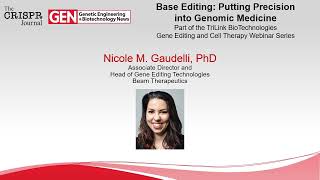
In this webinar, Kevin Davies introduces Dr. Nicole Gaudelli (Beam Therapeutics) who delivers a comprehensive talk on the evolution, chemistry, and therapeutic potential of base editing. Gaudelli traces the history of base editing from the pioneering cytosine base editors (CBEs) developed by David Liu’s lab and postdoctoral fellow Alexis Komor, to the creation of the adenine base editor (ABE) that she helped engineer. She explains the chemical distinction between "nucleobase" and "nucleotide" editing, and why precise single‑letter changes dominate human genetic disease. Gaudelli details her own transition from natural‑product chemistry to protein engineering, describing the directed‑evolution campaign that transformed a bacterial TadA deaminase into a highly active ABE (ABE8 series). Comparative data show ABE8’s superior editing efficiency, broader editing windows, and lower indel rates across multiple loci, including therapeutic targets such as alpha‑1 antitrypsin deficiency, sickle‑cell disease, and multiplexed CAR‑T engineering. She discusses delivery strategies (split‑intein AAV), off‑target mitigation (guide‑dependent and guide‑independent RNA/DNA), and the practical steps required to move a base‑editing platform from academic publication to clinical development, emphasizing cross‑functional collaboration. In the Q&A, she contrasts base editing with prime editing and reiterates delivery challenges. The talk concludes with a forward‑looking perspective on the field’s collaborative nature and the promise of base editing as a transformative therapeutic modality.
Chapters
Hello everyone and welcome to this webinar co-produced by The CRISPR Journal and Genetic Engineering and Biotechnology News. Today's presenter is Dr. Nicole Gordelli from Beam Therapeutics, and she'll be talking about base editing putting precision into genomic medicine. The webinar is sponsored by TriLink Biotechnologies. I'm your host for today's webinar, Kevin Davies. I'm the executive editor for The CRISPR Journal, which has been publishing research in genome editing for about 2.5 years now. We just received our first impact factor, and also editor-at-large for Gen covering the biotech industry for about 4 decades. The magazine has, not me. This is part 3 of TriLink's Gene Editing and Cell Therapy webinar miniseries, and if you missed the first 2, you can view them on demand. The speakers were Professor Wen Xue from UMass in Worcester and T.J. Cradick, formerly the head of gene editing at CRISPR Therapeutics. But we have a great speaker on tap today, and let's meet her right now. It gives me great pleasure to welcome Dr. Nicole Gordelli, who is the Associate Director and Head of Gene Editing Technologies at Beam Therapeutics, a public biotech company in Cambridge, Massachusetts, co-founded by Keith Young, Feng Zhang, and Nicole's postdoctoral advisor, Dr. David Liu. Nicole led the development, as I'm sure most of you know, of the second major category of base editor, the original adenine base editor, in David Liu's lab at the Broad Institute, publishing her landmark work in Nature in 2017. And incidentally, you can hear a lot more about the early years, the early development of base editing from Nicole and her colleague Alexis Komor in a 1-hour podcast we taped about 18 months ago in the Guidepost podcast series hosted by the CRISPR Journal. You can find that on all good podcast platforms. Nicole received her undergraduate degree in biochemistry from Boston College and did her PhD with Craig Townsend at Johns Hopkins University, working on something completely different: antibiotic biosynthesis. She's also a member of CNN's Talented 12, class of 2018. She's currently spearheading the therapeutic application of base editing across a range of medical conditions at Beam, including sickle cell disease, several other Mendelian disorders, and leukemia. Before I hand over to Nicole, please queue up your questions for the Q&A session in the closing portion of today's webcast. We'll try to answer as many questions as we can, so simply hit the Ask a Question button at the top of your screen and submit. All right, let's get this show on the road. Hi Nicole, we're thrilled you could join us today, and we are really looking forward to your talk. Take it away.
Welcome to this webinar on base editing, putting precision in genomic medicine. My name is Nicole Gaudelli. I'm an Associate Director at Beam Therapeutics, and I'm the head of the Gene Editing Technologies Group. I wanted to thank Genetic Engineering Biotechnologies News for the kind invitation to speak to you today, and to TriLink for sponsoring. So I wanted to start out with a brief history of nucleotide editing, or was it nucleobase editing, but actually base editing. So base editing started with an intrepid postdoctoral fellow in the laboratory of David Liu, Alexis Kamour. So Alexis is now an assistant professor at UCSD, and she was the one that really pioneered the technology we know as base editing today. So in 2016, she published the— with David— the foundational base editing paper, which describes cytosine base editors in Nature. And what she described was a molecular machine that enabled for the first time the reversion of single nucleotide polymorphism without the reliance on HDR and HJ. So what that really meant was she wasn't creating a machine that was using a cutting tool to make double-strand breaks and then reply and relying on machinery within the cell. Base editing was reimagining how genetic engineering could be done in the sense that she was now able to perform chemistry on the genome to specifically and precisely convert one base into the other without cutting the DNA. And this technology turned out to be really transformative. And others, in addition to Alexis, had also reported the development of such a molecular machine. And since the inception of, of this technology, the technology had been used in many labs around the world for a variety of different applications to really validate the robustness of this type of technology. And I wanted to say that, you know, David has cultivated a culture in his lab of really allowing the convergence of people and resources and expertise from a wide range of sources that really enables unbridled innovation to occur. And I think fostering this kind of environment in a laboratory really enabled to think outside of the box and reimagine what, what really could be. So I give a lot of credit to the two of them for really thinking of what could be, not what we had in hand, and developing such a transformative technology, which I will continue to describe. And you might want— you might ask, you know, why is— what's with this nucleotide nucleobase nomenclature that, you know, you started the talk off with? So it turns out that base editing really came about because it was just the easiest thing to say., but maybe not the most scientific. So from a chemical perspective, it's really a nucleobase that we're editing. I think originally we, Alexis and David threw around the idea of a nucleotide. So a tide indicates the phosphate that's attached to the nucleobase through the sugar, which of course is present in DNA, but usually describes more the small molecule, not actually the nucleobase in the context of a DNA polymer. Nucleobase probably is the most accurate description of what the technology is, which again, I'll describe in a few slides. However, it didn't pass the Apple autocorrect test. And what I mean by that is every time Alexis or David typed in nucleobase editing, the computer software, what have you, would correct it to nuclease, which of course is really the antithesis in a way of base editing in the sense that nucleases are doing double-stranded breaks and base editing goes through a mechanism that doesn't rely on double-stranded breaks. So the last thing either of them wanted was, you know, people down the line writing manuscripts or what have you writing nucleobase editing and accidentally it being converted to nuclease editing. That would really not, not, not be great. So base editing was arrived on, whilst not the most chemically accurate, description of the technology is really the easiest and passed the Apple autocorrect test, which is an important thing to consider. So, base editing really gets after a large landscape of potential genetic diseases to correct in that the dominant form of genetic variation in human diseases is actually caused by a single letter misspelling within the genome. So here is a graph that depicts the different ways in which our genome can be altered that causes some kind of genetic disease, and the vast majority of those alterations turn out to be the single letter misspelling. So having a molecular machine that really can precisely convert one, one base into another without cutting or damaging the DNA through double-stranded breaks would really be a very useful tool tool from the perspective of applying it for a therapeutic. And so I just want to sidestep for a second. I know when we talk about base editing, a lot of times we really focus on single nucleotide reversion. So that would be a, you know, a type of gene correction in which we directly repair a point mutation to restore a gene's function. So a lot of times, you know, this is sort of what we think of when we think of applications of base editing. But it turns out that base editing can be used for a wide variety of other things that also help from a therapeutic standpoint. For example, you can do gene modification, gene activation, so installing single-letter substitutions within a regulatory element or a promoter space to then upregulate some protein of interest. Gene silencing, multiplex editing, base editors can be a very powerful tool. So whilst many times you'll see here in the community people really focus on this gene correction aspect of base editing, base editing is used for a lot more than just base editing. So I wanted to take this moment and highlight that. So getting back to what base editors can do and how I sort of came into the fold of all this is if you consider all of, of the single point reversions that are out there that cause genetic disease, it turns out that CBEs, hypothetical CBEs, can revert in theory about 13% of those pathogenic mutations. While the vast majority of all of those single point mutations can actually be reverted by an A base editor. So something that can take an A to a G or a T to a C from, from the opposite strand. And I think this realization early on really was a motivating force for exploring the possibility of creating an additional base editor in, in addition to the foundational cytosine base editor. And the major problem with accessing such a base editor was that there was no known adenine deaminase that existed in nature to perform the necessary chemistry. So something that would be analogous to the cytidine deaminase, which does the chemistry for the CBEs. There was no comparable adenine deaminase. And again, I'll get into the, the more specifics about the chemistry in a moment, but I just wanted to contextualize everything for you. And so I just wanted to take another step back and kind of give you a little bit of background how I sort of got into all this, this mix of everything. So in a previous life and in my PhD, I actually studied enzymes and how enzymes made small molecules. So I considered myself a natural product chemist or a mechanistic enzymologist. I was always very interested in how enzymes could craft and do such intricate or delicate chemistry in a very efficient and concise manner to create all these sorts of molecules we find in nature that have really high potency. And these enzymes, which have been evolved through thousands, tens of thousands, hundreds of thousands of years are really optimized to be really efficient molecular machines. Um, in particular, I was interested in modular types of enzymes. So NRPs or PKSs that kind of passed down and built a molecule slow, um, one by one. In fact, I wanted to share that there was a time when I actually was in the hood and was a chemist. So this is a picture of me I think in my first year of, of my, my doctorate, which now feels like a long time ago. So after my PhD, I really became interested in taking enzymes that came from nature and evolving them to do something that we really would, that were desirable from a therapeutic perspective, for example. And with the foundational understanding of what an enzyme is doing in nature, could we, you know, through laboratory evolution, try to coerce it to do something more desirable? And so I came to the lab of Professor Liu to try and, you know, take my hand at doing evolution, of which his lab and him in particular are, you know, world-renowned experts for. Discovering not only new ways of doing directed evolution, but conducting various evolutions of naturally occurring enzymes. So while I was in his lab, I was really interested in evolving an enzyme in an antibiotic biosynthetic pathway. And for about a year and a half, I was really diving deep into natural product synthesis and how to do semi-synthetic approaches for making carbapenems. And really, you know, straight down that path. And along the way, I became really good friends with Alexis and sort of got very distracted, I would say, by what she was doing. And I suppose you could say I'm still distracted by that. I thought that what she was trying to do in the lab was really unique and transformative, and I found myself spending less and less time thinking about proteins and antibiotics and more and more time about DNA and how to make base editors and things like that. And what we shared in common is we both had a PhD in a more traditional chemistry laboratory. So she was an inorganic chemist and I was an organic chemist. And what I had to offer her was I knew how to purify proteins and things like that. And through my mentoring of her on how to do molecular cloning and things like that, I really started to not only build a really strong friendship that is to this day, you know, I consider her my best friend. I really started to learn about what she was thinking about and became really deeply interested in that. And remains so to this day. So, um, going back to cytosine and adenine-based editors and in the fold of all this. So cytosine-based editors, so what Alexis and David had invented, um, while I was dabbling in, you know, the, the land of evolution and, and, um, carbapenem semisynthesis, um, is cytosine-based editors are molecular machines in which you have a cytosine deaminase. So this is a naturally occurring biocatalyst. It's covalently hooked up to an impaired form of Cas9 and a small peptide known as UGI, which basically inhibits base excision repair of uracil. So Alexis spent probably about a year between starting the project and publication developing, optimizing, understanding how this base editor worked, and through iterations of engineering basically had shown and proven that in mammalian cells we can convert cytosines to uracils, which then are read as thiamine, and hence reported the first base editor. Now fast forward to the adenine base editor. So I was very interested in evolution. I knew that an A base editor was— could be potentially very valuable if we could access such, such a hypothetical editor. But unfortunately, unlike the cytosine base editor, there was no known deaminase that could convert adenines into the hydrolytic deamination form of adenine, which is inosine. So one had to be created in the laboratory, which, you know, retrospectively, I— it was quite a risk, yeah, to undertake because this was kind of a crazy thing to do, but I think the need was so great and the challenge was really motivating for me. I really wanted to take my hand, a stab at trying to do this gene editing thing, which initially I just saw it as an opportunity to really play with enzymes and see what was, what could be from dabbling. So this is just showing, You know, I hate these heat maps, but what I'm trying to show is if you hook up naturally occurring deaminases that act on adenine to form inosine, but not in the context of DNA, they— we have adenine deaminases which work on RNA, small molecules, things of that nature. If you hook it up to Cas9 in a similar fashion to the cytosine-based editor, Unfortunately, you don't really get any editing at all, even when the effective concentration of that substrate now is super high. So that really demanded directed evolution. So over the next year and a half, I really became devoted to this idea of creating something that didn't exist in nature. So I put down all my other projects. I've spent up until that point, probably between undergrad and graduate school, about maybe close to 10 years working in the antibiotic natural product field. And I was like, you know what? I'm really interested in this. This is really transformative. I really wanna just focus on this because if there's any shot of this working, it demands my entire attention. So I dropped everything and I doubled down on this project, which at the time I was told was insane. But it turned out to be a lot of fun and maybe one of the best decisions I've ever made. So in a nutshell, so summarizing about a year and a half of work, I developed a system to directly evolve an adenine base editor. So I started with a TadA deaminase. So TadA works on the single-stranded portion of a tRNA, and evolve that to work on single-stranded DNA. So through many iterative— it's a tough word to say— iterative rounds of evolution, David and I reported the first adenine base editor, affectionately now known as, or affectionately to me, ABE710. And we demonstrated that this space editor not only worked in mammalian cells but worked very well across a variety of sites and in a variety of sequence contexts. So from my perspective, you know, how did I get from a natural product chemist to now BEAM? And, and what it really started out with was a love of science, and I became an organic chemist to a mechanistic enzymologist, to a protein engineer and evolutionary biologist, to now a gene editor at Beam, in which I continue to enjoy working with these molecular machines to bring them into a therapeutic, which is a really exciting outcome of all this work. So here's a picture of myself Alexis and Holly Reese, who was a graduate student at the time of this work, is a co-author on the paper and is a current member of BEAM. So this was a really dynamic group of ladies to spend time with in the lab and make discoveries with. So, um, I wanted to highlight for you some base editing basics and really demonstrate more clearly why base editing is referred to as chemistry on the genome. So what I'm showing here is the start to finish of how an adenine can be turned into a guanine in genomic DNA. So you start with a target of interest. So this is your diseased genomic loci, for example. You treat your cells with a base editor. In this case, I'm highlighting the A base editor. So since the deaminase is hooked up to an impaired form of Cas9, that Cas9 can be thought of as the mothership which can be programmed to the desired site in the genome with the use of a guide RNA which has complementary to the region of interest. Once the molecular machine is at the site of interest, the deaminase does a hydrolytic deamination of the exocyclic amine of adenine, in this case, to form inosine. Once that inosine is installed, or concurrently for when this inosine is installed, Cas9 makes a nick on the opposing strand. And what that does is that coerces the cells to identify this inosine-containing strand, so the strand which actually has what would normally be thought of by the cell as a lesion, as the good strand to use for replication. And then during DNA replication, this I is read as a G, and, and it's installed. So you, by the end of the whole process, you get an adenine which turns into a guanine. And of course, on the opposite strand, you get a thymine turned into a cytosine.. So here is, you know, in a very concise view of the chemistry behind it. So with the cytosine-based editor, this is that exocyclic amine that gets converted to a carbonyl. Of course, this is known as uracil. Uracil is read by thiamine, and complementarily Adenine gets turned into inosine by the same hydrolytic deamination of this exocyclic amine. So basically water is added into this carbon center and you get collapse and formation of this carbonyl, and this molecule inosine is read as guanine. So this is truly manipulating the DNA on a chemical level and tricking that cell into accepting this chemical lesion, right? So this is a modification that normally you wouldn't necessarily want, but we intentionally want to put that, install that in there to correct the disease, tricking that cell into accepting this, this edit, this chemical edit, as, as something it wants to, to replicate and then incorporate in newly formed strands.. And all this again is done without reliance on machinery such as NHEJ or HDR, which is what CRISPR 1.0 technology rely on. And then it does not go through a double-stranded break. So at BEAM, with this base editing technology, we really want to utilize it and understand and implement it so that we can precisely, permanently, and predictably change gene sequences so that we can create lifelong cures for patients suffering from really debilitating genetic diseases. And that is really the goal. That is the ultimate goal. And I'm here from a perspective of being in an academic lab. Creating the technology and being in the technology from, from the very beginning, and then bringing it to, um, and then following it, um, to a biotechnology company and seeing then what it takes to take that described technology off the pages of a glossy publication and into a patient. And I think that That is an experience and a privilege that is really, really deeply inspiring for me. And what does that look like? So on a very high level, you know, to do, to take a technology from an academic setting or an academic publication into, you know, real life, you know, honest to God human therapeutic, There's a lot that goes in into this, and the bar is really high. So, you know, obviously to make a therapeutic, the bar is higher and should be higher than doing a publication. It's a very long road. There are many challenges. You have to continually adapt to those challenges. Collaboration, teamwork, really working across different departments is absolutely required. There's no I in team, and really having a unified vision amongst everybody and what it is and what it takes to make a medicine and make it really successful and transformative for, for these patients. But with all of this, the reward is deeply great. It's greater than publishing in a glossy journal. And so, it's been really illuminating for me to go from an academic setting and into this biotechnology thing, which if you had asked me 10 years ago, would I, is this my career path? I would've said, no, I'm going to become a professor and have, a group of students, and I think life just had a different path, and I kept putting one foot in front of the other. But this has been such a rewarding experience. I can't imagine anything else. And it's really opened my eyes into everything that goes into making, making a technology. You know, when you write manuscripts or you're applying for grants, a lot of time the motivation for that work is towards human health and therapeutics, but it always stops with the publication, or at least in my experience, it sort of had. And there's the publication, you know, if, if we're so fortunate to get to, um, you know, the ability to make it into a medicine is really just the beginning of everything. Um, so I've made this sort of chart of, you know, my experience in, in seeing what it really takes. So The technology is a piece in a much bigger puzzle to really get technology to a patient. So there's platform technology, there's therapeutic proof of concepts, so taking that technology and really working with it in vivo, doing biological assays, working in relevant cell types, people that look into delivery, there's all sorts of modalities, how you're going to make the, the reagent that's going to go into a human. So chemistry, manufacturing, control, and clinical development, and all these things contribute to making a medicine that goes beyond, you know, just, just having the technology. Because if you don't have all these other pieces, it's just going to lay flat on, on those pages of the publication. So therapeutics, look at in vivo validation, off-target biology, pharmacology, toxicology, delivery looks at all sorts of modalities, AV, LNP, mRNA delivery, RNP, like looking at everything that's possibly available and picking the right modality for the right app for whatever application that you're, you're looking to, to apply the technology to. CMC departments look at quality analytics and regulatory, which is really, you know, something you're not necessarily exposed to in academics, but really is vital to the success of any drug product clinical development. So enrollment, enrolling trial sites to conduct your clinical trials, having relationships with PIs, patient outreach program, there's so much more than just the technology. But of course, for me, I remain on the front end of things of the platform technology. And my group and how I see it is that we're here to create, innovate, optimize what we have, and to educate everybody on the different tools we have at our disposal and what the, the limitations and potentials of the various tools are. And so with the toolbox that we have, so we have many different DNA editors now, we have RNA editors, we're really trying to make these tools as efficacious as possible, optimize them for different target sites, characterize them very deeply so we really understand all the nuances of them, adapt them, continue to innovate in every iteration of this optimization and characterization, continue to inform and educate the broader community about our learnings to continue to move the ball forward and to advance the technology. So base editors are sort of a whole class of molecular machines that are out there. There's a lot of different flavors and different architectures to consider. So I have this little scheme up here to sort of summarize the different flavors of base editors that are out there. These are highlighting C-base editors and A-base editors. And so when you're considering what base editor to choose or what to, you know, where to start, there's, I guess, 5 different considerations that I think about. And you want to use a C-base editor, an A-base editor, or both. So that of course depends on the mutation you're trying to solve, the proximity of a PAM. So base editors can be limited by the availability of a PAM, the editing window, the bystander mutation, and what sort of a minimum efficiency you need. So to give a little vignette of how therapeutic targets can inform and influence what we do on the platform, I'll give a little vignette about alpha-1 antitrypsin deficiency, which is a disease that we're focused on at BEAM. So, this is an example of a single nucleotide polymorphism. So, one of those, you know, abnormal protein expressions that results from a single letter mutation within a gene. So, it's caused by a single letter mutation within the serpina gene. And so, this is known as the pi Z mutation. So, it's a glutamic acid that's turned into a lysine. So this causes, um, a toxic gain of fun— function phenotype. So it causes fibrosis or cirrhosis of the liver. There's not really an approved treatment at this time for patients suffering from this disease. Um, sometimes people actually get lung transplants. Um, it causes a deficient antielastase function, and that leads to lung damage and COPD, which is why many patients require lung transplants. And this mutation could be, in theory, reverted by an adenine base editor. So step 1, you know, we tried to— we identified what base editor could be used to revert this genetic disease. So A base editor is the answer. We had to look for the proximity of PAM. So it turned out there's not an NGG PAM, so that's the hallmark of a pyogenous base editor. It recognizes an NGG PAM. There was an AGC PAM which placed the target A at position 7, which is within the editing window of ABE. But there also existed this 5' adenine which relied— resided, excuse me, at the 5 position in the protospacer.. And we really wanted— this was the best place to start given the editing window and the PAM restriction. So a lot of engineering had been done to couple a Cas9 that was AGC or NGC tolerant to TadA. And what we were hoping to see was efficient adding, editing at position 7, and if there was editing at position 5, to evaluate what that biological effect was. So it turned out when we used off-the-shelf AB710 that the editing efficiencies were not spectacular, unfortunately. So you can see in, if you treat patient-derived fibroblasts, so these have that mutation installed in, in, in its genome, when you treated it with ABE-710, which is what we had available at the time, you couldn't really get, get editing levels that were really anything to write home about. In addition, we were getting editing of this bystander A, and so we needed to understand that effect. And we also had some alleles that had this 5-only edit. So the first thing that we really wanted to try to do was to understand what that bystander edit did. And it turned out that through an elastase activity assay, along with measuring the amount of alpha-1 antitrypsin— so this is the protein that's defunct when you have the E342K mutation. Present in what these patients have. We found that if you are able to revert that mutation, of course, you get nice wild-type levels of alpha-1 antitrypsin. If you have reverted that mutation and also have that 5-edit, that also is okay in the sense that we are, we are observing levels of alpha-1 antitrypsin protein of similar levels to wild-type and validated with this elastase. Assay. But if you have edits which are this 5, this bystander 5 only, well, this, this doesn't really give you a beneficial outcome. But the majority of edits were either 7 only or 5 plus 7. So this is really an example of when a coding mutation can still give you and does give you an invalidated way levels of editing that, that you're really looking for, and, and validate with a phenotypic outcome. So we knew that if we could identify an editor that could do the 7G edit and, or 7G-Phos5G, we'd really be in a good place if only we could get that editing to a higher level. So this is really an example of where a therapeutic arm of the company is talking to the platform. So where I reside, and that interplay really allows us to accelerate the development of tools that are really precise and optimized for the target at hand. So what we really wanted to try to develop was a new base editor, a hypothetical A base editor, that would maximize the occurrence or the installment of edits which cause beneficial alleles, which again, which would be the 7G and 5+7G edit whilst minimizing those bystander alleles. So that really was the goal. Can we make something that's precise for this application? And so the answer really came to be that most obviously was we need to take a step back and dip back into the well of evolution and evolve a TadA from the ABE710 starting point beyond to access something that had higher efficiency. So in order to do that, we didn't reinvent the wheel. We used a similar system that I had used while I was a postdoc in David's lab. In which we did iterative rounds of directed evolution again in bacteria. So just really not changing anything about what had been previously described other than I increased the stringency of, of the selection. And then once you have hits within, within this evolution, evolutionary, directed evolution platform, you then validate that in mammalian cells. Concurrently to this work, a postdoc and graduate student in David Liu's lab, Michelle Richter and Kevin Zhao, developed ABE8e, which is different than these ABE8s. And they did their evolutions through PACE, or Phage-Assisted Directed evolution. So they, their approach took a more kinetic route and mine was more thermodynamic. And one of the major differences that was with this, this round of evolution versus what I had done previously and during my postdoc is I used a fully synthetic library to randomize TadA. And what this really meant is I was able to access all chemical space at every single amino acid within the TadA open reading frame. So there was no amino acid that I wasn't sampling during this evolution, which is a distinction from when you used error-prone PCR approaches, which is what traditionally is used, certainly in academic setting, because it's just quicker and more cost effective. The other side of this is using a chemical library, which allows you to really sample all chemical space and, and look at all 20 amino acids at every single position, which can be deeply enabling. So satisfyingly, when we conducted the evolution, we really saw that 6 of the 8 amino acid mutations that we identified were actually caused by— would have required 2 nucleobase changes per codon. Which was unobserved with the previous TadA error-prone libraries. So using this chemical library really was enabling to access something that could truly outperform its predecessors. And what we found was these mutations really hovered in two areas of TadA. One was in the active site whilst the other was in the C-terminal alpha helix which for some odd reason seems to accumulate a lot of mutations over the course of, you know, I guess these 8 rounds of evolution at this point. So there's something really special about the C-terminal alpha helix that maybe others out there who are structural biologists can, can help illuminate what's going on with that. But I digress. So what I wanted to do was really look at all these mutations in a variety of contexts. So There's two main architectures of ABE8. There is the sort of canonical architecture that employs a wild-type TadA fused to an evolved version of TadA. So this is, you know, what was originally used for ABE710, and that was the motivation for having this dimer architecture was really because in nature TadA is a homodimer. And then I also explored, as, as others in the field have also investigated, an abbreviated version of the editor which only employs one, one monomer of TadA. So this is just the evolved TadA which has all the mutations. I also wanted to look at the effects of adding two bpNLS tags versus one. So in the ABE-MAX architecture, which has been reported I guess maybe a year and a half ago now, it was reported that having two of these tags really helped with editing efficiency. We found in our hands it didn't really help with on-target efficiency even at difficult-to-target loci, but it did have a negative off-target effect. So we stuck with the, these two architectures having both heterotandem covalent linkages of two monomers of TadA and just having the evolved TadA alone. So we looked at 40 different, we made and evaluated 40 different constructs, ABE8 constructs across 8 different sites And we made this computational hierarchical evaluation of all these editors across all the sites and really converged on a subset of these editors to move forward with and further characterize. And these editors all significantly outperform AB710. So we really felt confident we had something of value. So this is just, you know, our favorite bar graph showing across 8 different sites, the performance of these core 8 editors in relation to the canonical ABE710. So visually you can see pretty quickly that at all these sites for the indicated A's in the various positions within the editing window, there is a marked difference between these ABE8 constructs and ABE710. And so this is just looking— this chart here is looking at the delta of the A to G editing efficiency between ABE8, and APE7 across all of the positions in the target window across all the sites. So this is really a condensed representation of the data that I think is a really powerful way to look at information, especially when there's a lot going on. And what we found is APE8s result in about a 1.5 higher editing at, you know, traditional canonical positions, which I denote to be A5 through A7, and a 3.2-fold higher editing at these non-canonical positions. One caveat of ABE8 is that this higher activity has enabled editing at more positions within the standard editing window. So what I'm showing here is a representation of the editing window So here we have our PAM. We, in base editing world, start the nomenclature of assigning position starts, um, 5' of the PAM. But at any rate, it effectively widens the window of the editing. And so that has pluses and minuses. If ABE710 works really well for you and your A is positioned at 5 or 6 within the editing window, then you should— yeah, ABE710 might be the tool for you. But if you have an A that really isn't hitting the mark at position 5 or 6, and/or you're trying to target As that are further outside that narrow window, ABE8 provides a solution for that. And really what this looks like in practice is about, um, you could— an additional 3,000 more mutations can now be accessed with this ABE8-based editor based on the, the access and ability to convert As at positions outside the window. So it all depends, you know, this is going back to picking the right tool for, for, for the job. Interestingly, while ABE8 is a more active variant it actually had lower indels frequency at most sites. This was just an observation we made and not really, didn't really delve into that. For those of you out there that are interested in diving deeper, I'd be really curious to hear your findings and see what you might come up with. So I'm sure it has something to do with the repair and kinetics of all these things. But again, it was outside the scope of what we were trying to evaluate. This is just highlighting that TadA is still modular in the sense that if you hook it up with other Cas9s, it's still that boost in efficiency we're seeing with the canonical pyogenous NGG PAM can be translated into these other non-NGG PAMs. So S. aureus benefits from a more active TadA, as well as engineered variants of pyogenes. Satisfyingly, we also see that when you hook up this TadA to a dead— so a completely dead version of Cas9, you still can get editing levels that are certainly above AB710, but even close to what you're getting with the canonical version of this molecular machine, which employs that nickase. So the nickase does increase and boost editing efficiency. But if for some reason there's applications which indels really have to be minimized— so base editing has really, really low indels to begin with, but if you really want, you know, low to absolutely no indels, putting this evolved TadA onto a dead form of Cas9 really can get you can get you what you're looking for. And this was something that was surprising in a way that it was active enough to overcome, you know, the boost in efficiency you get from that nickase. But certainly, again, that nickase does still give you a kick. So I don't want to get too much into the weeds of this, but a lot of publications look at gene editing with plasmid transfections, and we started to evaluate, you know, the what off-target effects look like when you do mRNA delivery. So, you know, when you're making a therapeutic, nobody's trying to cure patients with plasmids and HEK cells. We're really trying, you know, we have different modalities that are more relevant, mRNA, you know, being chief of them, or at least, you know, an option. So what we found is that, yes, that, you know, especially guide-dependent off-target. So things that are caused by mismatch, of course, they, they go up when you're using a more active deaminase. I think that is to be expected. But when you're looking at these off-target effects with mRNA, there's quite a bit of a reduction in, in that off-target editing. So that's really encouraging because, you know, that, that's really what's going to be more therapeutically relevant.. And when you're doing these off-target evaluations, you know, you're not going to be looking at these random sites that are, you know, from publications. You're going to be looking at sites that correlate to the target, the target of interest. And so we also wanted to evaluate the safety even further by looking at guide-independent RNA off-targets. So this is something that's more— our guide-independent off-targets is something we're more focused on because it's something that's been highlighted in the literature in the community over the past, I guess, year and a half now. And really, you know, the big takeaway is that whilst there is some RNA guide-independent off-target events, really when you start doing mRNA delivery, you can get a 130-fold decrease in these events. And certainly if you install this V106 W mutation, which was described by Holly Reese, I think, about a year and a half ago, you can really mitigate that, that kind of response and outcome. And certainly these, these levels are quite low and something we were really happy to see. We took this further and looked transcriptome-wide, and again, we saw very low levels of guide-independent RNA off-targets.. And again, inclusion of this V106W mutation that's been reported in the literature really offsets any small amounts of transcriptome-wide editing we saw. So we evaluated this in primary cells, so T cells, and looked at HEK cells and basically had got the same outcome in both. So what we really are focused on and wanting to understand is how does this affect DNA guide-independent off-targets. Because I think this, this is a little bit more of interest in what we really care about in terms of off-target effects. So we, like others, use this assay in which we deliver the reagent to cells. So we delivered mRNA and a guide targeting B2M. We let those cells grow up. We cell sort them and isolate population, we isolate single cells that are B2M negative. So that ensures that the reagent has seen the cell and the cell's been treated. We isolate those single cells, those cells are expanded, and then we take 5 clones per treatment sample and put them through whole genome sequencing. So for each sample, we had 30x coverage, and then we evaluated, that outcome. So we really were like robust in our sequencing and data analysis to really have high confidence in, in, in the conclusions and outcomes that came from this really important study. Um, so what we found is that as, as expected and reported in the literature, when you take these cells and treat them with BE-4, you do see, um, an enrichment of C to D, C to T, or G to A edits. So that's obviously caused by cytidine deamination. With no treatments, you don't see any sort of enrichment of any one base to the other. APE710, as had been reported in the literature, did not cause an enrichment of any A to G edits. And similarly to AVE-710, and very encouragingly and satisfyingly, our 2 most heavily edited or evolved editors, so AVE-8.17 and AVE-8.20, did not show an enrichment of A to G edits. So here's our p-values to support these claims, and this really was an impressive and encouraging result that had, you know, implications for therapeutic relevance. So getting back to the vignette about alpha-1 antitrypsin disease, so this is really highlighting when you have an interplay between platform and therapeutic groups, you really can make progress in treating genetic diseases. So here is where we started with off-the-shelf editors, you know, from, from my original publication. And then where we sort of are now, so in a very different place from evaluating these new ABE8 editors and really optimizing editing for these beneficial alleles through really cranking up the editing power of the, of TAD-A through iterative rounds of evolution and minimizing that bystander edit to really now starting to be in the regime of we have something that really can be transformative. And so the next step now is to pass the technology back to the therapeutic group, so the liver group, and then they go on and do all the biology validation in vivo-based editing. They work with delivery to then make, you know, get the proper reagent to deliver it to the cells that need to see that reagent. I also want to highlight Dr. Michael Packer, who has generated all the data for the alpha-1 using these ABE8s, and he too was from David's lab, and I've had the pleasure to continue to work with him. He's giving a talk at Cold Spring Harbor, so, in a week, so check that out if you have the opportunity. So I just wanted to quickly, I know we're, I'm conscious of the time, highlight for you the power of ABE8s 8 and what it can do for therapeutic applications. So as I said, you know, we always focus on this gene correction aspect of, of base editing, which is a powerful application of base editing, but there's so many more things you can do. So gene activation is one of them. So sickle cell disease is a disease that many are interested in because It affects so many people in America. People are really suffering from this disease, and it's, it's caused by a single letter misspelling. So, and the single letter misspelling, it causes a disorder for healthy red blood cells where they're no longer able to carry oxygen through the body, and then these cells take on this sickling shape. Um, so it turns out that if you can upregulate fetal hemoglobin, that you can ameliorate a lot of the symptoms of sickle cell disease. So it does this by inhibiting the polymerization of the deoxy sickle hemoglobin, so that, that thing that's sort of making them sickling. And it turns out that there's people walking around this Earth that have mutations in the promoter region of their gamma globin gene, which upregulates fetal hemoglobin, and they have the mutation causing sickle cell disease, but yet they don't actually suffer from the debilitating disease. And what I want to just mention briefly is that the higher the level of this gamma globin, this fetal hemoglobin, the the greater or the further reduction in disease. So you really want as high level as possible. So I wanted to highlight for you that there is a promoter region you can target. So this is— just go back a slide. This is what's called the Britis mutation. So it's an area of the promoter region of the fetal hemoglobin gene that's been identified in people walking around this earth that if you make— they have this mutation and they have upregulated fetal hemoglobin. So, what we did is we tried to target the same loci that is found in these people walking around, recreate that mutation, and to install the— and enable the upregulation of the gamma globin. And So here is the target of interest, and what we see is that when we treat that target with ABE7 versus ABE8, we get a markedly different outcome in terms of the amount of gamma globulin that is produced. So we installed this mutation, not only that, but also measured the amount of gamma globulin that happen as a result of these mutations, measured that gamma globulin, and then evaluated the differences in the samples treated with 7, AB7 versus AB8. And we found that there was a really large difference between the median globulin values between AB8 and AB7, which was really a great outcome. And it turns out that there's different alleles, and this is going back to, you know, is a bystander edit bad or good or what have you? Because in base editing, bystanders can occur. And it turns out in this case, actually having that bystander edit, so having both the edit at position 7 and 8, was— it turned out to be a good thing.. So we plotted this in, in the correlation between the upregulation of gamma globulin and alleles that had both edits. So all this to just say that, you know, this having the ABE8 was an improvement over ABE7 in that we could produce more gamma globulin at this loci. So just really, really quickly, we can also use base editors to install stop codons for a C-base editor or splice sites or attack splice sites to silence them. And they're really great for multiplex editing considerations because we don't have double-stranded breaks. So there's a growing body of evidence that suggests that genome editing can be used to confer beneficial properties to T cells in the context of C-cell therapies such as CAR-Ts. So if you can engineer these T cells and knock out receptors of interest at will, you really have a really powerful tool. And nucleases are traditionally used for these types of approaches. But as you know, nucleases introduce indels, and multiplex editing can be challenging because they result in genomic rearrangements and toxicities with variable frequencies. So having a tool that can knock something out while still, while not causing double-strand breaks, would really be transformative. So in addition to CBEs, which can install stop codons and silence proteins through splice site targeting, ABEs can also do this. Of course, can only target splice sites. You can't install a stop, but ABEs broaden the scope of targeted loci, which is great. And so we just wanted to demonstrate that this was possible now with ABE8 and wasn't before with ABE7. So initially we just looked at a bunch of different targets of interest. We looked at a whole host of guides and we evaluated those guides for, for their efficiency and used flow sorting as a proxy for outcomes that we would see with something like NGS. What we found was that ABE820 across many different sites of many different targets really performed the best. So again, ABE820 is the most highly edited TadA that we have. And then when we took the best guides for each target and look at the gene editing outcomes, we saw that ABE820 as well as many other flavors of ABE8 across these 6 important targets really had, you know, I'd say pretty close to quantitative editing across all the sites, which was really, really fantastic to see. And I think the greatest— one of the greatest outcomes is when you did multiple— when we did multiplex editing. So really combining 3 targets at once using ABE8 and evaluating against ABE7., and looking at the conversion across these sites, what we see is that we still retain really high base editing across the 3 sites with ABE8, and really we're struggling still with ABE7. So it's a really clear difference between ABE820, these ABEs we have now, versus what we had, you know, off the shelf from, from the original publication. And so I just want to close with, you know, what, what, what it takes to really bring a publication to, to the bedside. And I think it's something that I'm still learning and something I'm continuing to mature into and develop an understanding of what it takes. But really, it takes a strong foundation of a technology. If you don't have something that really works robustly to begin with, it can be a challenge. And I think, you know, maybe I should have put this number 1, because I think this actually is the most important attribute or the most important thing when you're really trying to bring something into existence in the real world. And it's the people. I think the people is what matters the most, because a building is just, you know, brick and mortar. It's, it's nothing without the blood of the people and everybody working to a common goal, committed to one another, communicating, adapting to, you know, this evolving field, which is just really crazy, and really working collaboratively across all these different pillars of what it takes to make a technology really work. And I think that if and when we get to the point where base editing is, you know, an honest-to-God technology, it will really be a moment in history to remember. And I'm really excited to be a part of that. So with that, I'd just like to acknowledge the many people that have contributed to this work. There are so many more beyond what I have listed here. I think this picture was taken, you know, definitely pre-COVID, obviously. About a year ago. I think maybe we're double this now. I, I've sort of lost track, but we're growing and thriving and continuing to believe in this common goal of using base editing to treat and cure patients suffering from debilitating diseases. So I want to thank Holly, Dieter, Jason, Aaron, Ryan, Conrad, Jonathan, Michael, Louise, Lauren, David, Ian, Matt, Alex, Norris, Pino, and John, and everybody at BEAM for really, you know, believing in, in this journey and being, being there alongside me. I want to highlight too that the core ABE8 editors are deposited on Adgene, so please check them out so you can request them and play with them in your own lab. And if you're interested, follow me on Twitter @NicoleGadelli.
And thank you for your time and attention. Nicole, that was a stunning presentation. Thank you so much. We're going to move in just a few moments into our Q&A session, so please get your questions in. And a reminder that we'll be archiving today's presentation so that you can view it on demand as part of the TriLink mini-series or share with your colleagues. All right, it's time for our Q&A session, so let's bring back Nicole and just give us a couple of moments to transition into the Q&A session.
Well, Nicole, this is Kevin Davies again. Thank you so much. We seldom indulge our webinar speakers to speak for a full hour, but that was absolutely superb. So don't feel bad It was worth every minute. It was worth every minute. It leaves us with one problem, however, which is we only have a few minutes for questions, and we've received a barrage, not surprisingly, of about 20 questions. So what I think we're going to do is we'll take one or two now, but we're going to port them over to Twitter and invite you, if you don't mind, to over the next day or two to answer them as we post them from the CRISPR Journal account using the hashtag #trilinkbase. So if you didn't get your question in, feel free now to go onto Twitter and post a question for Nicole using the hashtag #trilinkbase, and we'll get those posted in the next, in the next, well, hopefully today, but if not, then very soon. Let me just pull up the questions we received. Let me take a couple. Nicole, one that was definitely on my list was about prime editing. So of course, your former colleagues and former supervisor segue from base editing to produce a new system called prime editing, and it's been announced and published that there's going to be some sort of collaboration potentially between Beam Therapeutics, your company, and potentially a new company that David is setting up called Prime Medicine. What could you say a little bit, not perhaps not so much about the commercial aspects of prime editing, which I fully understand you're probably not allowed or able to to talk about, but how does the scientific flexibility and capability of prime editing in principle compare and contrast to the base editing system that you've been describing?
Yeah, thanks, and thanks everybody for spending the hour with me. It was really a treat. So yeah, prime editing is a technology that I find to be really exciting, and I find it to be complementary in a lot of ways, and to base editing and other technologies. You know, I think in this field it's easy to sort of say, you know, this is the new generation of CRISPR. We got 1.0, 2.0, 3.0, sort of in the, you know, Apple iPhone vein. But in reality, there's many tools for many applications, and we need as many tools as possible to really treat genetic diseases, and that really is the goal. So prime editing is a completely different mechanism through which to conduct gene editing that's different than base editing and can do editing in ways that base editing cannot. For example, we currently don't have a really robust transversion editor, so for those applications it might make sense to explore prime editing technology. That being said, prime editing is not as advanced as base editing by any stretch of the imagination, so we continue to evaluate it as it's an emerging technology. There's a lot to do, but it's not as mature as base editing, and certainly when we consider transition mutations or things that base editing can correct, base editing in relation to prime editing is a superior technology in that vein.
Okay, also you didn't have a whole lot of time to talk about the delivery aspects. You did touch on it midway. One question was in terms of delivery, we know that the base, the base editor Cas complex is pretty big, so how do you go about fitting that into an AAV vector for in vivo delivery?
How do we solve the delivery issue? Yeah, that's a really, really good question, and so the way that this issue has been delivered for— solved for AAV delivery is you can do some molecular tricks, so it's called a split-inteine, so basically you have two AAVs that have pieces of the base editor that when it's transcribed into the cell, it then clicks together in a way, so it's been a really interesting molecular challenge that engineers in the field have taken on and really tackled, and I think it's been recently reported, at least in David's lab and more broadly others, this split-antenne approach for molecular machines that are too large to encapsulate in one AAB.
So we split it up is the, is the Twitter answer. Yeah, it doesn't sound like that should work, but it apparently does, and I don't know if it's been published yet, but there has been some presentations, I think in a mouse model of progeria, if I'm not mistaken. So that's, that's very encouraging. We've had literally dozens of other questions, Nicole, on off-target effects, immunogenicity, all the usual suspects and more. And because we've just about run out of time, what we're going to do is put those over to Twitter using the hashtag #TriLinkBase, and we will get those up as soon as we can and allow— invite Nicole and maybe she'll rope in some of her many talented colleagues to have a go at addressing some of those so that you can get the answers to your many questions prompted by Nicole's superb presentation. If you enjoyed that presentation, as I'm sure you did, can I suggest also that you check out episode 10 of Guideposts. This is the CRISPR Journals podcast series. I had the pleasure of recording a fabulous interview, also an hour long, with Nicole and Alexis together. It was, it was really the Nicole and Alexis show. That was great stuff. It was posted and presented last year, just over a year ago, available on Spotify and all your favorite podcast platforms. Episode 10 of Guidepost, the CRISPR Journals podcast series. All that really remains for now is for me to thank Nicole Gordelli from Beam Therapeutics for an absolutely superb presentation, and on behalf of Jen and the CRISPR Journal, I really want to wish everyone at Beam and in the base editing field all the luck in the world for developing and pursuing this chemistry on DNA. It's, for those of us who are a little older than you, Nicole, it's just amazing to see the progress in the platform technology that you've established. It's incredibly exciting. Also want to thank TriLink for supporting today's webinar. It's been a great series on CRISPR and base editing that TriLink has supported, and we've been very, very delighted to produce these, uh, this series for them. Most of all, I want to thank you, uh, one of more than 1,300 folks who've pre-registered, uh, to attend today's webinar. Please tell your friends if they weren't able to attend live so they can do it on demand. It'll be posted at least for another 12 months, and I think we'll have great evergreen value. So for everybody at GEN and the CRISPR Journal and everyone who helped produce today's webcast, I'm Kevin Davies.
Please stay safe and goodbye for now.
More from Joshua







Scientist Stories: Hans Waterham, The value of phenotypic assays in peroxisomal disorders




Scientist Stories: Joel Zlotogora, Genetic carrier screening programs for reproductive purposes