Scientist Stories: Peter Schultz, A New Model for Biomedical Research Institutes
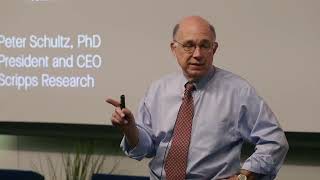
Peter Schultz describes how Scripps Research merged with Caliber, a nonprofit translational institute, to move discoveries from the lab to patients. The combined organization runs a full pipeline from early research through late-stage clinical trials, funded by a $100 million recoverable grant fund designed to recycle returns back into basic science.
Chapters
[Speaker] Scripps has historically been, as Jamie said, an institution focused on advancing scientific discovery, and we want to continue to do that at the highest level, but we want to do more than that now. What we'd really like to do is combine those basic discoveries with translational capabilities and with the end goal of accelerating the translation of new scientific discoveries into much-needed new medicines. And in doing so, not only make new medicines that directly impact patients, but also create a new mechanism for funding basic and translational research that makes this whole process sustainable. Into the future. So that's the goal. As Jamie said, and we're going to do this by combining organizations. Just— so I'd like to give you just a little background on the organizations that we're putting together. One is Scripps. Jamie described Scripps. It's one of the largest nonprofit research institutes. Great faculty. We have a graduate program. Ranked in the top 10 despite our small size. And even to our surprise, I think Nature actually did a survey of the impact of institutions on scientific innovation, and Scripps came out number 1 in that. So we do do great science. We do science across a large spectrum, as, as Jamie said, biomedical research interest from genomics and proteomics technologies to understanding the structural basis for the immune response to synthetic biology. And just a couple of examples, recent examples, is how do you— how does your sense of touch work and how do you sense temperature? Really important questions. Artem Patapushin and Andrew Ward actually understood. The receptors involved in this and how they convert a sense of touch into an electrical signal that goes to your brain. There are a lot of drug targets that forever we thought we couldn't deal with because we couldn't find drugs that would bind to them. Matt Disney's lab has created a new approach towards not targeting proteins which are the classic drug targets, but towards targeting conserved regions of RNA. And so this has become very exciting, okay, and he already has molecules that are targeting these conserved regions for a variety of diseases ranging from muscular dystrophy to cancer. We're— we have groups involved in stem cell biology. Kristen Baldwin's group can take skin cells from patients patients with neurodegenerative disease and recreate those diseased neurons in a dish in the lab where we can now study them and actually expose them to drugs to act whether we can correct those defects on the level of individual patients. And our structural biology, immunology, and computational groups have created a really interesting approach to make broadly neutralizing antibodies and vaccines. That actually could, in the end, prevent HIV as a vaccination strategy. And these are in the clinic, the antibodies are already in the clinic now in collaboration with Gilead. So not only does Scripps have a rich history of research, but also of making drugs. The most recent are tafamidis for cardiomyopathy, which which we expect to be approved shortly, and Ozanimod for MS and also patients with Crohn's disease and ulcerative colitis. And you'll hear a little about those later today. But despite all of that science and all of those medicines that are being created, not only at Scripps but around the world, it's the golden age of biology, there's still a huge need for new medicines, okay, for degenerative diseases of aging, for childhood diseases, autoimmune diseases, neglected diseases, cancer. Why, given we know so much about disease, is it taking so long to create the new medicines? That's the question. And the reason is, is because most of the discoveries are made in research institutions. And research institutions historically have lacked the infrastructure, the people, the expertise, and the processes to turn those discoveries into clinical medicines. Pharma does that, but there's a huge cultural difference between the commercial sector and the nonprofit research sector that creates intrinsic barriers. The handing off discoveries from scientific enterprise to the drug discovery enterprise. And so that's a problem that we have yet to overcome, and it really slows this development. So to that end, while I was at Scripps with my lab, we started Caliber. Caliber was begun as a nonprofit translational research institute. With really the sole purpose of accelerating the development of new medicines. And as, as Chris said, it came out of our experience with Novartis in building a genomics and drug discovery institute, building new technologies to accelerate drug discovery, lower its cost, and effectively make it doable in the nonprofit sector. And so we not only built those tools, we used those tools. We put 13 drugs into the clinic or approved over that period. But out of that came the belief that you could really do this in the nonprofit sector. And not only could you do it in the nonprofit sector, but you could do it free of many of the constraints, commercial constraints that drive commercial drug discovery. So we built Caliber. It was funded, it's funded by a variety of mechanisms. We have pharma partnerships. We have collaborations. With major foundations, some of those in the room today. We built all of the tools, kind of state-of-the-art tools for modern drug discovery. Not only preclinical, but clinical drug discovery expertise, a large portfolio, and a large number of collaborations. So we can do, and the lesson is we spent a lot of time building technologies. With Novartis and a lot of their money. That allowed us to very rapidly bring up in the nonprofit sector all of the tools we need to do this. All the way from the research bench to dosing patients. So we have that infrastructure. We believe that that infrastructure is enabling, but we don't understand all science. There's no way, you know, a group of people in San Diego can understand all of the science associated with all disease processes. So it's obvious we should collaborate with all of the best and brightest people in the world that do understand the biology. And so we've become very good at that. And so given that, that's caliber. We had Scripps. When I was in a moment of weakness, my arm was twisted to become President of Scripps, I thought, what could we do that would really be transformational and change the way not only nonprofit research works, but how you make new medicines? And the idea was really to, for the first time, create this bench-to-bedside paradigm where you join seamlessly basic research, the innovation, talent, resources of the academic research world at Scripps with its translational capabilities caliber. And by joining these two, you actually create a sustainable source of new ideas that are moved from the bench all the way into the clinic, okay, accelerate the drug discovery process, and actually create a way to make the whole process sustainable by partnering later stage assets that are further along the value inflection curve with pharma for further development, but then reinvesting those resources and funds back into the research enterprise. So we think we could do a lot if this model's successful. Not only accelerate the development of medicines, but create funds that allow us to do it. For perpetuity. So can you do that? That's the question. A lot of people are interested in doing this. Can you actually make this work? And I think the advantage we had in making this work is we could simply bring together two organizations that were complementary in their capabilities and simply glue them together and come up like a square wave instead of trying to build these capabilities internally within a basic Research Institute. So that's what we did. And the question is, where are we and what's the status report? And what I'd like to do is give you an overview of a few vignettes to show you where we are in this process and where we're headed. We've— importantly, if you want to do this, you want to build a pipeline because you want it to be sustainable. And so you need early stage programs, later stage programs. And then you need clinical programs. So we built across Caliber and Scripps programs at every stage. The later stage programs we have that we've built over the last 5 years or 6 years or so are shown here on this slide. They're in— some of these are in the clinic. They're in the IND enabling stages. So they'll go will be dosed into patients this year and some are at candidate declaration state. These cover a broad range of diseases. Cancer, Parkinson's, neurodegenerative diseases, degenerative diseases of aging, infectious disease, fibrosis, lung disease, and others. And briefly, the program that's right now in a Phase 1 trial in a 60-patient Phase 1 trial is a regenerative medicine for osteoarthritis, which is a huge unmet need. It afflicts 20 million Americans. There's no disease-modifying drug. You take painkillers or you get your knee replaced. So we've created a medicine that when you inject it in the knee induces resident stem cells in your knee to form chondrocytes and make cartilage. So you're actually making cartilage and repairing the damage. So far we've dosed 25 patients. There's no adverse effects. This will read out in a year and a half. And then we're already working on a formulation to take this into a Phase 2 clinical trial. We're doing the same thing with multiple sclerosis. We have a drug that induces stem cells to make oligodendrocytes to make myelin. To repair the damage in MS. And the same for heart and lung disease. Cancer. Metastatic hormone-refractory prostate cancer is a huge problem, okay? How do you deal with that? It's drug resistant. So we've created medicines that actually recruit killer T cells from your own body to prostate tumors to kill the tumor. Interestingly, we took some metastatic prostate cancer from primary tumor from patients at UCSD with metastatic bone metastases and in preclinical animal models absolutely ablate the tumors. So this is just completed GMP manufacturing. We're into GLP tox studies which look very good and we hope to dose patients the fourth quarter of this year with this new drug and innovative new approach towards prostate cancer. There's a therapy that's really exciting called CAR T cells where it's a similar approach. You use the— your own immune system to kill cancer cells. What you do is you take T cells out of your body, genetically reprogram them with a protein that targets them to cancer cells, put them back into patients, And now the T cells ablate the cancer. And people are achieving what look like cures of cancers this way that have failed every other therapy. The problem is you now have a living drug, a cell. It's hard to control. People also are dying in this therapy. So we've created a technology platform that we think allows you for the first time to really have exquisite control and tunability over these CAR T cells.. And if you can do that, then you can actually expand this technology to a whole range of solid tumors. And so to do that, we formed a really exciting partnership with AbbVie. They're committed to this field and they think this may be the best approach to begin to tackle solid tumors like prostate cancer, colon cancer, and others. So again, in partnership with AbbVie, we're actually putting this therapy into patients. At the end of this year as well. How about other diseases? Parkinson's disease. You know, there's this new realization that like you can tackle cancer through the immune system, you may be able to tackle neurodegenerative diseases through the immune system and inflammation may be a major part driving these diseases. So there's another kind of T cell in the body, Tregs, that have been shown in preclinical models to stop or reverse disease in Parkinson's models, Alzheimer's models, ALS, and others. More importantly, folks just did increased Tregs in patients, Parkinson's patients, using a protein called GM-CSF. And in a Phase 1 trial, they saw an improvement in motor function. And some of the improvements in these Parkinson's patients were really dramatic. The problem is, this is a short-lived drug. You have to give very high doses a lot, all the time, so it's not really practical. So we made an antibody version of that that looks very good. It's now already in non-human primates, long-lasting induction of Tregs. Good tolerability, and we're hoping to initiate a Phase 1 clinical trial in 2021 on this in a Parkinson population, but we think if it works, it will also work for other neurodegenerative diseases. Another interesting approach towards cancer and vaccine development is to activate endogenous pathways that your body uses to clear viruses. Well, cancer cells mutate so quickly they start to look like they're foreign, okay? So if you can activate these mechanisms that fight foreign invaders, the idea is you could tackle cancer with that. There are some drugs that have been created that look very promising, but they aren't very good, so you have to— you can only use them by injecting them in the tumor. Really limits their utility. So we've made, using the technologies we have, orally active compounds that are active in vivo models that we believe will allow you to extend these therapies to a huge range of cancers. Moreover, we now understand at a molecular basis how these molecules work. So we're hoping to declare a clinical candidate by the end of the year. How about intestinal disease? A huge challenge, okay? Ulcerative colitis, Crohn's, and others. How do you fight these? You fight these with anti-inflammatories. Part of the problem with the disease though is a compromised intestinal barrier. So you really wanna repair that barrier if you wanna reverse the disease. How do you do that? Again, we have a regenerative medicine based on a naturally occurring peptide that we've engineered called GLP-2. That if a normal intestinal barrier in a mouse model looks like this, and you destroy it in a model that mimics intestinal bowel disease and you give this drug, you actually get complete repair, okay, and amelioration of all the symptoms. So we think this could be again an exciting approach to deal with intestinal diseases. Again, not simply slowing the disease or treating the symptoms, but repairing the damage that's underlying cause of disease. And then a final example is a program that came out of our partnership with the Gates Foundation where we're looking for systemic drugs that every time a mosquito bites you, it dies before it transmits the disease to somebody else. So we're putting hopefully a drug into the clinic this year with the Gates Foundation, Medicines for Malaria Venture that does that. But at the same time, we realized this was a class of molecules that actually not only kill mosquitoes, they kill ticks. In fact, a related structure is in dog flea and tick that you give your dogs every 3 months. Well, if you simply ask the question, does your dog— your dog's running around in the fields, does he get Lyme disease? The answer is no. So an obvious next step is why don't we just make a human version of this that we take once a month starting in May. And the ticks die when they bite you before they can transmit the disease. That would actually prevent Lyme disease. So those are some of the programs we're doing moving into the clinic. How do we do that? Jamie raised the funding issue. We're creating a fund called Primer. That its purpose is to have the funds to move that portfolio through IND-enabling studies into the clinic. And that fund is roughly $100 million, okay? We think we can do that with $100 million because we're also partnering with foundations— Wellcome Trust, Gates, and others that are also providing support. But we're raising this fund in an interesting way. It's as recoverable grants or gifts. So if people want to impact disease, they can make a charitable contribution to that portfolio. They can even direct it to any medicine within that portfolio. If anything in that portfolio is successful and partnered with pharma, we get a return. We give people their money back, okay? The only constraint they have is to use it for another charitable purpose. And the rest of it is actually reinvested by us in the biomedical research enterprise. So it's an interesting approach. It's— people are interested in this. The Gates folks and Bill Gates was the first one to contribute to this fund and most recently the Hearst Foundation. And the goal is really to make new medicines, but if we're successful, you can actually impact other charitable purposes with the fund. So we have about $75 million raised and we're going to try and close the rest of the fund by the end of this year. And this is the portfolio that Primer is funding. But what happens when we're done with that? What we'd like to do is make this entire research, basic research and translational research enterprise sustainable. And that's a huge reason Caliber was partnered with Scripps. And so now that that partnership exists, we're actually starting to build an earlier stage pipeline that involves a lot of programs, not only from Caliber, from Scripps, and also our other collaborators. And you'll hear about these later today. Just briefly, just as 4 examples, a regenerative medicine that you give after a heart attack that makes new heart cardiomyocytes at the expense of fibrosis. So repairs heart damage. Molecules that protect organs from damage and degeneration. Molecules for childhood diseases like Prader-Willi syndrome where we have very interesting molecules in animal models of Prader-Willi syndrome that actually address the metabolic and cognitive challenges of the disease. And type 1 diabetes, we have a large collaboration with the JDRF to make regenerative medicines that, that regenerate beta cells. So those are examples of some of the earlier stage programs. We have a large partnership with the Gates Foundation. So I've talked about diseases of the developed world that we all suffer from. How about the developing world? This is probably our larger— largest partnership. We've already put drugs into the clinic for tuberculosis and childhood diarrhea, which is a huge problem in the neglected world. And we've built interesting capabilities with them. We've built the largest repurposing collection in the world, 13,000 molecules, every drug that's ever been put into people or late-stage clinical development. Why did we do this? Well, it turns out Many drugs can be repurposed. AZT was a drug that was repurposed for HIV. Thalidomide became just an incredible drug for multiple myeloma. So you begin to have these— this huge drug collection. If you find something for a disease where these drugs have never been tested, it allows you to move very quickly into the clinic, either with that drug itself or a modified version. So as an example of that, the Gates folks were interested in Cryptosporidium. It's the major nonviral cause of childhood diarrhea. We started that program and within 3 years screening that collection, we actually had a drug in people, which is pretty incredible from start to finish. Not to finish, but to dosing patients. And it was a drug that was discovered by— developed by Novartis for leprosy many, many years ago. And they actually were very helpful in letting us progress this. So we built a pipeline for neglected diseases as well. And finally, as Jamie alluded to, that's to put drugs in people, but there's a whole other part of medicine is understanding how your disease is different from your neighbor's disease and understanding, really developing what's called precision medicine so we can treat you realizing that you're different than everybody else. And so that is the mission of Scripps Research Translational Institute and it in fact has the largest NIH grant given to use genomics, digital medicine, and bioinformatics to begin to tackle this challenge. Not only to treat disease, but to prevent disease. So that's what we do. And the idea is let's create a new model for research institutes that bridge basic and translational research. Hopefully that will accelerate the development of new medicines for all of these, you know, dire needs that we have. By, as a research institute, not only accelerating but moving these medicines further into the clinic, we create more value and we capture more of that value to reinvest and fund the whole enterprise, okay, to augment the federal government and philanthropy. And so we hope the success of this model will not only benefit us but hopefully create a new paradigm for how basic research institutes, nonprofit institutes, work with the commercial sector hand in hand to create new medicines to the benefit of both and to the public.
More from Joshua







Scientist Stories: Hans Waterham, The value of phenotypic assays in peroxisomal disorders




Scientist Stories: Joel Zlotogora, Genetic carrier screening programs for reproductive purposes