Scientist Stories: Phil Sharp, Discovering RNA Splicing and Co-Founder of Biogen
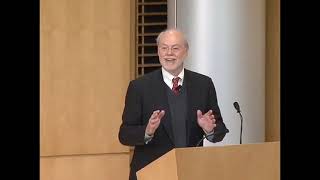
Phil Sharp discovered RNA splicing through electron microscopy images of adenovirus, work that won him the Nobel Prize. He grew up in rural Kentucky, studied theoretical chemistry, then pivoted to molecular biology at Caltech. Sharp co-founded Biogen and later Alnylam while leading MIT's biology department and directing the Cancer Center.
Chapters
Great turnout in recognition of Phil's eminence. And I'm sure we're all looking forward to what he has to say. And I don't want to take away any of his stories, but I was thinking about how to introduce him. I realize I've known Phil for more than 35 years, and we've been colleagues here at MIT for more than 30. I actually first met Phil when he was working at Cold Spring Harbor. And he came to London where I was a postdoc to do some experiments in Lionel Crawford's lab. I think I may be the only one in the room who's actually seen Phil working at the bench. But he was. He was running hydroxyapatite columns in the days when that was one of the ways in which one separated hybridization reactions. So then both of us were recruited to MIT when the Cancer Center opened in the mid-'70s., and we've been colleagues ever since, and it's been a great experience. I remember soon after, maybe a couple of years after, 2, 3 years after the Cancer Center opened, Phil showing me an EM picture in the hallway outside his office, the same office he has now. And this was the famous picture of splicing of adenovirus with the loops that you could see in the electron microscope looping out where the where the introns are, and this was obviously very exciting. He was very excited, as was everybody else, and things went on from there, as you well know. And I'm not going to take Phil's thunder and talk about his science. I expect he'll tell you some of that and the people with whom he's interacted and worked. And he still does great science. The lab still is a leading lab in RNA biology and continues to break new ground, and maybe he'll say something about that. But there are several other sides to Phil. You probably know this. So he became director of the Cancer Center when Sal Valoria stepped down, the founding director, and did that job very well for a number of years. And then in the early '90s, Phil and I swapped jobs. At that point, I was the department head and he was Cancer Center director. And we swapped jobs. And I got the better part of that deal, I have to tell you. For several reasons, not least of which the biology building, Building 68, at that point had been designed and partly built, but occupation hadn't happened and the fit-out hadn't happened, and Phil inherited that onerous task and helped to get everything set up as it is now, running very well in that building. I guess you occupied it in '93. And the other task I bequeathed to him to him he also did very well, which was the biology requirement, which had been argued through MIT and approved by MIT, but not yet implemented. And Phil had to implement it. And it's been a great success, as you all know. So he went on, ran the department for a number of years very well. Subsequently, he ran the McGovern Institute, got that launched. In the meantime, he founded a couple of companies, Biogen, which is just across the road here. Still there, one of the earliest biotech companies. And more recently, Alnylam. I don't know whether you're going to talk about this side. So that's an RNAi company that Phil founded. It's doing very well. And while he was doing all this and carrying on with his great science and being a great colleague, he also did a lot of things in Washington in terms of advising various parts of NIH and the the government. You recently heard that Eric Lander and Harold Varmus are going to be on the PCAST committee. Phil was on an earlier incarnation of that in which administration? Clinton? In the Clinton administration. So he's been an influential player both here and in Washington and worldwide, and I'm looking forward to hearing how he got there.
Phil. Thanks, Richard. It's a real pleasure to have you introduce me. The person who actually was most responsible for having a new Department of Biology building constructed here at MIT was Richard and his colleagues. And I think we all owe him a debt of gratitude for that and many other things. And it was a challenge but a pleasure to be head of the Department of Biology and work with all my colleagues. So what I plan to do today is to sort of put an emphasis on my early years. I think that's what most of the students in the audience are most interested in. And to tell you a little bit about where my background is at, and that'll feature a lot of Kentucky. Kentucky, and then to bring you through some of the early transitions in my career. I'm sort of an individual who I think was probably coming from development through a generation older than myself. And the reason I say that is that I grew up in rural Kentucky at a time in which industrialization of that part of the country and movement of people to urban centers was just happening. And I was born before that happened, and then my family went through that transition. And I'm going to talk a little bit about that, and I'm going to show you some pictures that I rescued from my mother's little box in the closet this year when I was down there visiting her over the Christmas holidays. And note in these pictures the lack of pavement. Most people don't live and grow up in the absence of pavement, but note the lack of pavement. So my family— let me put this on. I got it, Richard. It's down. My family moved into a part of Kentucky, northern Kentucky, in a town called McKinneysburg, a bend in the South Lickon River, a beautiful little spot. In 1848. They came out of Culpeper, Virginia. They were probably moving into that part of the country under a land lease, having fought in the American-British 1812 War and being given leases and land in Kentucky to encourage it being settled. This is my grandfather Sharp and his wife Sarah, we called her Sally. They're obviously dressed to go to church. This is back in the farm on the Broadford Pike where they lived all the time I knew them. He was a blacksmith when he was young, an iron worker at the middle of his life, and then a farmer towards the end of his life. When that man was 92, I worked in the sun with him putting fence posts in. Most of a day. He was an incredibly strong individual. This is my mother's side of the family. This is Norah in the middle. That is her mother, my mother's mother, and an uncle and an aunt, Judy and Carl. This is back in McKinniesburg. This is in 1840, just about the time I was born. I was born on D-Day, 1844. I mean, 1944. So I'm sorry. I'm not quite that old. But that's back in McKinneysburg. My mother and father are shown here on the left. Again, this is my dad, Joe, and Catherine, my mother. This is with my dad's two brothers and sister. This is in 1940. You note my father here has what is a farmer tan. You note that his forehead is lighter because he wears a hat because he's in the sun all day, and his arms are very brown because he's, at this stage, a tenant farmer. He farmed until I was 13 and then began working in the city. This was again taken back in McKinneysburg. In a bend in the river where the family was at. This is yours truly at a year and a half of age. I'm the only son in the family. I have two sisters, one six years older than I, Joanna, one a year and a half younger, Sandra. But this is a pretty traditional family, and believe me, as the only male child, I got a lot of benefits. And that picture sort of speaks all the pride of my parents in me. And I was encouraged from the time that I was this age to go to college, even though my mother had an 8th grade education and my father had a high school education and had not used it, been a farmer. I was encouraged from this age to go to college, and my two sisters were encouraged but not quite so intensely. Tell you a story as to how that encouragement happened, at least in part. When I was 6 years old, I had started a piggy bank from this time. It was actually a rooster bank. It was this big. And my parents asked my grandfather on my mother's side, Coben, to buy a calf, a heifer calf, in town. And they brought it out, and I paid $16.75 for that heifer calf. What was the deal? My parents were going to keep the calf as a cow when it grew up and take the milk. And I was going to get the calves each year to sell to save money to go to college. And that happened. The cow was named Blackie. She lived for 14 years, and that was part of my funds to go to college. The other part of the funds to go to college was I raised 15 hundredths of an acre of tobacco. When we bought a farm of our own, I was given 15 hundredths of an acre that I would get the cash from, and that went in to pay for college. And by the time I got to the age of going to college, I could pay about a year and a half of college out of that. So I was encouraged at the time. It's a little disconcerting that being head of the cancer center, I paid my way through college growing tobacco. But life has got some ironic moments to it. And this is one. This is about '13. This is a school picture. At this stage, I was at a school— public school system in the county of Pendleton County. And I was in about the 6th or 7th grade. I had already decided that I was going to be a scientist, even though I didn't know what a scientist was. I was in love with math and science. Reading about it. I read every book in the library, talked to anybody I could. But at this stage, I had already recognized that my interest was going to be in quantitative math and science. And I just basically continued to develop those talents over that period of time. At this stage, I had about 20 classmates with— in my class at Butler. We had one class all the way through 7th, 8th, and 9th— 6th, 7th, and 8th grade. And when I went to high school, my freshman year had 16 students in the class. We consolidated, and that led to then a class of 60 in Pendleton County. This is myself. I show this picture to, again, emphasize the lack of pavement. And that house behind me there, I'm standing on the farm where I grew up on what is Tail Point Road, now called Phillip Sharp Road. It is officially named. That's the farmhouse behind me there. That's the nearest house to our house on this beautiful hill overlooking a great view in northern Kentucky. My nearest boy my age was about 3 miles away. I worked on the farm. So I spent my years either going to school or going to the farm, working on the farm, having chores in the morning, chores at night. I think here I'm getting ready. It's the springtime. I still have long sleeves on. I'm getting ready to go to school. But that was sort of my background and experiences. This is my high school graduating picture. There were 10 students out of 60 selected to be honors. I was one of the 2 males. The other was a fellow who didn't go on to school. It was a shame. He was very, very talented. I basically applied to one school to go to college. It was Union College in Barbourville, Kentucky. It was a Methodist-related school. My family was a member of the Methodist Church. I wanted to go to a small school. On Saturday night, after I dropped off my date, I stopped at the pastor's house, sat down on his kitchen table, and filled out the application. Luckily, they accepted me, because if they hadn't, I don't know what I would have done. I was very foolish. My counseling at this high school was the principal called me in one day. I thought I was in trouble and said, Phil, what are you going to do after you graduate from college? I mean, graduate from high school. I said, I plan to go to college. I've applied to Union. He said, fine. That was the total counseling that I got. I had had one other conversation. I had several with the principal, was Mr. Back. He was a wonderful guy. I'd had several conversations with him, but one other of a similar nature. He called me in about, oh, about 6 months before this. And asked me if I was interested in going to medical school. He said the local Chamber of Commerce had asked him to approach me to see if I would be interested in going to medical school. They would pay for it, a part of it, if I would come back and practice in the community. I told him I wasn't ready to make that type of commitment, so I didn't. Think about doing it. So I graduated and went to Union College. It was at that stage, and still is, a small college in Barbourville, Kentucky. It's in Knox County. This was during '62 to '66. Better than half of all the young males who were drafted or examined for draft from that county failed. Malnutrition was so bad that— and health was so bad that you— the typical young person didn't pass the Army physical. You could give birth as a woman in the hospital if you could post $100. If you couldn't post $100, you had to use a midwife. So, it was a very poor part of the state. A beautiful place. I got a reasonable background in math and chemistry, and then applied because I had a professor named Dan Foote who taught me chemistry. I TA'd for him. He was there for 2 years. I was basically hanging around him all the time. He was a graduate of the University of Illinois, and he encouraged me to apply to to the university there, and I applied to the University of Illinois after 3 and a half years as an undergraduate to do my PhD in chemistry. So luckily, this was in January when I applied. I didn't have the money to wait till June. And they accepted me as a— graduate student in the Department of Chemistry at that time. So I go into the department. This is a wonderful department. The Big Ten at that time, the University of Illinois was within the top 10 departments in the country. It was a very large department and a very good department. So I take my qualifying exams, and I flunk 3 out of the 4. I flunked physical chemistry, inorganic chemistry, and analytical chemistry, having passed organic chemistry, which Dan Foote, this professor I talked about, taught me at Union College. So I did exactly what I should have done, and that is the head of the department said, "Go take our undergraduate courses." And I did within a semester, and in 3.5 years, from total time, got my PhD. This is the subject of the two major papers for my PhD. You will notice it's Light Scattering and Hydrodynamic Properties of Polymer Chains with Excluded Volume. That's predicting the three-dimensional conformation of polymers in solution, taking into account that there was physical exclusion of space due to these polymers. It's easier— if you, in a theoretical sense, don't consider that. But the important part of it is it was published in the Journal of Chemical Physics, and all that work was theoretical. I really didn't put my hand on a lab bench during my PhD program at the University of Illinois. So when I got my degree, I was fortunate enough to have been accepted for my postdoctoral work at Caltech. And in the laboratory of Norman Davidson, who is shown here, myself, Harumi Katsumatsu, and Don Robinson. I think this picture was taken a couple of years after I left. I'm not sure, but it was the only one I had of of Norman that I could find in this short period of time. When I arrived at Caltech, I knew I was among the best of my generation in terms of being a postdoctoral fellow or a young trainee in life science. That's what it means when you're at a place like MIT or Caltech or Stanford or Harvard or others. You're among your generation's best. And if you can actually do science and contribute in that community, then you should be very confident that you can do science and contribute anywhere. So Norman was a physical chemist when he began his life. He did shock tube kinetics. He was the second reference after Norman. I mean, after Eigen, in very rapid shock tube kinetics. He then did inorganic chemistry, contracted throat cancer in the mid-'50s, when he was 50 or so. Went to Chicago, took a sabbatical, was treated with radiation, switched to biology. And when Bill Dove, who's a professor at Wisconsin, came to see him as a graduate student, Norman said, Yes, I'm interested in having you as a graduate student, but I'm not sure I'm going to be here 3 years from now or 4 years from now to see you get your degree. Well, luckily, he survived till he was well in his 80s, did magnificent science, and made the transition from physical science to biological science. And as the— sort of in the middle of that transition, I appear in his lab. And next to his lab is the lab of Jerry Vinograd, who discovered superhelical DNA. It's a name you don't hear very often. There's a great story around Vinograd that I could tell, but I won't for time. But it was a wonderful environment. And it was an environment in which one was left to try to make this transition into molecular biology, which is where I wanted to go. And I knew that Norman would be someone who could understand my chemistry background and was moving into molecular and cell biology, and that he was an outstanding professor. I read all his papers. I just loved his papers. Just, they spoke to me in a way that almost nobody— no one else's work did. So I then was very, very pleased when I was able to join his lab. His objective at that time— and you don't need to see all this, I'll just tell you, it's to remind me what I was doing as a postdoctoral fellow. His objective at that time was to map genes on chromosomes. And he had developed with Ron Davis, who was a grad student with him, And I overlapped with Ron at Caltech for 6 months. Ron, with Norman, had developed electron microscopy of DNA, being able to use the electron microscope to look at DNA molecules, and particularly to look at DNA molecules that might have deletions or insertions so that you could map where the physical change was at on the chromosome. And he wanted me to look— the objective was take this technology that Ron Davis had developed as a phage, a lambda, and map genes on chromosomes. And he wanted me to do that chemically. Well, I was not a good enough chemist to do that. But I knew— I soon began to read a lot about— and I had already read a lot about molecular biology and genetics before I went to Caltech. I've never had a course in genetics. I've had one course in— two courses in biochemistry. And if they'd have known that when they hired me here, they probably wouldn't have hired me at MIT. But I had read a number of courses, a number of books, and working with Ron Davis, learning microscopy, and then This is an example of what I did at Caltech as a postdoc. And this is the visualization of a plasmid out of bacteria that has 450 kb in it. It's a big segment of the chromosome of E. coli. And here is lambda phage in a heteroduplex where I can map it. Integrated into the genome of the bacterial chromosome. This was the Campbell model, where lambda attachment sites were opposite the cohesive ends. These are the chromosome arms. This is the F factor, sex factor, that picked up this piece of the chromosome in F primes. And I developed the technology to isolate these large pieces of DNA and to determined their structure by electron microscopy. And I saw insertion fact— insertional elements, mutations due to that type of activity. This was in '69 through '71, when, you know, these are the first glimpses that we had of chromosomal DNA. Norman and I wrote the paper and coined the term KB, because this was one of the first examples of using pieces of DNA that were thousands of base pairs long. And the paper coined the term KB. And it was actually very interesting paper work. I did drug resistance factors and a number of other things. But '71 was not a good time. The country was in a recession. Molecular biology was just a field that was growing. Though I had strong support and letters from Norman, there weren't many jobs around. I was interviewed at a couple of places that I would have been interested in. Stanford Chemistry interviewed me, but didn't offer me a job. The places I got letters from and wanted to interview me for a position, I wasn't eager to go there. So I decided that I did not want to spend my career working in bacterial systems. I wanted to address the problem of the structure and expression of genes in mammalian cells. And partly being exposed to Jerry Vinograd at Caltech, who used small DNA tumor viruses such as SV40 to map out genomic sequences or viral sequences in mammalian cells led me to think about the issue that I could use, or wanted to use, viral genomes and study their regulation as expressed in human cells. To look at this problem of the pathway of gene expression and regulation in human cells. So I talked to Norman, and we decided— I said, I want to get this type of experience. Where could I get this type of experience? And we decided that I would write to Howard Tinman, Dave Baltimore, and Jim Watson. To see if I could get an additional year or two of postdoctoral experience learning this technology. The response of those three people were what you would sort of expect after you got to know them. Howard responded, "Well, I'm not sure. You need to come and talk to me, and we'll see what happens." And David responded, "I don't have any space now." He had just discovered reverse transcriptase. If you can wait 2 years, I might be able to get you in. And Jim Watson, who had just taken over as the— at Cold Spring Harbor and started to develop a DNA tumor virus group at Cold Spring Harbor, called me after he got the letter and said, hello, I'm interested in having you come to Cold Spring Harbor. I'm going off to Europe in a week, and I need the answer within the week. So I went around the department at Caltech and talked to a number of senior faculty about what was going on at Cold Spring Harbor and who Jim Watson was. In fact, I knew him by reputation. And everything checked out. And then I made the move to Cold Spring Harbor— sorry, this does this every time— to Cold Spring Harbor, where I was on a postdoc with Jim Watson for 1 year. This picture was taken a little after that time. And he, at that stage, had was spending half his time at Harvard as a faculty and half his time at Cold Spring Harbor. He had taken over from John Cairns at Cold Spring Harbor. I think at the stage he took over, which was about a year or two before I came to the lab, the laboratory's research volume was $150,000. The laboratory research volume now is probably $40 to $50 million. The total budget of Cold Spring Harbor is much higher than that. So he rescued Cold Spring Harbor. But more specifically to my interest, he had recruited a large number of very good young people who were addressing the problem of how viruses replicate in our cells, human cells or animal cells, and create cancer. And that was a really exciting research program. It's something I wanted to learn. And I had an enormous amount of fun at Cold Spring Harbor. Now, one of the individuals I collaborated a great deal with at Cold Spring Harbor is shown here, Joe Sambrook. Joe is one of the few really great experimental scientists that I've had the pleasure of working with. I think there's only been 3 that I consider absolutely magnificent experimental scientists. People who, you know, could write out a very complicated protocol taking weeks to months and execute on every bit of that protocol. And have that protocol, you know, taped to his desk before he started. And, you know, 2 weeks later It works. The dots are there. The lines are straight. The controls are done. Controls for controls are done. He was a magnificent experimentalist, and intellect, and writer. He's now at the Peter Mac in Australia. But here we're at Cold Spring Harbor. That's Tina Turner. I think I'm holding one of those hydroxyapatite columns that Richard mentioned. And I can be fairly sure, with his finger pointed down, Joe Sambrook saying, fuck you. Because that's the language he used. But he was an incredible, talented individual to work with. And I enjoyed every minute of it. I also met a large number of other people at Cold Spring Harbor and collaborated with them. Ulf Peterson taught me to work with adenovirus. He came out of Stockholm— Uppsala, Sweden. Mike Botcham was an officemate. Both Ulf and Mike were officemates, shared an office with me at Cold Spring Harbor. Joe Sandbrook, Terry Grodzinger, Bill Sugden, Walter Keller were all people who were in James' laboratory at that stage. That's the lab. That I was part of. And we just had a great deal of pleasure. At that stage, Cold Spring Harbor was sort of a commune, a scientific commune, in the sense that your lab was over there about 50 feet from the house. So anytime the conversation in the evenings got a little boring, you went back to the lab. It wasn't good for the family life, but it was good for science. And I had an enormous amount of fun. After 3 years at Cold Spring Harbor, I decided that I really wanted to return to a more academic environment. It's a small lab. It's away from a university. I love the university environment and the diversity around the university. In terms of different disciplines and different people and students and all the things that went with it. So I began to search for faculty positions in my third year at Cold Spring Harbor. Now, I did many things, contributed to many programs in collaboration with a lot of other people at Cold Spring Harbor. But probably the most important one was dissecting the adenovirus genome. Now this I didn't do totally at Cold Spring Harbor. I did, with Ulf Pettersson and others, break down the adenovirus genome into restriction maps, created the restriction map, identify this region as the E1A. E2, E3, E4. This is the late strand. This piece here we missed, but got correct later. But began to work with adenovirus and mapped out that this was the— or determined by looking at adenovirus-transformed cancer cells that this piece of the genome here was the piece that was most critical. For transformation and even got mutants and studied which particular genes in this piece were important. We produced a restriction polymorphism map of adenovirus long before it was done for human DNA to map different regions genetically. But we really had a great deal of fun in this molecular biology and in molecular biology on SB40. Isolating restriction enzymes and enzyme maps, developing some of the technology that became critical for the recombinant DNA technology. So I went on the job market. Things were going great. '74 was a good time. The economy in many parts of the country were picking up. The War on Cancer had been announced. There was a lot of money coming into academic science and molecular and cell biology. So I was being entertained at a large number of places, offered nice positions, but I was waiting. And I was waiting for MIT. Tom? Phil, was it Cold Spring Harbor or Caltech where you did your first lab work? Caltech. Caltech. Norman Davidson told me when I walked in the door, no more theoretical stuff. I was going to need to learn lab work. I wanted to. I went to Caltech to learn that. But we did publish one theoretical experimental paper on the Holliday structure, rotation and free energy calculations on Holliday structure. But it was all— all experimental at that stage. So when you were doing electron microscopy work, were people— Shabalsky and others were off doing similar things, right? Shabalsky was— Norman and Ron Davis were the first to use electron microscopy to see a deletion on a chromosome, and that was in lambda. Shabalsky's laboratory was the first to introduce denaturing agents so that that single-strand DNA in the heteroduplex would be extended, as the example I showed you. And then Ron Davis extended that technology and brought it to Caltech. So they were the two people in parallel, and then, you know, it expanded from there. Okay. So— I was waiting for MIT. Obviously, you know about places that are starting new institutions. In this case, it was the Cancer Center. I knew Dave Baltimore and Salvador Luria were going to be major players in it. And boy, I wanted to be down the hall from Dave Baltimore at MIT. And I waited. And I waited. And I delayed everybody. And I waited. And then finally, there was a call. And they asked me to come up and interview at MIT. I since learned that there were two names on the list. One was myself, and the other was Ed Skolnick. And I don't know. I think Ed turned them down. But I came up to interview. And my impression of MIT— was confirmed by the interview. So I'm here. I'm meeting all these wonderful people doing wonderful science. And Dave Baltimore was going to introduce me for my lecture at noon. And at this stage, I was working on adenovirus and had this transcription map, but not at this level of resolution. No one had done microscopy. I go to David at about 11:30. We have a conversation about 20 minutes. He says, let's go get prepared for the talk. So we walk down in Building 5616. He says, excuse me, I got to make a detour. He runs downstairs. He pulls out change in his pocket and buys his sandwich out of this machine, takes it up to the seminar, and eats his sandwich. And that was lunch at MIT. I go out to dinner that night with a number of faculty members, some of whom are probably in the room. And we go to a Chinese restaurant. And, you know, I love Chinese food. And this was a significant group. And they had a lazy Susan. And they put all the food on the lazy Susan. And then you take a rice bowl. And I usually eat Chinese food by putting a little rice and then putting something on the rice and using chopsticks to eat it. So I take a little off the lazy Susan. And I'm guest. I'm given first. Opportunity. And then that lazy Susan goes around, and by the time it goes around one time, there was no food left on it. So it taught me that if you want it, you ask for it. And if you need it, do it. So it was a very invigorating place. And I waited one week. Salvador Luria called me. And said, would you please come up? We want to offer you a position. And I came back up. And I was the worst negotiator you can imagine. I said, what are you offering? He told me. I said yes. Because everything else was secondary. Because I knew that if I was in this environment with these people around me, I could take care of all the rest. I would have great students to work with, great colleagues to think with. A lot of young people like Richard and others who were here. I didn't worry about money or space or anything else. It would have been secondary to that particular issue. This shows a picture of Salvador Luria, who was director of the cancer center, Dave Baltimore, and Nancy Hopkins. This is in the laboratory that Nancy occupied initially. She was my officemate. We shared an office next to each other. And then she moved down on the third floor, and I took this lab over. So this was a wonderful way to begin your independent research laboratory. I tell this story to all the job applicants who come in to try to tell them what it's like to be at MIT. You all know. You're here. But most people don't know how science works at MIT. And most environments are not nearly as interactive as we are. So when I was at— just took over the position, 2 weeks in, I was getting bored out of my mind. I had a postdoc, Jane Flint, with me, wonderful person, and a technician. But I just needed more action. More people to talk to, and more things to think about. So I went down to Dave Baltimore and asked if I could attend his group meeting and participate in his group meeting. And he said yes. So as assistant professor, I got up there every so often and talked about what I was doing and all my postdocs did. Bob Weinberg was already meeting with him. Nancy at that stage— I don't think Dave Houseman at that stage was also That was called the floor meeting. I've been at MIT 34 years. Dave Baltimore has been gone for 15 years. And we're still having floor meeting Wednesday noon in this room from 12:30 to 1:30. All of Weinberg, mine, Tyler, Jackie Lees, Mike Yaffe, Rudy Yanisch are all meeting and talking about science. So it's been 35 years as a show in science. And it's one of the most stimulating things. It's a way of sharing science. And it has been incredibly valuable to almost everybody who's been involved. So a very interactive environment, a very important environment, with lots of great colleagues to do science. And then in '77— I'm going to have to move along. In '77, Sue Birgit and Claire Moore Using the electron microscopy, as Richard pointed out, we were able to visualize this RNA-DNA duplex. And what is shown here is 3 loops, A, B, and C. And those were the 3 loops that said that adenovirus was extensively spliced and that there were heteronuclear RNA was related to messenger RNA by the excision of introns, and that that structure was due to the fact that here is the body of the message, A, B, and C, and A, B, and C were exons. They weren't called that at that time, but they were subsequently called that by Wally Gilbert. 17, 19, 26 spliced here. Introns excised. That's what those loops were. And that was RNA splicing. Wow. That changed everything. Changed everything in sort of cell biology. It was really one of the distinctive insights that said what gene expression was like in bacteria was going to be significantly different. In mammalian higher-order systems. It was just a terribly exciting time. I then spent a number of years working out splicing. And this is a cartoon that was drawn by Paula Grabowski. Paula was a postdoc in the laboratory, and I showed this cartoon for years. Splacers are a cut above the rest. Here's trans-splicing. It's something I had people doing pet projects on, spliceosome. Pet project number 1, I would hang graduate students' and postdocs' heads on these pet projects. And I was a little even bolder in that cartoon than I am now. Actin was another pet project. But Paula Grabowski, while she was in the lab, first recognized that there was a lariat structure created as a splicing intermediate, and then subsequently identified the spliceosome. Lariat was also— that term was coined by Tom Matiotis. Rick Padgett was the first to develop in vitro splicing of an intron. And spliceosomes, we coined the term, and John Abelson as well. And that led to this, which was related to group 2 introns. And we spent a good bit of time working out this textbook thing, as well as a number of other people in the field. And that occupied a lot. I also worked on transcription at that stage, but I don't want to talk about that now. I want to talk about this. So this was through the '70s. This particular picture is from the research— National Research Council, National Academy. And this is a picture published in '85, but dates the Asilomar Conference in 1975. And there I am at the Asilomar Conference. And for you who are younger in the audience, you might not remember that when recombinant DNA was developed. Everyone was concerned about the potential hazards related to it, and a moratorium was put in place. A moratorium that said you can't do recombinant DNA around the world. And in fact, for about 6 to 9 months, it was totally honored by every scientist that I know of. A remarkable consensus. So we didn't do a bunch of experiments we intensely wanted to do. And then this conference was held at Asilomar in California to talk about issuing guidelines and how we should begin to do these experiments to do them safely. It was one of the more remarkable experiences in my life. The conference was only about 150 people, and clearly getting into it was difficult. And the way I got into it, I called Paul Berg, who was one of the major organizers of it, and said, "I really want to do this." And Paul had known me when I was at Caltech, and we had collaborated over the period of time— interacted. I never collaborated with Paul. And he— got me in. And that initiated this issue of biotech. The Asilomar Conference was front page New York Times for weeks. It informed the country that something new was going on. And new is another way to say there's an opportunity of change, and change brings opportunities to make investments. And what this is, is my first interaction with biotech. In the fall of '76, as we were discovering recombinant splicing, I got a call from Ray Schaefer, who was an MIT alum, and he had been in metallurgy here, went off to American Brake, head of research ultimately. And then International Nickel in Canada. And he just calls me cold and says, I'm now in charge of a venture capital group. I want you to fly to California to give me advice about making an investment in a new genetic engineering company. The company was Genentech, and I had no Biotech is a term that might have just been coined at that time. I had had no experience with capital, venture capital investment opportunities at all. I walked through the department and asked all the senior faculty in the department if they knew anyone who consulted in the Department of Biology because I wanted to talk to someone about what the issues were. The only person in the Department of Biology in '76, who consulted was Irv London, and he consulted for J&J. So this was— so I flew out to San Francisco. In walked Bob Swanson, Herb Boyer, Itakura, and Riggs, and they laid out on sketch papers the cloning of the insulin A and B chain, the cloning of growth hormone, and talked about establishing Genentech. International Nickel got the first opportunity to invest in Genentech. They bought 13%, I think for $350,000. Ultimately, because of that, they had to divest of that. So we— Ray Schaefer and Wally Gilbert and I started talking about establishing a biotech company on the East Coast and in Europe. And we invited a number of European colleagues to join us in Geneva, Switzerland in 1978. And we held a scientific conference at the Richemont Hotel in Geneva. Made lists of biotech opportunities and how to potentially go about them. Ultimately, meeting in Paris, we decided to organize the company. There was a great deal of suspicion about the venture capitalists. No one understood what was going on. So we locked each other up in major interlocking boards and everything else. But— and then in Zurich, We passed out the ownership in the company. This is in a restaurant. This is Wally Gilbert, who was a major figure in the company. And this is Ken Murray. And this is Dan Adams. And Biogen was organized then in 1978. It's 30 years old. The company was established in— Geneva. This is from Life magazine covering biotech and Biogen. And this is again Wally and myself and Bernard Mock and Charles Weissman and Hans Schaller. And this is Ray Schaefer, Rob Corthorn, who was CEO. We went through a lot of CEOs. I'll tell you a little bit more about that in a moment. But at this stage, I was climbing on an airplane on Friday after the last class, flying to Geneva Saturday and Sunday. And Sunday afternoon, I'd fly back. And— what? No, the Concorde didn't go to Geneva. It was first class Swissair. And I tell you, when I die, I want to fly to heaven or to hell on first class. Class Swiss Air, because it was good at this stage. So you had to stand to stay awake. I mean, you were so exhausted in this process. Biogen at this stage was really a science-driven company. And we had scientific advisory board meetings 4 times a year. We talked about what was going on in the company. You know, if you're going to have a scientific advisory board and scientists are running the company, you have your January meeting in the Caribbean. So this is at one of the scientific advisory board meetings. This is Ken Murray. Ken was the first to clone the hepatitis B genome. That was the intellectual property behind the hepatitis vaccine. He has taken all his stock in Biogen, all the royalties from hepatitis B, and given it to the university, Edinburgh University, as the Darwin Fund. No, it's in— it's a Darwin Fund. He's committed more than $100 million to Edinburgh University. But we were down in the Caribbean and having a great deal of fun. That's where we held our meetings before the stockholders got mad. And then on Christmas Day, 1979, Charles Weissmann isolated the gene for alpha interferon. That's an assay for alpha interferon. He was in Davos. Nagata was in the lab. They had been trying to clone alpha interferon for 2 years with Biogen support. And Nagata assayed bacteria-containing plasmids one by one, and there it was. And that became then the major first opportunity from Biogen in terms of commercial activity. At that stage, Biogen had gone public. It went public at $23. It was trading at $4 at that stage. And when your CEO who was at that stage Wally— Biogen's Wally Gilbert says, I'm not really in it for the money. You know there's going to be a transition. And Biogen underwent a transition at that stage in the early '80s. And Jim Vinson came in and took over the company. And he was a businessman. And he made a lot of money. And Biogen then took off with a a number of products that has been a pleasure to be involved with. I've been on the board of Biogen for 25 years, and it's been a great deal of fun. This is the group of us celebrating the 25th anniversary of Biogen in Geneva again. And I don't have time to go through these people. So— Coming back to where I began. In 1993, I had the great and immense pleasure of being awarded a Nobel Prize. That makes you visible. This is the Pendleton County High School that I graduated from. And this is a plaque, not the same year, the next year it was taken, of the acknowledgment in that community of the Nobel Prize. As Richard said, in '93, I had just taken over as the head of the department in '92. We were moving into the new building. A telephone call comes at 6:30 on Columbus Day weekend, and I then have a nice trip to Sweden and a lot of great experiences. I now have a grade school named after me in Pendleton County. So there's a school right at the end of the road that I grew up in. It says Phillips Sharp School. The most interesting comment about that came from my colleague here at MIT, John King, when it was covered in the MIT paper. John King looked at me and said, Phil, you can't screw up now. You don't want to disappoint all those kids. So— and I've had the pleasure of working with an enormous number of colleagues here at MIT. This was last year. I was acknowledged at a Red Sox game. Tyler and Laura were there with a number of other people. And I've just had an enormous pleasure of being part of the Koch Institute, which Tyler has developed, and the steel is going up next door. I would be remiss if I didn't comment on Margarita. Margarita has been my assistant for 34 years. This is a picture of a wall in the office where she has collected pictures of kids and everyone from my research group over that period of time. And she actually collected some of the slides that— historical slides and collecting them. This is my 50th birthday party. Norman was here to co-chair with Dave Baltimore. It was organized by these people, all of whom had been in the lab and had gone off. And it was— I mean, everything that happened in my scientific career here at MIT is a product of all their work and effort, and I greatly appreciate them, and I try to keep touch with all of them. And this was the 60th with Margarita here, Paula Grabowski, and Steve Borutoski, and a number of other colleagues who have worked with me since that last 60 and then some who came before that. So with that, I appreciate the audience, and I will— I don't know what the plans are, but if you want to take a few questions, I would be willing to do that. If somebody wants to leave, just— I know this is time someone up. Hi. So having done theoretical chemistry at University of Illinois, you go to Northwestern, and the first thing that you do is kind of like almost like preparing for the kind of experiment that you had to do for 5 years later before the splicing. I didn't figure it out that way at the time. Yes? Is it possible that you have in your mind, kind of like subconsciously, that you were thinking about the structure of these, even though probably at the time it was very tenuous? I was— I knew I wanted to look at the molecular biology from the perspective of DNA. This was the best technology to take structural biology of a genome to the problem of gene expression. And I had made that decision when I went to Caltech. It was at Caltech I got interested in the question of the expression of genes in higher cells and the relationship of heterogeneous nuclear RNA. Because it didn't— you know, there was enough good data that I thought something very strange was happening. And I did not think you could understand diseases as cancer and development and and other things unless you understand the fundamental principles of how a gene was regulated. Before you discovered splicing, was there any suspicion that something funny was going on? Oh, yeah. Oh, yeah. Oh, there was lots of suspicion. It was just ignored by 90% of the people. I mean, Jim Darnell spent 10 years of his life working on heterogeneous nuclear RNA, and Sheldon Penman here at MIT. It just got to the point where everyone was ignoring it. It just wasn't a solved problem. But I will make a point for the students in the laboratory. I learned a lot of physical chemistry when I was in my PhD program. Went to Norman's lab. I learned a lot more physical chemistry and biophysical chemistry. And being able to handle those tools and understand that community gave me an unusual leverage point to look at this problem as I moved into cell biology. So knowing something different well when you move into a new field that's relevant to that field is a very powerful way to enter a new field. And that did have a lot of consequences. And—
I've always been glad that you now claim yourself Oh, yeah. When we first got to MIT, I was doing cell biology, viruses. He said, why do you work on cells? They're so complicated.
You never know what you're going to get. Question? Do you go back to Kentucky often? Do you visit your high school? Well, I go back to Kentucky— Kentucky Colonel. I go back many times a year. I always go back for the third Sunday in August. That's when my mother's family have their family reunion. There's about 100 people that show up. And this is like, you know, living a novel. I drop in. I listen to what everybody's doing. I keep contact with those people. I go back many times. Not many times, several times a year. My mother and father are still there. My sisters live there. So, I keep in touch.
Are you the only scientist in your family?
I actually have a cousin who's an engineer at the University of Kentucky. But we're the only two with advanced degrees. Is there a story behind Ethidium? What? Is there a story behind Ethidium? Oh, yeah. There's an enormous story behind athidium. Lerman, who for many years spent time here, was the first to identify that a proflavin at that stage, an aromatic ring, would insert between the bases of DNA and give you enhanced fluorescence. When I was at Caltech, Jerry Vinograd had discovered superhelical DNA and realized that with the constraints of superhelical DNA, he could get differential affinities for ethidium to separate superhelical DNA, an incredibly powerful tool. And when I went to Cold Spring Harbor, we were working on wanting to purify restriction enzymes. Dan Nathans had just discovered— he didn't discover restriction enzymes. The story is Ham Smith was working on recombination in biochemistry. He isolated a bacterial extract, threw in DNA, and realized that the DNA was being degraded, but it wasn't being degraded to oligonucleotides. It was being degraded to short fragments of DNA. He then recruited Tom Kelly to sequence the ends, and realized that the ends had a cohesive sequence to them, and discovered restriction enzymes. As this work was going on, Dan Nathans was in Israel at the Weizmann Institute wanting to begin working on SB40. He went to Ernest Winniker, got some P32-labeled SB40 DNA, stuck it in his coat pocket, got on the plane, and flew back to Baltimore. Went down the hall, got Ham Smith's restriction enzymes, mixed the two, got a pattern of 11 fragments out of SB40. Dana and Nathan's PNAS, Nobel Prize. So, but there was many things that happened at that time. And then there was other work with restriction enzymes.. But the ability to isolate and identify fragments of restriction enzymes as an assay for purification of them, I was given that problem. I wanted to purify restriction enzymes in '71, '73, and '72, actually. And I had remembered the thidium technique. I used it all the time. Physical principles of it, mixed it with agarose, introduced agarose and ethidium, and there came an assay that became dominant for restriction enzyme purification. Just taking pieces off the wall. It was interesting to hear the work on your part that went into founding Biogen. Can you talk about your motivation? Was it scientific? Was it medical? Was it financial? It was a combination of two things. One, it was very exciting science. But I had good science going on in the laboratory. But what became very clear as we were thinking about this is that this technology, which had been developed in laboratories around the country, needed to be translated to the private sector to begin to be perfected to create a number of useful and practical things. It was chemistry. It was the same thing that happened in chemistry. You know, you discovered the elements and then synthesized things. You used them to make new things. And we had discovered genes and how to isolate genes, but we now had the ability to use them to make new things. And then that needed to be practiced in the private sector where money can be focused on things and make it happen. So clearly when Wally Gilbert said, I'm not in this for the money, he wasn't. He was in it to develop a private sector activity taking this technology and creating new useful things. People could get jobs, have an exciting and interesting life. So we knew we were creating a new industry. And that was lots of fun. But once a company has got money from stockholders, you have a responsibility to use that money to get returns and grow and return investments. And you want to do that in a societal, responsible way. But that's part of the obligation. OK, Phil. Nice question. Any suggestions given to the students and the postdocs for— Excuse me. Any suggestions given to the students and the postdocs for going to be in the tough job market now? Oh, yeah. Two suggestions, I would say. One is persist. I mean, if you really want it— If you really, really want it, then go for it. Persist. Persist. And the other thing I would say is that you can't imagine how much change is going to happen during your professional career. There's just no way you can look at the beginning and see the end. Science changes too much. Society is just so dynamic. So you've got to be prepared and willing and able to accept and use change, which makes it all very exciting. Thank you.
And given your genetic background, you're going to be here for a while to follow on on this.
I hope.
More from Joshua







Scientist Stories: Hans Waterham, The value of phenotypic assays in peroxisomal disorders




Scientist Stories: Joel Zlotogora, Genetic carrier screening programs for reproductive purposes