Scientist Stories: Polly Fordyce, Microfluidics for High Throughput Biochemistry
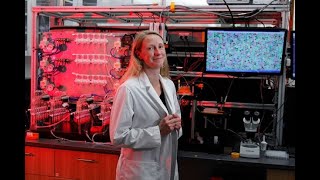
In this talk, Polly Fordyce describes her laboratory’s development of a microfluidic, cell‑free expression platform that enables the recombinant production, purification, and functional measurement of thousands of proteins in a single experiment. The motivation is the scarcity of large‑scale thermodynamic and kinetic constants needed to train next‑generation AI models for protein function prediction. The workflow involves printing DNA plasmid libraries onto glass slides, aligning microfluidic chambers, expressing proteins with EGFP tags, capturing them via anti‑EGFP antibodies, and probing function with fluorescence‑based assays (binding curves, enzyme activity, inhibition). The platform can process ~1,800 proteins per run, reducing weeks of work to 48 hours and generating more inhibition constants than the entire field produced in two years. Case studies include (1) a mutational landscape of transcription factors Max (human) and Pho4 (yeast), revealing how non‑DNA‑contact residues modulate binding affinity and specificity, and (2) enzyme inhibition screens that expose the limits of structural similarity for predicting catalytic efficiency. The talk also discusses challenges: cell‑free expression variability, protein size/yield limits, reliance on fluorescent readouts, and the desire to move toward mass‑spectrometry readouts. Audience questions probe the additive thermodynamics of multiple binding sites, scalability to all protein classes, and the constraints of fluorescence tagging. Fordyce emphasizes that the platform’s data will feed thermodynamic partition‑function models, which outperform traditional position‑weight‑matrix approaches for predicting in‑vivo binding.
Chapters
I'm here to introduce Polly Fordyce, and let me do it this way. When big discoveries are made in science, you can often trace them back to a new technology that's extraordinarily enabling or a person who's come into the field from the outside. And in Polly, we have both of these. She was trained as a physicist, and she's brought those rigorous sensibilities to her work, as you'll see in her talk. Her lab has been making technology— technology development, as we all know, is very difficult to do well. Her lab has been making extraordinary advances in building devices and in creating methods for performing biochemical and biophysical measurements that are usually done in a one-off way or a few at a time, now at the tens to hundreds of thousands at a time scale, which is just hard to conceptualize. These are new advances, and we're all still getting used to the fact that it's possible to do this. But if Polly's work does for biochemistry and biophysics what next-gen sequencing has done for genomics, which I think there's a very strong likelihood it will, then if that alone happens, the results will be truly extraordinary. On top of that, Polly's timing is impeccable because her work comes at a time where, as David pointed out in the Q&A, we have a tremendous need for empirically determined training set data to drive innovations in artificial intelligence. And so the combination of this set of technologies in this moment in time, I think, explains to you why we're so excited to have Polly here. She is a gifted speaker, a highly decorated researcher, and a very generous and devoted member of our community, and we're really lucky to have her here. So please join me in welcoming Polly.
Okay, thank you so much for the opportunity to speak. And I just want to start by kind of reflecting on what David just talked about. The progress over the last 5 years has been, you know, really last decade has been truly phenomenal, where I think most people couldn't even conceive that it would be possible for labs like David's to do what they can do now. And I think in large part, a lot of that was due to their own talent. They're building little mini houses out of proteins, which we just found out about, which is kind of crazy. But also to the availability of lots of really high-quality data. So in the Protein Structure Database, we we had all of these incredible structures, and we could really define the problem in that a very good prediction would be a prediction that had a sequence that created a structure that looked as close as possible to the experimental structure. So when we think about kind of the next grand challenge, it would be thinking about getting these proteins, designing them to have particular functions. And so we know that once folded or remaining unfolded as a conformational ensemble, these proteins go on to do a variety of different So they bind DNA, and that regulates whether genes turn on and off. They bind other proteins, which transmit all of the signaling that takes place in a cell. Or in the case of enzymes, they end up turning over substrates into products and driving chemical reactions that wouldn't be possible in reasonable times in their absence. And so we've been thinking a lot about what are the data that we need to be able to design sequences that have exactly the function that we want. And so we're very fortunate in that there's a variety of thermodynamic and kinetic constants that we can use to describe how stably a protein is folded, or the strength and kinetics with which these proteins bind their DNA protein and chemical targets. And an advantage of these physical and thermodynamic constants is, you know, as David was speaking about earlier, now we have the ability to try and collate information across space and time of different laboratories, and then use that as gold standard training data in order to develop this next generation of algorithms. And one of the challenges is really that we don't have that much of this data. So I think that question and answer session was perfect in that it really motivated what are the hardest next challenges and why are they hard. And a lot of it is because we just don't have large numbers of these physical constants, these thermodynamic and kinetic constants. Particularly in certain cases. So, one case would be thinking about transcription factors and cellular signaling proteins, which bind one another with very weak and transient affinities that make them hard to detect via most experimental methods. Similarly with enzymes, right? Enzymes can turn over a whole host of different chemical reactions. And just to sort of emphasize why we're going to need these constants and structure isn't really enough, The first problem we can think about is an enzyme. And so here is just an overlay of 3 different structures for 3 orthologous enzymes that Eliel Akimbani is studying in the lab. And you can see that they overlay perfectly, but in Eliel's early measurements, he's already shown that their activity varies by many orders of magnitude. Right, so even if they fold into the same fold, they have really different catalytic efficiencies. I think another example, which has really been, I think, brought to light by AlphaFold, is looking at predictive structures of human proteins. One thing that really stood out is if you look at the human proteome, about 50% of it is unstructured. And this doesn't include just random proteins. This includes some of the stars that we think about all the time. So, this is— you know, these are two of the most famous transcription factor oncogenes on the left, MYC and p53, and glucocorticoid receptor, another transcription factor. So, these disordered proteins are really enriched in proteins that are at the heart of regulating gene expression in our cells. So, I would argue that then learning how to predict molecular function from sequence is going to require a lot of data that we don't currently have. So, these quantitative ground truth measurements, and we're going to need them at scale. We're going to need them for a lot of different sequences. And particularly for some of these low affinity interactions, the way we've historically done it is by growing up huge amounts of these cultures and sort of doing this one by one. And as we think about trying to scale that to hundreds of thousands or millions of sequences, it's just clearly not going to happen. And so my lab has really been focused on the last several years of developing these microfluidic devices that allow us to recombinantly express, purify, and then functionally characterize different proteins at what we hope is the necessary scale. And so the way it works is we can create libraries of DNA plasmids, and then we can use a robot such that we print the plasmids onto a glass slide, and now we know who is who by its position in this two-dimensional array. We can then align microfluidic devices on top and push cell-free expression mixtures into every single chamber, so we solubilize the DNA, and now we make each construct in each chamber. And so I'm coloring all of these chambers green because each of these proteins is going to have an EGFP tag at the end so we can see how much we made. We can specifically pattern the surfaces of the devices with anti-EGFP antibodies. So now we can pull down the EGFP-tagged proteins. We can actuate valves on the device so we can sort of protect that bound protein, and we can wash away everything else. So now we've recombinantly expressed and purified typically about 1,800 proteins per experiment. And this is kind of what it looks like. So now we've got our protein of interest with an EGFP tag sort of immobilized on the surface like this. And then we can iteratively introduce different fluorescent materials so that we can probe their function. So in the case of DNA or protein, we can introduce their DNA or protein partners at different concentrations and quantify how much comes down relative to the amount of protein on the surface, and we can use this to reconstruct concentration-dependent binding curves and get these gold standard thermodynamic and kinetic constants that tell us the strength and the kinetics of these binding interactions. In the case of enzymes, we can introduce reagents where, as the chemical reaction takes place, we build up light. The whole thing is sitting on an automated fluorescence microscope, so now we can just image and reconstruct all of this data. So to just kind of emphasize, like, what this gets us, If we were going to use these traditional methods for 5 different proteins, it would take us about a week in order to do this recombinant expression and purification. And now with these devices, in about 48 hours, we can take— we can recombinantly express, purify, and functionally characterize 500 proteins. And in the course of one of the first enzyme characterization experiments, Craig Markin and Daniel Mctarrie in the lab through these experiments measured more inhibition constants than the entire world in 2 years. So it really accelerates the pace at which we can get these data. So I want to just tell you one quick story about how we can use these data to attack problems that I think are really hard for current computational methods and where these data, I hope, will stimulate kind of the next generation. And so this is a project being led by a really talented graduate student, Renee Hastings, in the lab. And it was— her former mentor, who's now graduated, Arjun, was in the CBI training program here. And so, just thinking again about this problem of transcription factors, so we know that transcription factors bind DNA at specific regulatory regions in order to recruit or repress the rest of the machinery to turn on or off gene expression. And we typically characterize these transcription factors with a logo where we sort of talk about what's their high-affinity, most preferred motif. But it's really not like they just bind a single high-affinity motif. They bind a whole host of different sequences with very different affinities. And we can kind of borrow from the protein folding literature to visualize this as a landscape where we have high affinity, very strong binding, but we also have other sites that are bound weakly. These weak sites are evolutionarily conserved and they're functionally important. So, I think one of the most beautiful illustrations of how important they are is work that is recently coming out of Emma Farley's lab at UCSD, where she looked at an enhancer element that's known to be bound by an ETS transcription factor. And this binding site is weak. So, this 0.15 means that it binds at about 15% of the very strong binding sites, so it's a very weak binding site. And this enhancer is involved in limb development in mice. And so Emma took this very weak binding site— oops, okay. She took this very weak binding site and all she did was make a single nucleotide substitution that made it a very little bit stronger. So now instead of binding at 15% of the wild type, it binds at 25% of the wild type. And now these mice have an extra digit. Right? So, I hope that this convinces you that thinking about some of these weak affinity sites is going to be really important for understanding function. And I think it's also important as we start thinking about next-generation base editor therapies and other kinds of CRISPR-based technologies where we want to have very few off-target edits. Okay. So, Renee decided to ask, what is it that determines transcription factor binding specificity? And she started with a good model system. So, this model system is two transcription factors, one from humans, Max, and another from yeast, Pho4. Both of these transcription factors are basic helix-loop-helix transcription factors, so they're thought to be structurally pretty simple. And they both are known to bind the same high-affinity site. This is called an E-box site. So, they both like CACBP. GTTG. When they fold and in their, you know, crystal structure, you can overlay them on top of each other and they look just about the same. If you look at the actual contacts that the different amino acids in FO4 and Max are making to the DNA nucleotides, they're basically the same. They're using the same residues to contact the same DNA nucleotides. But when you look at their overall binding affinity landscape, it's actually pretty different. So, here Renee has plotted— these are the binding strengths and kind of the number of motifs that are bound at that strength. You can see that Faux4 binds the CAC GTG site pretty strongly, and then this is sort of its nonspecific background binding. And so, we can visualize this kind of as a well where there's like a deep well for this consensus and then kind of a shallow well for the off-target site. When we overlay what this looks like for Max, you can see that Max doesn't bind CAC-GTG as tightly as Faux4 does. And it also doesn't penalize binding to other sequences as much. So this means that Max is just— all of the contacts are the same, but Faux4 is very specific, and Max is not that specific. And we can visualize this by looking at these two different energetic wells. OK, so now the question is, what is it that makes Faux4 specific? But Max, so promiscuous. And so, we can do an alignment, and we can look at the residues that are conserved across all of this family of transcription factors, these basic helix-loop-helix transcription factors. And we see here, these are some of the residues that are involved in actually contacting the DNA. Those are basically conserved across all of the basic helix-loop-helix transcription factors. But you can see that these other sequences vary quite a bit. And they vary a lot between FO4 and MAX. And so, if we're going to want to ask a question of how variations in the sequence are impacting the overall binding specificity landscape, we're going to need some way to make a lot of different mutations. And so, here is where Renee and Arjun turned to these microfluidic devices that we have. And so, they used them in order to recombinantly express and purify many different transcription variants and then quantify DNA binding for each. OK, so what does this mutational landscape look like for Max? So Renee and Arjun went ahead and they created a library where every single amino acid position within and just around the DNA binding domain, they created two different substitutions, an alanine and a valine, so that we could have to kind of biochemically different perturbations at each position. In addition, they chose known pathogenic variants. So, MAX is actually a really important transcription factor for human health. It is the transcription factor that MYC, the famous oncogene we were talking about before, has to heterodimerize with in order to bind DNA at all. So, they included these pathogenic variants. They also included some other kind of interesting substitutions that are conserved in other members of the family. As well as a few amino acids designed to specifically perturb different biophysical properties to understand how that impacted function. And so Renee went ahead and she made these measurements, and she was asking, okay, now let's look and let's see how each one of these mutations impacts binding. And first, we're just going to look at the consensus CAC GTG, the high-affinity site. And when we look at the nucleotide-contacting residues, Here, this line here is the wild-type KD. Bigger numbers mean it's weaker binding, right? And so, all of these nucleotide-contacting residues, when you make that mutation, you basically lose binding. That makes sense. We can also look at some of the backbone-contacting residues, and now we're starting to see some are really important for binding affinity, some are not. We can look throughout this entire protein, and now what we start to see is a lot of these these amino acid positions that are not conserved and they don't touch the DNA at all, they actually have really strong impacts on consensus binding. So, the next question we can try and ask is, are these mutations impacting affinity? Do they equally impact binding to all DNA sequences, or do they preferentially impact DNA binding to some? And so, to do that, we're going to move beyond the measurements we just made where we measured every mutant binding to the consensus motif.
Motif.
And we're going to repeat these measurements where we're going to look at binding of all of these transcription factors to a variety of different DNA sequences where we've systematically mutated the nucleotides in the motif. Okay. And so, now, this is a little bit of a complicated plot, but here I'm just going to show you— this is the variance. So, this is like how much of a difference in the delta delta G do we see across all of these different sequences. And if that's low, it means we're basically affecting all of the sequences sequences equally. And when we plot this against the measured affinity to the consensus site, we can see a couple of different things. So, here we can see these are a lot that have low variance because they didn't really change binding at all. And then we can see here there are some positions like this proline at the end of a helix. That proline, any mutation that you make is going to reduce the affinity and break binding. But there are other positions here like this methionine where as you substitute different residues, you can basically tune the overall affinity up and down. And when we look at where these amino acids are lying within the crystal structure, we can see that they're always kind of here at the protein dimerization domain. So now we have a little switch that we can use to tune binding overall up or down. What about specificity? Are there particular mutations that make Faux4-MIG-MAX more specific than it already is? And so, for here, what Renee did is she went ahead and she made these measurements where she compared the effect of an amino acid substitution relative to the wild-type protein for one DNA sequence versus another. And so, now you can see most mutations have equal impacts on both DNA sequences, but there are some that kind of fall off the line. And in this case, these mutations make the transcription factor worse at binding the consensus and a little bit better at binding these other sequences. Sequences, we can now consider this distance from the line. That's going to be our residual, and we're going to ask kind of the distribution of residuals. How different do we see binding to different sequences? And so, that's what I'm plotting here. So, here on the Y-axis, these are all of the mutations that make Max more specific for the consensus versus more promiscuous for other motifs. And then, on the X-axis, these are things that bind more tightly versus more weakly. The first thing we see is a whole cluster of residues here. These are all of the residues that are involved in contacting the DNA, so we see that. That's kind of what we expected. But we also see the appearance of really interesting residues up here that are all not contacting the DNA. They're facing the solvent, and in this way we can either make Max more specific, and we can make it bind either tightly or more weakly, so we're just discovering little dials in the protein that we can use to tune function. Okay, so how does this compare with Faux4? So now this is the plot that I was just showing you, right, where we can look at— this is more specific and less specific and weaker and tighter. And we can compare our old friend Faux4. So the blue is the Max, the orange is the Faux4, and you can see that There are lots of ways that we can make Max both tighter and more specific, but we really can't do it with Faux4. So, what is it, then, that makes Faux4 more specific than Max? And one thing that Renee reasoned was that both of these transcription factors are really disordered in solution, and then they only assume structure when they bind to the DNA. And they become this helix. So, she asked, if we make Faux4 more helical, Does that increase the binding to the DNA? And so that's this experiment here, where you can see that as we make Faux IV more helical, that's more towards the left, the overall binding affinity gets tighter, whereas the same is not true for Max, right? So something different is going on for Max, and this sort of implies that there are two different types of kind of folding pathways going on here, where for Faux IV, you're just unfolded a helix, that helix binds DNA. For Max, you have probably a more complicated unbound conformational ensemble, and only some of those conformations are capable of recognizing your consensus site. So that model would predict one more thing, which is that if we make Faux IV more helical, we should also make it bind faster. And so Renee did these experiments. That's what I'm showing you here. So this is the K-on for Faux IV. And as you make FO4 more and more helical, that k-on gets faster, exactly as we'd expect. When we do the same measurements for Max, we don't see that. And so overall, this is kind of pointing to a picture where the difference between FO4 and Max— and maybe this is true for other nucleic acid binding proteins— none of it is visible in this structural bound state. All of it is really visible in this invisible-to-us unstructured state. And so I would argue that accurately predicting function for a lot of these nucleic acid proteins is going to require getting more and more of this data and then ultimately using some of these really powerful algorithms to try and learn from those data to ultimately predict the function. So I want to thank all of you for your attention and the opportunity to speak. I want to thank everyone in my lab and funding sources for their work towards this project, and I'd be happy to take questions. I'm happy to take any questions.
Questions for Polly? Right here.
Thanks for a very cool talk. And I think that needing to think about the distribution of bound and unbound is really important. So I want to ask a question sort of maybe future-looking a little bit. A lot of these gene regulatory elements like promoters, they have sort of periodic regions of the transcription factor binding motif that, like, repeat along the region. And so, there are multiple of them, multiple opportunities, some more or less like the consensus binding sequence. And as you mentioned, there's this need for dimerization or oligomerization of many transcription factors. So, there's really this sort of conformational ensemble of many different bound or unbound states. Some of which you can measure. Do you think that with these experiments you've done, you'll be able to do sort of linear additions of, oh, if there's this many repeats of the sequence and these binding partners, you can just combine them together, or will you have to do more sophisticated measurements moving forward to sort of think about and account for those?
So I think it's a great question. And, you know, one question is basically how well does additive thermodynamics of multiple proteins explain what we see in vivo. And I think this is— I think for a long time, people have tried to— have been forced to invoke— they've tried to compare predictions of binding in a cell using position-weight matrix. And then they really haven't been able to explain what we see in a cell. So it ends up being you see a lot of places where there's a strong binding site, and there's no transcription factor there. And you see a lot of transcription factors that are sitting at places where there is no strong binding site. And so there are two possibilities. One is that there's some magic in the cell, cooperation and competition between proteins, nucleosomes, like post-translational modifications, and that magic is really important. The other possibility is just that our models, our position-weight matrix models, are not very good thermodynamic models, which we kind of know. And so we have a paper that answers exactly this. It's been in review for a year, sadly. I retain hope that it will be published at some point. But we've shown that in a lot of cases, if we just use slightly— if we use a partition function model from thermodynamics, we can really accurately predict everything that we see. And it's just really that the position weight matrix isn't enough. And a lot of these low-affinity subtle sites are really important for localization in a cell. That's a great question.
Thank you for the talk. Really amazing. And I really— I think this high-throughput protein expression purification assay is going to have unimaginable potential for all the applications. And for that, actually, I'm curious about, is there any— like, currently, there's any— like, some— are all proteins will be able to use this for high-throughput screening? Or there may be some requirements, like— I don't know, for example, like, is there any limitation about protein size when it's too big or anything about the yield? Do things can— yeah, so I'd be curious to learn about that.
Yeah, so I think historically people have sort of felt like cell-free expression, that bacterial, recombinant bacterial expression is the gold standard and cell-free expression is like sort of something you will do that might work. I think it's a little bit the opposite in that bacteria have a whole system of feedback where they're constantly looking for misfolded proteins and other things that they want to chew up and get rid of, and they're taking your protein and they're sending it to inclusion bodies, and they're doing all kinds of things that the cell-free expression just can't. And so I have been really pleasantly surprised by— we've tried to make thousands, many thousands of different proteins now in these cell-free expression mixtures. Which cell-free expression mixture is best? Depends on the protein in ways that we cannot yet predict, even though I wish we could. But so far we've been able to recombinantly express in mammalian or bacterial or purified extracts things that you can't express in bacteria. So I don't think there's really a length limit. A lot of it just, we don't know what it is. We had a rotation student that tried to figure out what expresses and what doesn't. We don't know what it is, but most of them do.
Great, thank you.
Last question from Carolyn.
Thank you. It's just incredible, and I'm thinking through some of the questions that have come up here, and what came to my mind was right now the way that you're reading out these microfluidic chips is through fluorescence. You're capturing the images, which means that the protein needs to be fluorescent or tagged with a fluorophore, or the enzymatic reaction has to be fluorogenic, I guess. And to what extent do you find that limiting? And what would you like to be able to do that you can't currently do?
So I think the two things that are currently most limiting are it's hard to do this, right? So a lot of people are like, I would love to do this in my own lab. And we have published a lot of open source videos and parts lists and everything to build a lot of this equipment and long protocols. But it's hard to do. So we're trying to host people to come here to do it. We're also trying to develop new technologies where we could get rid of the device. Are there ways we could do it where we don't need a valved microfluidic device and a lot of automation? And then another thing that we're interested in, we've developed a lot of coupled assays where we're able to measure a lot of different enzymatic reactions. But we're really interested in moving towards a mass spec, readout, where I think it would open up the ability to monitor a lot of activities that we can't look at now.
One more round of applause for Polly.
More from Joshua







Scientist Stories: Hans Waterham, The value of phenotypic assays in peroxisomal disorders




Scientist Stories: Joel Zlotogora, Genetic carrier screening programs for reproductive purposes