Scientist Stories: Rachel Green, Regulation of Protein Synthesis
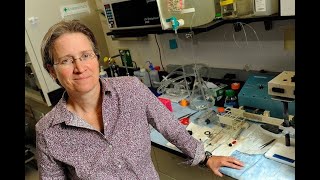
In this talk, Rachel Green narrates her scientific journey—from a chemistry undergraduate working on self‑splicing introns in Jack Szostak’s lab, through mentorship by Jennifer Doudna, Harry Noller, and many leading women scientists—to her current focus on ribosome biology at Johns Hopkins. She introduces the concept that ribosome collisions act as a central hub for translational quality control and for activating global stress‑response pathways. Using a traffic‑jam analogy, she explains how initiation rates, codon usage, and ribosome density shape translation flow and how collisions flag problematic mRNAs for decay and toxic peptide removal. She presents structural evidence from cryo‑EM of collided ribosomes, high‑throughput ribosome profiling that maps collision sites, and biochemical data showing that intermediate doses of the elongation inhibitor anisomycin, which promote collisions, maximally activate MAP kinases (p38, JNK). The kinase ZAK is identified as a collision‑sensing upstream activator; ZAK knockout abolishes p38 activation, and PhosTag gels reveal ZAK phosphorylation only at collision‑inducing drug concentrations. Green proposes a model where ZAK travels with elongating ribosomes, becomes activated upon collision, and directs either mRNA‑specific quality‑control pathways or broader cell‑fate decisions (apoptosis, differentiation) depending on the kinetic context. The talk concludes with acknowledgments of her lab members, collaborators, and funding sources.
Chapters
So, good morning. Thanks for having me here. I feel a little out of place. I just want you all to know that, first of all, I should say I really enjoyed the day yesterday. It's motivating to hear all these efforts. I've certainly benefited from the efforts that have taken place for many, many years now. I've been in this game a little while. I did follow Carla's instruction and was asked to talk about science, and so that's what I'm going to do, but I'll tell you a little bit about my pathway first. But what we really are going to get to is the colliding ribosome as a hub for translational control, which is actually a pretty new exciting idea in my field. So it's going to— what I'm going to do is tell you a very short story. I took out a lot of the pieces of data, but I'll give you a little bit of a sense of how we think about things and how we get to scientific answers and how that makes us excited to do science. So in terms of my path, I have had a number of great mentors along the way, and we haven't seen too many pictures of of men. Uh-oh. There we go. So we heard about Jack Shostak yesterday, who was a co-chair of the Nobel Prize with Liz Blackburn and Carol Greider. And Jack Shostak was my actual graduate school mentor. So I went to school at the University of Michigan, and I majored in chemistry. And I really had built— done organic synthesis and was excited about that. And actually, I ran into one of the women in my field, Jennifer Doudna, who was a year ahead of me in Jack Shostak's lab. And she said— I was at a happy hour, and she said, You know, Jack's lab is pretty great, and if you're a chemist, we're interested in really chemical things. And so that's how I landed in Jack Shostak's lab. I did a rotation, and it really was a great lab for a chemist because what we were interested in was understanding how this small, about 200 nucleotide long RNA was able to excise itself. It's a piece of RNA that excises itself from its own primary transcript in the absence of any protein. And so that was a really exciting idea at the time. Because it suggested that RNA, which we knew could do lots of things that were sort of structural, you know, we knew the ribosome was made of RNA, we knew lots of things were made of RNA, but we didn't know RNA could do things. And this, the evidence that this intron could do things on its own without any proteins was great motivation for thinking about an RNA world. And actually it was Tom Cech that ultimately got a Nobel Prize for his studies of the group 1 intron and this idea that RNA was catalytic. So it was a pretty exciting time. It was a great project for a chemist, and it was great for me because I got to think about the origins of life. And what fascinated me was the idea that in the origin of life, something had to emerge first, and it had to be informational and functional. And that's why RNA was the ideal molecule, because it could be informational, because it's like a coding piece of information, because it's like DNA, but it could also be functional. And so the idea was that an RNA emerged from this primordial soup, and that was the beginning of life. So that made me very excited, and I finished my PhD, and I would say that Jack was a super supportive mentor. I wouldn't say he was overbearing in any way, and he certainly— he wasn't super hands-on, but he created a great environment where ideas were free and open, and I really developed nicely in that lab. I grew to get comfortable being a scientist. I should say also my history is I was from the Midwest. I was pretty shy, and I didn't— wasn't really very comfortable going to the East Coast. And it was in Jack's lab that I sort of became comfortable with myself and about my role as a scientist, and it was certainly with his support. So I ended up after studying this group 1 intron, I was still pretty fascinated with the origins of life, but I wanted to get a little bit bigger in terms of the biology of the system I was studying, and I again talked to Jennifer Doudna, and among the people she mentioned was a guy named Harry Noller who was in UC Santa Cruz out in California, and this is Harry. Who was another wonderful mentor. Santa Cruz was a quieter place to do science, but Harry was somebody who had forever loved the ribosome. He was the first person to think that this, or to really go after the idea that this very large machine now composed of 5,000 nucleotides of RNA, that at its core was RNA doing the functional things of the ribosome. And if you think about how life has to evolve where you have to go from information to function into our modern-day world, It's the chicken or the egg problem. How do you make proteins before you have proteins, and what's the machine that would make them? And the ribosome is this machine that's predominantly made of RNA. It's this huge, beautiful machine, and the idea is that this is what got you out of an RNA world because this is what allowed proteins to be made. So this was, again, a really motivating environment. It was— you can see there were trees. It was really beautiful and a lovely 5 years that I spent my life in Santa Cruz with this incredibly supportive advisor. And then I went on to my job at my faculty job at Hopkins. What I should say is that in addition to having strong male mentors along the way, I was in a field that from day one was populated by amazing women, and these are some of the amazing women that were in my field. Christine Guthrie and Joan Steitz sat in the front row at every single meeting, and they were there for every single talk, and when I went on stage for my first talk, they smiled at me, and I remember that because I was shaking. And there's Jennifer, who guided me along the way. Melissa Moore, who's now heading a company actually in Boston, Moderna Therapeutics, was a real mentor along the way. Marina Radnina is a German colleague who always was there. Lisa Esmeralda just passed away, but she also was in the front row. So I really had an amazing field of female scientists, and so I never felt, as other people did in other fields, that there weren't female mentors that were strong and playing a leading role. And I think the RNA field was unusual in that way. And those of us who stayed in it have always commented on that. At Hopkins, I've also been supported by a collection of awesome females. And these are just some of the sort of senior females that have been there since I got there. There's some familiar faces here. Again, Carol Greider, who won the Nobel Prize, has been my chair. She's been my chair for 20 years in the Department of Molecular Biology and Genetics. And Hopkins is a place where women, you know, there are more men than women in leadership roles. But Carol has been my chair for 20 years, so I've had a good example of leadership among women and a supportive environment. Last but not least, as others have done, I should mention that my mother was my real mentor and my real reason for going into science. My mother was a chemistry teacher in the '50s when my brother was born, and when she was pregnant, she had to stop teaching chemistry. And she then stayed home and raised us. But she became the nature lady in Rocky River, Ohio, where she took all the little kids out on the field trips to look at the valley. And to look at evolution and rocks. And so she certainly was my motivation. So that's sort of my path. I've been at Hopkins for 20 years. I was fascinated by the ribosome. And I was fascinated by the ribosome because it was this beautiful thing to think about, about the origins of life. And that's sort of where my interest started. But also in line with the themes of this meeting, my interests have evolved a lot over the years. And they've evolved a lot through technology and through being in a place. And I think it's good to be in a place and to take advantage of who's around you and what they're doing and what what they're thinking about. And so that's led us into really very different places from sort of my early chemistry background. So what I'm going to do now is tell you one new story. It's an exciting story in the field. I hope you think it's exciting. It's about as general a talk as I've ever given, and it still might not be general enough. So what does the ribosome do? The ribosome translates the genetic information found in messenger RNAs to make proteins. Shown here is a typical eukaryotic messenger RNA, which has a special little feature at the end, a cap and a poly-A tail. But effectively what the ribosome has to do is it gets on at the cap and it scans until it finds the start site, which is an AUG trinucleotide. The large subunit joins, the ribosome then walks 3 nucleotides at a time along the messenger RNA template, adding an amino acid with each step that it walks along the messenger RNA template. Until it reaches at the end of the informational— the open reading frame, we call it— a stop codon. And stop codons are recognized by protein factors that promote the release of the final protein product. And the ribosomes get recycled, we call this, and dissociated from the mRNA template so they can start again. And we've studied all the details of the biochemistry of most of these steps over the years. And that's what's fascinated us. And what I'm gonna tell you about is sort of what happens when these steps are impeded in certain ways. And so the way we always think about ribosomes, but I've actually never shown photos this way, is as a traffic problem. So this is a little bit of stress in your life. I'm actually gonna talk about the ribosome and stress. This is a stress for all of us, and you can see. But actually this is a multi-lane highway, and this is a highway where in fact you could switch lanes to get off and solve a problem. The ribosome, by contrast, can't get off the lane. It's on a messenger RNA, and it's going to encounter problems. And that's what I'm going to tell you about, or what happens when ribosomes collide. I went onto the— into the web. It's a wonderful place to try to give you some fodder for thinking about this. And here's, you know, people have studied the physics of a traffic jam, and you can actually look at what the physics says. And actually, the best one I found was there was a Japanese study, I don't know, 40 years ago, where they put they had a big track and they put 22 cars on the track and they told the drivers to drive at an absolutely constant speed around this track. And of course it doesn't quite work. And then they studied in live, they have these live images online of the collisions and how they happen. And they make the point, as you can imagine, that the way you avoid traffic jams is to have low density or appropriate density on a track. So there's the collision. When the collision clears, they also can see that when this collision clears, and these cars are all piled up, that it's kind of relieved going backwards. And so you can follow the motions of cars on a track and how the stress, which is this collision in front, gets resolved over time. So there's all sorts of literature on this. To put this in the context of the ribosome, this is the challenge. And this has led us to think about how it must be that messenger RNAs have evolved in all our cells. And if you want to avoid traffic jams, which are clearly inefficiencies, right, because you stop, then once the lead car goes, then the next one can go, and the traffic jam iterates backwards. The best way to build things for optimal flow is to not have traffic jams happening. And so the way we think about that is that the rate of initiation of each ribosome on a messenger RNA has evolved to be appropriate for the speed that the ribosomes in the open reading frame are going to move at. And the speed that ribosomes move in an open reading frame is dictated by the types of code that they have in their open reading frame. And we know that not all codons are equal, and some tRNAs, which are what decodes these codons, some are less abundant than others, some are more abundant than others, some are good tRNAs, some are bad tRNAs, and so we've learned a lot about how it is that the speed of codons dictates what happens, and we understand now that it must be that the load is dictated by the speed at which ribosomes move here. So. So that's the idea is that ribosome is its flow. Optimal flow involves no collisions. I've also been— found recently this picture of the cell that I'm going to tell you why I think you should be convinced that this is going to be important. So this is a picture of a cell. This is tomography. And this is a yeast cell that's been sliced, and they can look at it by tomography, and you can identify features. And if you actually identify some of the features, the feature that really stands out is a ribosome. And so what's happened here is the— in this study, the ribosomes were identified because you can see their structures in these tomographic images. And you can then ask how many ribosomes are there floating around in a typical yeast cell. And what you can see is that it's 20% of the volume, which seems to me like an underestimate. It puts them at 23 micromolar, which is incredibly concentrated. So from my perspective, I'm sure there's some DNA here. This is apparently a mitochondria. DNA apparently does some things. It encodes some information. But I think if you're thinking about how the cell is driven or how events in the cytoplasm are driven, understanding ribosome function and thinking about the likelihood of them interacting with one another is a pretty reasonable thing to think about. So that should motivate you. So for a number of years, we, as I mentioned, we've studied how ribosomes move along a messenger RNA template, how they decipher different codons, all these specific events. And then we became interested in a set of problems, which is what is it that the ribosome does when it encounters a problem? And there are lots of things that can go wrong. Sometimes there are errors in the message that are made in the nucleus. There are splicing errors that put in aberrant events. Sometimes there's degradation that happens and the message is actually broken. And actually, probably an easy one to think about is we think UV damage damages messenger RNAs. And it damages it in a way that ribosomes can't keep moving. And all of those things are a problem, and it turns out, as you would expect, cells have figured out how to deal with problematic messenger RNAs. And because problematic messenger RNAs make problematic proteins, and problematic proteins tend to be toxic— I think we have a talk today on toxic proteins— the cell has evolved mechanisms to say if this message is making bad proteins, we should get rid of that message and stop translating it. And what we've learned in the past 5 years or 3 years is that the key trigger of saying this is a bad message is that ribosomes collide. And that when ribosomes collide, the cell can identify those collided ribosomes. And it actually— what happens, it recruits an E3 ligase that otherwise couldn't bind there. It provides a new interface to recruit an E3 ligase., and that is the trigger that dictates a whole set of mRNA-specific events, which involve specifically targeting that messenger RNA for decay, specifically targeting the bad nascent peptide for decay because it's toxic, and getting the ribosomes back because they're precious. This is what we and others have studied for a number of years. These ideas really came out of some beautiful biochemical work from my former postdoc's lab. And some work actually by a postdoc from Aaron O'Shea's lab, computational work. So that really has been driving what we've been thinking about in our field, and it's been an exciting idea. To me, it makes a lot of sense. How do you know ribosomes— so you saw how many ribosomes there are in a cell. How do you identify ribosomes that are just slow? And the idea is this is the way you identify the ribosomes that are really slow. They're so slow that there's a collision on a message where there shouldn't have been So that's all very exciting, and that's what we've been studying. But we've stumbled on something new, which is that we think that in addition to these mRNA-specific events, which seem like a great thing to do if you have a problematic message, what if you have lots and lots of problematic messages? What if in UV damage, many, many, many of your messenger RNAs get wrecked, get targeted for modification? Then you have all sorts of ribosomes everywhere stuck And the solution isn't to degrade the message, degrade the peptide. The solution in UV stress is to say, we need to put on a cellular program to fix things. It's not to target that message. It's to make a decision about life. Should we do apoptosis? Should we differentiate? We need to fix it in a very programmed way. And so what we found is that when you're under general stress conditions, the colliding ribosome is also a trigger of these very standard canonical signaling pathways that many of you I'm sure have heard about, the MAP kinase signaling pathway, and this is a general initiation pathway. So that's what we're excited about. I've skipped some of the data. We have lots of ways of looking at colliding ribosomes, and I skipped the data in the interest of time, which is we can use high-throughput sequencing methods. So that kind of fits in with what we talked about yesterday. That's transformed our field. We can take cells, we can open them, and we can map where every ribosome in the cell is sitting on every messenger RNA in the cell. And in that way, you can evaluate where they are and where the problems are in a very specific way. And that's how we know collision— that's one of the ways that we know collisions happen. As always, another way that we know that collisions have happened is that the structural biologists got their skin in the game, and they've solved a beautiful structure by cryo-EM of ribosomes colliding, and two different groups did This? Once the cryo-EM people get their hands on it, people only remember that. But I want you to remember that it was biochemistry that led to the idea that colliding ribosomes are the signature. They're wonderful groups, but they came later. But this is a beautiful structure. And what they did is they had to figure out how to, in an extract, stop a ribosome. And this is the lead ribosome. This is the large subunit, the small subunit. This is the colliding ribosome right here. It's actually at an angle. It's the angle Harry Knoller— characterized when I was arriving in his lab in 1993. It's called a hybrid rotated ribosome. This is the messenger RNA that connects the one ribosome to the other. It's actually inaccessible right at the middle, which is a key thing for us biochemically because it means we can identify colliding ribosomes by using nonspecific RNases, and you're left with a colliding ribosome that you can study. So it's a beautiful, beautiful structure, and we've learned a lot about colliding ribosomes from looking at the structure. So that should convince you that it's a thing, and I could have shown you other things that it's a thing. And I'll tell you a little bit about how we discovered these signaling pathways. So we, for a number of years, have been interested in what happens under stress. What is the cellular program to deal with stress? And there are a lot— this is all a very new field for me. I've always been a biochemist studying the ribosome, and stress is difficult, and lots of things happen in stress. But the ones that I've been interested in is what happens to the ribosome and stress. You can imagine that when your cell is under stress and it wants to redo a program and you have that many ribosomes that are driving everything about a cell's life, you want to reprogram translation, protein synthesis. We know that one of the first things that happens under any cellular stress is that there's a block on initiation. That goes through very well-known pathways, the TOR signaling pathway, and the so-called integrated stress response by phosphorylating a key initiation factor. We also know, however, that elongation is inhibited, and that's inhibited through phosphorylation of a key elongation factor called the EF2. So that blocks elongation, and that's what the cell does when it's under stress. It says, okay, stop everything, we need to rethink what's happening. We stumbled on this through detailed experiments that you really don't want to know about. When we were working in yeast, we were studying hyperosmotic stress and oxidative stress in yeast, and we were able to see using our high-throughput sequencing method that there was this block in elongation. Actually, we were able to see that those hybrid— all the ribosomes were now rotated instead of straight up and down, and we could see that by footprinting. And that led us to understand that under stress this was phosphorylated, and it turns out there was of course a 30-year literature on that that I had only become aware of during this moment. And upstream of this phosphorylation event, though, are the MAP kinases. So p38 is a MAP kinase that's stimulated by oxidative stress. Hyperosmotic stress in yeast activates a different MAP kinase called Hog1. And these converge on phosphorylation of this key factor that blocks elongation. So that was interesting. And I was actually sharing this story with my new colleague downstairs, a guy named Sergi Rejoux. Because he studies MAP kinase signaling pathways and he's always studied MAP kinase signaling pathways and I knew nothing about them. He said, "That's really weird because he studies activation of JNK and p38, these MAP kinases, and he studies in mammalian cells using optical sensors." But he said, "Our favorite way to activate MAP kinase is a drug called anisomycin." He said, "Does that make sense to you? Does that mean anything?" It does make sense because it's a ribosome elongation inhibitor. He said the other things we use are cyclohexamide and sarsen and ricin. He says anisomycin is the best, but that suggested to me that somewhere upstream of the MAP kinases and downstream of stress, which is too complicated for a biochemist to deal with, is something a little simpler, which is anisomycin, cyclohexamide, and ricin. And I know as a ribosome person that those three things all directly target elongation. Anisomycin is an elongation inhibitor that blocks peptide bond formation. Cyclohexamide blocks the non-rotated state, and ricin and sarsen are drugs that inhibit both of them. So I knew that these were simply elongation inhibitors working on the ribosome, which suggests that somehow the ribosome is upstream of these pathways. And that's when I got really excited because oxidative stress to me is too hard. Lots of things happen in oxidative stress. But I think I can study the ribosome. So that's what we've been excited about. It turns out it's been known for a number of years that there's something called the ribotoxic stress response, but I'm going to tell you that we're thinking about it now a little bit differently because of this idea of collided ribosomes. So I've led you to this point where you can imagine that if it is true that these inhibit the ribosome and that triggers this response, it could be that these drugs just target the ribosome and make them slow. Right? It binds in the active site and it makes all the ribosomes just slow. And that would be— that could be the trigger. Okay, all the ribosomes in the cell are stuck and that might lead to triggering these pathways. But it could be true, as I've just told you, that the way you know that a ribosome is really slow is because it's slow enough that a collision happens. And so that was the idea. We wanted to know, is it that all the ribosomes being slow triggers these kinase signaling pathways? Or is it that they're so slow that they cause collisions and that's how they're sensed? As biochemists, we were able to do a simple experiment. It was actually first developed by my former postdoc. And the idea is that if— this is what you've seen already, ribosomes moving freely, no problem. We knew that if we put in a high dose of a drug, that all the ribosomes should bind the drug and they would all hard stop. And so that wouldn't result in collisions. But we reasoned that if you put in an intermediate dose of the drug, the occasional ribosome will be targeted. And the other ones behind it are not targeted, and so they'll run into it. And if this were the case, and if colliding ribosomes are the trigger, then you would anticipate that there'd be a higher signal at lower doses of anisomycin. And so that's the experiment we did. We simply took cells and we titrated anisomycin, and we looked at the activation of the signaling pathways, which we do by a Western gel to look at the protein levels. And that's shown here. This is total p38. This is phosphorylated P38, which is its activated form, and this is phosphorylated JNK, which is another P38— it's a P38 homolog. And what you can see is that as we titrate anisomycin, that we get an optimal response activation of the pathway at an intermediate concentration of cyclohexamide. And we take this as evidence that in fact it's not ribosomes that are hard-stopped that are leading to the trigger, but in fact it's colliding ribosomes that activate this response. We've done a lot of other things to provide support for this, but this is the clearest, simplest experiment that tells us this. We've been able to go on and understand a little bit more as I've come to understand MAP kinase signaling pathways actually have a number of layers to them. There's MAP double kinases, MAP triple kinases, and people are very interested in knowing all of these. I can tell you that we know that p38 is a cytoplasmic protein that's not bound to ribosomes. So this is not a direct connection to activation of this pathway. So again, talking to my colleague downstairs, Sergey, he was able to tell me that in fact a particular triple kinase has been associated with this pathway already. It's called ZAK. And so we wondered if ZAK was closer to the ribosome in this pathway. And I'm not going to show you the data to convince you that it is. But we first wanted to know, is ZAK involved in this response pathway that we're studying? Surgi was able to provide us with cell lines lacking ZAK, that have ZAK, and don't have ZAK. If ZAK is important, we should not activate in the absence of ZAK. Those data are shown here. This is again our activation band here, p38 activation. You see in the absence of anisomycin, it's not activated, in the presence it is. This is a Western blot looking at the presence of ZAK, and you can see this is a knockout cell line for ZAK. You see when you knock out ZAK, there's no activation. So ZAK is important for the activation, so it belongs here upstream of p38 and downstream of the anisomycin in collisions. Kinases always phosphorylate things, and so we predicted that ZAK might get phosphorylated in order to activate this pathway, and I can show you one piece of data to show you that that's true. So what we did is we ran a gel that actually allows us to look at ZAK phosphorylation. It's a special gel, it's called a PhosphoTag gel, and it was really hard to run, and my postdoc's really good. And it's shown here, and so you can look at Zak and its state of activation. In the absence of anisomycin, it runs like this. At high anisomycin, it runs the same way. And at intermediate doses, it's phosphorylated. So that suggests to us that stress happens, ribosomes collide, Zak gets phosphorylated, that leads to P38 getting phosphorylated, and that leads to cell fate decisions. If you were a biochemist right now, you'd be saying, okay, that's great, you've shown me ZAK sees something about colliding ribosomes, but does it see it directly? And the 3 slides I deleted were the ones that were going to show you that in fact ZAK associates not just with elongating ribosomes, but it really likes best colliding ribosomes that we can isolate with that RNase treatment with that red mRNA that's resistant. And we can show that ZAK binds directly to the ribosomes. So I want you to remember this because this is going to be a biochemical publication that we're sending in next week, and the cryo-EM people are going to come in a year, and they're going to say they figured it out. But you heard it here first. No, I'm just kidding. We're collaborating. I've already sent it to my good friend in Germany, Roland Beckmann. He's working on it. So it's important, but it's irritating. So with that, I'm going to close and just give you a summary of our model. So our model is that— ribosomes collisions are really central to these biological stress responses. I showed you a picture of a cell to convince you there are a lot of ribosomes around, so the idea that you would use the ribosome as an indicator of a problem makes a lot of sense. There's a lot of translation happening. And our model is that when there's a problem, that ZAK actually— this is the data I didn't show you— that ZAK sort of travels with elongating ribosomes. It's kind of always there, but that when collisions happen ZAK gets activated. We don't know if actually it falls off, but we know that it does go and activate downstream kinases, and that these lead to the cell fate choices of apoptosis and differentiation that a cell needs to do when it's undergoing some major stress. It does that instead of all those mRNA quality control events, which are also triggered by this, but we don't want that happening in a general stress. We want the broad general stress response.. And we presume that this sort of decision of mRNA quality control versus general is going to be dictated by kinetics, by concentrations of specific rest— these quality control factors, they're not in high abundance— and that that's how the cell manages this sort of problem. So your takeaways are in fact the cryo-EM and that beautiful structure as a trigger, that the cell is jam-packed with ribosomes, and it all makes sense. And I'll close by thanking the people who did this work. Colin Wu is my wonderful postdoc who's really done a lot of the nicest things in my lab over the past few years. Sergey Rizhov is my new colleague downstairs. He's 2 years in, hired, and I recommend that you talk to your new young colleagues because they've got great new ideas. And this is his first student, Amy Peterson. And this is my lab, and I've had funding for a number of years from HHMI and the NIH. And I'm really thankful again for you inviting me here. Thank you.
More from Joshua







Scientist Stories: Hans Waterham, The value of phenotypic assays in peroxisomal disorders




Scientist Stories: Joel Zlotogora, Genetic carrier screening programs for reproductive purposes