Scientist Stories: Rita Levi-Montalcini, Discovering Nerve Growth Factor & Surviving WW2
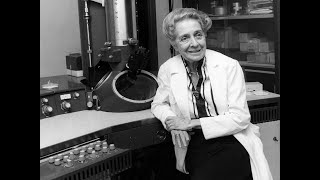
Rita Levi-Montalcini discovered nerve growth factor while conducting experiments in her bedroom during WWII, barred from publishing in Italy due to anti-Jewish discrimination. She observed massive cell death decades before scientists named it apoptosis, and collaborated with Viktor Hamburger and Stanley Cohen to develop the neurotrophic hypothesis that shaped modern neuroscience.
Chapters
Dr. Lady Lopatchina, it's such an honor to be here and to visit the M. Drake Foundation. I'm very honored to be here.
Thank you so much. Thank you, Martin. To me, it's a great honor. I have such admiration for your work. I am very, very happy. Thank you so much, Martin.
So the Annual Reviews of Physiology and Biochemistry have a series where they would like to ask senior neuroscientists to talk about their life in science. And this article will be directed to young scientists as well as older scientists who would like to know about the history.
Thank you, thank you, thank you so much.
So they very much wanted me.
I'm delighted. No person would be better than you, Martin. Thanks so much. But my admiration for all what you have done is absolute.
Well, thank you.
I still do work despite of my age.
So yesterday you said you were motivated to be a scientist because you found beauty in the nervous system. Beauty in the nervous system.
Perfect. Correct. Correct.
So what did you find beautiful about the nervous system?
Well, you know, it is obvious. Every cell I mean, nerve cells, particularly the brain, is such a marvelous object to study. And I was a neuroscientist, you know, so I was delighted, particularly when it was discovered the in vitro system, and Joseph Bellamy did not discover but brought it to England. So I had all the reasons to want to work in this way, not as a scientist, but as a beauty. This is true.
So the in vitro system was discovered in the mid-'50s, 1950s?
Discovered by me? I mean, well, using— I knew very well the tissue culture. It was not known in Italy. I was a student of Giuseppe Levi who brought the in vitro system to Italy. So I decided, because it was very difficult to find the niche, the chemical nature of the factor. Because I know the in vitro is the best way, so I went to Rio de Janeiro, applied all what I knew, and I discovered the effect on not— I mean, of this factor, not on angiopoietin, but on the incision. So without this discovery, nobody would have never found the niche of the neurotrophin factor— in the chicken blood, it was too diffused. It was necessary a system which was in vitro system to bring the possibility to biochemist, technical, to identify the peptide.
So earlier in 1940, 19— '52. Yes, that's it. Well, my question is, during that period, who supported you?
No one. I was working on my own. I mean, I had not very much money, but I could do it by myself, you know. It was not financed by anyone.
You did not have a fellowship?
It was in my bedroom. It was a period of persecution. I was not a victim of personal persecution, but of the group at the time. So it was very— I did not ask any help. I did everything with my personal very little finance I got. Not finance.
So your family supported you?
Yes, very much so. Because they knew that I needed all the little money necessary to implant it. I mean, practically it was almost no money. I worked in my bedroom and I just had a microscope which I bought. Was very expensive, and a very minor gadget, nothing, but it was very little, the amount of money necessary to do the experiment I did in my bedroom.
So your mother was there and she supported you?
Yes, exactly so. My father was already dead. So later on, when the situation became very serious in Italy because of bombing of the city, we moved to a little house in the mountains near Turin, and then I continued my work and discovered the effect, I mean, not only on Jeffrey, but on the—
Well, you told me a long time ago that during this period period, you observed cell death, massive cell death.
Yes. And it was about— it was in '72 discovered the gene— I mean, the—
I mean, how do you call it? Apoptosis. Apoptosis, yeah. So you discovered it 30 years before.
30 years before it was discovered, because I saw a lot of cells die. Why they die? What is the lesion? And then in 1972 it was given the name of upper third.
So during this period in Turin and also in the early '50s, you wrote many papers. Your observations you published in many papers during that period in the '40s and '50s. Was it difficult to publish?
Italian papers would not accept— But the Vatican accepted. The Vatican was against Mussolini. The Italian people did not accept because of my name, you know. So I could not publish in Italy. Also, the only one was the Vatican. I published in Vatican and also published in Belgium.
In Belgium?
In Belgium and also Switzerland. I mean, I could publish abroad, Belgium and Switzerland, and in Italy, Vatican.
So because of your Jewish name, you were discriminated in publishing papers in scientific journals?
Yes, but not in Italian papers. I could not.
So this must have been very discouraging to have your papers rejected because of your name.
It was discouraging. I did not care about it.
You didn't care?
No, Moses, I was totally indifferent. I did not expect to have never recognition. I was enthusiastic in the possibility of Robinson Crusoe, where I was working. I mean, I was working for his beauty, what I was doing. Totally indifferent of recognition. So it made no difference for me. I mean, I never cared about this. I was totally— I mean, I didn't know if I could survive. I did not care about it. Many people, many friends of mine had already been brought to Auschwitz. Miraculously, we were saved. She said we never should, because we tried to go to Switzerland in the night, and it was a terrible mistake. By chance, we were not taken by German or even Italian fascists at the moment we arrived at the frontier. So I realized the danger. I didn't know that Auschwitz was expecting me, but I knew the danger. So we decided at the last moment not to stay there, but come to go back to Italy because the danger was very, very high. I mean, to be immediately taken if a German or Italian fascist would have seen me with my family, which is That's a miracle.
So when you went to St. Louis and worked with Viktor Hamburger, you developed a very important theory, the neurotrophic hypothesis, which is based on competition for NGF and other trophic Peter Hamburger knew my work, not from Italy, but reading a Belgian paper.
So he was very impressed by my research. So he wanted to know how we were so much different. He was a student of Spemann, was thinking the periphery acted through induction. I did say no, it's not induction. It's just that it's different, it is necessary, like for a tree is necessary the, the water. So we had entirely different view. So he invited me, this was after the war, to work with him for about, he was a chairman, about a few days or few weeks. I stayed 30 years because I found in Department of Zoology chaired by Victor, excellent place to work. Stan Deacon came to work with me because I discovered the in vitro effect of the aroma. So I gave to him— I did not know Stan at that time. He was waiting, he was taken by Victor Hamburger from another important laboratory. So he was a young man, a biochemist, so he could not I could have discovered the neurotrophic factor if I only worked on the embryo. So it was my idea that I had to find a better possibility. I knew about tissue culture. I went to Rio de Janeiro and immediately discovered the in vitro effect. First, I saw the effect on sensory and sympathetic innervation. A decade later, But not even me, it was other people who found that this factor acted also on the central nervous system. It was not my discovery, you know.
So your career has spanned now 7 decades at least, and I'm wondering if you were to start your career now, what would you want to work on?
I knew that now we are in wonderful new possibilities, scientific and technological. Which were not available when I was a young person. So I believe I would start as many people, students here too, that is to become a biochemist, a molecular biologist, which I was not at that time. So I believe that now I would take advantage of the enormous development, scientific, technological, which were not available in my time, not even Dulbecco, not even those who received the Nobel Prize with me, but before me, they had any advantage. They were more than me capable to work on viruses.
So your classmates Renato Dulbecco and Salvador Luria were working in virology and also in phage genetics, but you actually created a whole field of neuroscience.
Well, I was very much willing to leave the nervous system to work on biology or genetics, but they told me, no, continue to work on speaking with fluency. I mean, you have done something very important, don't change. Because at that moment I wanted wanted to change. He said, but there's nothing I can do anymore. And it was a moment difficult because I said I didn't know that I had done a really important discovery. I knew it was important, but not so much as to continue. So I was hesitant as to leave the nervous system to work with Luria or with Dulbecco, who were my close friends. Fortunately, I assisted in this work.
So I'm also wondering, what advice would you give young people now? Many young people are not interested in science, and it's a very exciting time, as you mentioned.
My— I mean, I would say, as I always say, that nothing is beautiful as to work on scientific social, any problem, to be very invested in what you do. I mean, not be afraid, but knowing that you will never go ahead if you don't do it very seriously and then all yourself. So the point is important, it will be very engaging. What you do, you should do well. I will say that is no problem as important as scientific or social, because I am also working on social problems, you know, on Africa. So the point is to know what is important in life, not just only very simple and stupid things like being beautiful, having success. This is nonsense. So I always say so, and I have many followers, you know, not all, but many. So the people here are all of this idea. I work here, I am delighted because Excellent people here. I mean, Antonina, Peter Calistano, naturally, first, and the other journalists. I mean, many people, not too many, but some people still understand the importance of being invested in important problems, not in futility.
So you mentioned your work in Africa with women, and since you're You're such a strong role model for women scientists, and women scientists have usually more difficulty in getting a high position. Why do you think it's so difficult for women?
Well, I don't know. I'm writing a book on this point, you see. I mean, we are subjected to— idea which are preconceived ideas. I mean, the man is more intelligent than women, they say, because it's convenient to say. It's nonsense. We are the victim of a problem, genetic problem. It's not true, because we are far more— it's all about epigenetics, not genetics. I mean, human beings are not like insects, or, I mean, invertebrate entirely act by genetic program. Human being and vertebrate in general have the possibility to adapt to non-genetic, epigenetic. It's far more important. Environment is important. So we are no more victim of dogma. I mean, I write a book, "The Dogma Implanting for a New Future." Yeah, I mean, the title of my new book is "The Destruction of Dogma for a Better Future." I mean, we are still victims of dogma, you understand?
So I think NGF is for humans evolved evolutionarily to not only be involved in development of the nervous system, but also in higher-order behavior. Because, you know, in Drosophila and C. elegans, you can make a nervous system without NGF. So NGF has other properties.
My paper, the vital role of NGF, is from pre-embryonic to the lifespan of vertebrates. So we know today that it is a vital role and is present before the formation of the embryo in the ovocyte and the sperm. This is the I-code. It's due to NGF, which makes connections. I mean, the NGF is active long before the formation of the organism, like sperm and organism, you know. So this precedes. I don't know, sir.
So I understand you're still doing research on this idea that there are early events affected by NGF.
Is that correct? Just before the oocyte and spermatozoa, we have proved it is already present there, the early part in the embryo, far before the nervous system is formed. So it's not that the NGF is necessary for— it's already present before. It is a universal molecule which is very important for a vital role, a vital role of NGF, which is not only neurogenic. We proved it with experimental monoclonal antibody to NGF in a very early stage, a very in the beginning of formation, and we found out that with the removing, you have not the death, but a very bad development of the embryo, which eventually died. And this is because it's necessary, I mean, NDF, for the— it's not spermantide, it's not organizer. Organizer, if you take away the organizer, you have no organism to form. If you take away by, I mean, by interjecting a mouse, or if you take it away by antibodies to inject, see, although the embryo is formed, this is very badly formed and is doomed to die because it has no capacity of proliferation, so it will slowly die, not like it would be no formation, come on, let it again, of the embryo. The embryo is very poorly built.
So I have to ask you, uh, old experiment that you did with Sam Cohen using antibodies against MGF, the original experiment in sympathetic ganglia. How did you get the idea to do this experiment?
Stanley Cohen, who was an excellent biochemist. Do you know him? Yes, yes. Excellent, excellent scientist and human being too. So it is very much his merit. So he found that it was necessary to destroy the NGF through the method we had to find out what is the action. So we found out that if you destroy the antibody, now I mean, you don't have any more— all the sensory superposition do not develop, you know, we have immunosuppression.
But this experiment was very, very important, and it preceded— this is really a knockout experiment. Yeah, it preceded by 40 years a mouse knockout experiment which got the same result. So I think it was a very key experiment that was done at that time to establish the importance of MGI, and I think it reflects a lot of creativity and also interpretation to do the experiment and also interpret the results.
Sure, it's true. I say so in my new book. I mean, it's the two identical results but different kind. Transgenic mice, you don't have transgenic chick. I mean, it's the same. I mean, you can destroy the NGF in transgenic mice knocking out, but you can also destroy by immune, by antibodies. This is two different ways of destroying. So in the chick embryo, you have only the possibility of antibodies because you don't have transgenic chick, but you have also in the mouse. So the mouse offered to us the possibility of studying the action of MGF not only in very early stages but throughout a very large time, and also later on the Alzheimer's consequence of the lack of MGF. So everything came out because we transferred our interest from the chick embryo to the mouse as a model. Of how the NGF standard came out.
So after 50 years of studying NGF, there's still a lot of interest. Very much. So what do you think in the future will be the future of NGF?
I can see most of it. I mean, my title, Vital Role, I have to find out because a new scenario is open now. I mean, we know that NGF is not only working on neurotrophic— it's also neurotrophic, but far more. So what we are learning now, we have a new scenario ahead of us. We know that NGF is acting, is it— I mean, is it vital from all the— from all the sides. Is term that I got from very, very early later on. The future will see how this universal important factor came to existence and what can still open to find out from this new way of looking at the object. I mean, is it topic, term, is it— so, I'm not saying the one or the action or the topic. And then we found out that you have only female.
One question. I know you're heavily involved as a senator in the Italian Senate, and I wonder how you feel about politics.
No, I do not like politics. I like problems, social problems. And naturally I am from the left and not from the right, because all the problem can be developed and solved by open mind, not by being right. I mean, people are better? No, we are all the same. But it's the way our approach may be different.
I don't know if I answered. Very few scientists are involved in politics.
And those that believe that with the people of Africa, women, if you give them instructions, this is what they do, is they will do as well and better than them.
Well, you're definitely a role model. That is, how do you feel as being involved in politics, in Italian politics?
Not too bad, too happy. But when it was a previous government, I was very much in favor, and I still am. I thought that this was your way, democracy. Democratic, not totalitarian system, or this is against the possibility of development. So I became interested in trying to follow these, and I worked very much in the Senegal, in the Senegal, and I'm working now in Africa, you know, to give women all possibility. Instruction is more important than everything.
I understand you're the longest living Nobel laureate. Nobody else has lived as long as you have who has a Nobel Prize. And I just wonder, what's the secret to your longevity?
Because I never think of myself. I'm totally indifferent. I mean, my life, I am to some extent indifferent if it will end tomorrow or longer. I mean, I have no problem of my health. I don't care about it. I'm totally indifferent.
So you're thinking about others and you're thinking about problems.
I don't know if this is the reason that I live so long. Tonight I do not sleep, but I think, because it's wasting time in sleeping. So all the night I think. In the morning I have new idea. This is because I'm totally indifferent to food and indifferent to sleep. I never give— I barely give too much importance to sleep and food.
So you don't sleep at all at night, just a few hours?
Normally I don't sleep in the night. I take half an hour, not every day, but sometimes in the afternoon, that's all. I have no interest in sleeping. Is not wasting time. And I don't need food more than this, very little.
So maybe the caloric restriction— Oh yes, I think it's that. —on longevity. But I think it's also the fact you're very active. I also think that since you're so active at this age that it has an effect on your plasticity. Increases neurotrophic factors in the CNS, and it helps you be more creative.
You know, there's also something else to tell you. I use every day my factor NGF in a collyrium. Now we know that collyrium immediately goes to the brain and works on the cells. So it's also possible that my vitality is in part due to the fact that P times CD, I call it the collusion, is your eye, because I have lost vision, close to zero. It may be, I don't know. I mean, this is an hypothesis.
So one more question. What is the happiest time of your life? This one. Right now?
Well, it was very good when I realized in part importance of the discovery of neutrinos. But all of this, the very end of my life, gave me the possibility of working not only scientifically but socially, what I wanted when I was 20 years old. I did not believe to become a scientist, I did not know. I wanted to go to Africa with Pfizer to help against leprosy. This was my idea of life. At the very end, I work scientifically, but I work also to help women in Africa, southern Africa. So I do believe that the best period of my life is the present one. I had an excellent time with Humboldt, with Stanley Cole. He was an excellent biochemist, and we had an excellent relationship also with each other.
Thank you so much, Gracie.
You've had a remarkable career. I mean, honor more than I deserve to have you speaking.
You have such a remarkable career.
I don't believe I made it. It's my— no, it's your kindness and generosity. It's not my merit. I mean, it just happened. The pleasure of a long life, and that quite the end is even better than the beginning. You know, when I was a child, I was a very unhappy child because I saw that a woman— my family was a totalitarian, I mean a Victorian kind, my father. So I could not go to high school, but I studied by myself. So I resented it and I was very unhappy. After '60, my life is coming better and better.
More from Joshua







Scientist Stories: Hans Waterham, The value of phenotypic assays in peroxisomal disorders




Scientist Stories: Joel Zlotogora, Genetic carrier screening programs for reproductive purposes