Scientist Stories: Rita Levi-Montalcini, History of Neuroscience
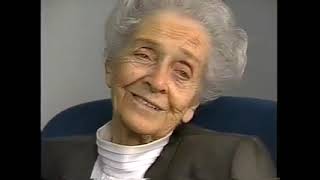
In this extensive oral-history excerpt, Nobel laureate Rita Levi‑Montalcini recounts her scientific journey from the oppressive racial laws of Fascist Italy, when she was forced to set up a makeshift laboratory in her Turin bedroom, through her development of unique microsurgical tools and pioneering tissue‑culture techniques, to her early neuroembryology work on chick limbs and the debate over induction versus a peripheral nutrient. She describes the pivotal 1950s experiments that revealed a humoral factor released by mouse sarcoma tumors, leading to the discovery of nerve growth factor (NGF). Working with Victor Hamburger, Stanley Cohen, and later collaborators, she details how NGF was biochemically identified as a protein, its classification as the first neurotrophic factor, and its later re‑interpretation as a cytokine that links the nervous, immune, and endocrine systems. The narrative expands to her studies on mast cells, the role of NGF in inflammation, and behavioral research showing NGF surges during aggression and anxiety in mice and humans. Throughout, she reflects on the influence of mentors (Giuseppe Levi, Victor Hamburger), key collaborators (Stanley Cohen, Luigi Aloia, Eric Shooter, Hans Thöny), and the broader scientific community, while also sharing personal philosophy on creativity, aging, artistic identity, and her involvement with the Vatican Academy. The account blends scientific detail with personal reminiscence, illustrating how perseverance, technical ingenuity, and interdisciplinary thinking culminated in a discovery that reshaped neurobiology.
Chapters
When the war was just on the verge of being declared, I came back from Belgium to Turin And there I found myself in the impossibility of doing any work at the university because of my racial position. I don't know how you would call it. I don't care about, you know, race. Race do not exist, as it had been said. Race do not exist, but the racist do exist. So I was at that time already a medical doctor. I took my degree in 1936. So I had to abandon my position. I could not go anymore to the university where I'd been working on neurobiology from 1936, even before 1935, start working with Professor Vicentin. In this condition, I could only do two things: either move to the United States, and this I would have liked, but family did not want, and then did not want to separate myself from my mother and brother and sister whom I loved very, very much. For this reason, I decided to continue my work in my bedroom in Turin. At the time, as the war started in 1940, just after the law which had been promulgated, the racial law in '38 and activated in '39, had been put out of work. I could not do any more medical work. I was a medical doctor at the time. I could not do any scientific work. I established a laboratory room in my bedroom, a small laboratory in my bedroom, continuing to work which ever since 1935 I had been working on at the University of Turin with Professor Vicentini. When the war was declared, June 1940, it became difficult to continue to work in Turin, and we moved to the country near Asti, small village close to the city of Asti, and there I continued my work even though it was a tremendous vicious campaign against Jewish people, but I didn't care about it, you know. At the time it was more boys and really very vicious, but no personal attack. So I continued to work, completely ignoring what was happening around me. I didn't care. I read the article by Dieter Hamburger, the 1934 article, while I was going from Thüringen to this small place in the country. But as I mentioned, I'd been interested in neurobiology, experimental neurobiology, long before then. That is, from 1935 I'd been working at the university. At the time I was a medical student, the last year of medicine, when I first started working on neurobiology and particularly on the chick embryo without knowing anything about Viktor Hamburger. This was with my friend who later on passed, a very good physiologist, We worked on the neurophysiology of the chick embryo, how the movement starts. Came out a long article during the war, Swiss article in Switzerland. It was the article which came to the attention later on also to Viktor Hamburger with the others. I was not in agreement with Viktor Hamburger about the reason why when you cut the limb bud in a chick embryo, the sensory and motor cells just undergo atrophy and degeneration. He thought it was a phenomenon of induction, lacking induction. I personally didn't believe so, and in this article which he read and was very interested in, I decided— and Giuseppe Levi is also co-author in this article— that because of death was not a phenomenon of lacrime induction from the periphery, but simply nutrient lacking. That is, by taking away the limb bud, the nerve cells, sensory and motor cells, which normally innervate the limb bud, were lacking something, a nutrient. They did not know what kind of nutrient was it coming from the periphery. So it was an entirely different interpretation Franz Ivan Witter Hamburger had been given. Witter Hamburger was a student of the great embryologist Spemann and just thought that this phenomenon was a lack of induction. I didn't believe so. In 1946, I had already my position as assistant to Professor Giuseppe Levi at the university. Giuseppe Levi received a letter from Witter Hamburger, a very beautiful letter. I still have this letter. And Giuseppe Levi called me and said, "Here is a letter of invitation to you. Will you accept it?" The letter was written in German. Victor naturally was German, and Professor Giuseppe Levi was very fluent in German, so he translated to me the letter. Professor Victor Hamburger wrote to Giuseppe Levi, "I know that a young person, a young lady working with you has been working on the same problem which I have been working on ever since 1934. Would she accept to come for 1, 2 weeks or even months to work with me in Washington University where I was chairman of the Department of Zoology? Professor Levy asked me, do you want to go? But at the time I had some doubt if I wanted to go and delayed until 1947. I was very excited by the letter, but I did not really want to immediately move away. When I received the invitation by Professor Wetterhamburger and took with me, it is perfectly true what you said. The special thing is my experience and really particular gift, I must say, to work with microsurgical instruments which I had prepared myself. They were different from Spemann's instrument. As perhaps you know, Spemann and Vitor Hamburger worked with glass needles which they fabricated. I preferred just normal needles, the needles which you use for sewing, and I transformed this needle on a mould into a microsurgical instrument. And I was very, very capable in just implanting, transplanting pieces of the embryo, and this had been done, doing, before even going to the United States. Besides this particular competence in working with microsurgical instruments, à la Renaissance, you can see, I became very competent in tissue culture. Professor Levi was a great scientist and a good man. His merit was not only to be excellent person and very good friend of mine, ever since up to the end of his life at 92. But he had also introduced me— he was a pioneer in the tissue culture technique, which no one knew in Italy. Carelli had written his famous book, and of course it was well known, the technique, in the United States. But there I was not very familiar. When I went to Washington U, I saw that no one knew about this technique. I was instead very competent. I spent 2 years with Giuseppe Levi before being thrown out from the university and working in tissue culture. So this was the special gift, or special instrument if you want, which I took with me when I arrived at Washington University. That is the competence in surgical instrument and in the Cajal technique, which no one knew at that time, And this was what I took, and what was the reason later on for my discovery. That is, I was very competent in the study of neuroembryology, because for 5 years I had been working on neuroembryology with the Cajal-de Castro technique. I was very competent in surgical instrumentation, which I prepared myself à la Renaissance type., and I was also very competent in tissue culture. 3 things. Immediately after I arrived, I took back Louis-Walter Ruswetter-Lemberg's problem: how it is that when you take away ablation of a limb bud or transplantation of an additional limb, you have in the first case a decrease of number of sensory motor cells, in the opposite case of transplantation, increase. In sensory motor cells in the additional limb. And it came out of work together with Viktor Hamburger where he recognized that I was correct and he was not. That it was a matter when you ablate, when you take away a leg, what is missing is something from the periphery which is necessary for the limb, for the nerve cell to grow. It was not a matter of induction. It was a matter simply of lack of nutrient. And this was the paper which came out with Svitolak-Borg at the time, one of the papers, because another paper which I wrote all by myself, it was on apoptosis and cell migration, which came out in 1950, and it was quite a discovery. But after having just done this discovery of— I didn't know it was apoptosis, programmed cell death— I knew that some part of some sensory ganglia in the chick embryo undergo massive cell death and also massive cell death occurs in the cervical level of the embryo. And this I described as an occurrence. I did not know at the time it was programmed, it was a physiological process, not consequent to the ablation of a leg. But the ablation of the leg also brought about cell death. And even now the situation is not very clear, because the programmed cell death is just what happened, and we know after apoptosis description and gene discovery about apoptosis, there's been a tremendous amount of work recently. However, they recognized to me a sort of priority, because I was the first to describe This is massive cell death under normal conditions. Later on, when we make the surgical ablation of the lab bird, also we have cell death. And at that time we were not very clear that it was the same phenomenon of apoptosis. So it was very, for a long time, practically ignored, the problem. What is going on normally physiologically, which is massive programmed cell death, and what is not physiological but experimentally produced or surgically produced or accidentally produced, lack of periphery. That is something which is lacking and just is a question which happens at the level of genes, the cell programmed cell death. Well, morning, winter morning. I believe it was 1950, Viktor Hamburger called me to his laboratory. The two laboratories were one close to the other and said, "I received a letter from a former student of mine by the name of Elmer Buecker, and he wrote about a curious experiment he performed. He transplanted a fragment of a malignant tumor on a mouse in the side of a chick embryo 3 days old. And what he found and described in this article, which came out in 1948, that sensory fibers from the embryo entered into the tumor. And 3 days later, when he checked the normal histological technique, he found that the ganglia were slightly larger than the opposite ganglia which were innervating the limb. The person, Elmer Buecker, thought that in the tumor was some histochemical property which attracted the sensory fibers to enter into the tumor. When I read this article, I found the effect extraordinary, and I was terribly enthusiastic about repeating the experiment and said so to Viktor Hamburger. Vittorio Hambourg agreed with me, but then he left for Boston where he was doing some experiment, genetic experiment, and I received at the time that he was gone the mouse, many mice carrying this tumor, mouse sarcoma viridatum, which is a mammary carcinoma, was at first, then it became called sarcoma because it's growing, it's not typical of carcinoma but of sarcoma. While Viktor Hämmerbücher was in Boston, I made the first series of experiments, and to my great astonishment and pleasure, I found out that not only what Hämmerbücher had decided and described was correct, but it was far more than that. Not only sensory fibers entered into the tumor and branched in, and I had not seen it because I did not know the tissue culture, the as the technique— he was not familiar with this technique— I saw that the fiber branched very regular without established contact with the cells, but just branching between the cells. And also found out that not only sensory but also sympathetic fibers entered into the tumor in even larger number than the sensory fibers. And what was to me extraordinary was that not only was the ganglion enlarged very mildly as Buechler had described, but were 6 to 8 times larger, yet only found a minor difference between the ganglion nervating the tumor and the ganglion nervating the leg. So I told to myself, this effect— is a tremendous effect which has nothing to do with the regular effect of peripheries. In the tumor, there must be something extraordinarily important which makes the sensory and sympathetic fibers grow much larger than normal and branch into the tumor nociceptors. When Victor Hamburger came back from Boston, he joined me in the Arctic, living in Montalcino in Hamburg, in 1951. Which describes this effect. At the time, I still believed that this effect was restricted only to the sensory and sympathetic fibers which enter the tumor. Victor Hamburger did not follow very closely. He was a very intelligent and very highly educated person, but not particularly familiar with neurobiology. I continued his work. And described an effect, extraordinary effect, later on at the New York Academy of Science, December 1952. And there I discussed something completely new. I said not only some large number of fibers enter into the tumor from the ganglia adjacent to the tumor, but all sympathetic ganglia, also the embryo, which are even very distant from the tumor itself are enlarged. So I said in this article, which became a very classical article, 1952 New York Academy of Science, I said I do believe that this is due to some substance which is released from the tumor and reaches all— which are receptive to it. And this was my first discovery. So I said, what about if I transplant— in the same article I wrote— the tumor not into the embryo, but far away from the embryo in the chorionantoï membrane? As you know, the chorionantoï membrane, which envelops the embryo and the entire egg, is connected to the embryo through the circulation, that is, the blood blood cell fibers, the circulation of blood cells go from the embryo to the yolk and take food in. So I transplanted a small fragment, small fragment of this malignant sarcoma, dendritic sarcoma 37, away from the embryo and it had the same effect. So I was enthusiastic about it because I said to myself and also to Viktor Hamburger, I said, I have discovered something entirely new, that it is not a matter that the periphery acts on the centre through the agency of nerve fibres which reach the periphery, but it is some humoral agent which is taken out, which is released from, in this case, from the tumour, which reaches the sensory ganglia or sympathetic, particularly sympathetic, through the circulation. So this was the discovery which I described in New York Academy of Science, December 1952. Later on, with Victor Hamburger, we repeated and enlarged on this new discovery. Came out the paper 1953, Levi-Montalcini-Victor Hamburger, where I repeated what I had already said, but in more extensive way in the article which I presented at the New York Academy of Science that gave absolute evidence that the tumor releases by humoral way, not through the nerve fibers, effect which reaches all the cells which are receptive to this factor. All the experiments I mentioned required tremendous amount of time. The chick embryo which had a tumor died in large number. The one which survived were in a difficult condition to store, and many of them also the technique did not work well. So it was taking months to have a result. So I decided that being also very competent in tissue culture, I could study this phenomenon in tissue culture. I said, with the embryo we will take years before we know what is the substance which is released by the tumor. I asked the permission to Victor Hamburger to go and join a friend of mine, Ertha Mayer, a German who had been living in Germany during the Nazi period and was working with Giuseppe Levi and myself in Turin. She had established a tissue culture laboratory in the Institute of Biophysics directed by Professor Carlos Chagas, who became a very close friend of mine. I wrote with the permission of Victor Hamburger to Professor Chagas, "Would you permit that I go there as a guest of his own laboratory to study in vitro phenomenon which I am not able really to study in detail the embryo, but they need tissue culture facility you have and we don't have. To tell you the truth, I could have established laboratories there in Washington University because I knew very well about it, but I was very curious of Brazil and I wanted to take this occasion to visit South America, so it was an excuse. Anyway, Professor Chargaff was delighted at the idea that I join him and he didn't know exactly what was the reason for. I left St. Louis, I went to visit my family in Turin and left in October 1952 for Brazil before the paper 1953 came out and left and arrived in Brazil I became a guest of Professor Carlos Chagas, and there I made the experiment which became known all over the world, and you have there a photo of the result. I took with me in my pocket two mice. At the time people did not look in your pocket as they do now, you know. I had two mice, each one carrying a fragment of tumor, mouse sarcoma, 138 or 137, practically the same tumor. And no one looked what I had in my pocket. Well, when I arrived there, I took away the tumor from the mice and tried to find out if in tissue culture the sensory and sympathetic ganglia adjacent but not close to the tumor which I took from the mouse would grow fibers. And it was a failure, and I was in despair because the tumor did not have any effect. So I decided perhaps the tumor must be adjusted to the chick embryo before being studied in tissue culture. I transplanted the tumor from one mouse to a chick embryo, from a chick embryo to another, and then when the tumor grew rather well, I took the tumor which had been cultured, which had been transplanted from the mouse to the chick embryo, and there I got marvelous effect. That is, the tumor which had been grown for— and still I don't know why— for some time in the chick embryo produced the effect which is now known as the halo effect and is described in my book and many articles. That is, sensory and sympathetic ganglia from egg and chick embryo implanted in tissue culture in the hanging drop technique as we used at the time, I just close to but not adjacent to the fragment of tumor which I had taken from the chicken embryo, grew a tremendous number of nerve fibers, which became known as the HeLa effect. That is, in 6 to 10 hours, the sensory and sympathetic cells into the ganglia start to produce a tremendous number of nerve fibers. And I was delighted of this effect because I realized that now I could know about the nature, biochemical nature of this tumor, which I could not possibly find if I continued to work in situ embryo. So after some period of doubt, and I wrote a long number of letters to Vito, who was delighted about this effect, I went back to St. Louis. It was February 1953. Working with the Stanley Cohen. We repeated the study which I had done in Rio de Janeiro. He was a young man, 32 years old, a brilliant and— as brilliant and modest person as you can see. And he immediately accepted when he knew about the result I brought with me from Rio de Janeiro, as it was a fantastic story. So he was very happy to come and accept vital invitation to come not as an associate but just simply as a chemist working with me without a position. And there it happened, then working together with me and just joining every day the seminar of Arthur Kornberg, he mentions this effect, he mentions that we did not know if it was a nucleoprotein or what was it. He did not know anything about, but just we thought a nucleoprotein. There he received the suggestion from Arthur Comber to add to the medium in tissue culture a snake venom particle which contained the enzyme phosphodiesterase, which is known to degrade the nucleic acid. Therefore, Stanley Cohen accepted the suggestion of Arthur Comber. And he added into the tissue culture a very little amount of snake venom and just did not tell me anything about it. The following morning I went there very early to the laboratory and I could not believe in what I saw. I did not know what Stanley Cohen had done. The number of fibers was 1,000 more dense the normal. I said, what did you do, Stein? Why? Well, he said, I added a little amount of snake venom and the phosphodiesterase decreased the nucleic acid. So we know for sure that the effect is due to a protein that is not only found in the mouse tumor but is present 1,000 times more in the snake venom than in the tumor itself. So we knew that the tumor itself produced the xenogloss factor and that the factor was possibly a protein, not a nucleoprotein, because with phosphodiesterase we had destroyed the nucleic acid. So we knew two things. First, it was not a virus because it was a protein and not a nucleoprotein. Second, it was not specific only of the mouse tumor, but also was present in very large amounts in snake venom. And that's how the 1956 article with Victor Lambert also took place in this, I mean his name is on this article, where we for the first time called this particular agent a neuroblast-promoting factor. NGF became later, ONGP went out. And we thought it was a protein, and Stanley Cohen also identified this protein through the technique, rather rude technique at that time, as a 44,000 molecular weight protein. The first discovery, which I believe was really quite important, I must say, and as a matter of fact this was the reason for receiving the Nobel Prize, was the first time that it was found a protein molecule, and the protein molecule we know exactly its source and also the chemical nature and the gene which produces it. For the first time, it gave us the idea that the development of the nervous system at the time depends on this particular molecule which is synthesized in the target cells, in this particular case in peripherative tissue. And for a long time, for 30 years, this was the Xyrola, this particular molecule, considered to be the first well-identified neurotrophic factor. Other were later on found, and this was the reason— it was the precursor of oncogene— for this reason we received, Stan and myself, the Nobel Prize. Recently, entirely new idea where This was never falsified, on the contrary it's been confirmed since first, but this was the top of an iceberg. The whole part of the iceberg was behind the water. What we are finding now is that besides this neurotrophic effect, NGF displays other functions which are even perhaps more important than the one we discovered in 1950. That is this particular protein factor is not only neurotrophin, but is also cytokine. It makes this interaction between different homeostatic systems, endocrine, immune, and nervous system, and perhaps it will be of great value in all diseases which have to do with deregulation of this system, for instance autoimmune diseases and inflammation. So without we falsified, on the contrary, confirmed the first discovery. This was only a part of the function of NGF. Now we see NGF as a neurotrophin, and other neurotrophins have been found similar too, but we also know that this particular agent belongs to this large class of humoral transmitters which are known as cytokines. It was in 1977, but not even with the 1977 article with Luigi Aloa, we realized the importance of the NGF effect on a cell belonging to the immune system, the mast cell. It was only, I must say, 1990 which I realized what this— I mean, little by little, this piece of information did not fit in a scheme, and we just were looking at all these without seeing the interaction, which was seen only, I must say, in 1990. My 1990 article, for the first time, the article is titled "A New Role for the Nuclear Specter," and this was the time, 4 years after the Nobel Prize, where all pieces came together and they realized that the action of NGF is very widespread, much more than we understood before. Before, there were pieces of information which we did not really try to put together, not in the article you mentioned, 1968. Before our work, before 1977, the mast cells were considered like Cinderella into the immune system. Coming into action when you have invasion by some organism and the organism undergo hypersensitivity and anaphylaxis. So the mast cell had not been given a very important function in the immune system. The immune system really, the prima donna were lymphocyte B and lymphocyte T, and the mast cell were quite ignored. Were found to be active only during hypersensitivity or defense against foreign organisms. When I found out, and this was with Luigi Alois in 1977, that TNF acts on mast cells, this had no sense about this at that time knowledge of the function of the mast cell. It came about only later, and particularly in recent years, that the mast cells have a very important function in inflammatory processes. They are very close to the terminal of sensory cells, P cells, sensory cells, nociceptive cells, cells who respond to analgesic stimuli. The mast cell became for the first time, well, I must say became If not the prima donna, we realize a function which is not only hypersensitivity and anaphylaxis, but these cells make a linkage between the nervous system, the immune system, and also endocrine system. They have a new and very important function, and they are in turn very receptive to noxious factors. They synthesize— the NGF is an article by Alberto León, my name is also on— and the same cells release a large number of explosive cytokines like tumor necrosis factor and lymphokine 1, B, and also nociceptors. So the mast cells have very high functional activity in inflammatory processes, and they are under the by the activity of the immune action. You see that particular immune, GIG, EG, and again under the action of NGF. In other words, these cells have a lot of receptors to the immune system and to the nervous system. They are activated not only by these different humoral agent, but they in turn release, synthesize the neurotrophin factor, they release it into the circulation, which has an action in the accumulation local of lymphocytes and other cells, or what you find in inflammatory processes. And this is how we saw right now the mast cell into an entirely different role as it was before this discovery. The mast cells are very closely linked to the nociceptors and in turn also with the immune system and endocrine system. My name is in because we have made contributions, but I wish that it is clear that this particular group, Life group, a research life group of Padua, where he worked in great detail. The article is also with my name because we had a collaboration. But he found that the mast cell not only has a receptor for the neurospetal but synthesizes NGF and releases it, and this has a very explosive action, cytotoxic action, just brought about clearly that T cells have a very, very important multifunctional activity. They are not only there to protect the organism against foreign body or foreign organism, but they release T cells and the NGF has a main role in all T cells. Not only the cell, but cell ever receptor track the high-level receptors, they track. But at the same time, they synthesize the neuroglial factor, they release the neuroglial factor together with other cytotoxic like tumor necrosis factor, they reuptake it, and they have a really very, very central role in all inflammatory process or autoimmune processes or inflammatory inflammatory process of different nature and neurogenic nature. I mean, the NGF modulates the interaction of the two homeostatic systems, but to some extent it's not only modulating, it brings about all defense mechanisms in activation by alerting the organism that something is going wrong. And therefore, the level of NGF increases before the level over the other lymphokines. In this way, we consider not only that NGF is modulating the interaction of the neuroendocrine and immune, but to some extent it's also an action like, how would you say, a key which opens, which starts the entire phenomenon. I mean, it's the first one to come into action when it is a danger is not only that brings about a linkage between all the systems, but is the very first to be increased in amount when something is to alert the organism that something may go wrong. That in 1990, I remember very well, it was during the night that it occurred to me Why should there be so much NGF into an exocrine gland, which is the mouse salivary gland? Up to that time, nobody had really tried to understand why, because the salivary gland is a typical exocrine gland, and male and female mice have equal need for a gland which has to do with digestive function. Now, at the time, I realized that it was very curious, queer, I must say, that the male mouse should have much more NGF, 10 times more NGF in his own mouse are very grander than the female because both have the same need for digestive function. Then it occurred to me also that mice in the wild live in groups together and are very aggressive against each other. So I thought that perhaps this large amount of NGF has some different functions from the digestive function, and perhaps this was the reason why male and not female has so much more. Male are more aggressive than female. And immediately I made the experiment which proved the reality of this, to put male mice, adult male mice, together in isolation. This was a discovery, it was a kind of treatment which had been discovered or at least realized by Valtelli, a very good, now maybe passed away later on, young man, that he decided to study aggression in mice by isolating from each other, then putting them together in a cage. When they have been isolated for 2 2, 3, 6 weeks, and they are put together, they are very, very aggressive. Now during aggression, I decided to find out what happened to NGF. We stirred the NGF into the circulation, not close to the salivary gland in order not to contaminate, and found it was loaded with NGF. This occurred to me in this particular time that this was the reason why the mouse salivary gland may mouse has so much NGF. It is nothing to do with digestion, but with a defence mechanism, particularly made against meal. You understand? So this to me was a very important discovery, and it was later on proved also in man. As you remember, it was Luigi Alois' work in his laboratory 3 years ago, that the young people, soldiers, which are due due for parachute experiments the following day, the day before, their moral NGEF into the blood normally is subthreshold amount. But when a young man, 20 years old, is being told that the following day he will be for the first time parachuted, the NGEF increases in his blood due to anxiety. In the following day, when the same young men, or many of them, shifted around, they reached the floor, the parachute stopped, they took the blood, Louis Jalloh and other people from my group, and found it was loaded even more than the day before with NGF. So the aggression which we have discovered and had the idea of this experiment into the meal mice has equal kind of result in humans. Human being parachuted. Well, to some extent, this shows that emotion, any kind of emotion, not only aggression itself, are very important for the release and circulation of NGFs as a defensive mechanism. The subordinate mouse, or the anxiety of the young man who the following day will be parachuted, is a way to activates the NGFs into the circulation, which in turn brings about activation of lymphokines, which are defensive. You know, I don't know if I'm clear enough, but anxiety is an additional phenomenon or additional event which increases the amount of NGFs, not only the aggression itself, which is just as you would have a mouse attack another mouse or a human being. But it is the state of anxiety which shows that NGF works not only, as we know, about differentiation of different systems, but also on the common— in the behavioural of the person. When the person is very anxious, and this is also true in diseases, teasing kissing mouth of NGF and in turn the NGF brings about activation of the lymphokine. I mentioned that when a young soldier for the first time is called to parachute and has first anxiety and then the activity, the traumatic action of the parachute, the NGF grows, the level of NGF increases into the blood. But this precedes increasing level of lymphokines which also act, which are activated. So this gave the idea, and we are in favor of an alert phenomenon. The fact that NGF increases before any increase of other lymphokines, which are also in circulation, show that the action of NGF is preceding a sort of that are alert when it is a danger, when there is anxiety or other things, first is the synthesis of NGF, then this in turn brings about increase of lymphocytes. And this came particularly after the parachute experiment. If I have to say, the people who work with me or not with me but made main major contribution in the study of the neurotrophic factor and other growth factors, certainly the first to be mentioned is Stanley Cohen, who working with me discovered the nature of the neurotrophic factor and immediately after this discovery discovered the epidermal growth factor and for this reason he received the award. It was given to me for the discovery of the— in our gross factor to him we shared of course it was the discovery of the epidermal gross factor. But other people also made outstanding contributions and I wish to remember that already I believe in '76, Lloyd Greene, a young man at that time and still young today I believe, not as young as he was at that time, made a very, very important Moser's discovery opened a new development to xenograft factors by finding out that cells, malignant cells originating from chromophyte cells, so-called pheochromocytoma malignant cells, respond in vitro to xenograft factors by changing from a type of endocrine from a stem cell to a nerve cell. This model has been used ever since its discovery up to the present day to find out the mechanism of action of nerve growth factor at the cellular and molecular level. Following this, and still today we use this system discovered by Doyle Greene, other people made outstanding contributions. The one which particularly worked together and did a large amount of work is Hans Thönen from Switzerland, who did really very, very important work on the studies on people with Down syndrome by himself alone. Not only the North Cross Factor Act, but also brain-derived growth factor act. And so Stanley Cohen made— I'm sorry. Ernst Thurnen made a large study, and very important still today, it's continuing, on other growth factors, neurotrophic factors, ciliary factor and those. Finally, a person I'm particularly fond of and admirer of is Eric Shooter. Eric Shooter entered in this field in the early '60s. He came from England and went to Stanford where he till now, and his work is magnificent from the point of view, being a chemist, knowledge of the way how the NGF works, and particularly through the discovery of the way it works on a receptor. He was the one who discovered the two receptors and with other people more recently, Chow and Kaplan and others, made very, very important and really opened new way by finding out how this low and high activity receptor P375 and TRAK work in bringing about the effect of the NGF inside the cells. Well, these are the ones which I want to mention, but naturally I have to mention the people people working with me, particularly Pietro Calzano and Luigi Aloia, very close friends of mine who in these last 30 years have been working with me all the time, and they did a lot of work. Then I mentioned the Life Research Group of Padova. I am very close to them, and we have been working particularly on the immune system and particularly on the action of massage. My first mentor was Professor Giuseppe Levi, a man of great stature as a scientist, as a human being. Three of us at the Nobel Prize, we were schoolmates. Luria, Salvador Luria, Renato Dulbecco, and myself were in the same class, and we all were admirers of Giuseppe Levi, even if no one of us followed the realist path. He was an histologist and he did not make a very important contribution scientifically, but it was the personality, Levi, which impressed all of us. Also was a pioneer of tissue culture in Italy, very much more in culture and man than all his colleagues, and so I have a tremendous recognition, gratitude gratitude for him, for what he gave to me, for the way he acted. He was a very, very violent antifascist. He went to jail, and he was a very, very courageous human being and ethically of high level. The second person, my mentor, Viktor Hamburger, to some extent as a personality is the opposite of Giuseppe Levi. Giuseppe Levi was temperamental, violent, and difficult. Victor Hamburger, a very gentle person, highly cultured person, and very pleasant to work with him. We had an excellent relationship, and I have a very lot of gratitude for having brought me to Washington University, for the friendship which was established. As a matter of fact, I dedicated to him the book which will appear in February in Singapore, which is the 20th century Nobel Prize winner, Ichuanowicz-Rothenheim. And my volume is the second Nobel's letter I dedicated to Victor Hamburger. These are the two mentors who had a great influence on my life from the point of friendship and different way of approaching life. The Vatican Academy, I am really proud of being the first woman nominated by Paul VI in 1974 as a member of the Academy, has done excellent work on different scientific problems and projects, always with a very open-minded and never just related related to religious feeling because many are Jewish members of the Academy. But besides religion, I mean, it's a very open way to look to scientific problems as related or not related to religion. And as I say, I'm very proud and I consider the work, particularly this year also, was excellent work which has been done in different fields of physics, particularly. So the contribution of the Vatican Academy is very, very important to science and to related other problems, social problems, religious problems, and scientific. The religious feeling is something which is inside of Homo sapiens. The need to believe or not to believe I am a highly ethical person, I believe. I give importance to the way I will live. However, I am considered agnostic. I do not really belong to any particular group, but I have high respect for all of them—Catholic, Jewish, or different kind. I believe that in the Vatican is very much respected this attitude. I made clear when I was nominated of my positions, they said, "We don't care about it. We care about you as a scientist and a very highly moral person." And I very much liked and enjoyed this way of looking at me. As a child, I was very close to my mother, still up to the day she unfortunately died. Father was a very powerful personality and I had some problems with him just because I cannot really accept his very powerful personality. After he died, I realized how much I owed to him. He died quite young. My three brothers and sister are Gino, who was a very famous professor of architecture and artist. He died also young of a heart attack in '72. We were very, very close and I'm very close to his children. The other is Anna, or Nina as we call, the elder sister, still alive, is 92, very lucid in mind, but she has a lot of serious problems. And we speak to each other every day over the phone or I go to Turin to visit her. My twin sister, of course, is very, very close to me, is Paola. She is a very great artist. Recently she has not done anything. What you see here is her work. She has never been acknowledged as she should have been because very modest and very indifferent to recognition, too much so, because she is really— she has been a very, very great artist. She was a student of Casolati, one of the most famous Italian artists. Exist in the '30s and the '40s, and we are very close, we live together. And this is the reason why I consider myself more as an artist than a scientist. I'm not— well, I know and I have no problem with mathematics, but I'm far away from being in this kind of very rigorous, analytic approach to reality. I'm much more intuition-minded, that is the right brain, and holistic way of looking things. And I believe that my discovery, in my way, just owe to this particular, if you can say, gift which I have to be very intuitive, to have a very intuitive and artistic mind. Old people are generally considered just out of connection with the world, but this is It is true that we lost a lot of nurses every day, practically 100,000, but the capacity to have these cells working even in old age has been proved by people like Russell, like Rolf Broder, the Puigwash founder and the atomic physicist who worked on atomic bomb, by great artists like Michelangelo and Picasso, who were over 90. Russell was 98 when he died. Lord Bortles, one year older than I am and very active. So I do believe in order to be creative in old age, at first you have never to consider yourself but just problem and never be interested in what you are yourself. I'm now 87, you know it, but I never think of it and I don't care when I will die. If I will have more weeks to go or months, I don't care. I do believe that by having the brain working very much, and I have some theory which I will write down, I cannot tell you because it's too long to speak about this, that you can improve your creativity by just working very hard and never thinking of yourself, and also I must say to have some particular capacity of having your brain work. But this I will write in a book which I am in the process of bringing to completion, and the title I mentioned to you in English will be "A Winning Card in a Tattered Sleeve," which comes from a beautiful poem by Yeats, "Sailing to Byzantium."
More from Joshua







Scientist Stories: Hans Waterham, The value of phenotypic assays in peroxisomal disorders




Scientist Stories: Joel Zlotogora, Genetic carrier screening programs for reproductive purposes