Scientist Stories: RNA Therapeutics with Ross Hannan, Catherine Mills & Melissa Moore
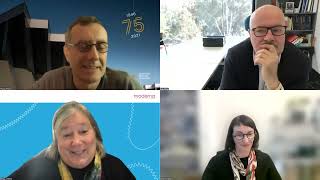
In this live panel discussion moderated by Thomas, Moderna CSO Melissa Moore, RNA‑delivery expert Ross Hannan, and academic Catherine Mills discuss the current state and future of nucleic‑acid medicines. Moore emphasizes how the small‑scale, sequence‑based nature of mRNA enables distributed manufacturing that could democratize access, especially for rare diseases, and describes Moderna’s mRNA Access program that offers academic labs free access to design and production resources. Hannan explains delivery challenges for rare diseases and inborn errors of immunity, the need for tissue‑specific lipid nanoparticles, and the mechanistic basis of ribosome‑targeting cancer drugs, including their activity in p53‑null tumors and mutation‑driven selectivity. The conversation also covers regulatory evolution after COVID‑19, with platform‑based approvals accelerating vaccine updates, and the importance of safety oversight. Hannan shares how Moderna protects intellectual property by delaying publication and limiting project exposure. Moore contrasts academic and industry career paths, highlighting the shift from grant writing to team‑oriented product development, the value of middle‑author publications, and the creation of a career‑mapping tool for biotech professionals. Mills comments on the need for regulatory capacity building in Australia. The panel ends with discussion of extending mRNA technology to animal health and the broader implications for global health equity.
Chapters
Um, we now have a segment where we have a, a short while for a discussion amongst panelists, and while our audience out there is maybe still getting ready to formulate their questions in the Q&A box. So, Ross, Melissa, Katherine, maybe you have comments that you want to make to each other to get the discussion going?
Sure. I'd really like to commend Katherine for her talk because I think you pointed out a lot of really important issues around that. And in terms of mRNA, and it was remarkable to me that the numbers that I cited for how long it takes a new medicine and how much it costs for the same, essentially the same numbers as yours. You know, one of the things about nucleic acid medicines, and I'm not, so now I'm not just talking about mRNA medicines, but I'm talking about antisense oligos, siRNAs, and ultimately it will be gene editing, but is that they are, it is truly different because, and I'll just start with mRNA to start with. Once you've found a messenger RNA that works for a particular disorder, then the, first of all, the manufacturing equipment needed is quite diminutive. So at Moderna, we're building out manufacturing facilities all over the world, and I know other companies are as well. But I hope that as, just as, you know, as we make more and more of these things and that drives the cost down, that eventually we, you know, even small communities will be able to make messenger RNA medicines. And then you can send just the sequence of the messenger RNA to local communities to make their medicines. And be able to distribute it locally. And so instead of having— it's more of a distributed system instead of a centralized system, which is then concentrated in just the rich communities. And so I think it is very much going to democratize medicine and make a huge, very big sea change in both how quickly we can make medicines and the egalitarian aspects of it. Hmm.
Melissa, perhaps you could just comment. I guess there's going to be a reasonable challenge for, say, some of the rare diseases where you have to deliver the protein to a specific site in the body, right?
Well, for the rare diseases, I didn't have time in this talk, but for rare diseases, you have to deliver the messenger RNA to the particular cell types. So for a lot of the rare diseases, that we're currently targeting, these— the target tissue is the liver, so hepatocytes. And so we have different lipid nanoparticles for getting the mRNA there. You do— I mean, the difference with rare diseases is you do have to give a higher dose than you do with a vaccine, but again, it's, it's all very doable. And so it's just, you know, once you know how to do it, and there's many, many— now that mRNA medicines have been a proven modality, there are many, many both companies and academics and other people entering the field too. And so I think the technologies will get better and better over time. And so, and by getting better and better, it's also going to get less and less expensive. Yeah.
So maybe I just insert here a question from the audience from Yin Yan Yap. To Melissa. How do you see the potential of treating inborn errors of immunity?
Hi, Yanjun. I'm laughing because I got that same question when I was in Japan yesterday. So inborn, it's like primary immunodeficiency. If you have a loss of function mutation, then you could use messenger RNA if you can get into the hematopoietic stem cells or the precursor cells to whichever cell type in the hematopoietic system that you need in order to treat that disease, you could use that. And there are rapidly— we and other companies are developing delivery systems to get into those cells. Now ultimately, for those patients and for ultimately for rare disease patients, I think we all want a cure, right? And that will come in the form of gene editing, gene writing, gene therapy. But those, those modalities are just not quite ready yet. And so what I think mRNA can offer in the meantime is we can really start treating those patients now. And while they're waiting for the gene therapy or gene editing. So, but I have seen data that are coming from a number of gene editing companies that are, they're going to be delivering the gene editors via mRNA. So the gene editors are proteins, so you need to make them by mRNA. And the dream is to get especially for things like, for sickle cell anemia, is to be able to deliver that to the hematopoietic stem cells in vivo so that you could have a one-shot cure for something like sickle cell anemia, which affects so many people around the world, particularly in low-resource settings. And it's coming. I think it in the next decade it'll be here.
Very good. Maybe one follow-up question to the point about regulatory changes. What, what is actually happening there? And, or, and how should we think about this for the future? For simplified regulatory approval of mRNA drugs?
I'm sorry, could you— I was reading another question. Could you ask that question again? Okay.
About the processes for regulatory approval, how should they change to really facilitate this progress without making it a dangerous endeavor?
Yeah. Yeah. Well, I think it's really the key thing about regulatory and also it's really important that all organizations involved in making these nucleic acid medicines, you know, we don't want to have safety issues and failures because of safety, because that can set back the whole field, just one such major safety issue. And that— the example I'll give was in gene therapy, where there was an incident in the 1990s that— maybe it was, it was the 1990s that set back that whole field for years. So it's inherent that we all should be very careful in, in for safety. And, but that said, the COVID pandemic has really changed the, the regulatory process. And so in order for us to be able to get that vaccine so out to the public so quickly, we had to overlap clinical trials, and that's something that hadn't really been done before. And then the ability, willingness of the regulators to work with the companies that were developing the vaccines and really be much more of a synergistic relationship instead of, you know, we talk to them and they come back to us 6 months later. That's really changed. But I think the big thing, and this is what I was touching on before is with nucleic acid medicines, once you figure out how to get them to where they need to go, that's the delivery mechanism, then— and that usually is where you have the, the dose-limiting toxicities and the side effects are usually from the delivery system. They're a class effect. Once you've solved that and you know that effect for that particular class, then you can easily make a new medicine with by just changing the mRNA sequence. So already for our vaccines, the FDA does not require us anymore to do toxicity analysis for every new vaccine because all of our vaccines are built on the same platform. And so that will speed up the, the regulatory process. And we've already seen that yesterday in Japan. They approved the vaccine, our new vaccine, for some variants that are circulating in Japan. And the data for that was not based on human clinical trial data. It was based on animal data, so preclinical data, because people are gaining, the regulatory authorities are gaining confidence that now we understand we have correlates of protection So we don't have to go through the full clinical trial process every time. And so it's just, I think it's going to speed up quite rapidly. The other thing about mRNA medicines, and this is also true of siRNAs and ASOs, again, they're temporary. So if they do start causing side effects, you can just stop taking them. And so that, that's a real advantage over medicines that where you're changing the genome.
I guess it'll be different, I guess, for the rare diseases, because I guess, sure, the delivery mechanism can be approved, but the protein you're effectively trying to change the expression of will differ depending on the disease. And of course, if you're trying to fix up a defect in, say, DNA damage repair, and you lead to overexpression of that protein, then you could cause DNA damage. So I guess there'll also need to be a couple of levels of regulation. One at generic delivery and then one at— they're probably looking at what are you delivering and what's the safety profile, I guess.
Sure. And that's the purpose of, you know, Phase 1 and Phase 2 clinical trials is to figure out what is the efficacious dose, right? So you tend to start at a very low dose and keep dosing up. Yeah, we haven't really thought about delivering proteins yet that affect DNA damage, although that's an interesting possibility. So we tend to stay away from the DNA.
I think we should switch over to questions that relate more to Ross's talk. So for example, I have here questions from Bruce Stillman from Child of Biohazards and Dong Chao. Relating to how your drugs work. Do they work in p53-minus tumours? Do they affect or regulate pathways beyond ribosome biogenesis? Where does the selectivity to only cancer cells come from?
All good questions. Yeah, the drugs do work very well on p53-minus tumours. And that's because the nuclear stress pathway isn't just regulation of p53. The slide I put up was certainly quite quick. But the ribosomal proteins also bind to other regulatory elements of things such as p21, to turn on p21 and cause cells to senesce or stop dividing, reduction in MYC expression through various mechanisms, turning off E2F. So there are multiple other pathways which are at play. And even in the p53 minus, these are still often active. So yeah, we can treat cells in vivo or tumours in vivo, which are p53 null. In fact, The efficacy of the drug in solid tumors does not correlate with p53 levels. The other question was, how do we get selectivity? Well, I guess that is a key question which we've been trying to find, because that also then leads you to how can you stratify patients, which is the number one question that doctors have. Clearly, it's through the mutations themselves. It's not a panacea, it doesn't treat everything. An example would be the work that Luke Furyk did where he showed that MIC-driven prostate cancer is exquisitely sensitive to the drug. But if you knock out PTEN, another model for prostate cancer, it does not treat that disease. Clearly, the MIC is causing significant stress on the cells such that when we knock out the ribosomal— knock out RNA transcription, they really just collapse in a heap. So I think it's part of this— the tumour cells are really right on the edge of being able to maintain themselves, and they're highly sensitive to these perturbations. But clearly, mutations in pathways can give selectivity, such as I described at the end, these ATRX and HDPR3 mutations, which gives selectivity because they specifically affect the ribosomal repeats. But we've got a long way to go to determine how we can select patients efficiently.
I have another question for you, Ross, from Damien Purcell. How did you capture and protect your IP to fit into your long-time timeline of drug development?
With difficulty. We had a period there where we couldn't publish the second-generation drug. None of that data I've shown you today has been published. And so we've had 5 years of not publishing any data to protect the IP. And so I didn't show a structure of that drug because we'll show that structure in the first publication, which we're writing up at the moment. So you do have to be prepared sometimes to hold on to your work and not present it, and that can pose a significant difficulty if that's the only thing you're doing in the lab. And it's— you have to be very careful about who you put on the projects. Not generally— it's not suitable for students because they need to publish their work and show it. And so most of it's been done through postdocs, but I've just made sure that they've had other projects to work on in addition to this. But it is particularly for the long development time for small molecules, a considerable problem.
Thanks.
Okay, I have a question to Melissa from Trauder. Can you speak about the switch from academia to being a Chief Scientific Officer? What's the biggest difference? Should we in academia be doing anything differently or training our students to do things differently to adapt to such a change?
Yeah, sorry. Um, yes, there's, there's a lot to unpack there. Um, so the biggest difference in switching from academia to CSO is I don't have to write grants anymore. Hooray! Uh, somebody else raises the money, so I just get to spend it. Um, the other difference is that in academics you are working with people who are training to be scientists, and so your main job is to help those students and postdocs learn how to do science and do it rigorously, and because the goal is learning, it takes longer because, you know, you need to let people learn and make mistakes. In industry, you're working with professional scientists, and they mostly are subject matter experts, and they can just move really quickly, so the pace of industry research is actually quite rapid. But a big difference between academics and industry is that in academics, for, again, for training purposes, each student or postdoc really needs to have their own project to work on, to be the primary person driving, to learn how to do science, and then to be able to demonstrate that they have, at the end of the day, accomplished and have the skill sets needed to get their PhD or move on to the next thing. In industry, the entire company has a goal or goals, and everybody in the company has to work toward the same goal, and so what is so crucial is teamwork, and so industry, we do not want prima donnas. We do not want people who are lone actors. What we look for are team players. And one of the things that I say to students, because there seems to be this impression that you, you know, obviously you want to have your single, your first author paper or your co-first author papers, but one of the things we look for on resumes is do people have mid-author papers, so where they're the middle author, because that says they're team players, that they don't always have to be first. And so don't discount your middle author papers. They're really important., and so doing team science is just very crucial for industry. The other thing I think that— and I had no idea when I went into industry the variety of jobs that are available in industry to people, dependent on their interests and their, you know, what their strengths are, and that still has been very obtuse, I think, too. You can't really see through the window until you're inside, and so one of the things that I'm working on now with the MassBio, which is our association in Massachusetts, that of 100— no, it's 1,600 biotech companies. It's crazy how many we have. We are working on an interactive career map for the pharma and biotechnology space that shows will show all of the different kinds of jobs that are available in the biotech-pharma space and then different career paths that you can take or that people have taken, and then also what are the requirements for entry, what are the entry points, and what are the, you know, do you need a high school diploma, do you need a college diploma, do you need a PhD, and then, you know, how do you get that? And so I think that's going to be really empowering. We hope to have that done by the end of the year, and that'll be available on the web for anybody, and it'll really, I think, be very helpful to see because, you know, most of us, we have— we all have our relative strengths and our relative areas of challenge, right? And so the best thing would be to get into a job that plays to your strengths and where you don't have to bang your head against the wall if you're trying to do something that just doesn't come naturally to you. The great thing about industry is that there are so many niche jobs that there is a job that is really sort of perfect for anybody, depending on what your interests and what comes naturally to you. So yeah.
Well, thank you very much. I'll open up the mic, so to speak, again to all the panelists for additional remarks.
So I just have a question for Melissa. How do you work with universities? And, you know, a lot of the fundamental research comes out of the university, which is then adopted. What sort of programs do you have to work with universities?
I'm so glad you asked. And I am going to pull up another slide deck here. We at Moderna have had longstanding collaborations with a lot of universities, particularly around our rare diseases, because in order to develop medicines for rare diseases— I'm just going to— sorry, I'm going to share. That's okay, because I do want to talk about this mRNA access program that we have. So this is a talk that I just gave at University of Tokyo 2 days ago. I'm currently in Busan, Korea.
The—
let me just get to the point I want to talk about. Anyway, so we, we've had to collaborate with universities for our rare diseases because you need animal models, and most of those animal models are with academics. And so we have longstanding collaborations. We also have longstanding collaborations on vaccines. So one of the reasons that we could move so quickly with the coronavirus was that we had been working for several years prior to that with folks at NIH who worked on coronaviruses and had knew what were, what was the right mutations to put into the spike protein to put it in a pre-fusion conformation to get the best neutralizing antibodies. And so that was all in the bag. That had been work done with on MERS that we could immediately apply to SARS-CoV-2. And so we have collaborations both with academics and with with government agencies. But one of the things that we like to point out is we really need to do better. There are over 225 viruses that infect humans, but we only— we have very few vaccines. And so there is no way for us to— at Moderna to do this. So we need to pull other people in. So we have started a program called mRNA Access, and this is essentially our gift to the world. We feel that we have developed this technology to easily make mRNAs and formulated mRNAs for particularly for vaccines, that we then want to give academics access to this. So we already are, you can see the University of Queensland is already on our collaboration list. People, the academics who apply to this program will get access to our mRNA design studio, to our production facilities, and we will be able to get within, I think within 5 weeks is our target, to get formulated RNA to them to try new designs for new antigen designs for new vaccines. And so I would, then this is the website I would encourage anybody who is interested in this, and if you also don't remember the website, if you just type mRNA Access Moderna, it comes right up in Google, that we really want to, to work with academics. And the great thing about this program is we are not requiring any— there are no strings attached. There is no— it's only a materials transfer agreement. There's no licensing that's required. There's We're not— we don't want your IP. We basically hope that if we provide these materials to academics and they, the academic lab, find something that looks like it's going to be a good antigen design, that as a trusted partner, perhaps they would come to us to help develop that with them. But it's not a requirement because we just think it's our moral obligation to do something about the lack of vaccines across the world. And of course, many of these infectious agents only affect very specific populations, and so they're going to be very specific to that country, for example.
That's fantastic. Is there a cost or something that— I mean, how do you triage out the people you're going to work with?
Yes, of course, we triage them. So you just can't, like, order it from a catalog.
That's not it.
So you have to talk to the folks at mRNA Access, and it— there has, you know, there's a back and forth. I think I'm not really involved in the application process, so I don't know if there's a formal, like, little— it wouldn't be a very long grant to fill out, but I do think it— we do want to be working with labs that are, you know, the top labs studying various things. And so, and obviously We don't have infinite supplies of materials, so we want to make sure we're giving it to people who we think have the best likelihood of developing new antigen designs.
And are you extending it to rare diseases or just—
We will eventually. The thing about vaccines, the amount of material that you need is much less than for treatment of rare diseases. And so because vaccines have the biggest impact on public health, And Moderna's ethos has always been to go after critical unmet needs. We think we're going to start with vaccines and see how that goes, but eventually we will go to rare diseases. The other thing is that as we're building out these manufacturing facilities all over the world, and of course Australia is one of the places where we're building this, there will be excess capacity at times. If you, you know, if we have manufacturing facilities for making lots of vaccines when there's not an epidemic or pandemic going on, or in the low season, why not use that excess capacity to make materials for academic researchers to further the research? And so that's, that's some of the thinking behind this.
Terrific. I have another question for both of you just briefly about Is TGA in Australia up to being very rapid in responding to these new types of mRNA treatments? And do they have the right people in TGA to actually analyse and make decisions on this, or is this going to be a learning process?
So I can't answer that because I don't have any experience with TGA at all. So Maybe Catherine can comment.
I can give a brief response, Ross, not in terms of the second part about people, but I think, I think what we would need is some fairly significant transformation of Australia's innovation systems and including the regulatory kind of capacities of the TGA. I think having the kind of that model that's been developed through the COVID vaccination regulatory process, for instance, that kind of where exceptions were made in the regulatory process, using that as a model for really normalising that kind of rapid transformation will really require a lot of change in how we do innovation and regulation in Australia, I think.
Yeah.
Thanks.
All right. I just saw a question pop up in the Q&A box, which reflects the importance of agriculture as an industrial sector in Australia. And, uh, Trada asks, do we think that this mRNA technology will become cheap enough to take it into animals, for example, against swine flu vaccination, against swine flu?
You know, I think with any technology, um, and I think about the car industry, right? At the very first beginning, automobiles were very expensive. And but then once they became industrialized, they became less and less expensive. And the same is true of cell phones and all kinds of things. And so as we make more and more of these and, and really hone the manufacturing technologies, the price goes down. And so I see no reason why you wouldn't be able to use mRNA vaccines for animals. It's just not been the focus of Moderna particularly.
I think there's an ARC Centre of Excellence in that, Thomas.
Okay, good. I think we are nearing the end of our allocated time, already slightly over. So I think it's probably time for me to conclude and hand over back to Sarada.
Great. What a wonderful session that was. So I really want to extend a big thanks to Melissa, Ross, Catherine, and of course Thomas for the great talks and a very engaging discussion session.
More from Joshua







Scientist Stories: Hans Waterham, The value of phenotypic assays in peroxisomal disorders




Scientist Stories: Joel Zlotogora, Genetic carrier screening programs for reproductive purposes