Scientist Stories: Robert Scott, GSK & Genetics and Genomics in Drug Discovery
In this talk, Dr. Robert Scott, Senior Director of Human Genetics and Computational Biology at GSK, explains why and how human genetics and genomics are integrated into drug discovery and development. He begins by highlighting the high attrition rates in pharmaceutical pipelines and cites retrospective analyses showing that targets with human genetic support are roughly twice as likely to succeed. He defines genetic evidence as disease‑associated variants located in or near a drug target’s genomic region and argues that such evidence provides powerful causal inference, akin to natural randomized trials. Scott reviews the rapid expansion of genetic data sources—GWAS, UK Biobank, whole‑exome and whole‑genome sequencing—and illustrates their impact with two case studies: (1) a missense variant in the GLP‑1 receptor that predicted efficacy and cardiovascular safety for GLP‑1R agonists, and (2) a loss‑of‑function variant in IL‑33 that enabled phenome‑wide assessment of potential therapeutic effects and safety signals. He then discusses two persistent challenges: (a) linking non‑coding variants to the correct gene and direction of effect, and (b) accessing sufficiently large, richly phenotyped datasets. To address these, GSK is investing in functional genomics (eQTLs, protein QTLs, CRISPR screens), multi‑omic integration, and AI/ML models to prioritize variant‑to‑gene connections. He notes the transformative role of public‑private resources such as UK Biobank, upcoming large‑scale sequencing and proteomics efforts, and the dramatic reduction in time required for phenome‑wide analyses. Finally, Scott describes GSK’s genetics‑driven R&D framework, where every target hypothesis is evaluated for genetic support, influencing prioritization, acceleration, or termination decisions, while acknowledging genetics is one pillar among many in the drug development process. He concludes with optimism about the expanding genomic landscape and its potential to deliver safer, more effective medicines more efficiently.
Chapters
So, moving on to the next talk, great pleasure to introduce Robert— Dr. Robert Scott. Robert is Senior Director in the Human Genetics and Computational Biology Department at GSK, where he leads applied and statistical genetics team. Robert was previously at University of Cambridge in the famous MRC Epidemiology Unit. Robert is going to tell us about genetics and genomics in drug discovery. So thank you very much, Robert.
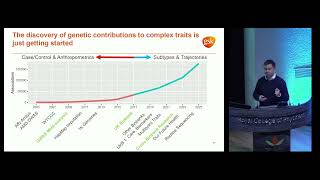
So I'm very grateful to the organizers for the chance to be here today and to share our GSK approach to applying genetics and genomics to medicine. I'm equally grateful for the first chance to be out of the home or site office for the first time in 18 months. And not even 2 canceled trains on the way from Cambridge could quell my enthusiasm to be here today. So it's a real pleasure and privilege. So I'll start by giving an overview of the things I'd like to cover today, which are why would we use genetic evidence in drug discovery and development, and why would having genetic evidence be attractive in support of a particular target indication pair. And I'd like to do that by covering the types of information that we survey as we do these analyses and we bring genetic evidence, giving some examples from the past that I think illuminate some of the strengths and the opportunities that we'll have in both present and future with our aims to bring genetic evidence to bring safer, more effective medicines to patients and to do that more efficiently and more quickly. So a question I'm often asked when I— certainly when I was based in the MRC Epidemiology Unit, when I worked with colleagues across the spectrum from early discovery through to prevention, would be, well, why would we study the genetics of complex disease, which are diseases by their very nature are multifactorial, have a range of lifestyle environmental causes? As you'll be well aware, there's a growing body of literature on the utility of common variants and genetics more broadly to predict individuals at differential risk of disease, and that's certainly an area of active interest both in academia and in industry. But the principal point that I'll focus on today is the utility of genetics and the ability to bring genetic evidence to understand the etiology of disease. In using genetics, we're reading the results of very powerful experiments of nature in humans. Of course, which are the organism in which we're most invested in our health. And I would argue give us very powerful causal inference linking gene function to disease phenotype, and in doing so give us a very attractive starting point for drug discovery and development. And of course, this is against the background that this audience will know very well of the very high failure rates in medicine development and huge challenges due to failures due to lack of efficacy even by the time By the point at which we get to Phase 3 studies, there is about a 50% likelihood that the molecule or the asset in which we've spent years, often a decade or more developing, will be likely to fail. And I would point to the fact that if we look back to the molecules that we take into clinical development, the likelihood of success is about 10%. And if we go back even further into preclinical development, the likelihood of success and being an effective medicine to treat patients becomes even lower. So that, of course, is huge inefficiency, brings huge costs to medicines, and I think gives us a marker there's a need for dramatic change in the industry in how we select, identify, and develop targets to become medicines. So what are the approaches we can take to bring additional and better insight into picking better targets that are more likely to become effective medicines for patients? One of those factors is genetic evidence, and this is work published some years ago by colleagues at GSK. That in a retrospective evaluation of drug development pipelines across industry noted that the proportion of targets with genetic evidence, and I'll comment on that in just a second, increased as we went further through from preclinical into clinical and late-stage development all the way through to approval, such that targets with genetic evidence are about twice as likely to succeed as those targets without. And what do we mean by genetic evidence? So in this particular study, what was meant that there's a genomic region that encodes a particular target, generally a protein that's a target for a specific medicine. In that genomic region, in and around that specific region, there are genetic variants that are associated with diseases related to the indication that that drug was seeking to treat. And you might ask the question, well, why is it that human genetic evidence appears to increase success rates? And the basic model for that is that human genetics give us this what I would argue is powerful causal inference because they get close to randomized control trials where a major power of the randomized control trial is randomization with respect to confounders where we can look and attribute differences in disease risk or event rates down to the fact that we modify. And if we think about this and how it relates to genetics, we have a similar model where individuals are randomized to particular alleles at conception that we now know through larger and ever larger studies alter our risk of specific diseases.— and that gives us some insight into these particular variants that alter gene function. We can then ascribe some difference in risk to the function of that particular gene. So these insights have brought real transformation in our strategy at R&D over recent years with Hal Baran joining to lead our organization, where he's very clearly stated that our organization would shift— our R&D organization would shift to be driven by genetics, and we're living that particular drive and experiment at the minute. So you might ask the question, well, how can genetics aid drug discovery and development? So some of the examples I will touch on are ability to help us identify new targets, to identify new protein targets that we think through perturbation might result in effective medicines. It can help us with validation of existing or potential targets through potentially prediction of efficacy, asking will perturbation of a target result in a positive effect on a specific disease. Will we then be able to test those genetic variants that proxy perturbation of a target, test them against other disease indications, and ask, well, do we see evidence supporting other indications as being potentially attractive opportunities for a specific medicine? And they might also give us insight into potential adverse effects of putative therapies. But for that vision to be realized, we need specific things. Specific conditions to be met. And one of those conditions is that we need genetic variants occurring. We need these experiments in nature to have been done. And we need to be able to tie these genetic variants that we observe in the genome to the function of specific genes so that we can infer or demonstrate them to perturb gene function. And the other thing that we really need— and I'll give some examples of how that can transform our insight— is large-scale datasets in which to establish their relevance, the relevance of these variants to disease. And much of what I'll discuss today is related to genome-wide association studies, and I present here a picture of the shifting landscape as we look at the advent of genome-wide association studies in the last decade or so. So this is showing a genome-wide association study for asthma, where in the first large-scale association study there were about 10 loci, in fact 8 loci observed across a study including 10,000 cases of asthma. As we fast forward 7 years to the advent of UK Biobank, overnight this number goes from the order of a dozen or so up to over 50, over 100 loci associated with asthma based on 50,000 cases. And the power of what we're looking at here, for those not familiar, this is a plot plot of every variant that we observe in the genome, negative log 10 p-value across all the different chromosomes here. Each one point on here is one of about 10 million genetic variants that we're observing. Each of these points here with a very compelling statistical association would tell us that something about that variant is altering a gene or gene function of genes in the region and is then altering disease risk. That's a very powerful starting point for us. And I think the fact that we have gone from these initial insights here to hundreds of loci, dozens or hundreds of loci associated with specific diseases, speaks to the scale of the opportunity and how our aspiration from years gone by is now becoming— our ability to deliver on that is becoming fit for purpose. And this is a theme to which I will return. So I'll give one motivating example that I think highlights the limitations. My early journey in joining GSK and some of the things that we sought to do that we were really challenged in trying to achieve and how I think we're now becoming far more effective. And that was following up on the result of an exome sequencing study. So this particular whole exome sequencing study that identified a huge number of genetic variants, low-frequency variants, in genes encoding protein drug targets and identified some associations with relevant disease phenotypes, albeit with limited power. And one of the variants that was identified in this particular study was a coding mutation, a missense mutation in GLP-1 receptor that was associated with fasting glucose. Now given what we know about GLP-1 receptor agonists, this gave us some insight that we, and GSK had a molecule in development at this particular time, a GLP-1 receptor agonist. We might be able to use this genetic variant to proxy the consequences of pharmacological perturbation of GLP-1. Receptor agonist. So it's a major drug class for type 2 diabetes, very effective, widely used for diabetes. However, of course, FDA guidance that any new antidiabetic agent should have, should demonstrate cardiovascular safety or at least the absence of any cardiovascular risk. There had been at the time some admittedly controversial suggestions that GLP-1 agonists were associated with an increase in rare adverse pancreatic events. And of course, like with many medicines, they have been, had been, have been suggested for use in a range of other disease outcomes. So having this genetic variant, we spotted an opportunity to ask, well, can we look at the association of that variant across the disease phenome, or as widely as we could, and ask, can we predict efficacy or adverse outcomes for this particular molecule or class of agents? So the first question we asked, given that these agents have been shown to be effective for diabetes, was the variant associated with diabetes? We find indeed it was associated with a lower risk of diabetes. Tackling the next question then, could we— and this gave us some insight that this might be a useful genetic proxy for GLP-1 receptor agonism. Could we give any insight into the cardiovascular safety of this class of agents? And we observed— and I just note the sample size here. This was a mammoth effort going back 5 years ago to get access to this sample size. Not only did we observe no increase in cardiovascular events, but in fact, if anything, we observed some evidence for protection from cardiovascular disease. And this was in advance of one of several cardiovascular outcome trials reported for this particular class of agent. So some evidence that using genetics can help us predict outcomes. So we then did the next obvious thing and asked to— and aimed to address some of the other questions that had been asked of GLP-1R agonists in looking at rare adverse pancreatic events, other cancer outcomes, looking at Parkinson's disease and Alzheimer's disease, other diseases for which some utility had been suggested. And what you'll find is there that we will largely— we observed no evidence of any association, but you will note the scale of difference in the sample size here, that we were really restricted in our power to be able to draw any compelling inference here. And the thing is, of course, we wouldn't only want to do this for 8 diseases. We would really like to do this across the disease phenome, but that was not possible at this time, and I'll come back to that just shortly. So I think that illustrates some of the opportunity, but some of the challenges that we face, and I'll come on now to some of our current and planned approaches. Just to start by saying that I think we have seen transformation in the scale of access and availability of genetic data, but I would argue we're only at the cusp of that increase. You have seen from very gentle growth through to UK Biobank arriving, considerable shift in the number of genetic associations observed in the literature. Our ability to go from crude case control phenotypes and anthropometric measures into disease subtypes, disease progression is increasing dramatically too, which is incredibly attractive for us. We're now seeing cross-biobank meta-analyses. Our Future Health, we hope, is coming online soon, and sequencing will soon become the technology of choice that gives us comprehensive capture of common and rare genetic variation. And we are seeing major investment in these public resources. GSK and several other pharma partners have invested in whole genome, whole exome sequencing of UK Biobank. I'll just come back to, though, the two challenges that still remain. The two challenges that still remain are, number one, that we require to have variants or be able to link these genetic variants to the function of genes, and as I'll show in a second, that's challenging. Large-scale datasets and access to those large datasets to establish variant linkage is really important. So I've, of course, in the first example presented to you the one that where we have a coding variant that's linked to an indication that's already in development for which we have efficacy data. That's a tiny minority of the cases that we observe. Typically what we're doing when we look at a genome-wide association study, when we zoom in, it'll look something like this. There are thousands of genetic variants in the region, potentially dozens of genes in the region. We're unclear which particular gene is affecting this association linking variant to disease. If you look closely here, you'll see this is a cholesterol GWAS. HMGCR, the target of statins, is one of the genes here. We would have some very high prior, but I'm afraid again this is one of the minority. Most of these genetically associated variants live outside of exons, so we don't have that very powerful link of coding function— of variant to coding function. And in my argument, our argument is that solving this challenge will unlock a huge number of target opportunities. We do this through two principal approaches, one of which is a range of in silico methods bringing computational and other omic data to support our variant to gene function, and then functional genomics and experimental experimental approaches. So when we look at these particular regions and we see the regional plots, we typically ask a few key questions to try and identify these variants that we think can proxy target perturbation. We ask, does a lead SNP or genetic variants in linkage with it alter the coding sequence of a gene? That gives us a high prior we have the right gene. Does it alter expression levels of either the gene, the transcripts, or the protein? Protein levels, are there any other features regulatory or otherwise that could link to the gene, or simply looking at the genes that are in proximity. And what I would note is one of the cornerstones of our ability and our wish to develop medicines is knowing the right gene and also knowing the required direction of pharmacological perturbation. Are we looking for inhibitors or activators? That would materially alter our enthusiasm, and I would note that directional inference is possible for some but not all of these examples. And I'd maybe come back to one example here. IL-33 was one, or at least a SNP in the region of IL-33 with no other data was identified in 2010. This was a particular target that GSK has had programs in development for. But really no other data linking those variants to IL-33 function. If we fast forward 7 years to UK Biobank, you'll see that the statistical significance of associations in this region changes dramatically. Not only that, with improved levels of sequencing, much deeper imputation and capture of rarer variation, we now identify a loss of function variant. So a genetic variant that prematurely truncates the protein results in no receptor signaling, thus what we believe to be a loss of function of IL-33 and a good proxy for IL-33 inhibition. Is now uncovered. So this speaks to the scale of increasing data, the ability to do sequencing and identify these rare functional variants. This gives us now an opportunity to ask what are the consequences, the phenome-wide consequences of IL-33 inhibition through this genetic proxy for inhibition. And I mentioned earlier for the GLP-1R example, we were able to look across those 8 particular phenotypes, and that took a long time, lots of emails, academic collaboration, etc. Overnight in UK Biobank, we can look here, and these are phenotypes on the basis of self-report, ICD-10 coding, etc. We can look at the phenome-wide consequences of IL-33 inhibition being reduced levels of eosinophils, lower risk of asthma by various definition, lower risk of hay fever, wheeze, and particular symptoms. And we can do this now. Overnight looking at 1,500 phenotypes on half a million individuals. So this moves from an area where we would have an aspiration to do this to a point at which we're actually fit for purpose and we can do this at scale. However, again, I pick the easiest examples because these examples, like IL-33, where we have a loss-of-function variant we can identify that's sufficiently common, we can do this type of analysis, are in the minority. So that still leaves challenges for these non-common coding variants. And core to our strategy now and some of the opportunity that we see is a big investment in other omic approaches, so generating eQTLs of variants that we can link to expression levels, to protein levels, to alternative splicing and function of different transcripts, to genomic perturbations through CRISPR or base editing, through omics profiling, through regulatory genomics, genetics, bringing all of these things together to build advanced analytic models, AI/ML-driven models to understand which are the best predictors where we can get insight into variants linking to genes. And we do that through internal development as well as through a number of very large-scale collaborations with leading genomics and genetics providers across the world. And this has become a big focus for us now to try and fill the gaps and address this challenge of linking variants to genes. Core to our strategy is the integration of human genetics with this functional genomics data, and both of which feed into these AI/ML-driven analytics, again, which then begin to give predictions of where we have insights into what we believe are true positives. Can we then help identify other instances where we have variants linking to specific genes? Evidence would suggest that this will lead to higher success rates, and we believe will lead to more high-quality and faster development of these targets. So I've spoken about another major challenge being limited access to data, and of course everyone is very aware of UK Biobank, which overnight brought an absolute transformation in access in both scale, richness, and accessibility of data. That's brought even more enrichment of the resource through a range of public-private partnerships, exome sequencing, whole genome sequencing, sequencing. Just 2 days ago, the first exome sequencing paper from 450,000 whole exome sequences detailed linkage to phenotypes from this pharma consortium was published. There is ongoing, right now, large-scale proteomics measurements of 50,000 individuals. So I think speaks to the huge opportunity. And the ongoing development of other key UK genome resources that will bring further potential to translate these insights to patients, or to patient care. And if I was to speak to some of the opportunity, the example I mentioned to you, this one very nice figure, was a study I started when I was at Cambridge and finished when I was at GSK. Took, when I scoured my emails, 18 months and over 1,000 emails of negotiation with academics asking for access to lookups for a single SNP. If you squint at this hard enough, this is the same analysis done in UK Biobank where arguably we get just about the same answer from UK Biobank. That took 3 hours and 3 emails discussing between colleagues to get to the same answer. So where we have an organization like GSK with dozens of active targets that we're working on and many hundreds of thousands of putative targets, this now begins to realize, to help us realize the potential. So what does this implementation look like? What does it mean to be genetics-driven? Because I know a lot of organizations have genetics as part of their strategy. What I would comment is that GSK, we are genetics-driven for sure. Every single target hypothesis that's in scope is assessed for genetic support. This is really now driving decisions to prioritize, to accelerate, to stop development of particular opportunities. Key criteria in decision-making, and I would argue the major driver for target identification. But I wouldn't wish to oversimplify. As a geneticist, I'm passionate about this, but it's not the panacea. It's not the sole driver of medicine development. We rest, of course, on very close partnership with colleagues in the research units who actually drive these medicines into clinical development, clinical and medicinal sciences, and genetics is one of several pillars that would give us belief in developing medicines. I'll finish— I'm not entirely sure, I think I'm just about on time— but just by saying I think the future looks even brighter I've told her what I hope is a transition from going from an area where we'd have aspiration but limited ability. Now we're very much functional, and I think with continued growth of genetic and genomic datasets, the opportunity to bring these insights and translate them to healthcare becomes even brighter. And I think, again, as I said, being passionate about the role of the UK in driving these things through generation of those resources, but also the real accessibility that everyone enjoys. And I'll pause there by saying thanks to many colleagues who have driven much of the work I presented, and thank you again for the opportunity.
More from Joshua







Scientist Stories: Hans Waterham, The value of phenotypic assays in peroxisomal disorders




Scientist Stories: Joel Zlotogora, Genetic carrier screening programs for reproductive purposes