Scientist Stories: Robert Tjian, The Biochemistry of Gene Regulation
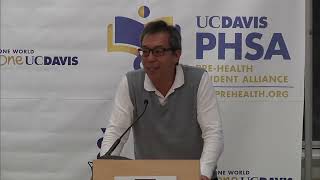
In this pre‑health conference talk, Robert Tjian (Howard Hughes Medical Institute and UC Berkeley) shares his optimism about the rapid advances in biology while acknowledging significant challenges facing U.S. biomedical research. He highlights two breakthrough technologies—single‑molecule, super‑resolution microscopy (exemplified by Eric Betzig’s Nobel‑winning work) and CRISPR‑Cas9 genome editing (developed by Jennifer Doudna)—as examples of tools that are reshaping our ability to study disease mechanisms. Tjian critiques the current funding climate, noting a growing emphasis on translational research at the expense of basic, mechanistic studies, and points to under‑preparedness for emerging health threats such as Ebola. He stresses the need for a larger, more versatile STEM workforce, arguing that training should emphasize critical thinking and support diverse career paths beyond academia. Tjian describes the Howard Hughes Medical Institute’s role as a “talent scout,” providing resources and freedom for scientists to pursue their passions. Throughout a Q&A, he discusses research policy, the balance between basic and disease‑focused work, the importance of integrating basic and clinical education, and the value of early research experiences for high‑school students. The talk concludes with a call to expand training, improve funding for fundamental science, and maintain the United States’ pioneering role in biomedical innovation.
Chapters
Well, thanks very much. This has been quite an amazing event. I had no idea that this venue was so big, first of all, and the interest that so many students have in the health sciences, which is a very positive sign. And I say that because There's been a lot of concerns, certainly in the medical field, about the fact that the United States seems to be slipping behind in terms of our support of research and that the government has other priorities. And so it leaves private institutions like mine to try to make up some of the difference, but of course we can't. We can't completely substitute. So I thought I'd just make a few comments about why I remain very, very optimistic about science in the US and particularly its biomedical and health sciences. I also feel that some of you who are going to start going into this field, that biology speaking very broadly, is something that is so exciting in the 21st century that I feel that it is going to be the century of biology. The tools, the insights, the reagents, and the knowledge that we have of very complex biological systems, particularly human systems, is advancing at a very, very rapid rate. And so it's for those reasons that I feel optimistic. At the same time, we have many challenges, headwinds as they would say. So I thought I'd tell you a little bit about what I think the challenges are, what some of the potential focus should be. And really, I don't want to sit up here or stand up here and talk for the next 15 minutes, but rather— those of you who are in the audience who might have questions for me. It would be more interesting to actually hear what your perspectives are. So I'm going to only speak for maybe 5, 6 minutes and then be happy to take questions from the audience. So, you know, what really drew me to biology was because it is incredibly complex. And it's complex even in simple organisms. It's particularly challenging— We're talking about human biology. So why do we do this? You know, if it's so complex and it's really hard to make progress, you know, why do we do it? Well, part of it is that we are problem solvers, and that's what we're trying to encourage amongst our students, is problem solving. And in a way, the harder the problem, the more interesting it is. One of the things that makes me very optimistic is that despite great difficulties of trying to understand, let's say, the molecular basis or underlying basis of pathophysiology of disease, we keep developing new tools. And these tools are so amazing and they come so quickly that it's what keeps me happy at night when I sit down and think about, you know, where we're going to be going in the next 5, 10, 15, 20 years. So what do I mean? What kind of advances are we talking about? So let me just give you two examples of amazing technologies that are truly breakthroughs, and they happened very, very recently. One example is the development of these incredible microscopes. These are light microscopes that can actually track individual molecules in a living cell. We call them single-cell, single-molecule imaging tools. And just a few years ago, it seemed almost impossible that we would be able to overcome the light diffraction limit and be able to do this. And you might be thinking, well, what's that got to do with, you know, human medicine? Well, the fact that I can now track proteins in neuronal cells that are involved in Huntington's and try to figure out what's going on with the pathophysiology is something that I couldn't imagine doing just a few years ago. And to underscore the importance of this discovery, as it so happens, just 2 days ago, my collaborator at the Genelia Farms Research Center, Eric Betzig, shared the Nobel Prize in Chemistry for this amazing technology. So I think that we're only at the front end of this technology, we're at the tip of the iceberg, but we can already see the tremendous forward movement that we will get from being able to look at molecules doing their thing in a live cell. So that's just one technology. Let me just talk about another one to give you a sense give you a sense of my excitement. And that's the genome editing technology called CRISPR-Cas9. This is something that was developed by a colleague of mine at Berkeley, Jennifer Doudna. And this again is very basic research. In fact, this whole system of genome editing derives from a very primitive bacterial sort of immune system to try to protect itself from invasion by viruses called phages. Again, we're at the very, very early stages of this rapidly emerging technology. I'm seeing it advancing daily almost in my laboratory and in other laboratories, as Jennifer is also a collaborator. And there is no doubt in my mind that this technology of being able to with precision manipulate genomes in the organism will be revolutionary for health and medical research. So I think these are just two examples. I could give you many more. And my point is that at the— just at the stage when some truly transformative insights and technologies are developing, our country seems to be backing off supporting the very basis of where these innovations came from. Now, what do I mean by that? Because after all, we still have a $30 billion NIH budget. And what I'm talking about is that more and more, a greater percentage or proportion of that money is directed towards what we call translational research or clinical research. Which is of course important, and don't get me wrong, I feel that we do need to have great research efforts in that area as well, but many of the biggest challenges that we face come from not understanding the molecular basis of the pathophysiology of disease. So, you know, we've all been hearing about the— crisis in West Africa with Ebola. Now we've known about Ebola since 1976, but there's been very little research done on Ebola. And what little has been done has been done by small biotech companies that are underfunded and undermanned. And you know that right now we're in a crisis because we can't even treat 2 dozen patients with the antibodies that seems to have some effect on at least slowing down Ebola. That's just one example of how little we are prepared with understanding the basic problems of some of these diseases. But that goes beyond just the, you know, the news of Ebola. It's really true about Alzheimer's, it's about cancer, it's about diabetes. All of these things we don't actually fully understand. And although the tools are there, we have tremendous tools in genomics sequencing and gene expression analysis, and all of this stuff is happening faster and faster, but we're, I believe, under-resourcing both in terms of people, which is you, the students, and the research enterprise as a whole in really getting at the fundamentals of biology. And so, you know, I spend some time on Capitol Hill talking to our congressmen and senators and trying to get them to understand this, and I think it's similarly true in California. I think we need to do a better job of trying to communicate the— where the bottleneck is in really trying to get ahead in health science advances. Now, I still believe that the U.S. is and continues to be a pioneer and innovator in the health and medical sciences, but many other countries have come to the realization that they need to deal with these global issues of health and are putting great resources into biomedical research and in the training of their And I see that every day in where our postdocs that are in HHMI labs, where they're coming from, where their funding's coming from. And for the first time, some of our American-trained students and postdocs are going back to their home countries in much larger numbers than we ever saw. So this gets me to another point that I wanted to emphasize, because some of you may or may not have been aware of various articles and discussions that have been presented at the National Academy of Sciences about, you know, are we— is our enterprise growing too fast? Are we training too many students? Are there not enough jobs because we are training too many students? And I'd like to say that there are many of us who feel that quite the opposite, we're not training enough students. I feel that the workforce has to be greater and more expert because the challenges are going to be great. And I also like to say that, you know, health sciences doesn't mean that you just have to do one set of profession. You don't have to be a professor. You don't have to be a medical researcher. You don't have to be an MD. That basic information of learning how to think is incredibly valuable in all walks of life and in professions. And I feel that we would be doing the country a disservice if we started to slow down on our training of science, technology, engineering, math, and so forth. We need to really, really ramp that up because I think future economies are dependent on it. So let me finish by saying that, you know, at the Howard Hughes, many people ask me, you know, what do we do at the Howard Hughes? Well, what we are are talent scouts. We're trying to figure out where we can identify the most talented individuals wherever they may be. We don't tell them what we want them to do. We just want to give them the resources to follow their gut in terms of what interests them, where their passion is, and give them enough resources and time to develop. Their expertise in whatever area. So we feel that it's really a human resource issue and that we are the ultimate scientific talent scouts. And we hope that we can make a difference. We will continue to try to hone our abilities to empower those of you who are interested in entering the scientific world, whether it's as an MD, as a researcher, as a teacher, nurse, doesn't matter. I think that fundamental education and learning how to think and to understand the truth in the complexities of biology is what we would hope to see. And with that, I'm going to stop talking and be happy to take questions from those of you who are here. Thank you. It doesn't have to be students. You can— anybody can ask me questions. Yeah. How does your lab work? My lab now works on actually using those microscopes to follow proteins that are called transcription factors that bind to DNA and decode the genome.. And for the first time, we can actually watch these molecules do their thing in real time and really begin to understand how these molecules work. And many of these molecules and their interaction with DNA can be traced to be some of the molecular mechanisms for disease. So that's one of the things I'm doing. Yeah. Yeah. Can I ask you a more general question about sort of research policy? Do you think there's a problem with the sort of overemphasis on a single disease model that drives our research? Yeah, I think that's correct. Yeah, well, I think that, you know, I think there's a lot of goodwill out there in trying to solve certain diseases. And, you know, we can all empathize with that, but as a strategy for the nation to deal with the larger issues of healthcare and medical advances, I think it can be actually counterproductive. I think there's a lot of pressure for everybody in the medical field to get to the translational side as quickly as possible, but Sometimes that's just not the right route to go because when you finally get into the clinical trial and you realize you don't understand the mechanism of action and something goes wrong, you can't interpret it. So my view, and I've had a lot of experience in the biotech field to realize that it's a little foolhardy to go into a clinical trial without really understanding underlying molecular basis, and that's what I think we should be putting our effort into. Yeah, Ken.
This is a pre-health conference, and probably the people in this room are the believers that basic research is part of health. But it would seem that perhaps we haven't been doing as good a job at the universities as we might at convincing our students of that, judging from the number of them that are over listening for how to get into med school. What do you think— what advice would you give universities or to the public at large about how to more effectively help people understand?
Yeah, that's a really good and tough question. I mean, I think that there's— you know, we're being pulled in two different directions. You know, one is obviously, you know, the sort of the rush to clinics because we would like to get our treatments to the bedside as quickly as possible, and everybody can understand that. But at the same time, you know, students coming in, the sort of our pipeline, if they— I think actually the students are pretty good about that. They get it in many ways. They probably get it better than our politicians, that they really need to understand the fundamentals before they can really get at human disease. So that's one thing. I mean, I think universities could be doing a little better job of sort of relating the basic side of science with the translational side of science. And I don't see as much crossover. You know, there are courses that are, you know, taught in medical schools particularly, or, you know, teaching people how to think about the clinic side. And then the universities that don't have medical schools are just teaching the very fundamentals, but there's no connection. I think that connection would help a lot so that both sides would understand, you know, where the value is. And we try to encourage that. I think the training of so-called physician scientists is key. And I think our mechanisms for doing that are, are a little rusty right now. Yes?
So you mentioned this debate of us treating— there's a glut of PhD students being trained or not. I happen to side with your view.
But if this room was full of postdocs who were doing their second postdoc right now, Yeah, well, I confront that all the time, both in my own lab and throughout the Hughes. Well, I mean, there are two things, right? I mean, one is it is definitely a competitive area, so if you're very, very focused on just being an academic, then of course your chances are lower. On the other hand, over the last more than a decade now, some of the best people that I've trained in my laboratories and others that are that are in my institution find that, okay, so a brilliant graduate student decides after they finish their PhD that they want to go into law or they want to go into venture capital. I think that's just great. I think that my point is that we should be training people to think and then they can decide whether they want to be a scientist modeled after ourselves or they want to go do something different. And because I think the education that we're giving them is fundamentally important in the real world of trying to discern difference between, you know, truth and science versus beliefs in things that are all through the internet, trying to discriminate between reality. So I think that That's what I feel is important. And if the general population of developed worlds can't have that, we're going to make bad decisions. Yes? [INAUDIBLE] [INAUDIBLE] Well, there are several, many steps because I said we're in the early stage. One would be some kind of technology that would allow us to actually look deeper into tissue rather than single cells on a plate, which is one single layer deep, which is pretty much what we can do right now because I think the ability to identify individual cell functions in the context of the entire organ is really, really important. So that's one problem. There are many other problems. One that we're particularly struggling with right now, ironically, we can track individual protein molecules zipping around the nucleus, but we have a hard time actually identifying the locus on the chromosome that that protein is acting on. And that's simply a technological issue of signal to noise, and I think we'll solve it. So those are just two things. You can think of many, many others. Yes? [Speaker:AUDIENCE] Do you think that high school students should do research on their own initiative? And how do you get them to that point? [Speaker:JAMES WATSON] OK, so should high school students get an experience in research? Absolutely. I've had a number of high school students from Berkeley come through my lab for a summer. Just to— you know, I heard one of the panel speakers talk about this. You know, just the experience of figuring— even if you don't get into that particular kind of science, just getting the experience of, you know, what do researchers do, how do they think, how do they interact with each other, what do they think is interesting, and so on and so forth. That experience, I think, is invaluable. I had it when I was in high school. Decades ago and it seemed impossible now. But I think, you know, a lot of universities realize that. I know that Berkeley and UCSF does this and I'm sure many others do. They have programs that will funnel high school students in for the summer just to get that experience. I think it's tremendously valuable in both ways. Maybe you'll decide this is not what I want to do. The sooner you can figure that out, the better. But many just get completely enmeshed in it, and they love it, and they never leave. Yes?
If you had to choose, which one do you like doing more, acting as president of Howard Hughes or teaching at UC Berkeley?
Oh boy. You're putting me on the spot here. I like them both, but I think through my long career at Berkeley, I sort of did a lot of teaching. I used to teach Bio 1A for 9 years, and I loved it. But I'm at a stage in my career where I thought it would be good to try something else. I had never done an administrative job before I took the Hughes job, so I think they took a huge risk on me, and I took a huge risk on them, but I like them both. They're completely different. You know, one of the things that I love about our profession, the medical health profession and being a scientist, is that you can actually go do a lot of different things. And it doesn't matter, it's not like you're stuck in one area. You know, I've done venture capital, I've done biotech startups, I'm now doing nonprofits. And I've taught. So I think there's nothing stopping you from doing any of those things in whatever order you happen to want to do it in because you're fundamentally trained to think clearly. So that's the way I feel about it. So I can't, I can't take any preference. I may go back to Berkeley in a few years and go back to teaching I probably will. Yeah. [INAUDIBLE] Not at the moment, although, you know, I have a number of Hughes investigators that are experts in infectious disease and in the immune system, so I'm guessing that they will be consulted about trying to develop effective vaccines, neutralizing antibodies, and so forth. I actually don't think that Ebola is the most difficult virus to actually tackle. It's very scary right now because we were totally unprepared, but there are many other viruses and infectious diseases out there that are much more difficult to deal with HIV being a good example where we don't fully understand the immune reaction so that we can elicit the right response to fight it. So like I said, or maybe I didn't say it explicitly, at the Hughes we don't tell people what they should work on. You know, if somebody amongst my investigators decides, hey, I've got a new idea for beating Ebola, and they start doing it and they didn't say they were going to do that in their 5-year review, wouldn't faze me in the least. So I hope that answers your question. Right. Well, I think we answered a lot of questions out there. If there are no more questions, you guys probably ought to go have your lunch. Thank you.
More from Joshua







Scientist Stories: Hans Waterham, The value of phenotypic assays in peroxisomal disorders




Scientist Stories: Joel Zlotogora, Genetic carrier screening programs for reproductive purposes