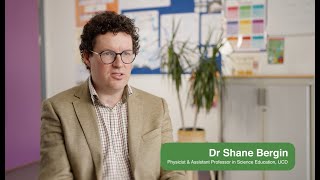
In this interview, physicist Shane Bergin discusses the value of interdisciplinary conversations among physicists, biologists, and other scientists, emphasizing that knowledge about fundamental questions like "what is life" transcends disciplinary boundaries. He reflects on his personal connection to Erwin Schrödinger, recalling his first class in the historic Schrödinger Lecture Theatre and describing how Schrödinger’s book What Is Life and his public lectures exemplify accessible, interdisciplinary science communication. Bergin stresses the importance of diversity in science to prevent groupthink, noting that varied backgrounds and perspectives enrich research and its societal relevance. He outlines his own research focus on physics education, investigating how people learn physics, the barriers that lead to gender imbalances, and how to make physics more approachable for the public. Looking ahead, Bergin highlights Ireland’s strong informal learning sector—particularly the Young Scientist program—as a model for engaging diverse communities outside formal schooling, and he envisions leveraging this success to broaden access to scientific learning worldwide.
Chapters
Shane, it's great to have you here. You're attending the conference today, and as a physicist, I wanted to ask you, what do you think is the value of bringing physicists, biologists, and scientists from lots of different disciplines together for conversations like this?
I think it's really important. So while we work in different schools, in different areas, I think knowledge is not discrete. The knowledge around issues like what is life does not belong solely in the School of Biology. It is their main focus, but other disciplines have things to say about it. It's the most existentialist question that we have, so it's the study of philosophy. Physicists have shown, like Schrödinger, that they can add something different. It's not that they know better, it's just that they can approach it from a different perspective.
And your background is in physics. You actually worked in the building that Schrödinger gave these famous lectures in 1943. How has What Is Life influenced you and your work?
In lots of ways. That's where I had my very first class as a student, was in the Schrödinger Lecture Theatre. It's a special place, and it's an unusual place because people don't expect to see the name Schrödinger in an Irish lecture theatre. They don't expect to hear the stories that he, he lived here very happily, the happiest time in his life for 17 years in Clontarf, and that he contributed to Irish life as well as to science. I also have lots of stories around how the echoes of Schrödinger were heard in the School of Physics. So for instance, when we found or were presented, I can't remember exactly which one it was, with a copy of his What Is Life book and reading it, working with an artist, a lady called Grace Weir, around how his story was woven into the fabric of the School of Physics and listening to the, and reading the amazing prose. He wrote really well. So What Is Life is a short book and it's very approachable. And what I loved about Schrödinger as a science communicator is that Schrödinger's lectures were public in 1943. They were for the public, so anybody could show up. The prose that he wrote showed how accessible it was. He was a physicist talking about biology, so he was interdisciplinary, and he wasn't doing it for profit. He wasn't doing it for any material gain. And I think most importantly, he was a refugee. He was a scientist that didn't belong in Irish culture, but yet added a huge richness to us. And I think at the moment in Europe, when we consider the massive amount of migration that's going on, we should see the value that every human has to give. And there are many more Schrödingers out there.
That's a really good point. So why do you think it's important that we have diverse people doing science?
I think diversity in science is incredibly important because we don't want groupthink. If we have the same sorts of people thinking the same sorts of ways with the same academic backgrounds from the same institute working on the same problem, we'd only make narrow contributions to knowledge, and we'd only have ourselves to talk to about that. I I think diversifying the types of people who do the research, the types of topics that we do, the people who we interact with to inform that research, and the people who we think the research may apply to, that's so important. And that ultimately comes down to having a very diverse bunch of people around you. And Schrödinger embraced that because as a physicist, he worked on biological problems.
So you're a physicist and now you're working on educational problems.
Mm-hmm.
Tell me a little bit about your research and how you combine physics and education.
Yeah, so I, I, I wouldn't wish to put myself anywhere close to Erwin Schrödinger, but I do work sort of out of field. So I think about how people learn physics and how the public engages with physics. And so that's very interesting for me as I am a physicist. I love it, and I have to consider what aspects of physics make it either approachable for people or maybe perhaps why there are barriers. Why is it that the majority of physicists are men or that we struggle to recruit people to teach physics in secondary schools. I think physics is fantastic. It's an unusual and different way of looking at the world, and I want to share that with others. I would like other people to have that aha moment, that discovery of physics that I had. Of course, in their own way. I wouldn't prescribe my way to others, but that they have the opportunity to engage with physics because it offers opportunity. It offers a wonderful way to think about the world.
And aside from hopefully having a future where more people and more diverse people are physicists or engage with physics, more. Where do you hope that crossover between physics and education will go in the next few years? What do you think is in store, or what do you hope is in store, for your area of research?
So one of the areas in which Ireland absolutely shines internationally is the informal learning sector. So this is where people learn outside of traditional school settings. We have fantastic institutions, and we have fantastic projects like the Young Scientist here in Ireland, where people get to explore what it's like to be a scientist or a physicist in informal settings. I think there's huge potential there. I actually come from the point of view that formal learning prepares us for a lifetime of informal learning. It's where we'll do most of our learning. So if we can understand how the informal learning sector in Ireland has been so successful, if we can think about how we can make it more accessible to more diverse communities, then we can be a leader in the world in that field.
Shane, thank you very much. It was great talking to you.