Scientist Stories: Shinya Yamanaka, Cell reprogramming and Pioneering Induced Pluripotent Stem Cells
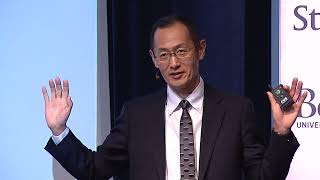
Shinya Yamanaka explains how four transcription factors can reprogram adult cells into pluripotent stem cells that become any cell type. Clinical trials are underway: retinal cells for macular degeneration, dopamine neurons for Parkinson's, and engineered T cells for cancer. The main barrier is cost and time, though banks of universal donor cells could eventually serve most patients.
Chapters
So good morning, everybody. It is a great honor to be here today. So before starting my own talk, I want to know general background of the audience. So how many of you are working on life science or biology? Please raise your hand. Oh, 90%. I see. How about physics or space? Ah, I see. How many mathematicians are there? Oh, I see. It's very good to know. Thank you. Thank you. So could I have my first slide, please? Anyway, so I started my career as a physician, surgeon, 30 years ago in 1987. I'm not that old. And actually it was my father who talked me into medicine. I respected him a lot. However, as soon as I became a doctor, within a year my father passed away. Passed away. He suffered from hepatitis C after transfusion. So, you know, as a young doctor, I was not able to do anything to my own father. I couldn't help him. That was the biggest reason why I decided to become a scientist. I wanted to become a scientists who overcome diseases. So as you know, science has overcome hepatitis C. We now have a cure for hepatitis C. However, there are many other diseases that science still needs to overcome. This is just a few examples. Like Parkinson's disease, blindness, heart failure. These are all very serious conditions, terrible. However, if you think about the cause of these diseases and injuries, it's rather simple. They are caused by a loss of function of just one type of cell. Or maybe two, one, or just a few type of cells. For example, Parkinson's disease is caused by a loss of function of dopaminergic neurons. Blindness is caused by loss of function of retinal or cornea cells. Heart failure is caused by loss of function of cardiac myocytes. It's only one type. If we scientists can prepare this type of cells in a large quantity, and if we can transplant these cells into patients, we should be able to help patients. We should be able to bring functional recovery to those patients. However, as you know, it is next to impossible to obtain a large amount of human cells. But now we can do it. At least in theory, we can do it by using this new type of stem cells: induced pluripotent stem cells, iPS cells. iPS cells have two important properties. First— oh, I'm sorry. IPS cells, we generated this technology 10 years ago, 2006. First in mice, and then in 2007 in humans. It's very simple. All we need is a combination of 4 transcription factors. By putting these 4 factors all together into your own skin cells, or blood cells, we can make your own iPS cells from each of you. iPS cells can grow infinitely. We can expand as much as we want. Furthermore, from iPS cells, we can make many types of cells that exist in the body, like brain cells, heart cells, liver cells, in a large quantity. By using this technology, now we can prepare a large amount of dopaminergic neurons, retinal cells, heart cells, so that we can help many patients. Many scientists, vision scientists all over the world, have been working on this application. Of iPS cells. For example, Dr. Masao Takahashi, a good friend of mine in Japan, she has already started clinical trial using human iPS cells 2 years ago for patients suffering from age-related macular degeneration. It's a blindness caused by a loss of function of just one type of cells in retina. She can now make that type of retinal cells from human iPS cells, and she replaced patient's own injured, aged cells with newly developed retinal cells from iPS cells. It's been 2 years and the patient has been doing very well. Dr. Jun Takahashi, he happens to be the husband of Masayo Takahashi. Just coincidence. But he has been working on Parkinson's disease. He can now make a very pure functional dopaminergic neuron from human iPS cells. He's now testing this strategy in monkey, and we're hoping that he can bring this finding to human as early as next year. Another friend of mine, colleague, Dr. Koji Ito, can make functional platelets as well as erythrocytes from human iPS cells. You know, countries like Japan, We are aging society. We are going to have more and more elderly people who need blood transfusion, but we are going to have less and less children who can donate their blood. So only after like in 5 years, we will be in huge trouble. We won't have enough blood donors. So we need to do something alternative. This iPS cell-based method is a good alternative to blood transfusion. This is also very close to clinical trial because in terms of safeness, it's very safe. You know, platelets, erythrocytes, they don't have— they don't grow, they don't have nucleus. So we don't have to— we don't need to worry about tumorigenesis in this application. So this is very safe. Also, we are fighting with cancers with iPS cells by combining iPS cell technology with cancer immunotherapy. We can make T cells from iPS cells, and in iPS cells, by using CRISPR, we can modify the genome of iPS cells to whatever we want. For example, we can introduce a T-cell receptor gene that can recognize cancer-specific antigen. And from those modified iPS cells, we can prepare a large quantity of cancer-attacking T-cells. In this way, we hope that we can overcome cancer, at least some forms of cancers. Well, at least in theory, we can make iPS cells from each individual patient, autologous transplantation. But in reality, it takes very long, and more importantly, it's very expensive. We helped Masao Takahashi, in her first clinical trial, we did genome analysis just for one patient. We spent almost half a million US dollars. So it's just too expensive. In order to overcome this practical issue, we have been working on so-called iPS cell stocks. So we are now making iPS cells from healthy volunteers instead of each individual patient. However, it's not autologous, so we need to overcome immune rejection. The best way to minimize immune rejection is to match HLA. However, HLA is so diverse. None of you in this audience has the same HLA, unless we have identical twins in this room. So here I show the HLA haplotype of 10 individuals by color. None of these 10 individuals or cells have the same color combination. So if we want to prepare iPS cell stock that can match these 10 patients with HLA, we need to prepare all 10 HLA combinations. If thousands, we need to prepare 1,000 iPS cell stocks. It's too much. But if we can identify this kind of HLA homozygous donor, the situation is very different. Because just making one good iPSC line from this HLA homozygous donor, just one donor, we can cover 4 out of 10 individuals shown by arrows. Because these 4 individuals have red and something else. As long as he or she received red from the HLA homozygous donor, they cannot distinguish transplanted cells from their own cells. Based on this model, we have, we and others have calculated how many HLA homozygous donors are required to cover large population. This is just some examples. In Japan, we have calculated 140 HLA homozygous donors can cover up to 90% of all the Japanese population. That means 140 cell lines can cover 100 million Japanese people. In the States, it's a bit more diverse, but still, 100 super donors, HLA homozygous donors, can cover 78% of European Americans, 63% Asians, 52% Hispanics, 45% African Americans. In the UK, it's very similar to Japan. So many countries, including us, are now working on this HLA stock project. I have 20 seconds. Okay. So today I only talk about cell therapy, but there is another important medical application of this technology. We can use these cells from patients, like brain cells from Parkinson's disease patient or heart cells from heart disease patient in order to understand, in order to make disease models, and in order to perform drug screening. So cell therapy and disease modeling, drug screening are the two important medical applications of this technology. I really hope that in the next decade, 10 years, we can realize many of these applications. So that we can overcome many more diseases. So thank you very much again.
Thank you very much. And there's time for some questions. Anybody from the audience? We have time for some questions. So we should use it. Oh, yes. Yes, hi.
You mentioned clinical trials in Japan. Are you aware of clinical— I'm sorry, you mentioned clinical trials in Japan. Are you familiar with clinical trials here in the States involving some of these applications?
Yes, in the States, as you know, clinical trial using human ES cells have already started., and we have been talking to them so that we can collaborate with each other. And maybe some of their applications may move from ES to iPS cells.
Another question?
Yes. How do the super donors avoid natural killer cells or— That's a very important point. So I don't think we can eliminate immune rejection just by using HLA homozygous donors. As you said, natural killer cells should recognize those cells because they don't have one HLA haplotype. So even using HLA homozygous donor, we still need to use some immunosuppressants. But we hope we can decrease the dosage and kinds of immunosuppressants.
All right, that's the last question then there over there.
Is there any prospect that the regulatory agencies will see the wisdom of this particular model and instead instead of testing drugs on rats, apes, et cetera, will use this as a screening process to eliminate— to get efficacy versus toxicity?
Yes, especially toxicity. You know, pharmaceutical companies has been using like dogs or other animals or cancer cells in predicting cardiac toxicity. But Now we can make beating cardiac myocytes. So actually many pharmaceutical companies have been working on how to use these cells in their own safety test. But we still need to talk about regulatory body because it's a huge change from conventional test. So in order to test, in order to change that kind of stereotypic conventional test. It's been very difficult, but I hope we can replace in the near future, in next 10 years.
All right, well, thank you very much.
Okay, thank you very much again.
More from Joshua







Scientist Stories: Hans Waterham, The value of phenotypic assays in peroxisomal disorders




Scientist Stories: Joel Zlotogora, Genetic carrier screening programs for reproductive purposes