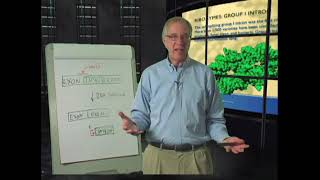
Thomas Cech describes experiments showing RNA can catalyze its own splicing. Working with Tetrahymena thermophila, his lab found that only magnesium and GTP were needed for the reaction to occur in a test tube, with no protein enzyme required. The discovery that RNA itself acts as a catalyst earned him the 1989 Nobel Prize in Chemistry.
Chapters
Hi, I'm Tom Cech, and I've been asked to talk about my favorite experiment. Why did I pick this particular experiment? Well, it was one that I did with my own hands, and there's something special about discovering something through your own work in the lab that, as much as I enjoy working with students and postdoctoral fellows and exalt over their discoveries, something special about being able to make a discovery by yourself. This came when we were looking at initially the transcription of a large ribosomal RNA precursor in a single-celled pond animal, Tetrahymena thermophila. The gene that we were looking at made an RNA that was interrupted by a stretch of non-coding sequence called an intron. And at this time, RNA splicing had been discovered a few years earlier, but people knew very little about the mechanism by which an intron-containing RNA would be spliced to rejoin these two flanking sequences called exons and release that intron RNA. Now, we had found in our studies of transcription of this gene that the RNA splicing was taking place outside of the cell in vitro with our purified extracted RNA. So this seemed to be an opportunity for us to investigate the mechanism of RNA splicing. Initially, this splicing reaction was taking place in the same cocktail of small molecules that were necessary for transcription. So, I decided it would be useful to see which of those small molecules is really required, not for the transcription part, but for the RNA splicing. So, I added them, I subtracted them one at a time from the transcription cocktail, I added them back, and I found that there were only two small molecules that were required. One was a simple salt, magnesium chloride, and the other was one of the precursors of RNA itself, guanosine triphosphate. A lot of specificity here. G was required. A wouldn't do it. C wouldn't do it. U wouldn't do it. It had to be guanosine. And this seemed unusual. It seemed interesting, but didn't really know what to make of it. Until someone else in the laboratory, Art Zogg, was sequencing the end of the intron after it was excised from the larger RNA. And he found that the sequence of the cut-out RNA started with a guanosine residue, which is one of the four nucleotides of RNA. We didn't think much of it until we found out from Joe Gall's laboratory at Yale University that they had sequenced the gene that encodes this RNA, and that they were adamant that there was no guanine present near that exon-intron boundary. The rest of our sequences agreed between the two laboratories. And so, here we had a situation where it looked like maybe there was a guanine that wasn't encoded by the DNA that was added to the end of the intron. And at the same time, we had this evidence from my earlier work that G was a required ingredient in the splicing reaction. So, maybe these two observations were related to each other. Although the idea that one could just add guanosine triphosphate to purified RNA and expect any chemical reaction, any cutting and joining reaction, to take place seemed unprecedented and really quite far-fetched. So, at the time, I did this reaction rather— this experiment rather quietly. I didn't tell any of the graduate students what I was doing. I didn't want to look foolish if this reaction failed, as it was probably destined to do. When I added in one tube radiolabeled GTP to the purified precursor RNA, and in other tubes, the other nucleotides. Finally, in the midst of my teaching schedule, had an opportunity to run the gel to look at the splicing products, and lo and behold, only in the lane where I had added the radiolabeled GTP was there a radiolabeled RNA band the exact size of the intervening sequence. So, I ran back to my office to try to get a little bit of peace and quiet to try to draw out what must be happening in terms of a splicing mechanism. And what I quickly came up with was that this guanine that was added during the splicing reaction was being joined to the 5' end of the intron. So, it looked like it was attacking the splice site phosphate and forming a new oxygen-phosphorus bond that hadn't been there before. Now, if that happened, that would explain how the GTP would be covalently bound to the end of the intron. But what would happen with the other product of this reaction? Well, the 5' exon would then have to be released with a hydroxyl group at its 3' end.. And exactly the same kind of a chemical step, if it occurred now between this exon and the downstream splice site, would result in ligation of the exons and release of the intron RNA with this diagnostic guanosine at its 5' end. And so, I thought, well, is this even chemically reasonable? So, fortunately, I had an organic chemistry textbook Within reach, pulled it out. It did not discuss this sort of reaction with phosphate esters, but with esters of carbon, this was simply a transesterification reaction. So what was happening— so there was precedent for this sort of reaction. You start out with one ester linkage, in this case, a phosphodiester linkage, and you now using the hydroxyl group of the ribosugar of guanosine as a nucleophile attack at this site. It's also called an SN2 reaction, as you've probably studied in your organic chemistry class. And this swapping of partners in this ester linkage turned out to be the key mechanism of RNA splicing. So, although it was exciting to have this mechanistic information about RNA splicing, the question of the catalyst that was allowing all of this to happen eluded us for another year. We were assuming that there had to be a protein enzyme that was responsible for a reaction that took place with this incredible specificity. After all, in this long RNA, there was only one site that was being chosen. As in splice site. There was also specificity with respect to guanosine relative to the other nucleotides. And the reaction was speeded up many billions of fold faster than a spontaneous phosphotransesterification reaction would be predicted to occur. So, if all biological catalysts are protein enzymes, where was the protein? And we spent a lot of time looking for protein contaminants in our pure RNA preparation. Finally, out of lack of being able to identify any, we switched around the hypothesis and said maybe it's just the RNA that is folding up to form the catalytic center for this reaction. To test that idea, we were able to make an artificial transcript that had never seen the inside of a Tetrahymena cell, and when we added guanosine triphosphate to that artificial RNA, the addition of G to the end of the intron, and the RNA splicing that ensued convinced us that it was time to announce that RNA could be an enzyme, that RNA had catalytic activity. This turned out to be the experiment, or the set of experiments, that resulted in the Nobel Prize in Chemistry, 8 years later. But I think it's important to understand that at the time, we were not driven by the possibility of getting awards or recognition. It was simple curiosity about how does RNA splicing occur and how could this reaction even be occurring with pure RNA that was driving us in the laboratory and giving us so much satisfaction.