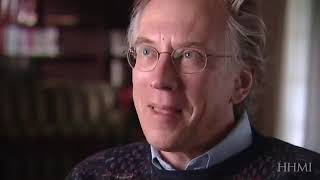
In this monologue, Nobel laureate Thomas Cech recounts his lifelong fascination with the physical sciences, beginning with childhood obsessions about rocks, minerals, and astronomy, nurtured by inquisitive parents and inspiring teachers. He describes his undergraduate chemistry training and early research experiences, which revealed a mismatch between his impatient personality and the slow, instrument‑heavy pace of physical‑chemistry labs. This led him to Berkeley, where a chance encounter with a former physical chemist turned chromosome researcher sparked his shift to molecular biology, a field that offered rapid experimental feedback and aligned with his curiosity. Cech then offers his personal definition of life—reproduction coupled with mutation, encapsulation, and energy transduction—emphasizing that the chemistry of living systems is ultimately a chemistry directed toward understanding life processes. He concludes with a vivid recollection of receiving the Nobel Prize in Stockholm, the surreal phone calls, the ceremonial bows, and the shared celebration with his lab members, underscoring the collaborative nature of scientific discovery.
Chapters
Well, when I was a kid, I was excited about rocks, minerals, especially crystalline minerals, fossils, and so much so that I would even go to the geology department at the University of Iowa, because I was living in Iowa City at the time, and knock on professors' doors and ask them about the structure of minerals, how they arose. It was really the physical sciences that I was most interested in. Astronomy also, especially meteor showers were a big favorite. In addition to those sort of self-generated interests. I think my parents, especially my dad, who was a physician, but a frustrated physicist, he always, I think, wished that there was more science in medicine. And impossible in our family to ever take a family walk without him asking questions about, you know, why the trees were turning color or something about the hydrodynamics of the water flow and the river going through town. Always stimulating sort of an inquiry of nature. And then some teachers, even starting as early as 4th grade when I had a teacher who brought a geologist into the classroom and started us thinking about rocks and minerals from the point of view of how the Earth was formed and what shapes the crust of the Earth as opposed to just, you know, look at the pretty rocks. Then going on from elementary school through junior high and high school, always some special teachers at certain intervals that stimulated my interest in science. Never had any interest in biology at all through college. Majored in chemistry.. And then had a couple of research experiences in chemistry which were very influential. They were influential in sort of the opposite way that you normally think of an experience being influential. They taught me that I didn't want to do this. So I loved the chemistry, the problem sets, the calculus, the math that was involved in working through problems in the physical sciences. But when I got into the laboratory, I found that the pace of the work, the tempo, just didn't suit my own personality, which is quite impatient. In many areas of physical chemistry especially, one spends a lot of time building an instrument, pumping all of the molecules of gas out of it before you can do your experiment. There's a lot of very sophisticated plumbing, in fact, involved in these experiments. People spend sometimes years building an instrument before they collect any data. And I became quite convinced that this was not for me, which put me in the uncomfortable position of arriving in Berkeley, California, at the University of California to start graduate school in chemistry knowing that, knowing only one thing, and that is that I didn't like doing the research. And of course, that is the definition of graduate work, is to do the research in the laboratory. So it was a bit of a conundrum. And fortunately, in wandering through the halls and talking to the different faculty, I came upon a professor who also had been trained as a physical chemist, but now was studying chromosomes. I didn't know much about what a chromosome was, but I knew it was very different from gas-phase physical chemistry. He was bouncing off the walls with excitement about it, and I thought I would give it a try. And I just loved it. I especially loved the fact that when you did an experiment, you would get feedback, often the same day., and you would learn something. Sometimes you would learn that the experiment didn't work, but at least there was this constant interplay between ideas and experiment, which would then generate the next set of ideas. That much more fit my personality. Well, I've read what many philosophers and scientists have used for definition of of what it is to be alive. And I think the simplest definition is that life is reproduction and mutation, interestingly. So if it was just— if it were just a Xerox machine making an exact replica, that's not quite sufficient for life. There has to be some variation added with each round as well. Now, of course, that concept of reproduction and variation or mutation, you might say, is insufficient for life. But I think that's embodied in everyone's definition. And then you can elaborate that and add additional requirements that a living entity has to somehow be separate, defined, encapsulated, enclosed. It has to be some kind of an entity separate from from the rest of its environment. It has to be able to transduce energy. Those are, I think, the fundamental aspects of the definition of what is alive. When you get to the details of how living systems work, you're really back to the level of chemistry. But now it's chemistry that is informed by and really directed towards understanding a life process. And so I found that being able to apply the principles of chemistry to something that was— to try to understand something that was alive was particularly exciting for me personally. It's a phone call very early in the morning. I was in Boston at the time. Joan Steitz and I had just shared an award from Harvard Medical School that is given every 3 years called the Warren Triennial Prize, and they made a big point at the dinner the night before that many of the winners of this prize, of their prize, had won the Nobel Prize within the next 10 years. Well, about 8 hours later, the phone rang and it was Stockholm, They told me what had happened, what their decision had been, and they put on a friend of mine from Stockholm so that I could hear her voice and know that this wasn't a crank call. But there was no chance that one would think it was a crank call anyway, because the moment I put the phone down, it rang again and it was a newspaper reporter on the other end. Well, I forgot to bow at the appropriate time after they had taken us through all of the practice of you bow first to the king and queen and then to the Royal Academy and then to the audience. And I think I was so flustered I forgot 2 of the 3 bows or something. It's an incredible experience, obviously, and one that I— that not just me but my family remembers fondly. I brought some of the key researchers from the lab and their families to Stockholm as well. And so it was nice to be able to share the— not just the moment but the whole week's worth of activities with some of the key people who had been involved in actually doing the work. Because, you know, this isn't an individual— I mean, it's an individual award, but inevitably, at least in the molecular biology field, there are more than one person who has contributed to the discovery.