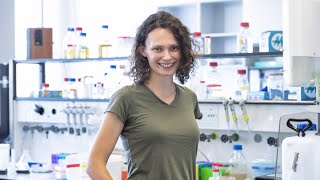
In this seminar‑style presentation, former Sarah lab PhD student Tina Perica (now Assistant Professor of Biochemistry at the University of Zurich) discusses her research on allosteric mutations and the critical role of structural context in protein function. She first describes her PhD work on a protein family that exists as homodimers or homotetramers despite an identical tetrameric interface; ancestral sequence reconstruction revealed that geometry, not interface residues, determines oligomeric state, and that multiple non‑overlapping mutational sets can drive the transition. Building on this theme, her post‑doctoral studies focused on a small GTPase that operates as a two‑state switch. By creating interface point mutations and performing high‑throughput proteomics and genetic interaction screens, she identified two groups of mutants that differentially affect nuclear transport, spindle assembly, and RNA processing. One‑dimensional ^31P NMR showed that each mutant shifts the equilibrium between two GTP conformations, and these shifts linearly correlate with kinetic parameters (GAP vs. GEF rates), providing a mechanistic link between allosteric structural changes and cellular phenotypes. Throughout, she emphasizes the importance of viewing protein function within the cellular network context. She concludes with personal mentorship lessons learned from Sarah, reflections on scientific culture, and outlines her future lab agenda centered on functional genomics, signaling biochemistry, and CRISPR‑based screens.
Chapters
So we're going to come to the last presentation, and it's Tina, who used to be in Berkeley, but I think now she's going to be speaking to us from, from her new professorship in Zurich. And, you know, it's really exciting, Tina, that, that, uh, to, to— that you've moved and that you're set up in Switzerland, and we look forward to your talk.
It's okay.
It's okay.
It's okay.
Oh, now we can see you as well and we can hear you as well.
I'm sorry about that.
Um, you know, was actually, um, kind of connects Cyrus and me and Janet in a way because you went, uh, on a Henry Welcome. You went to UCSF and had as well. Yeah.
Um, okay. Sorry about that. I cannot manage my own computer, which is a bit annoying, but I have my laptop so I can give this talk. Okay. So it's really an honor. First of all, it's kind of difficult now to follow Madan's talk, but it's really also an honor to give this talk because given how many amazingly successful people came out of Sarah's lab, giving this talk really feels like giving a talk at a very selective international conference. I mean, the quality of science today has been amazing. So today I want to kind of give you a little bit of overview about Alistairic mutations because that's one of the many things Sarah and I have in common, our love for Alistair. So I was a PhD in Sarah's lab from 2008 until 2013 at LMB. And after that, with the mentorship of Janet, I went to, as a Wellcome postdoctoral fellow, to UCSF. And now I've started my lab assistant professor of biochemistry at University of Zurich. And I've learned many things from Sarah, but one of the first and most important lessons, the scientific one, was you have to always think outside the box if you want to do exciting science. And I think the box at the time in structural bioinformatics was really focusing on when thinking about protein interactions, focusing on protein interfaces. And while it is true that it is a couple of hotspot residues that really define the energy of interfaces, it's not individual amino acids that perform biological functions, but it's the whole proteins. So Sarah and I wanted to study the importance of structural context that determines oligomeric state. And So to do that, thanks to Emanuel's database, we found an interesting case study family, a family of proteins that consists of homodimers and homotetramers, but the tetrameric interface between the dimer and the tetramer was 100% conserved in sequence. So that was a perfect example, a case study for us to study, well, it's obviously not the mutations in the interface, something else that has led to this difference in oligomeric state. And working together with Cyrus and Sarah, we found that it's actually the difference in the geometry of the dimer. So, the dimeric protein had the same interface as the tetrameric one, but it had a different geometry which was not compatible with the tetramer formation.. And then what I've done is I went to Jane Clark's lab and did experiments, and we did ancestral sequence reconstruction to try and kind of map the, really, the sequence changes, the mutations that occurred during evolution that led to this difference in oligomeric state. And we found two very interesting things. First was that this conformational change really mimics what happens functionally with the protein as it's performing its cellular function. And second thing, which was very surprising at the time, and I think it's still a surprising result, is that there are actually multiple non-overlapping sets of mutations that could lead to this difference. And I think Joe has mentioned this morning how Sarah's ERC proposal was not funded. And if I counted correctly, it was 3 science papers and 1 cell paper that was published out of this unsuccessful proposal. So watch it, that's what happens when you make Sarah angry. And so for my— so it's basically our main finding was that is, it's the it's the context of the rest of the protein that really determines whether this helix is an interface or a surface in the protein. And for my postdoc, I kind of stayed with the theme of the importance of context. And so there I focused on this question of protein function and how do we think about it. So protein function is actually a combination of its molecular mechanism that we can study biochemically in a buffer, but it's also this molecular mechanism is embedded in the context of the entire cellular network. And as you can see, this way of thinking was really influenced and shaped by being trained by Sarah. So, for my postdoc, I again found a very interesting case study of a small GTPase protein that exists in two states. So it's a very simple two-state switch, but that nevertheless performs many, many very essential roles in the cell. So it's very normally very difficult to study such proteins with classical tools of reverse genetics, because if you delete such such a gene, you have really deleted all of its functions at the same time. So my idea was to try and make mutations that will perturb individual functions of this protein and study them one at a time to try to kind of deconvolute how can one, one two-state switch regulate so many things in the cell at the same time. And I've done that by by making point mutations in the interfaces of these small GTPase and then doing a lot of proteomics and genetic interaction screens. And now to kind of crunch a lot of data, of a lot of genetic interaction and proteomics data, this is basically the main result that we found, is that we found two groups of mutations. So one group of mutations was having phenotypes that were similar to the deletions of genes that are involved in nuclear transport and genes that are involved in cell cycle regulation, so spindle assembly regulation. And the second set of genes were— the second set of mutations were similar to the deletions again of the genes involved in nuclear transport but also genes involved in RNA modification but not genes involved in spindle assembly regulation.. And as I said, these mutations were interface mutations, so they were nowhere close to the active site, they were nowhere close to the canonical switch 1 and switch 2 regions of these GTPase. But I couldn't— no way how I kind of analyzed the data on the proteomics or the genetic interactions, I couldn't really explain these two sets of mutations by trying to group them by in which interface they were. And so, remembering my PhD training and the importance of allosteric proteins, I then checked, well, do these mutations, although they're on the surface and far away from the active site, do they actually allosterically affect the kinetics of the GTPase switch? And now, to not show you a lot of biochemistry that I've done, the answer was yes, actually all of them. And to paraphrase a great biochemist, John Currien, if you're studying proteins and you don't see any allostery, you're not doing a very good job. And so most of this work during my postdoc was a lot of high-throughput genetic interaction screening and proteomics, but actually to really look at the details of of the aloe steri, we used a very simple structural method, which is actually one-dimensional NMR. So it's something you don't really even need a computer to analyze the data. So with 1D NMR, what you can see is you can measured the spectrum of phosphorus, and there's only 3 phosphate atoms, phosphorus atoms in the protein, and those are the 3 phosphorus atoms from the GTP. And you can see that the alpha and the beta phosphorus, we can see one clear peak, but the gamma phosphorus is always split into 2 peaks. And that is because the GTP bond conformation is actually 2 subconformations, One is the active signaling conformation and the other one is the one that's primed for GTP hydrolysis. When we've recorded this spectra for our mutants, we could see that we can really titrate between those two conformations with our mutants, from mutants that are 100% in this gamma-1 conformation to the mutants that are 100% in gamma-2 conformation. When we plotted this simple NMR spectra against our kinetic data, we got a perfect linear correlation. I mean, this looks really like something that you could put in Alan Furst's textbook. But so to now go back to our phenotype, so we have these two groups of mutations, and can we explain now these two groups with the GTPase cycle parameters? And the answer was yes. So basically, the Group 1 mutations were all the mutations that allosterically slowed down the GAP part of the cycle. And the group 2 mutations were the ones that allosterically slowed down the GEF part of the cycle. And so, but it seems like for the nuclear transport role of these GTPase, both sides of the cycle are important. So, it's actually the cycle balance that defines the cellular function of nuclear transport. And so kind of this really answered to me, at least contributed to the really fundamental answer, is how do you— how can you have one simple switch protein that regulates so many cellular processes at the same time? So one is we shouldn't forget about the allosteric. So we kind of think about this switch that switches between two states and then it binds all these all these downstream effectors, but it's actually the interfaces with these downstream effectors also have small steric effects. So, a two-state switch is actually a very complicated switch. And the second thing is, well, yes, we think about this as a two-state switch when we think about it biochemically, when we think about it in the buffer, but actually when you put it in the context of a cell, different other cellular processes can sense one switch in different ways. So, for nuclear transport, this one switch is sensed as a kind of a balanced cycle. For the spindle assembly checkpoint role, it's actually sensed as an off switch. And for RNA processing and some other processes, it's actually sensed as an on signal. And just to end this talk, I want to share with you some top lessons I learned from Sarah. When I was her student. First lesson is it's really okay to be overly excited about cool results. Like, don't ever forget that. It's not, it's not weird. Second really important rule that I've learned is that you just— some people are just not worth listening to, and you should kind of be careful whose advice you're taking. And third one, I think a lot of people have mentioned this, it's always be kind to everyone, and I think with Sarah, it's really clear that kindness is not something passive. Kindness doesn't mean like don't do anything wrong. Kindness really means kind of reach out to people and be active and speak up when something is wrong. The fourth thing is make sure you always end your talk with 3 take-home messages, so oops, this was my fourth one. And of course from that follows the fifth one, which is you don't always have to follow rules. And so yeah, I would like to thank you. And of course, Sarah, I think you gave birth 6 days to Maya, 6 days before my PhD interview, and I think I only had 15 minutes and you asked me a bunch of questions.. And I think I answered them. And many times I thought, I'm really happy that I didn't like freeze and mess up that interview because those 15 minutes really changed my life. And a lot of people, many of whom are here, Madan, who was really there for me when I was looking for postdoc positions and when I was looking for faculty positions. And then I will just I'll stop reading down this list because I will get too emotional.
Thank you all. Jane, Jane is here too.
Oh, Jane. And I think Janet is here too, and Natalie. Janet is on Zoom. Okay, good.
Jane is physically in person.
Hi, Jane.
Hi, lovely to see you. Yeah, it's true that I think it was a week or 10 days after I gave birth to Maya that I went in and did Tina's interview. And when I arrived, I realized that I had my slippers on because I took a taxi because I wasn't walking very comfortably. I took it— or cycling. Cycling was just out of the question. And I arrived and I realized I had my slippers on and I just put them on the table. She didn't seem to notice. They were the Birkenstock type, but it was the middle of the winter or like January.
Yeah, yeah. But yeah, I know, I noticed you had sweatpants on and they were ripped in the back. That's what I—
Too much information, guys.
Too much information.
No, it was great. Questions for Tina?
Allosteric mutations.
I will— I'll connect my computer and I'll finish up. I mean, the crowd who's here, Tina, the crowd who's here in person is not too expert on the allosteric mutation and kind of 3D structure front from, you know, the people from my group nowadays. But there are people on the Zoom who should be able to— Okay, so Jane wants to know what are your plans for your own lab over the coming years in broad terms?
Yeah, I'm gonna keep doing functional genomics. I'm gonna keep doing genetic interactions and really ask these questions: how do you have these simple biochemical mechanisms and how do they encode complex complex phenotypes. So a lot of signaling, a lot of biochemistry of signaling molecules, and a lot of CRISPR screens in my future. Was that good enough, Jane? I'm sorry.