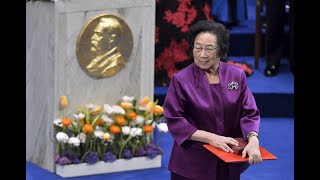
In this extended Chinese-language lecture, Nobel laureate Tu Youyou recounts the 40‑year journey that led to the discovery of artemisinin (qinghao) as a breakthrough antimalarial drug. She begins with her personal academic background and her appointment to lead China’s secret 523 anti‑malaria research project in the late 1960s, describing how traditional Chinese medicine texts were surveyed to identify candidate herbs. The talk details the systematic low‑temperature ether extraction method she devised, the chemical analyses (elemental, spectroscopic, and crystallographic) that revealed the peroxide‑containing sesquiterpene lactone structure of artemisinin, and the subsequent pre‑clinical animal studies that showed 100 % cure rates in mice and monkeys. Tu then outlines the early clinical trials in China, the rapid scale‑up, and the drug’s registration by the Chinese Ministry of Health, followed by WHO endorsement and global adoption that saved millions of lives. She acknowledges the massive collaborative network of Chinese institutes (Academy of Traditional Chinese Medicine, Institute of Materia Medica, Shanghai Institute of Organic Chemistry, etc.) and international bodies (WHO, World Bank, UN). The lecture also warns of emerging artemisinin resistance in the Mekong region and Africa, describing WHO’s coordinated action plan to preserve ACT efficacy. Throughout, Tu emphasizes the synergy between traditional Chinese medicinal knowledge and modern scientific methods, the importance of interdisciplinary teamwork, and the cultural pride of turning a centuries‑old herbal remedy into a Nobel‑winning, world‑saving medicine. The talk concludes with gratitude to colleagues, supporters, and a poetic homage to Chinese cultural heritage.