Scientist Stories: Yukiko Yamashita, Uncovering the purpose of Genomic Junk
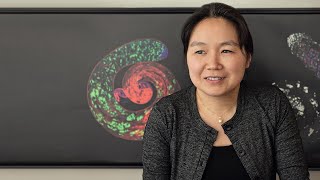
In this Whitehead Institute webinar, host Ankur Jain introduces Yukiko Yamashita, who presents her lab’s research on satellite DNA—formerly labeled as "genomic junk"—and its essential role in chromosome organization. Yamashita explains that satellite DNA, a highly abundant tandem repeat (e.g., AATAT), forms chromocenters that physically bundle all chromosomes together via the D1 protein, a DNA‑binding factor that bridges repeat sequences. Loss of D1 disrupts bundling, leading to the formation of micronuclei and germ‑cell death. The work extends to hybrid incompatibility: divergent satellite repeats between closely related Drosophila species (melanogaster and simulans) prevent proper chromocenter formation, causing sterility and lethality in hybrids, suggesting a mechanism for speciation. Yamashita discusses evolutionary dynamics of repeats, the difficulty of sequencing and manipulating repetitive DNA, and the presence of D1 orthologs (e.g., HMGA1) in mammals, linking chromocenter dysfunction to micronuclei formation in cancer. The Q&A covers visualization methods (DNA FISH), the proportion of junk DNA involved in bundling, cross‑species protein rescue experiments, variability of repeats, and broader implications. The talk emphasizes that satellite DNA, though non‑coding, is functionally critical for nuclear integrity and genome stability.
Chapters
Welcome to today's webinar, Seeing the Whole Blueprint: Uncovering the Purpose of Genomic Junk. I'm Ankur Jain. I'm a Whitehead Institute member and an assistant professor of biology at MIT, and I'll be your host and moderator for today's event. Today's webinar is the second in the series of talks that we have organized at the Whitehead Institute to share our science with the broader community. Our topic today is Seeing the Whole Blueprint: Uncovering the Purpose of Genomic Junk. And in a few moments, we'll hear from our presenter, Whitehead Institute member Yukiko Yamashita. She'll highlight the ways in which fundamental research that is being done at Whitehead brings novel biological processes to light. And she'll introduce us to her lab's latest research on the function of satellite DNA, which had long been regarded as genomic junk. Before we get started, a couple of logistical reminders. This webinar is being recorded for future viewing. Yukiko will also be fielding questions towards the end of her talk, and you can submit your questions at any point by using the Q&A box. With that, I would like to introduce Yukiko Yamashita. Yukiko is the Susan Lindquist Chair for Women in Science at Whitehead. She is a professor of biology at MIT and an investigator with the Harvard Hughes Medical Institute. The Yamashita lab studies the process of germ cell development, a process that is critical to the continuation of species. Yukiko earned both her bachelor's in biology and her PhD in biophysics from Kyoto University in Japan. She conducted her postdoctoral research at Stanford University And prior to joining us at Whitehead, she was a faculty member at the University of Michigan. Yukiko has earned numerous very prestigious awards, including being named a MacArthur Fellow, a Searle Scholar, and she— as well as grants from Keck Foundation, Niagara University, and the American Society for Cell Biology. With that, I'll hand it over to Yukiko. We are looking forward to learning about your work.
Thank you very much. I have to share the screen first and then this way and then get it. So is this okay? Yeah, thank you very much, Anca, for the introduction. And then really, you know, hi everyone, and I'm really excited to present, you know, what my lab is doing right now and kind of Yeah, and then, well, so I want to give you some sort of, you know, the size and feel more than the detail of the data or that kind of things. And especially, like, how to say, my hope today is to convey this, you know, excitement of exploring into really uncharted territory. And hopefully you can see that, you know, that you can't really prescribe what you might discover. You have to just go with it. And that, but that gives you so much you know, the joy along the way. So today, you know, I'm going to really tell you about, you know, functional junk. What is it, right? So I think, you know, the one, you know, why I decided to study this is I often, you know, one sort of misperception I encounter often is this, you know, with the genome sequences, we have human genome sequence, Many people feel the world is like this. We have blueprint of everything, every single tool, and we know how it works, etc. That means with the CRISPR technology, for example, these days, if you find any mutations in any patients, now you can fix it right away because we know exactly how it works. But I'd like to say that's actually the big misperception. Because, you know, if you look at all those, you know, the blueprint of our, you know, the genome, oftentimes we find something like this, you know, something that looks like a tool, but you don't know what it is at all, right? And then if you find, if, you know, you find a mutation or some sort of variation in that kind of tools of unknown function, we as a whole community, as a society, or the medical field, we will have a harder time to really see if that is really causing certain, you know, the symptom of the disease, or it's just a harmless variation. So you started with this, whatever the tool of unknown function, let's say you find a variation in a patient. Something like this, is it bad or it's okay? Or something like this, you know, those things are, you know, in half. Is it bad or, you know, it's okay? Or it comes in a different color, is it good or bad? It's really difficult to judge, which is really in contrast to the situation where we know the function of the tool perfectly well, such as screwdriver. So in this, you know, in case of screwdriver, we know exactly how it works. That means if you see a mutation, something like this, you know, the tip of the screwdriver is chopped off, we know it's not going to work. So that means we have to fix it, and then we probably know how to fix it. But, you know, because we also know how screwdriver works, it comes in a variation in the colour of the handle or a little bit of slight difference in the shape of the handle, we know this works. So this variation is not going to affect anything. So now let's go back to this mysterious tool. How can we judge any variations, bad or good? So for that, you need to understand the mechanism of action, how this is really functioning. And then to just give you the answer for this particular tool, this is how it works. Actually, you can actually pop it up. And this is actually the portable, you know, coffee dripper when you want to bring your coffee to the outdoor activities like camping. So now finally, when you understand the mechanism of that tool, how that tool works, now you can tell the color variation, this blue one, is totally okay. It's not going to interfere any of the functions of coffee dripper. If it's in half, probably it's not going to work. You have to find a way to fix it if you want to have coffee. If you have a big hole in the middle, but what now that you know what it is, probably if you can put the, you know, coffee filter or maybe two of that, and then if you know to, you know, just slowly pour the hot water, probably this is workable, right? So this is one thing. And then, you know, in studying the all sorts of, you know, the going into the mechanism of, you know, how life works, we use Drosophila in my lab. And if you look at this fruit fly, often, you know, I also get lots of questions, why do you study this tiny insect? You know, is that really useful at all? You know, the Drosophila was established as a model system by this famous Thomas Hart Morgan. Without him and his colleagues' contribution to the field, we wouldn't know that all those genes, which is an element of the inheritance, are on the chromosomes. Also, many genes involved in cancer were first identified in Drosophila. So, you know, the, you know, demonstrating the, you know, the importance of the model system. So, my view of using Drosophila is something like this, you know, to, you know, to understand, you know, how, you know, the Lego house is built, you can start with a little bit of, you know, that you want to start with a little bit of simplified version of it, something like this, before you can go into way much more complicated Lego castle. Really important aspect of it is, you know, both of these, you know, the tiny Lego house or ginormous Lego castle, are both made of the same unit, such as cell. So by understanding smaller version, now I think, you know, you can actually get the much, you know, the better picture of how more complicated things might function. Okay, so I just told you that our genome is full of tools. Of unknown functions, right? That sounds bad enough, but if you look at the actual whole genome of our human chromosomes, things are even worse, because these, all those tools of known function and unknown function only goes to 20% of our genome. So the remaining 80% are mostly considered as junk. What does that mean, right? Okay, so let me explain what is junk. So this is the, you know, the micrograph version as well as cartoon version of the chromosome on which our genes are on. You know, these are made of, you know, the DNA and the protein complex, and then that contains all of the blueprint of our life. So, and all those, the genes typically that, you know, the code for the blueprint for, or, you know, the recipe for the protein or tools, right, typically on this blue, you know, the light blue area. But you see tons of, tons of, you know, the area that doesn't have any, you know, the so-called coding capacity. So these, sorry about that, this area often occupied by so-called satellite DNA, which is a tandem repetitive DNA, for example, AATAT sequences repeated a million times for megabases, of the DNA sequences. And these, you know, the satellite DNA is really ubiquitous and abundant, can be more than 50% of the genome depending on the species. Despite this abundance of ubiquity, this has been typically regarded as junk because it's non-coding, meaning it doesn't produce any proteins. So, if you look at the, you know, the language of the DNA, it really looks like gibberish. So, that's why this, you know, the satellite DNA has been regarded as, or disregarded, as junk. So, several years ago, you know, I and my former postdoc Madhav Jagannathan, you know, when he started, we sat down and said it doesn't make any sense, 80% of our genome is completely junk or useless. That's how we decided to study this, and that was the only, you know, can't be completely useless, that was the only motivation for us to start this. So, then since then, what we discovered is this. So, in that, you know, this is a typical, you know, that any, you know, cells contains the multiple chromosomes, right. But then, you know, these chromosomes as a shape only appears in, you know, only certain phase of the, you know, when cells are only getting ready for the cell division. But in real life, these chromosomes are more, you know, doesn't have a shape and then just packaged in the nucleus. And when that's happening, people have known this satellite DNA kind of associated with each other from the monotypic chromosomes. And this aggregation or clustering has been cytologically defined as a chromocenter. This presence of chromocenter as a structure, cytological structure, has been noted like almost, you know, 100 years. But, you know, its function has not been known. So, what we found is— okay, sorry, and this is actually the other version of the chromosome you can see over here. And, you know, this blue shows all those chromosomes, you know, that when cells are getting ready for the cell division, and these magenta or red decorating the chromosomes, these are the specific start and end DNA segments, in this case AATAT repeats.. And if you look at the individual chromosome, you see many spots, right? But in a real cell, you see the same, this, you know, the regular sequence comes into one spot like this, you know, over here. So this, you know, that represented this, you know, the clustering of the chromosomes. And we discovered how this is, you know, that this chromosome centre is formed. We found a protein called D1, and it So, and then this protein has the ability to bind to this AATAT sequence and then bring multiple AATAT-bearing DNA together to, you know, to bundle many chromosomes just like a barrel growl. So, and then, you know, as you can see here, DNA strand is over here and over here, and the D1 can just bridge them together. So that means in the absence of D1 protein, you cannot bridge the chromosomes together. And then this is what you see. Over here. Now, instead of having one major, you know, the clustering over here of the AATAT, the mutant which cannot cluster this DNA, AATAT DNA, have multiple AATAT spots like this. Okay, so then the next obvious question is what do chromosomes have to— why chromosome has to be bundled, or what's the function of a chromocenter, right? And then if you mutate this D1 protein to disrupt the chromosome centromere formation or chromosome bundling, you lose the cells a lot. So this is a control situation. This Drosophila testis contains lots of germ cells, which is a precursor for making sperm. And in the control or wild-type situation, you have many, many cells showing green over here. But the mutant, quickly lose cells. So, that means at least that told us this protein or chromosome bundling is important, right, because cells are dying. But why cells are— how cells are dying? Without knowing it, the only conclusion we can make is, yeah, this gene is important, period. So, but we are kind of, you know, stuck over here. Like, this is important, but how this is important, why this is important, we didn't know. And either we had, you know, this is, you know, the research, you know, unprescribed research. We are really stuck about it, yeah. And we don't understand why this is happening, how this is happening. And then, you know, Madhav and I was, you know, staring at the, you know, this image for a while, actually during our meeting, I believe. And then we were just staring at it. And then one moment we realized, Ah, what is this? I don't know if you notice, here's a black spot, which is not green, right? So, and then we started wondering, what is this? Why there is some sort of, you know, the dark holes over here? What does this mean? And then when we saw this, now we thought we might have an answer, which turned out to be the case. So, it turned out to be it's a small nucleus. You know, in control situation, you know, each cell have just one nice round nucleus, which is shown shown in green over here. All DNAs, all of your chromosomes are, you know, encapsulated in one nucleus by one envelope like this, you know, in a sac of nucleus. If you don't bundle the chromosome, what you see is, you know, some chromosomes start coming out of this nucleus to form its own tiny nucleus like this. And it turned out this was the reason why cells are dying. Right, based on these data and some other, you know, a little bit more detailed data that I'm not going to show, so we came to this, you know, idea. Okay, so the chromosomes are typically bundled by chromocentra like this, and then as I told you, this— so for to bundle all those chromosomes, you need this, you know, the protein that can, you know, bring all the DNA together by binding to saturated DNA, which is the D1. And this bundling of all those chromosomes is likely the reason how cells can encapsulate everyone in one nuclear envelope. In the absence of this bundling, now individual chromosomes are free from each other, they are not anchored to each other. So now individual chromosomes start floating out of the nucleus to form its own micronuclei or nucleus, so then this actually leads to the cell death. Okay, so that based on that, you know, we want to really propose junk or satellite DNA is actually not really junk. It's a critical constituent of the chromosomes to form a single nucleus. So let me just recap conceptually. So we human beings have 46 chromosomes, right, and that all, you know, that together, you know, they encode the whole blueprint of our life. So that means all of books, or all those blueprints, has to be in one place, which is that nucleus. Everything, all those information, has to be in one place. This is very much like the situation where you have to put all the volumes of encyclopedia in one place to have full information. So then, in case of the chromosomes, this, you know, the putting all information in one place, it's done by physical linking of the chromosome, all those books together, just like a bookshelf, you know, in a nucleus. Envelope, you know, does encapsulate all those chromosomes. And this bundling, or, you know, the gluing, is done by a protein called D1, just as I told you. Okay, so that means, right, that people thought, oh, satellite DNA does not have its, you know, the content information. You know, if you go through the page of encyclopedia, you know, that this satellite DNA does not participate in that part. Instead, you know, it's not— it doesn't have content information, but it's critical to contain the information very much like a book spine, or, you know, so that you know which books to put together into one place. So now in the last few minutes, I want to spend just a little bit of time, you know, how we are going with this information. And then again, you know, I want to kind of illustrate how, you know, I'm the prescribed research might go. So finally, when we convinced ourselves that the satellite DNA is not junk, we had to face one interesting, well-known fact, which is the satellite DNA is actually highly divergent between even very closely related species. So that is true between, for example, human beings and the chimpanzee or gorilla, the coding sequence or the non-junk part of the DNA is very much similar, but a satellite DNA is very much different between those two species. Same things are true with Drosophila melanogaster. That's our laboratory, the model organisms, and its sibling species called Drosophila simulans. And all those different satellite DNA is shown in a different colour over here on the chromosome. And then you can just, you don't have to know what it is, but just the colour difference tells you melanogaster and the similans don't have any, you know, I mean, don't have much similarity. But, you know, as an insect, they look very much the same. And if you, somebody bring one fly to me, is this melanogaster or similans, I won't be able to tell. You know, the melanogaster and the similans are very much alike. And then they, you know, most of the genes are very much the same. So, but now, okay, let's think about this. Those two species have very different satellite DNA, like, you know, depicted in, you know, the blue or greenish, you know, satellite DNA versus orange satellite DNA. If you make a species hybrid, meaning you mate Drosophila melanogaster with simulans, so they are that close, they can mate, they are that close. But then they bring in two kinds of chromosomes together, right? This is very much the situation when you have one set of encyclopedia and you have a completely different second set of encyclopedia. Their contents, if you probably go through each entry, each content of these two encyclopedias, I'm sure you can find very similar information. Content is very much the same, you know, no matter which country you live, you know, our knowledge and, you know, all those, you know, things are pretty much the same. But they are those, you know, the information is bundled slightly differently. So that means they are not exactly the same. So, is this a problem or not? So that became our idea. So, okay, so you can cross, as I said, melanogaster with C. murans. If you do so, the hybrid, the, you know, the progeny of this crossing would be, you know, the hybrid female, you know, the daughters are sterile, and then sons are dead. And if you look at this female, sterile female, they barely have any germ cells, that's the egg precursor cells in their ovary. So, this is how it actually looks like. And over here, I'm showing melanogaster, just a pure species ovary, and these blue cells over here, like there's probably tens, you know, 30, 40 of those cells over here, this is a precursor to generate the eggs. Of this melanogaster, right. On the contrary, if you make a hybrid, they still make an ovary very okay, but these bruise cells, you know, these egg cell precursors are very much reduced. And eventually, by the time this, you know, the ovary fully develops, all those germ cells are pretty much gone. Okay. And then, but we wanted to take a look even a little more, you know, the closer look. So, okay, so here's the idea, right? If you look at the pure species, all nucleus contains all the chromosomes with the compatible satellite DNA like this. So that means these chromosomes can be bundled completely okay. That helps to contain all information, all volumes of encyclopedia into single nucleus. That's how you see very nice, you know, that the, you know, the nuclear envelope that's encapsulating all the DNA in it. Here is a situation, it's a pure species, but you, you have, you know, the protein, you know, the bundling protein mutated. In that case, you cannot bundle the chromosomes, then you end up with having micronuclei, because, you know, now, you know, all those books are scattered. So that's how you see the micronucleus over here., right? Now in a situation of a hybrid, now you have two sets of the books that is not quite compatible, which we thought. So maybe these, you know, the chromosomes with the same saturated DNA might be bundled. We don't know, but, you know, we guessed. And then, you know, these orange saturated DNA-containing chromosomes may be bundled okay, but can they bundled together or not? That became a question. And indeed, as we suspected, in hybrid situations, those, you know, the germ cells, egg precursor cells have tons of micronuclei like this, you know, that there's a big nucleus and some other nucleus over here and the smaller nucleus like this, meaning, or, you know, to us, this suggests that, you know, that they failed to bundle chromosomes as this cartoon indicates. Okay, so now I think, you know, we are coming up to this idea, this might be a reason why hybrid cells are not happy. And then, you know, the chromosomes from two species are not quite compatible with each other. And we wonder this might be how, you know, the species split into two. Just to summarise, you know, today, you know, I told you about the satellite DNA, which has been regarded as junk, junk, but our conclusion is it's not junk. It doesn't have, it doesn't contain content information, but it has a critical function to contain the contents, right, to bundle the chromosomes, right, connecting all those chromosomes for the encapsulation, you know, to put all those volumes of the books into one place together. So that's the function we think. And then, you know, the second part Now we are guessing this, you know, the divergence in the book spine or those kind of meta-information, not the contents, might be the cause of the hybrid incompatibility or how two species get split from each other. With that, and then, you know, the actually knowing satellite DNA is not junk has opened up so much, so many lines of the inquiries in my lab. And then we, So we are really excited in addressing those, you know, the really new questions that, you know, came out of this, you know, the finding. So with that, I want to thank all my lab. And then, you know, I just joined in the middle of the pandemic, so that means we actually never get to have a chance to have a group picture yet. So this is a, you know, patchwork of the old lab and the new lab and so on. But, you know, I can't wait to, you know, for a day that everybody gets together. And to take a new picture. And I want to thank all those, you know, for the support, for funding, and then community and so on. And thank you so much, and happy to take any questions you might have.
Thank you. Thanks, Yukiko, for that wonderful talk. It's amazing. We have several questions pouring in. I'll start with the first one. One attendee is asking about what technologies do we— do you use to visualise these repeats and in general to conduct research in repetitive elements? And what are the key limitations of these technologies?
Yes, so just to visualise those specific DNA on the chromosome, it's relatively easy. That's so-called DNA in situ hybridization. So if you have, you know, the one strand of the DNA, you can design the complementary DNA that's going to hybridize with each other. I mean, you know, they, you know, adhere to each other, you know, as they form the DNA double strand. So in doing so, you can design a probe that is, you know, bound with a fluorophore so that, you know, the ATAT can be visualized in red, and then some other different sequence can be visualized in green. So that is, yeah, you know, the visualization is not that bad. The really challenging part is this repetitiveness of a sequence. That means it's really difficult to completely read those sequencing and then align on the chromosomes. So when we typically say, you know, whole genome sequencing, we typically just ignore repetitive regions. So that means even, you know, even today, the entire sequence of the repetitive region, including satellite DNA, is not really completed for most of the species. You know, for some, you know, the beetle species, you know, we started having some, you know, pretty good assembly of exactly how the beetle region might look like, but it's not complete. And they're far from knowing of all different species. Yeah. So that means, you know, it's really difficult to— if you don't know what's in there, you know, if you can't sequence, it's really difficult to go after, right? So yeah. And then we often joke, you know, that means, you know, that there's no competitor because they don't have information. The problem is we don't have information either. So yeah, it's a still a challenge. But I think, you know, so one, my one hope is, you know, that by doing, you know, our kind of research too, we can hopefully get enough number of the people get excited about this, and then more effort is put into sequencing and ideally mapping these, you know, the satellite DNA of the, you know, of the many species genome.
Yeah. Another question is, what portion— so, junk DNA is about half of the genome, as you mentioned— what fraction of it is responsible for chromosomal bundling? And are there any other functions that you hypothesise or that your lab is looking into?
Yeah, that's a really interesting question. We don't know how much is necessary or how little is sufficient. And that is also related to this difficulty of, you know, first of all, difficulty of reading and completely assembling the sequence information. And without that, it's really difficult to manipulate those sequences. So, for example, you know, now, you know, that we have so much technology of editing the DNA, but if that's a, you know, the target is a unique sequence, you can precisely go to that target sequence to manipulate whatever the way you like. But if you have same sequence repeated over and over and over again like this, you just cannot, you know, manipulate this repetitive DNA so easily. So I think, you know, that we don't know the exact, you know, the degree of how much of the saturated DNA is required to do the job that we— I described today. With that said, we do have, you know, that we find saturated DNA in other weird places, such as in introns. You know, we have been studying some really interesting, you know, gene structure. So that is, you know, the so-called coding sequence is like about 10 kilobases, but it contains the intron that spans like megabases, right, you know, it's so much bigger than the actual coding sequence. So it seems like this, you know, the genome's intron seems to have some function in gene regulation. We don't know exactly what it is. But we started, you know, tackling on that kind of question. So, you know, the satellite DNA seems to be everywhere, and exactly how they function, I mean, just so much to explore. And there's so little we know about them.
Related to that, how do different species know that they have to evolve different repeats, and how do they do that?
Yeah, so I think this is more like, I mean, they are not purposely evolving different protein or different satellite DNA. So by the nature of the repetitive DNA, So they are known to be very unstable, meaning one time you might have, you know, 1 million AAT-ATTPs. It's so easy to lose some of them. Let's say it becomes half a million. But then because you need to maintain some amount of saturated DNA because it's functional, it's not junk. So that means, you know, based on the knowledge in the field, I think it's quite conceivable whatever the satellite DNA has, you know, this fluctuation of, you know, the shrinkage and the contraction and the expansion, contraction, expansion. And then this is just for the sake of maintaining satellite DNA amount, right. But then if you, when you are expanding, there is so much room to introduce a mutation. So one time you might have an AATAT repeat, when you are expanding, you made a mistake and some of the repeats become AATAC instead of AATT. Probably that is very tolerated by the cell. But if you keep doing that, and, you know, the one day, you know, you had 90% AATT, only 10% AATAC, and then, you know, whatever the years later, this percentage might flip. When that happens, you might better select the protein that also has a mutation a little bit so that, you know, that's going to better bind to the new spectrum or new composition of the saturated DNA. So I think that's how DNA sequence and then binding proteins are kind of drifting, not necessarily actively evolving. That's what I think right now. I mean, We don't have evidence, but I imagine that's what's happening.
It's a great segue to the next question. How does D1 protein recognise such a short cognate sequence, especially when the DNA is all coiled up within the heterochromatin?
Right. So, we don't know exactly, but the D1 protein has multiple DNA-binding proteins. And then this unit, each unit is known to go to a so-called minor groove of the DNA, which is AT-rich. So, we probably have to do a lot more of the biochemical, you know, analysis. I suspect, you know, that D1 has a probably broader binding spectrum instead of AT-AT, you know, for example, maybe AAT, AAAT might be okay, for example. Yeah. But I— so how it's going to recognise exactly, you know, the sequence or some aspect of the DNA structure that, you know, we don't have a full understanding of it yet.
Yeah. Another question is, what happens if you express the similar Simulans D1 in melanogaster?
That's a good question. We do have, you know, the data we have been getting. Yeah. So, if you just express D1 protein from C. mirans in the context of the melanogaster, and nothing, I mean, it looks okay, they look happy. We actually tried to deplete it, meaning, you know, you, you, you, you you know, the melanogaster D1 mutant, that means melanogaster doesn't have its own D1 protein. And then you try to rescue that mutation by, you know, the similar D1G, it doesn't work. So that's, you know, that's pretty exciting. That means, you know, that they are, you know, the, you know, the detailed mechanism of the function, exactly how the protein interact with other protein and so on, is not quite the same between those those two species. And I suspect that also contributes to why, you know, these two species cannot hybridise.
There are several questions relating to are there any homologues of T1 proteins in mice and humans? Yeah. Are there any mutations in those proteins that cause diseases?
Right. So, I probably should know better about the mutation. I mean, the disease-causing mutation, I don't know. We don't have, you know, the complete, you know, the homologue with a high sequence similarity with D1. But based on the structure, you know, it's believed that it's the functional ortholog is the so-called HMGA1, which is also, you know, have, you know, AT-rich binding you know, the domain, and so on. And then, so that, you know, we have shown at least in the mice cell, we haven't done anything with the human cells, but in the mouse cells, this HMG1 has exactly the same function as D1. If you mutate, you form the micronuclei, you know, that they are localizing to the chromocentra, and so on. On top of that, you can actually even overexpress Drosophila diva in the mouse cells, and that has the ability to bring, you know, the chromosomes together pretty well. I mean, I don't think it can replace the function of HMGOM, but diva actually facilitates the bundling of the mouse cells.
Several more questions coming in. So, there should be a— this one immediate follow-up from the speciation hypothesis would be that there will be strong correlation between the emergence of these different repeat sequences and the corresponding binding protein, the D1 binding protein. What mechanism would assure this co-emergence?
Right. So, okay, this is— sorry, this is a really out-there answer. You know, even less, you know, the real evidence. Yeah. But I mean, not D1, but we have another gene with a very similar function as D1. And, you know, how to say, they are kind of, you know, the partner, do the similar things, you know, they're dealing with a different satellite DNA sequence, but bring all those satellite DNA together. So, in that situation, we have actually the one gene that clearly goes to, you know, the bundle of the chromocentra. And then there is a gene duplication event right next to it. And you have exactly another sister or sibling genes right next to each other. And then one is way more divergent than the other. So, and then we have a suspicion So, together these proteins might be adapting to bind to the diverging satellite DNA.
Yeah. Related question to that, is the D1 protein same across all individuals of the same species, or is it divergent within the species itself?
We don't know. You know, I mean, I think we kind of did, again, a little bit of, you know, the sort of experiments, you know, that we thought that's interesting. And we specifically sequenced the D1 gene from so-called Barrançac chromosome. Sorry that it's a little bit too technical, but that's a Drosophila chromosome that's not allowed to decombine with other chromosomes. So that means any genes in the Barrançac chromosome is essentially trapped On top of that, you know, those balanced chromosomes tend to have a little bit of different saturated DNA contents. And we thought, okay, maybe that gene might be, you know, the D1 might be evolving. And we didn't do anything thorough, but you know, when we sequenced a little bit of those balanced chromosomes, D1 didn't have any variation at all, unfortunately.
So these repeats tend to be highly divergent, they are unstable. Do we know what's the variability across different cells within a single organism?
Yeah, I mean, that's another really good question. If you look at the just saturated DNA of the different strains of S. cerevisiae, and I mean, I said even protein is not different at all. But then, you know, the target DNA sequence has a little bit of variation between the different strains of Drosophila melanogaster we already know. And then within an individual, I think, you know, I mean, I think they are decently stable. But, you know, because the destabilization tends to happen during aging. So, I mean, that's, you know, I mean, that's another interesting possibility. As you get older, you might lose the, you know, the repeat number, and then next generation you might have to bounce back. So, but so far we haven't detected, you know, the visible difference. But again, you know, the minor copy number change, I don't think we can detect for the reason we discussed the area that you can just sequence so that you cannot precisely get to the copy number or anything. If you lose the copy number by half, you can see it. But if you're losing by 5%, which is substantial in terms of the timeframe of the evolution of the generation, but that 5%, I don't think we have ability to to detect that difference. So I think that's actually one major, you know, the bump right now for me, for us to address this specific question. So if you are interested, whoever asked this question, yeah, I mean, if you have any good idea, yeah, let me know.
Yep. So another question is in the hybrid species, hybrid experiments, when you see these micronuclei, are there two different types of micronuclei? The chromosomes from one species go to one kind and the other—
So, it actually doesn't look like that way. You know, the my cartoon was admittedly a little bit, you know, misreading, just to, you know, conceptualize the, you know, the— I mean, visualize the idea. We know when, you know, chromosome formation doesn't work, all chromosomes are affected equally, and then you just, you know, the ability to bundle anything is compromised, actually. So that, you know, we guess that there's some sort of, you know, the biochemistry of the protein within a cell is making that way. So that means when we see the micronuclei, it's not necessarily any specific chromosome or any specific pattern we can discern that, you know, Yeah.
So just to clarify, because there is another question relating to it, so you don't observe— it's not the same chromosome which you always see going?
Yeah, yeah, yeah. I mean, there might be some, you know, some pattern that we haven't recognized, but no obvious patterns like that specific chromosome always go that way, or this and that chromosome are always together or always separate. I mean, that we don't see any of that kind of obvious patterns.
There's a follow-up question to a previous question. So tandem repeats are present in bacteria that reproduce asexually. What roles will these repeats have in bacteria?
We don't know. And in case of bacteria, I mean, you don't even probably have to have the mechanism to bundle multiple chromosomes, right? You have essentially one stack or that's a chromosome. So we don't know. I mean, that's an interesting question, but we don't know. But with that said, I would speculate, you know, the DPE2 binding protein could have evolved for some other purpose at the beginning, and then, but you know, the potential that could have been, you know, adapted later for, you know, the bundling of chromosomes. Yeah. But yeah, I mean, that's really interesting speculation. But so far, we don't have any direct information to, you know, to make a connection between those two.
Yeah. This is more of a clarification question. When you mated the two fly species, it's only the germ cells, it looked like it's only the germ cells that die and not the entire organism. So, can you elaborate on that?
Yes, yes. So, I only focused on that germ cells that's disappearing from the sterile female. And I briefly mentioned male oocyst. So, you can capture those males that's dying, you know, that they die as a larvae, you know, they don't come as an adult male. So, that's why they, we just call it the dead. But you can actually go back in a timeline and then look at the much earlier stage before they actually die. Their somatic tissues, non-germinal tissues are actually affected as well, that those sort of die. And then if you look into it, they have tons of micronuclei. So, cellular mechanism is pretty much the same across. That's what we feel. So, with that said, then you wonder, right, naturally you have to wonder why female somatic tissue is okay. How come those female come out as adult fly only having a problem in the germ cells? That we don't know. Why this, you know, the stereotype-specific you know, the issues arise, that's actually the big question that we don't know.
Yeah. In the light of your work, how would you see hybrid vigor? Can you explain hybrid vigor?
Yeah, that's now, you know, my new favorite question. So for the hybrid vigor to happen faster, they have to be you know, hybridizable, you know what I mean. So, you know, the hybrid, the bigger is, you know, when two parts are not divergent enough, at least they are compatible. In that situation, I can imagine they can bring in all those, you know, the good sorts of things from each other. But then once it becomes completely incompatible, they can potentially bring in good things, right, from the gene. You know, hybrid of beggars, I assume that is, you know, the contribution to the hybrid of beggars having, you know, the different genes that's coding a part. I mean, I'm, you know, I'm imagining, right, you know, the certain, you know, the, um, so, but then, you know, the saturated DNA or this hybrid incompatibilities is coming from the non-coding part. So the non-coding part has to first function. I mean, with the example of the Americana and the Britannica, right? So let's say that there's some entry that's missing from Britannica or Americana, right? If you bring both, oh, you actually increase the information. The one entry of whatever there was missing from Americana but existing in Britannica, some other words opposite way. You bring them together, you have better knowledge, right? I mean, I would say that's probably the hybrid bigger, you know, the equivalent to the hybrid bigger. But that is only possible when you still have the basic, you know, the rules of bundling those, you know, the books together. So that means, you know, the both of them comes as a bundle the books, that's okay. But I would imagine, you know, Americana comes as a physical book, Britannica comes with, you know, the DVD. You might not be able to combine the information together. I mean, you know, just as a, you know, analogy.
Yeah. All the analogies in your talk and here as well are amazing. I think just one last question is, what has been done in identifying the genes— or this process of budding of nuclei into micronuclei, what do we know about that process? I think there was a related question earlier. Can you tie it to micronuclei in cancer or other diseases?
Oh, yeah, yeah, yeah. So, previously, you know, the micronucleus has been mostly studied in the context of chromosome segregation. When chromosomes cells trying to divide and then it goes to the two daughter cells, some chromosomes are left behind in the middle. And then, you know, when they cannot completely incorporate it to the, you know, vast majority of other chromosomes, that forms the, you know, the micronuclei. So, because of this prior knowledge, when we realised, you know, the D1 mutant has a tonne of the micronuclei, we into this mitotic defect a lot. I mean, seriously, I mean, because we thought that's the answer, and then we didn't find that answer. And then when we did the live observation of this d1 mutant, what we saw is it's not a mitotic defect. You look at, you know, the interphase nucleus like this, and then all of a sudden, the portion of the micronuclei just indeed buds off. So, the molecular mechanism of forming micronuclei seems to be quite different between, you know, what we are seeing versus in, as a, you know, the study, the context. With that said, you know, in, you know, you know, related to cancer, right? So, you know, for the tumour genesis, it's suspected that the faster you form the micronuclei, inside that micronuclei, there's tons of DNA damage happens, and then that you end up mutating some critical genes and that causes the cancer. So that means, okay, if you disrupt chromocentra in a way that's not too severe and the cells survive, animal survives, and that might cause the, you know, some micronuclei to form and then mutate enough, you know, the chromosome damage and the mutation forms and that leads to cancer. That's a really interesting possibility. That's one thing actually I really wish if anybody has— this must have been super easy PubMed search. I feel ashamed that I have never done that. All those, you know, the chromocentra proteins in the mammals, are they identified as, you know, oncogene or tumour suppressors? I don't know. I haven't done any thorough literature search. I mean, that's really obvious things, you know, we should be doing.
Yeah, that's great. I think we have reached the conclusion for today's presentation. Thank you so much, Yukiko, once again for being with us here today and sharing all the wonderful insights. And thank you to all the members of the audience. Please save the date for our next webinar, which will be on June 15th, and we'll be featuring our newest Wrighted Fellow, Tobilona Olu. Oni. And until then, please take care and stay healthy.
Bye-bye.
More from Joshua







Scientist Stories: Hans Waterham, The value of phenotypic assays in peroxisomal disorders




Scientist Stories: Joel Zlotogora, Genetic carrier screening programs for reproductive purposes