This content was created by Emanuel Ruiz. This content was uploaded by Emanuel Ruiz. This is a YouTube video titled "$2,701.96/day selling this product - just copy me" (published 2025-02-28). It is a single-speaker instructional/marketing monologue by the channel host presenting an Amazon FBA case study. The presenter explains how a sub-$30 running chest pack (multiple SKUs) generates roughly $2,700/day, and provides a step-by-step playbook: define the customer avatar and pain points, highlight product features (waterproof, ripstop material, minimal design), align images/bullets/A+ content to the avatar, use reviews to validate claims, continuously monitor and A/B test click-through and conversion rates (example: lifetime-warranty ribbon test), defend against low-cost competitors by better resonating with customers, and only then scale with PPC and TikTok traffic. The speaker cites personal results (top seller in niche, ~$12M sold since 2018), offers a free training link, and asks viewers to like and subscribe. Metadata (title, content type YouTube, thumbnail, and publish date) was used to contextualize the summary.
Chapters
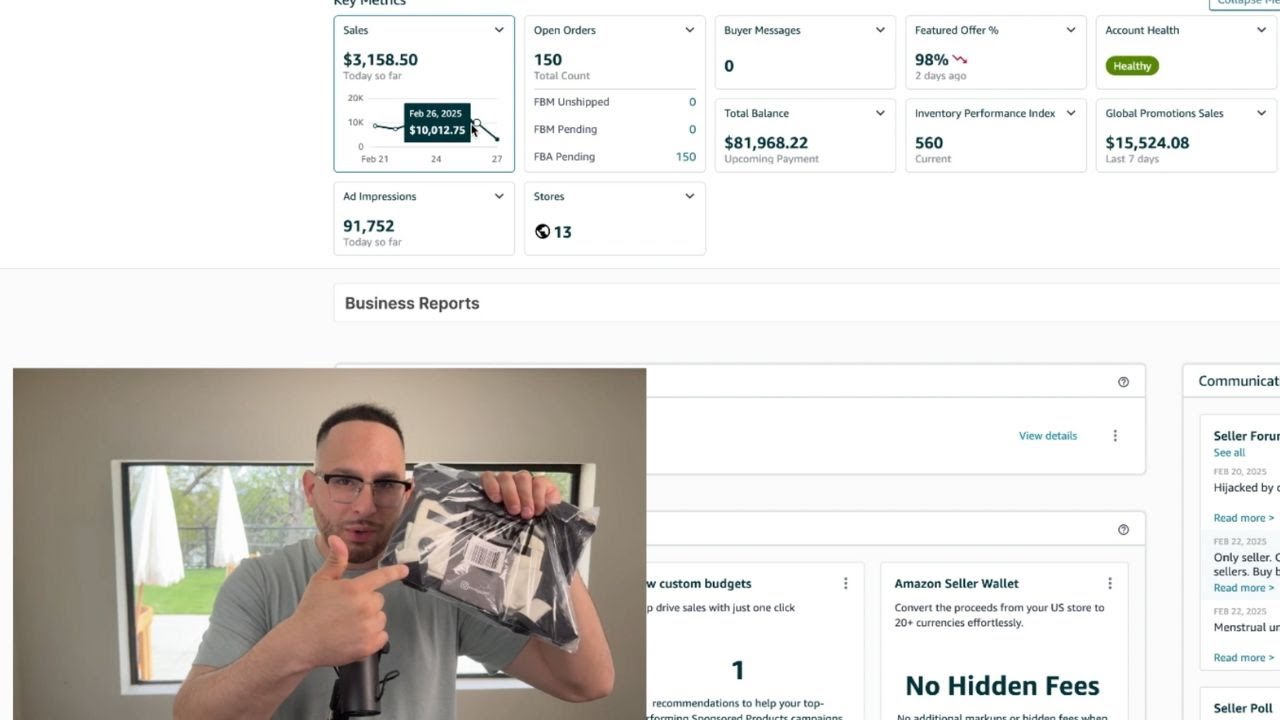
This particular product on this account makes over $2,700 per day. And why am I focusing on this product for this video? Well, I'm gonna give you the exact playbook on why it does so well. And the reason why I'm choosing that one specifically is because we're talking about a sub-$30 product. I do have other products in this actual dashboard that's a weighted vest that costs a lot of money to produce, costs a lot of money to ship. And obviously it's a higher ticket item on Amazon that sells for anywhere between $150 $250. So that's why we're not going to focus on that because most of you guys watching this video can go ahead and afford to produce an item just like this one, right? That goes ahead and sells on Amazon for right around $30-something. And if you guys want further proof, which again, I am an open book, I'm just going ahead and showing these numbers because you're getting advice from someone that's actually in the trenches. You can see this is the chest pack here. This is a different variation of that chest pack. Different variation of that chest pack, different variation of this chest pack. You get the point, right? There's 5 different SKUs, same exact product. Um, the top seller obviously does right around $53,000. So when you add everything up every single day, it accounts for $2,700. Okay. So why are you here in this video? Well, as you guys know, I don't do any edits. I just want to go ahead and give you broad view and perspective as far as, um, what I see a lot when it comes to Amazon FBA sellers and what they are doing wrong within their business. To better help them, right? Because basically what ends up happening is whenever I talk to an Amazon seller, they want to get to that $2,700 per day, or, you know, make FU money, this and that, blah, blah, blah. So they try and get to this PPC and scaling phase, which, as you can see, it's all the way down here. But most importantly, when you're here, it comes last. And why does it come last is because PPC is useless without a strong foundation. If your product listing, images, reviews aren't dialed in, no amount of PPC will fix a bad conversion rate. Once your foundation is solid, then scale with PPC, then scale with TikTok Shop, then scale to try and get as many eyeballs as possible for your product. You see, people come to this step and try and do this first without having a strong foundation, which we're going to go over that in this actual video. So first things first, what is the most important thing when it comes to selling an item? And I'm going to give you detailed analysis on this actual Product, right? So understanding your customer avatar, and I just dropped something. I don't make any edits on my videos, so I go ahead and appreciate you guys going ahead and viewing this. But as you can see, what are who is your customer avatar and what are their pain points? So what do you have to go ahead and identify first, right? You have to identify your customer avatar. Who are you targeting? You have to understand their demographics, their lifestyle, and their interest, right? For instance, this running chest pack is people that want to go ahead and run long distance. When you run long distance, you want to still be able to hold your valuables. And this allows you to go ahead and hold your valuables. And what do they struggle with that this product actually solves? So an example, pain point number 1, long-distance runners need a place to store their valuables, their keys, their wallets, their phones, their water pouches. Another pain point is market alternatives are bulky, include unnecessary hydration packs, and lack style. Again, I like to go ahead and add this because whatever there is in the market right now doesn't really compare to this running chest pack. There's obviously other running chest packs that are similar to mine, But we hone down on who the customer avatar is and we continue to go ahead and speak to them. And this is all going to go ahead and make sense. So again, what is your problem trying to go ahead and solve? That's the pain points. Okay. So what is the solution when it comes to this actual product? Well, our actual chest pack is waterproof and it has a ripstop material. It's just a fancy, like premium nylon, right? So it protects valuables from sweat and, from sweat and rain and will endure in all extreme weather conditions because runners will go ahead and run outdoors. And it can rain, it can go ahead and be sunny. It can go ahead and be raining, snowy, whatever. You guys get the point. And you also go ahead and run in different surfaces, right? You can run up in the mountains, you can run out in the street. So you want quality products to protect your valuable assets, right? So obviously we're tying this in with the actual product. Convenient access, right? Everything is within reach while running and you have a minimalistic style design. So it's practical yet fashionable for runners. Do you guys understand this, right? This is, the most important thing when it comes to your actual product. Why are you creating your product and who is your product for? Right? That's the most important thing out of anything, because once you identify your actual customer avatar, your packaging, your design, your actual listing on Amazon can all mold into speaking to this customer avatar. So that's why in this YouTube channel, we go ahead and focus on that. Right? So resonating with your customer avatar, every touchpoint must reinforce the solution. So your images show the product solving the pain points in real life scenarios, right? So your secondary images are going ahead and showing why this item is going to go ahead and help your pain points. And also what material is this? Because obviously we want a product that's going to hold all these valuables and your valuables will be safe regardless of the weather condition or regardless if you go ahead and fall, right? Bullet points call out the exact solution to your customer's pain point. A+ content visually reinforce the benefits, close-up waterproof, fabrics, easy access to the pockets. You guys get the entire point. So use these examples and implement it into your actual products to talk to your customer avatar. And this is a very detailed one that doesn't really— I can't really drive the point home more on this one. Your reviews should validate the customer's pain point. If you truly solve the problem from your customer's avatar, your reviews will naturally reinforce it. So Whenever you do look at this running chest pack and you go on Amazon, you're going to see the reviews and you're going to see actual runners talking about how easy, compact, fashionable, um, when you're running a marathon, how this can go ahead and help them carry all of the different things that they go ahead and need. So obviously we're going ahead and talking to our customer avatar and our customer avatar is leaving us reviews, actually going ahead and using the product for what its intended purpose is for. So all of this works in synergy, right? So all of this has to go ahead and tie in together. The common mistake is many sellers focus on just the product and not the avatar. This is really high quality product. Go ahead and use it whenever you go ahead and use it. You guys get the point, right? And copycats fail because they don't deeply understand the customer. And this is, this is more so with people that complain about Chinese sellers coming in there and, and going ahead and using a lower price point. And they go ahead and complain as to why their product sucks and why it fails. No. Your product is— if a Chinese competitor comes in there and undercuts your price and people are going ahead and purchasing them, it's because you haven't spoken and resonated to your customer avatar enough in your actual product listing page. Okay. So that's really important to go ahead and drive home. And another thing is like understanding your audience applies to everything, even this YouTube channel. There's a reason why I only come out with videos to specific Amazon FBA sellers. I'm not trying to cast a net of different people to watch my videos. I'm only specifically trying to make Amazon FBA videos to Amazon FBA sellers. That is why I don't have massive amounts of followers or subscribers to this YouTube channel. And that's why I don't have massive amounts of views on every single one of my videos, because I'm very niched down. But I understand that people that are watching my content obviously want to consume detailed things in their business, which is Amazon FBA. So this is why you guys watch this channel, because you know that every video I go ahead and make is to better help understand and scale your Amazon FBA business. So again, this is why this YouTube channel kind of is preaching to the choir as far as what I'm saying when you're coming out with a product on Amazon. Okay. So let's move on to like the conversion rate, right? Consistent conversion rate and click-through rate is something that needs to be monitored at all times because consistently monitor your metrics. If the conversion rate and click-through rate drop, immediate action is needed. You have to be able to A/B test different items. Example, a small ribbon in the main image with lifetime warranty significantly increased my conversion rates. Right. So let's go ahead and use that example. So one of my products here, if you viewed on Amazon, you can see that I'm consistently going ahead and running different A/B testing. And you can see here, I have this lifetime warranty. It's tiptoeing Amazon's terms of service, but I do multiple A/B tests. So I know that it is allowed by Amazon. So if Amazon allows me to go ahead and publish this image, means it is within Amazon's terms of service, but I can only find this out if I'm continuously trying to A/B test. So again, make sure you're always going ahead and checking your click-through rate and checking your conversion rate, because if anything dips, you have to be able to analyze why it happened and what you can go ahead and do to better fix it. Okay. So going back to the actual Google document, right? So key takeaways, never set and forget. Competitors will steal your sales if you're not consistently optimizing. Again, we're doing this Amazon FBA full-time, right? I make a living off of Amazon FBA. I have brands, I have products, and I'm consistently going ahead and testing. I am not going to let another competitor come steal my sales away because I'm consistently going ahead and trying to make my product better. With this actual product right here, I'm already one of the top-selling people in my actual niche. As you can go ahead and go down here, you can see that in my own category, I am number 2 right now. So there's nobody else that is ahead of me. There's one person, but obviously I go ahead and fluctuate with bestseller ranking with this other, uh, with this other brand, but I'm going ahead and I'm the one doing the testing for myself. I'm the one driving traffic from TikTok. I'm the one going ahead and trying to analyze how I can make my products better because I'm trying to be the example. And that's how you should be in your actual niche, right? You want to be able to, to figure out why someone's at the top, replicate what they're at the top. And once you're at the top, try and figure out different ways to stay there. Okay. And that comes with analyzing, going ahead and doing more research, this and that. So then and only then can you scale profitably because whenever I talk to students, the number one thing they want to go ahead and do is make more sales, but you can't make more sales and actually scale profitably unless you understand the Amazon game. And the one thing about understanding the Amazon game is understanding your customer avatar. So once you that foundation is solid, then scale with Amazon PPC. And most importantly, look, this is not my only brand. I've sold over $12 million on Amazon FBA since 2018, and we're probably going to add another $3 to $4 million to this this year alone. So if you are interested in going ahead and learning my strategies, there is a free training on my link in the bio on YouTube. So go ahead and check that out. I'll also go ahead and include it on the link below just so it's easier to go ahead and look for. But if you appreciate anything I said in this actual YouTube video, All I ask for in return is like this video, consider subscribing, because I'm always going ahead and bringing you value when it comes to Amazon FBA and scaling your business. But until next time, guys, peace.