Podcast EP 221: Meet the DEO’s New CEO and the Next Chapter in Coaching & Community
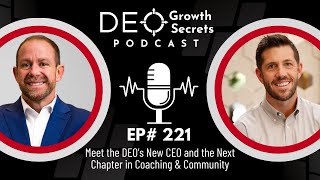
Jacob Poole, co-founder of the Dentist Entrepreneur Organization, hands the CEO role to Emmett Scott. DEO grew from 19 dentists in 2016 to 300 members generating $2.7 billion in collective revenue. They discuss the coaching model, core values like generosity and humility, and how peer learning accelerates dental entrepreneurs.
Chapters
Hello, everyone, and welcome to another episode of DEO Grow Secrets. I'm your fearless host, Emmett Scott, and today I have Jacob Poole here, owner and partner at DEO with us, the dentist entrepreneur organization. That is the podcast you're listening to right now. This is the founding guy here and oftentimes the host as well. But we have some fun news and I think some fun teaching too, Jake. That's going to be make this podcast kind of unique because this is an experience that probably many go through, successful people go through, but they don't talk about explicitly. And so I was really excited to have this as its own podcast. So thanks for being on. Of course. And let me just jump right in kind of with the first question. You know, you went from owner buying this business and really scaling it, which naturally grows into this position we call CEO. And I'm curious, just starting off, how was that journey? Because most entrepreneurs are technicians initially in something for us, a lot of clinicians, right. And then they grow into the entrepreneur space and then they start feeling these executive responsibilities. So can you kind of take us through that journey? And for you, I mean, you were really strong on marketing and sales, which a lot of entrepreneurs, that's how they start businesses. But what was that journey like for you? And. Yeah, just walk us through it.
Yeah. Excited about this announcement we're going to make today. And kind of, I think you're right. It's probably important to you, set some context. So when I came on, the DEO was kind of a thing, but not really. I met a guy named Dr. Mark Cooper back in 2016. He was like a coach. You know, he coached what he called entrepreneurial dentists. And on the side, he had started this little thing he called the Dentist Entrepreneur Organization, but it was 19 people in it. It was just on the side. It wasn't. It wasn't a real company. It wasn't an entity at all. It was all kind of under his umbrella. And when him and I met, I said, you know, we teamed up. I said, mark, I love what you're doing. I love entrepreneurs. I love dentistry. I just sold my marketing agency, a dental marketing agency, and I met these 19 people, and they were, to this day, some of my favorite people I've ever met in the world. They're so humble, so, so growth minded, so generous. And they were meeting with each other every, you know, every other week, once a month. Dr. Cooper was kind of meeting with them. And so I talked to Dr. Cooper, I said, mark, we should take this night, these 19 people and we. We should make this the. What this is. We should make the DEO the overall thing. And so we announced it at the following summit in 2017. Some people still to this day talk to me about it. We said, you know, this is now a new thing. It's called the Dentist Entrepreneur Organization. And yeah, we were 19 people. I mean, we were, you know, the equivalent of a really, really small dental office, if that makes sense, as far as revenue goes and size. And we've grown it since then over the past eight years to. We're about 300 members now. And there's a. There's a whole different energy it takes to take something from zero to one, you know, from. From like nothing to something. And that's where a lot of my energy was. Well, now that the DEO is something, right, I think it requires different skills and different people and different team setup, and it makes my skills probably more relevant in a different spot. So. So that's where we're at today is I'm asking myself, huh, what is the best spot for me with the deo? What is best for the company and who is best to lead the company into the next. The next evolution of what it might be?
Yeah. So maybe we'll give everyone the punchline and then come back to some of this as well. But you have gone from being this founder, partner, owner, and being the entrepreneur, becoming the CEO. And now just recently at our event, you announced that you're moving from CEO to Chief Growth Officer and making that move, which is really interesting. So I want to dig into that. And. And then I'm moving into the CEO role. Right. You came to me, said, hey, I think this is a better role for you to play. So that's kind of the punchline of the announcement here. For those who are involved with deo, many of them know from the event that we were just at, but as you were stepping through those different processes, what did you notice and what could you kind of tell our listeners here of what it's like to move into that CEO role? What. How it was different than being kind of the entrepreneur, growing the company type things and what things ultimately you started looking at and going, I don't know that that's what I want to do or who I am long term.
Yeah, so exactly. So that is. That is the announcement. I'm kind of moving myself into the Chief Growth Officer and then Emmett, you know, asking you to be the CEO. And I think it's an incredible move for the company. It's incredible move for. For our Team and for everyone. I'm very, very excited. And how did I come to this kind of conclusion? Well, you know, there's a few questions that I kept asking myself over and over again. One of them is, you know, what. What does the company need? You know, what. What's best for the company? And when you're going through these evolutions from entrepreneur, we call it, to executive, and let's put it in terms of what a dental office might be from. From a really small one office to a few offices, right up to, you know, 40, 50 with our coaches. Now we have maybe 50 employees. 40, 50 employees. And I think when you get to that level, you know, I noticed that my days were they went from meeting with customers all the time and building a community and texting my favorite customers all the time to. To really managing a larger team. Right. And coaching executives some, you know, and really a lot of HR and a lot of, you know, budgeting and finance and all of that, and a lot of building culture and a lot of softer skills. And so I loved all that. Right. Like, especially at first, it was really challenging me a lot. And then over time, I looked at my day and I was like, man, I was a lot more excited when my calendar was filled with meeting, like, things that grew the business, right. Or meeting with new customers or coming up with a new marketing campaign or making that really key contact that might open up a different thing for the. For the video. And so over time, I was like, man, I think. I think this growth idea is a better spot for me. And then meanwhile, Emmett, I noticed you were just, like, on fire. You were recruiting people, and the team was loving you. And, like, you're building an amazing anywhere where you were in the company, you were building this amazing culture. You were. You know, we'd have team members who were, like, doing pretty good, and then you'd start managing them, and they do, like, great. And I'm like, wow, Emmett has, I think, these executive skill sets. And so it became a natural, a natural move. And it really. I think it just became clear that was best for the company.
Yeah, I think what's really cool about this, and part of the reason we wanted to do the podcast is it's not talked about a lot because there's. Frankly, most entrepreneurs never make it successful enough to have to worry about this, if I'm just being honest. But those who do kind of feel like there's a natural progression. Progression, they can't change. And the reality is they can't. Being the owner of allows you to be any position you want. And of course we can use our idols like Elon Musk, etc, who have decided they're not going to be the CEO of companies typically. And they are, most of them use a similar title of growth officer or things like that because that's where their passion was initially was going and solving those customer related problems. Not being the chief administrator, administrator frankly of the organization. But I think it requires a level of self awareness. Right. Would you agree? And really looking back and saying, where's my unique ability and what do I want my life to be full of on the calendar? I think that was interesting that you said that. I looked at my day and go, I can do these. They do give me some level of enjoyment. But what if my calendar was full of these other things? Right?
Yeah, yeah, exactly. You know, the interesting Tthing to be 100 honest, Emma, is when, when I tell people this, sometimes they, when they respond to me, they respond as if like this was like a really hard decision or maybe I'm taking a step back or maybe, maybe I'm like, I don't, you know, I don't know, as if I've got some kind of like shame around stepping back from the leadership role. And the reality is I couldn't be more excited. Like when I think about this, I'm. My days, I'm on fire all day now because so, so just to give more detail, I'm working with our sales and marketing team. I'm working with some big initiatives within the company and I'm talking at the ground level to people who are interested in the deal and I'm coming up with new campaigns with the team. I'm managing a little bit of a smaller team. It's a quick and nimble team and we're like kind of got that hustle mentality similar to when we had 19 people. Right? It's like a hustle mentality. And I could not be happier. People were saying, well, this is so humble of you, Jay. It feels, it feels, it feels easy. It feels like an easy decision. We have members that have done this, Emmett. We have members that have moved over to clinical director and then brought in a CEO or elevated somebody. We have members, DEO members who have been with us for a while, who have elevated themselves to the board. And they're not even clinic, they're not even in the org chart, they're just on the board. So I think it's whatever, you know, whatever people want. Like this is the, the benefit of building an organization bigger than ourselves, right? It's bigger than me now. And so we have the benefit of doing this.
Yeah. Or even those who have stayed in the chair and then hired the team above them. Like, no, at the end of the day, yes, I want multiple locations or I want one super location. But my enjoyment comes with just being with the patients. And so I think just continuing to emphasize that it is somewhat of a build your own adventure, that at the end of the day you're an owner, that you're moving towards this natural progression towards passive profits. Passive profits does not mean you're not doing anything. It means you're doing the things you want, when you want, how often you want. Right. And for most of us as entrepreneurs, I would say that we want to continue to be active. We don't want to retire from life, we want to retire from certain activities. And so I was thinking back on what a bold move you made, because I remember back when you called it dentist entrepreneur organization. And combining dentist and entrepreneur at that time, now it feels so natural. But at that time, that was very bold. And I think that in and of itself was its own entrepreneurial move. Can I just ask, like, what kind of gave you the courage to do that or why did you feel that was necessary? It felt like the market definitely needed that. You know, ADA had kind of gone anti DSO at that time. And so entrepreneurs didn't really feel like they had a home there. Adso was really for the biggest players. So those emerging groups didn't feel like they had a home. So looking backwards, it makes total sense. But at the time, how did you think about that and why did you feel confidence to lean into that?
Yeah, I mean, at the time I was on my own entrepreneurial journey.
Right.
I was trying to. It's kind of this meta, you know, circular reference thing. Like, I was trying to start the deal and I had already built a marketing company and I was finding that like the biggest jumps I would make, I would just go to these masterminds. I would just go to, I would join, I'd pay a lot of money and I would go to an event or I'd go to like, monthly things. Entrepreneur Organization was example of one of them. There's one called Mastermind Talks. There's one small one called Frontier Club. I mean, a bunch of them. And I would notice like, I can read every book, I can do this, I can do that. But being around other entrepreneurs who are a little bit ahead of me was I was making massive jumps. And so it be. And I still to this day believe that Is, I mean, if you want to get in shape, to me, the first thing I would advise you is go make four friends who are in shape. Like that's it. Like it just naturally happens after that. And so I found that there was these entrepreneurs or these dentists who, they didn't self identify as entrepreneurs. But you know, looking back and turns out a lot of, I think dentists become dentists because it is an entrepreneurial pathway, right? You can set your own schedule, you can build the business exactly how you want it. And with the DSOs coming in, I think it opened up a whole nother level of, of, of possibility for the most ambitious people. And so it became natural. There's, there's these really ambitious dentists who just felt like being in one office or being in a small team, they had so much more to offer. Put them in the same room together, they just started growing. I mean, I mean we have the craziest kind of case studies of the members that started back then. Many of them are doing 30, 50 million completely out of the chair, completely haven't built a business. And it just be. It was just a natural kind of. It just, it seems so natural at the time, but, but maybe not, right? It didn't, it didn't. I didn't know what was happening. It's connecting the dots in retrospect.
Well, it shows the power of like leaning into, hey, this is what I need in my life as an entrepreneur and these 19 people need it. Maybe there's more. I'll put the flag up and see who comes. And like you said, because you did that, we now have over 300 members that have joined, representing 2.7 billion of revenue that we're now coaching with over 20 coaches. So everyone's. What's cool is with your vision, yes, it's scaled large, so now we have all that data in that community. But we've also scaled small at the same time. So every member getting their own mentor and coach, we're still keeping that kind of 19 person ratio with the coaches, et cetera. And so that initial part you said, and kind of your focus on how do we create entrepreneurship, how do we create intimacy, how do we create these little groups, big groups, et cetera, you can see that just kind of proliferating through the organization. And the last thing I'd say is since you made this move, the organization's just done better. Right. So your focus on marketing and sales has tripled the amount of members coming in. It's allowed me to focus on the fulfillment side. To make sure they're getting this better and better product. And I say that almost to give everyone permission to just be yourself. Right. We sometimes overthink the strategy to the point that we work our place ourselves in a place of misery and the business into a place of stagnation. And you just being yourself has helped grow the business and provided a product, I think, to our customers that's very unique. So, yeah, very appreciative of that.
Well, don't worry. I mean, I got a few questions for you, so you gotta. In a second. But I would say to kind of finalize that point, you know, one thing I realized is, you know, skills and strategy and all these things with like, leaders and all the books we read and trainings that we take. To me, the most important thing is that a leader comes in with energy every day. A positive. Like nothing replaces a leader that's enthusiastic and in momentum and excited. Right. Like the leader can have every communication skill or every difficult conversation skill or whatever. But if we're not coming in with energy every day and excited about the business, you're, you know, it's going to be really hard to be successful. And so that's the key is, right, each of us always have. Have to be putting ourselves in a spot in the company where we're able to come with a lot of momentum, right. Like, which is, you know, kind of gives us the energy. So at the end, that's what it is. And I'll keep asking myself that. I'll keep asking myself what's best for this business, what's best for me, which is often best for the business, because if I'm excited, the business can do well and we'll keep evolving. But another cool thing about this is, you know, you and I over the past three years have become partners. I mean, you were, you were not a partner in the business. And so as. And now you are, and now you're going to lead it. And it might be cool to kind of talk about how that became because, you know, when I was growing the. And we were at, you know, we're at 30 members, 50 members, I was getting, interacting with a lot of people. Right. And a lot of people were interested in contributing to the deal more. A lot of the DSOs made a lot of really cool friends. But over time, you know, your eyes. Partnership developed. So I guess I'm curious from your end, how did, how would you, how would you explain or tell the story of our, our partnership?
Yeah, I've always been passionate about some level of giving Back or. Not to make it too altruistic, but I enjoy mentoring and teaching, and probably mostly for my own learning, frankly, to synthesize what I've learned and try to articulate it and simplify it down, et cetera. Being in DEO not only upgraded my own thinking, but allowed me to share and seeing people utilize some of my ideas and then upgrade, that allowed me to then take from that upgrade. And I think that's the power of a group, right? You're crowdsourcing best ideas and you're leapfrogging. And so you start going through this time wormhole that you could be working incrementally, but instead you start doing exponentially. So that was the initial draw once I retired from my own DSO. You know, I'll be honest, having been the CEO of 1300 employees and 150 million in revenue and 70 locations and all that, there was a little bit of a reprieve of, like, I'm not the CEO anymore, and I just get to come in and build a great coaching platform. But having said that, there is, once you've built certain skill sets, a natural inclination to, like, oh, well, let me just lead that. And, oh, I've done that. And you and I have had these conversations where you said, I think I can absolutely develop the skill set you've had and having to scale up because it's pattern recognition and other things that we learn. But I think as a business owner, you're like, but why would I. What would be the fastest path? I already enjoy this part. You already have these skill sets. Let's just divide and conquer. And so it felt pretty natural and simple to do that. And then this is a smaller team than 1300 people. And so it feels like, in a lot of ways, easier because you've had those skill sets.
Well, I think it's cool even how we started. Maybe it's helpful for the listeners. So, you know, how did we get here? So back when the do was 19 people and 30 people and 50 people, I was always going out and looking for people who could come in and really teach our members things. And so at that time, I remember you had, like, 20 locations. You ended with 70, 77 or something. Right. And so I asked you a few times to come and speak. And so I remember the first one in Houston, you know, you. You were on stage and you spoke, and. And then I asked you to speak again, and you just. I remember one time I was. I was missing a speaker in, like, Minneapolis or something. I need some people. I called you like, two days beforehand and to fly to Minneapolis. And you did. And I was like, what is this guy doing? I can't believe he's doing this. Like, I was like, what's going on here? And you were always just operating from, like, massive generosity, helping our members. I remember you offered to have our members come in, tour your facilities, which we did twice. And so you're just offering all this stuff. And I think what you and I did, which is. Which was really smart, is we just kept working together little by little, and this taking the next logical step. So, like, when you come speak, we would say, what can we do next? Right? Or when you would. When. When you would offer your, you know, people to come come visit you, we would say, okay, what's next? I remember we. We then did a podcast together, right? Do you remember? We had your phone, and then you had that little furry microphone that hooks right into your phone. We were at your offices, and we're like, let's record a podcast and see us throw on the table. And it was one of my favorite ones we've done. And so I think. I just think it's cool. Like, that was how we've evolved, is we've just done one thing. It went really well, and then we decided, what's next, right? Almost like a. Almost like a relationship, right? We didn't dive in and get married first. We're like, little by little.
Yeah, you think big and act small, I think is a really good thing for any entrepreneur. It's fun to be visionary, but at the end of the day, taking some level of action together. And then I think what ended up revolutionizing the industry, if I could be that bold, is because of both of our natures and interest in kind of helping and creating vulnerability and openness that didn't exist in dentistry. You go on some of these forums, and even today, and it is brutal out there. You ask questions, you post something clinically, whatever it might be, and it's like chum for sharks in the water. And then there was deo, where these are the very successful individuals, like, hey, I need help here. And people are like, oh, have you tried this? I did this. I have the same problem here. You can fix it this way. And it was like, what the heck's going on? This is freaking amazing, you know? So I think we set a tone, and I think that attracted me to it as well, is like, here is a safe place. I can give all my secrets of what I'm doing, which, by the way, aren't that great of Secrets because someone has to actually execute on them. But one does and then they'll. If they're generous, they'll come back to me and say, emmett, I upgraded what you did and I'm giving it back to you. It's like an open source platform. Right. And I think that's what's now revolutionizing in D O is we are this open source business platform crowdsourcing everything from our WhatsApp groups, you know, to our training and live events, to, you know, just the ability to connect generally your coach with you, etc. That everyone's just upgrading on top of each other in a very unique way that didn't exist. So that was draw to it, I think.
Yeah. And you know, more looking back, I think we had. I think our core values are the same. You know, we talk a lot about core values almost in a really, you know, esoteric, kind of difficult to operationalize way, like what does it really mean? Right. But at the end of the day, so, you know, our. I spent a lot of time figuring out what our core values were inside the deal and what united all of our members. Um, and so looking back, I think you were the epitome of all of those. So generosity, right. We've talked about, you know, you just continue to show up generously and give. We share in common, being growth minded. What does that look like? We're sharing podcasts for each other. We're like literally almost every single day we're both sending each other stuff to keep learning. Gratitude, which I think leads to positivity. Right. We're both, you know, really value the idea of focusing on what we have and not what we don't have. And therefore every, you know, every day is a positive environment. Right. We're not coming to the table like, oh, upset or anything within the biggest core value I think, Emma, that we probably share is this humility. Right. So people are saying to me that generously that it's taken a lot of humility for me to make this move. But I think, you know, since day one, that that is the thing that bonds us. Right. Is we're constantly. We define it as being interested in what's right, not in being right. So we're interested. Interested in the truth. And so the core value match at the end of the day, I think Emmett is really what's allowed us to excel and then leads us into the future. Right. So you mentioned a little bit. But what. Yeah. What are we thinking now for the DEO? I'll give my. My 2 cents and I'm curious what your 2 cents is first.
Yeah, yeah. And actually ironically I get to meet with one of our members here right now, so we're gonna have to cut this a little bit short. But one one takeaway I hope everyone gets is not just a love fest between Jake and I and our bromance here, but as you're trying to model your own business and you're thinking about what's working, what's not and what your roles are, I think we've got a model here that you should steal and kind of pressure test where it is and isn't working. Is there a decision for you to make around your role and responsibility? Is there an alignment that's off? Because it takes work to get this level of alignment. But to answer your question, what's really awesome is now we've got these incredible mentor coaches all the way from 10 million, 20, 50, 150, 300 million in revenue, that is doing one on one coaching with each of our members. We did not have that a year ago. And so every new member who comes in gets that mentor coach. They have access to all the coaches through what we call expert calls, so you can do one off meetings with them as needed. And then we have these bolt on services where you can have them even come into your office through our fractional COO services and train your teams, etc. And that's just taken off. On top of that, we've layered in fractional CFO and bookkeeping because we got tired of everyone's books not being clear and everyone trying to run their business through intuition and not true numbers and strategy. So those type of things and we're just adding more and more soon. We're adding now the capability to help prepare business plans and investment decks. That's going to be coming on in the next couple of months here. And so, you know, ultimately, Jake, the focus is how do you take care of the member, how do you take care of the customer? How do you take care of the customer? And if you're just like resiliently passionate about that, I think whether you're in a dental practice, construction company, whatever it might be, or doing, you know, coaching and community, that's always the secret formula. Just take care of the customer.
Yeah, I mean, at the end of the day we're helping dentists who see a future that's, we say, just bigger than themselves alone. Meaning that you're showing up every day and you feel like everything's on your shoulders and you know, you're the dancing bear when you stop dancing, the business stops. You want to create something bigger than that, something that's beyond just you. That's what we're doing. And, you know, the formula works, and so the future's kind of bright. I think we're both the most excited we've ever been for the company.
Well, thanks for being on our podcast, Jake.
Appreciate it. Thank you. Yeah.
And as I'd like to end, until next time, you know, keep smiling. But if you want to come, come check out the dental group.com and join this amazing group of growing entrepreneurs. All right. Thank you all so much.
More from Emmet
Emmet Scott on the Entrepreneurial Mindset That Brings in $150 Million in Revenue
Emmet Scott on the Entrepreneurial Mindset That Brings in $150 Million in Revenue
Growing Your Dental Group — Knowing When To Scale and Pitfalls To Avoid: Emmet Scott & Jake Puhl
DEO Faculty Member Emmet Scott Reveals How to Get Buy-in from Owners and Non-owners with A.S.T.R.O.