Podcast EP 243: Leadership Lessons Every Dental Practice Owner Must Learn
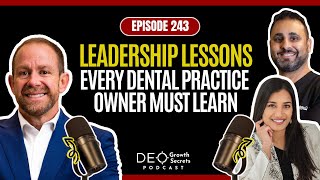
In this DEO Grow Secrets episode, host Emmett Scott interviews dental practice partners Dr. Lakshmi Reddy and Dr. Waibhav Rai about scaling their multi‑location dental group from a single office to ten practices with 15 associates and 130 staff. The conversation covers how the partnership formed, the pitfalls of promoting based on loyalty versus skill, building a leadership bench, HR and compliance challenges, maintaining culture and employee engagement at scale, dividing responsibilities between the co‑founders, and the importance of open communication. They discuss concrete operational lessons—such as hiring professional HR talent, recognizing that great individual contributors aren’t automatically great managers, and creating structured communication channels—to avoid performance dips. The duo also shares their tech and AI journey: experimenting with cloud‑based practice‑management platforms (CareStack), overseas staffing to stabilize wages, and adopting AI tools like Pearl AI for diagnostic visualization, ChatGPT/Gamma for internal communications, and broader AI‑driven patient‑engagement strategies. Throughout, they emphasize the role of the DEO community and coaching in surfacing blind spots, and they reflect on the human side of leadership—humility, empathy, and treating the team as customers. The episode ends with a call to action for listeners to join upcoming DEO events.
Chapters
Hello, everyone, and welcome to another episode of DEO Grow Secrets. I'm your fearless host, Emmett Scott. Tonight, I'm really excited to have two great doctors who are partners with each other who have scaled what I love. Okay. Dr. Lakshmi Reddy and Dr. Waibhav Rai. And what I love about both of their bios, because it's so true, is they both start off with compassionate dental professionals. They both are. They're just good people and just proof that you can have a bigger impact, continue to scale, have an impact in your communities, on your team, and that's not mutually exclusive. To grow a dental group and not do good as well. So, Dr. Reddy, a proud child of immigrants, she graduated the highest honors from the University of Hartford in just three years, earned her DDS from New York University as one of the school's youngest graduates, and completed her residency at Staten Island University Hospital, specializing in Invisalign and botox therapy for TMJ. Dr. Reddy combines precision and care to help patients feel confident in their smiles. She lives in Potomac, Potomac, Maryland, with her husband and young daughter. You can tell I'm from Texas. And enjoys traveling, tennis, and time with loved ones. Dr. Waibhav Rai is a skilled and compassionate dentist who combines technical excellence with deep empathy. Immigrating From India at 13 and growing up in Philadelphia, man, that had to be quite the change. He graduated with highest honors from the University of Pittsburgh, earned his DDS from Howard University, completed advanced training at a transplant institute, and a residency at the VA Hospital in Washington, D.C. with expertise in implant dentistry and endodontics, Dr. Rai is passionate about mentorship, and these two are just crushing it. So I asked him, I said, how many practices have you guys tried to acquire or acquired since COVID because it's just a different world? And they said, eight. I'm like, wow. Bless your souls. That is amazing. So I'd love to hear, I think everybody would love to hear kind of how this started and your partnership, how it started. You know, you don't only hear, like, bad things about trying to grow dental practices, but especially partnerships. And I'm sure you guys have had to work through quite a few things. So how did this come together?
Yeah, absolutely. I think the way it started was, you know, I'm a couple years behind Dr. Wright in when we graduated, but he was already a dentist. He was in Maryland and had his first practice. And I moved to Maryland after I got married and was looking. Was looking to get started. So I found him on Indeed and did an interview. We got together, started working together.
He Was looking for an associate. Huh?
He was looking for an associate because he was buying a second practice. So during that second practice is when we started collaborating, Working together for a couple years. Understood that our working styles are very similar. I come from a business background. Both my parents are in business. So I always wanted to grow it into business and not just do dentistry. And he's obviously the same way. So it was very synergistic from that side of things. And we had a similar clinical mindset to like, our treatment planning philosophies, how we take care of patients. So all of that aligned well and. Yeah. And then the rest is history. We decided to partner up and. And here we are.
Wow. Dr. Rai, how was that for you? You were.
Yeah.
By yourself, and you bring in this associate and pretty soon she becomes your business partner, huh?
Exactly. That's one of the most important things. Right. Recognizing when you meet a great person and a great business person to help kind of elevate the business. So that's what I saw in Lakshmi early on as an associate. It was just kind of, you know, very clear early on that, you know, when you have a great team around you, you can do a lot more. So, yeah, we talked it out. We had a. Same vision, a shared future that we were kind of looking towards in dentistry. And, yeah, 10 practices now and looking forward to continuing the party. So. Yeah, practices.
How many associates? How many employees?
We have 15 associates now and 130 employees. We stuck.
Yep.
I think.
I think it's. And it's frozen for a second. Emma's got shocked with that number.
Which number was less?
You can do it with less people. There he is.
All right. If only I had good Internet connection. So, Michael, you jump in if I. If I lose it again. So, okay, did you guys. You guys answered my question right when I asked? So, so repeat again. How many? How many?
15 associates. 130 employees.
Okay. Yeah. So lots to manage. I. I jokingly say if you're successful in business, especially in healthcare, the world rewards you with a bunch of crazy people to manage. So there's lots of new skill sets that you've learned along the way. So why don't we jump right into it, if you don't mind. You guys are so open and vulnerable. I'd love to hear. Dr. Eddy, maybe starting with you, like, what's the lesson learned the hard way? You know, what was the thing that we used to say? And as we were growing, you know, to our 70 locations, where was that in the business plan? You know, I wasn't planning that. So. Yeah. What are some of the things that you feel like have been hard?
Yeah, I think. I think there's. There's a lot of lessons learned the hard way, for sure. And I think one that really stands out for me is over the last few years, specifically, as we. As we grew a lot, how to identify the right people for leadership roles to build your leadership bench. In the beginning, we made the mistake of promoting based on loyalty. So we would, hey, this person's been with us the longest. They know the company inside out. Naturally, they should be in a leadership position. And while that can sometimes work in operationally heavy roles, it didn't always translate for us, which to a position that would require a specific skill set that maybe this loyal employee didn't have. So, for example, we identified our first leadership role should be in HR after we saw Jackie Brown doing her thing at deo, and we were just like, wow, this lady's amazing. We are dealing with so much shit that we should bring somebody like her on board. And we were blown away. So we said, we need to go hire hr. But we made the mistake of promoting an internal person who was very loyal and. And we thought, hey, she knows the company, she knows the people. But she just. She didn't execute the way she should have, obviously, because we didn't set her up for sex for success, and she didn't have the right skill set. So eventually we had to learn from that mistake, hire a true HR professional and put that away. But it was a difficult conversation to put her in that role and take her out of it.
So I think one thing that's so deceptive, in fairness to us as entrepreneurs, is when we're first scaling, we're all kind of moving slow and learning together. And as we get to a certain size, we can train that person. We just don't have the time. Meaning the business is going so fast that you don't have the time. So had it been growing at the same rate it did when you first started and you were figuring things out, maybe she could have gotten there. But now you're at this trajectory where it's like, I actually need you to know the HR laws. I need you to know how benefits work. I need you to be able to have these conversations tomorrow and so forth. And so I think it's a really good call out that what worked when we started doesn't work as we start to scale. And the professionalizing side. Yeah, it's a really. That's a really good one.
Yeah. So piggyback on that. We also kind of like, one of the things we're learning is great players are not always going to be great coaches. So people who are great office managers, we realized just promoting them and making them in charge of other office managers doesn't just simply work. And if it's going to work, they're going to require a lot more support, a whole different training, because there were people in our leadership group that were great at what they were doing, but if we just left them there, things would have been great. But this is the. This is the growing pains where we learn that sometimes, you know, growth is not everything. Sometimes consistency, sometimes leaving people and letting them be is what, you know, Dr. Eddy and I absolutely 100% say that that's where we kind of learn that the business is the people. And if you get the people right, the business runs itself. So it's been. It's been a good learning experience.
On that fact, we also expose the fact that we've never hired these positions before. Right. So it's blind leading the blind. And our skill set is pretty poor. And so though we're good at a lot of things, when the business reaches a new set, yeah, we realize, like, it exposes our own capabilities. This is where, frankly, having a good coach or someone who's been there and done that can help us to navigate those. Can you kind of walk us through maybe the stair steps of one location, two locations, three, four? You know, I mean, you guys have gone so fast here. Where have you seen some break points just kind of reflecting back, you know, HR is one of them, I think.
Three practice, four practice. We were still kind of getting away with a lot of things, but after the fourth one.
What does that mean, by the way? What did you get away with?
Like, like we were.
We were able to kind of drive the culture, right?
Yeah, correct. Like, like we could. We could internally promote people. We could get everybody up and running and we. They were doing great until the scale came into the play and they started their support network. We didn't create maybe as good as we could have. So I think third and fourth, we could just kind of hide behind it where hr, you know, one of our first HR person was our hygienist, who was really, really amazing hygienist. And she wanted. She approached us. She had interest in kind of helping us kind of scale, and she saw what we were doing. You know, a hygienist. Fantastic. You know, she was amazing hygienist. She got away with a lot with early on as an HR person. But when it comes down to, like you said, compliance issues, laws, and when things started kind of going, she wasn't prepared for that.
So I think, I think to piggy. To piggyback, probably on what, what doctor is saying also, I mean, we were also able to cover up a lot of stuff because we were just able to outproduce the problems at that. 3, 4. I mean, there was probably a lot of stuff going on, but hey, I mean, numbers look great because we didn't get to that point where we were carrying, you know, you know, stuff that was happening outside of the offices, you know, at SLD level, because we hadn't developed that yet. So nothing was outside of the office level. But as we grew a little bit more, we realized, hey, this. We've somewhat lost control because we don't have those individual touch points with our staff members where they're hearing from us, talking to us, connecting with us on a regular basis. So everybody's on the same page. And I think that's when things started to get really difficult for us. And we realized, hey, we need a leadership bench.
Who's.
Who's going to be able to, you know, connect with us and also disseminate that culture into. Into the offices and the rest.
It was an example of things got tough. What, what kind of things started popping up? There you go. This isn't going to scale.
I think the communication that Dr. Reddy just highlighted right there as it is. And we realized that beyond a dentist, we're also somebody people are looking up to as their employers. And that leadership, that inspiration, right, you can't make people work. You have to inspire them to work. That requires getting to know them, getting to connect with them. I think that piece was a big one for us that we, as we start scaling, we start failing at that, that we kind of left that piece out and we had to build another layer to help kind of connect people to the company instead of connecting with us. And that was a tough thing for us to learn that, hey, we're. We're not going to be able to get to everybody at 10 locations on a daily basis where we'll have those intimate conversations, we'll try to get you every two weeks. But sometimes those things kind of dilute itself, right? So that connection became a big, big problem. Since then, we have been able to kind of recognize that, which was the first step, that we were failing at that. And that was a need for every employee post Covid that they wanted that engagement and they wanted a purpose and that came not from their, like, you know, I mean, the co workers do a good job. We work a lot on creating that culture and morale because people want to be connected to something bigger than themselves. But still, we felt like right now our role is very clear. We want to make sure that this is not going to run unless people are connected with the company. The mission, that inspiration piece, is very clear for them.
And I think if you want specifics on, like, what happened along the way, that for us was very tough, is initially when we built the leadership bench, going back to, like, not putting the right people where they need to be. We were so disconnected from the offices, and we were clinically less involved. So there was, like, a whole thing happening in sld, which is the management company, where we were spending a lot of time, and the people we had put in those leadership positions to, hey, go. And you're in charge of, you know, working with this team, and you're in charge of working with this team. And it just wasn't. They. They weren't good at coaching them because they just weren't the right people. So there was a big disconnect, and it showed in the numbers. I mean, we took a dip. We took a dip before we realized, all right, this is not working out. Took an axe, basically, and got rid of them from. From that role.
Yeah, yeah, the numbers are great. Scorecard on are things working or not? And you called out something that most of the time happens at the single practice level a lot, which is revenue, covers a lot of sands. And so you're just so focused in on being great at procedures, great at taking care of the patient, and you can just produce so well. And then at some point, it kind of exposes all these other skills when you scale that you haven't developed. And, man, it's so tough, right? Because on one side, you're trying to figure out what is the most important stuff that does need to get to you. Clearly, everything can't anymore. And what's the most important stuff that you need to message down and touch. And some of it's worth it and some of it's not. And I think that's been. I'm sure there's places where you jumped in and micromanaged, and then you're like, wait, that doesn't work as well. And then there's other places where you abdicated, and you're like, yeah, good luck. Just work hard. And you're like, wait, that. That's not clear enough. You know, so, yeah, there's a lot
of that kind of like, that clarity came to us. Little bit more. Little too late sometimes. But it did eventually, because when the pain point became so much, we had to figure it out, like, what's not working? And yet to look inside and say, hey, is. Is. Is. Is growth? Are we. Are we just going towards a growth for the sake of growth? And then we took on this whole model of sustained growth, and that became our mantra, that, hey, let's shore up before we go out and start talking about scaling. Uh, let's clean up some of these deficiencies that we don't have. The skill set. I mean, we're. What. I mean, I was a bio major. You know, I'm a dentist. We don't know all these other things that are happening in the business side of things that requires a, you know, so, yeah, so it's. It's been a fun journey, but wouldn't go back and change it anything.
How did you get the humility? And because this is actually one of the more difficult parts when you are a great clinician, when things were going fine, when you were running them. Right. The initial reaction of every entrepreneur, every industry is, okay, my people just suck, and I got to get better people. And then we burn through a bunch of people and we're like, well, maybe it's not them, it's me. You know, so how did you kind of reconcile or get to the point where you're like, I'm actually missing a leadership skill set, and I just don't have this structured. Right. Was it just like most of us, it was just pain.
We went to the first, first, second, and third, and it wasn't working. Well, it's not them, it's us. Maybe we need to do things differently. After the first, second, third didn't work. What's happening here? Are we. So we had a open conversation about changing our strategic thinking overall of how we viewed people. And I feel like. And we think still and, you know, five years from now, we'll be like, what were we thinking five years ago? We think we have kind of worked on that the most, which has helped us get a lot. It became a lot easier from, like, 6 to 10. It's becoming easier, actually, as we're valuing the people story a lot more. Like, right now, we have this, like, core principles where, you know, happiness and balance plays a big role. So when we are trying to hire people, they'll say for the pay that it's great that they'll. They're willing to commute an hour, hour and a half. But if it's out of their footprint, where they're not going to be able to have that balance of life, we actually look at that as a. As a. As a thing that maybe we don't need to hire that person, even though they're great, because they will eventually break down. So kind of like think for them before they think for them attitude, and they'll do it because they want to. And people don't know. Like, we don't know. They don't know what their limits are, when they're gonna break, and we have to look for them. So when that became clear to us, Lakshmi and I were able to, you know, put a. Put a pretty. You know, the culture is pretty good. You know, I don't know. Dr. Reddy, you can speak to that a little more of how progress has been since then, right?
Yeah, I'd love to hear Dr. Reddy, because one of the things all of us as entrepreneurs have to overcome, too, is we get that a patient's a customer because they hand us dollars. Okay. It takes us longer to figure out that our team is also a customer. And it's really weird to us because we're handing them dollars. And so in the beginning, we're like, I'm paying you. Just do your thing. And then we realize, I think, to your point, Dr. Rai is like, the compensation package has an EQ component that if we're really good, we're even seeing around the corners for them and saying, I appreciate your willingness to work here, but I know how this story is going to play. I mean, that's a lot of maturity and capability. So, yeah, Dr. Reddy, build on that. How did you get to that point where you're like, okay, fine, they're our customer, too?
For me, I think it probably took longer than it took for. For Dr. Rai, because we have very different personalities, obviously synergistic, but very different people. And it took me a while to realize, like, people are not part of the business, they are the business. And naturally, I am more of an introvert. So my natural skill sets are like, okay, strategies, systems. I can see the problem coming. I just want to solve it and move because I just. Making quick decisions and moving on to the next thing. What I didn't do was, like, slow down and talk to people, talk to the team members and value their input and really bring them into the decision. And I think working with them and connecting them to the bigger picture, that stuff was really hard for me. It was very uncomfortable because that's not naturally the stuff that I gravitate towards. But when I realized that, I think that changed a lot of, you know, what the organization became focused on, which is culture became the foundation and not just an afterthought. Right. And I think it's really changed how, how their performance is. I think they feel connected to the mission and what we're trying to do. So performance has improved significantly. So I'm all in now.
And you know, like, it actually, when we kind of start thinking of them, our quality of life improved because we weren't just putting out fires. They became more empowered, they believed more. They were able to solve a lot of problems themselves because they knew that we were kind of going above and beyond to making sure that things were lined up on a professional life, personal life. I know there's a lot of things about, hey, don't bring your personal issues to work. If there was the case, which was happening a lot post Covid, people just had childcare issues. People had a lot of, you know, like, things that were bandwidth issues. We decided like, hey, let's open that up and help you solve it. We realized they're actually sometimes a DA who's like 25 years old.
We'll have examples like, they don't know how to communicate unless we reach out to them and like, really bring it out of them. Like, I think to build on that example, we had a D A who couldn't get to work anymore because something happened with his car. It was stolen or something. Instead of telling us, he was like, okay, I. I quit. And we're like, hey, you're like one of our best performing DAs. What? What's happening? What happened all of a sudden? I thought you were doing great. He's like, yeah, I just. I don't have transportation anymore. And I'm really going through this thing where I'm having financial issues getting a car. I'm like, okay, how about we give you a loan and we work on how you're going to pay that back because you're a valuable team member to us and we want you to be here. And he, you know, forever grateful. And he's been with us for like five years now.
Wow.
Wow.
Yeah. I really like that part is assuming that they won't communicate well. That's a cool principle. You know, I remember as we built up even centralized services to support the practices, that they never called them for support of the practices. Right. Like, we had to figure out how to get down to them. You know, we'd have chairs broken and practice like, hey, why haven't you called Us to fix these, like, oh, we're just so busy. Right. And I love the way you're taking that though, on a very personal level. There has to be some room for it. And it's a balance. It is a balance that it can't become just a personal mess at the price. But. But that's kind of what the leadership rounds give you. Cool. Anything else you guys want to add to that? That's super helpful because it's such a. I mean, let's think about this. Most of us who are growing and running businesses, we're pretty a type personalities. We're go. We're about the mission, we're about the results. And there's a totally different skill set to slow down and connect with the team and make sure that they can see the. The whole plot to the trailer in the movie that we throw at them in drive by delegation. Right. And. But once we unlock that, we're like, oh, my gosh, this is. This is actually easier. You know, slow is real. So. Yeah. Anything else you guys want to add to that?
No, we're good. We're just happy we're on this side and not still trying to figure that out.
How. How a lot of pain drives change. Right. How have you guys divided out your responsibilities with each other? That's always tricky too, to really have a respect, you know, Dr. Reddy, you called out like, we're different people. And at the beginning of any partnership, that can create a lot of conflict in the most mature versions. This is probably true with marriage too. They start to become complementary with one another. Like there's a respect for the differences rather than a conflict. Tell me a little bit about that because I know many people have partners or even just associates that they're trying to figure that out with.
Yeah, I think it's. It's tough. I mean, we've obviously, over the years have come to know each other very well. And what are the nuances? What are. What are some of the things that, you know, might be a pain point or a trigger point for me versus him and kind of just avoid those rather than poke at them nowadays. Because we've learned and evolved from that. But yeah, I think. I think we've just figured out how to divide up some of the responsibilities on. Sometimes I take on a little bit more admin, sometimes he takes on a little bit more clinical stuff on like mentorship with doctors and things like that, where I'll work on some of like identifying what's our next growth opportunity. How do we get there? What are Our plans. So kind of we work on what we think our skill sets are and how best we can complement each other. Because some of the things I like to do, he doesn't, and some of the things he likes to do, I don't. So once we figure that out, it's become a lot easier.
So powerful. Yeah. Dr. Rai, anything you'd add?
Yeah, I think understanding each other's strengths and weaknesses was a key part of that partnership. Right. What we all, you know, are. And that required an open communication, you know, partnership. You know, it's been probably one of our greatest strengths here is our working relationship together have been so strong over the last six, seven years. We had to be on the same page. A lot of communication, a lot of open discussion to kind of align ourselves because the whole team is looking at us. Right. So that required internal discussion that was more transparent and more open. And we had this kind of thing that if there was something that I was doing without her, I have to make sure I go above and beyond. I felt more pressure to go make sure that I don't kind of let her down on that. And I think she sometimes feels that way too, when she kind of goes into her own island. So we work together every day. We travel to the offices together. And our admin days are also aligned. We take some, you know, separate meetings. You know, we have a, you know, she. She spearheads most of the financials, hr. I kind of lean towards more so clinical mentorship with the doctors, connecting with the, The. The staff stuff. But she, she does a lot of that legal, financial, hr, kind of housekeeping that kind of keeps everything running and acquisition opportunities, you know, kind of like where the pulse of the practice lies. And then, you know, I. I sometimes kind of go towards, you know, more managing of the doctors, you know, supporting them and just, you know, I. So she, she gotta lets me kind of go and kind of build that culture morale thing and kind of work with the, With. With the teams themselves. So it's been, it's been fantastic.
Yeah, it's truly. Well, I have a ton of respect for it. Someone who's been married 27 years. And I tell my kids, you only need two things, Jesus, and a good therapist. And you can do it too. But in every partnership as well. I know behind the scenes, it really takes a lot of courage to stay in the conversations that happen. And I agree with you. A sliver of light difference between leaders is blinding to those below. And so the more you can work, you know, no one likes the mom and dad fighting in different areas and it's not good for the company. So the amount of work you guys have done to create that alignments, you know, I have a lot of respect for.
Yeah. And we generally make sure any, any, you know, differences of opinion are always done way out of, you know, obviously never in front of people. We don't ever have. Even if he's saying something or I'm saying something crazy, we just kind of like, okay, let's talk about this when everybody leaves.
Yeah, it's awesome. Okay, let's pivot away from people from for a second. Let's talk tech A.I. you know, we've got it, we've got to solve this because labor does keep getting more expensive and the reality is a lot of the tasks people don't even want to do anymore. Right. For their own health and well being, etc. And so tell me a little bit about what you guys are experimenting with there, what you're thinking next, that kind of stuff.
So, so the tech story was a important early one when the wage inflation took place and the numbers, you know, the P. Ls just took a hammering. So, so we, we started looking at the tech story a little bit more seriously to kind of incorporate our first kind of like three years ago, our first instinct was we're going to go overseas. Which is a little bit more easier lift than just overhauling the entire tech of the company itself because that just comes with a lot of compliance. How do we introduce that to an already team that seems to be overworked. But I don't know how we're providing so much support. Like how do we introduce this new, you know, technologies are great, but it's only as good as the adoption. And that's like a scary thought to us that you know, we might think that this might be a game changer from a conceptual level, but at a tactical level, the front desk girl who's just kind of trying to kind of figure things out already with this software, switching all of this around at every one of those locations was something like, you know, so we are now feeling more confident into a cloud based solution. But we're still not 100% sold on if there's a right answer out there. We do think at a 10 practice level a cloud based solution long term on paper sounds very, very promising. So we're looking forward to, you know, what that goes into. We've looked at Care Stack more closely now. I don't know. That's something that we're looking to kind of decipher a little bit more closely when we come to Dallas and the eo, like, kind of, hey, what do you think? What do you think? That's like a great place. DEO does a great platform for us to like, are we on the right track? What's bad about this? What about what? You know, we use the A lot for, like, hey, here's our thought. Let's find out why that won't work. And usually DEO does that really well for us because we'll hear that really clear.
It helps to have 500 entrepreneurs all trying different stuff.
Somebody's already struggling with the decision. Yeah, so, so let's not step into that. Let's learn from their mistake. So we're, we're big onto that, but obviously, you know, we're at the, you know, at the basic level. You know, the AI adoption is something that we're pushing hard at with. You know, if you want to make a presentation, let's use Gamma. If you're using, you know, a simple email, just have chat GPT help you with that. Like just any communication that we're looking to do, let's get more efficient. Like, that's simple stuff. Obviously this is 2025, but, you know, sometimes some of this staff member that we're talking to, we're still like, are you using ChatGPT to write your emails and your reports? And sometimes like, what? No. And I'm like, how come you're not. So there's that lag also that happens, which we're like to try to incorporate. But yeah, we're excited about the tech story. I think overseas has helped us stabilize the wages a little bit to kind of think about this tech thing. Michael actually was phenomenal when we started talking to him about practice management software switch. And he was so he made it so easy and simple for us because we had a, we had a concern regarding revenue drop if there is a software switch and how do we mitigate that? And our focus was just systems and protocol, but he kind of gave us a whole lot of coaching on, hey, you know, it's a cash flow issue as well. So if you're not, if you don't have the reserves to tolerate that dip, because the dip will happen, it's hard to like avoid that. So how are your banks looking? And we never connected that directly, but it's so simple. And to learn from somebody like Michael, a simple thing, that's, that's one of the things that we really, you know, credit DEO for, you know, these complex things in our head can be simplified from somebody like Michael who has, like, wealth of experience way beyond us. So, yeah, we're excited about that.
I think. Yeah, it's awesome. That is one of the power of. Of deo, if you think about this and kind of reduce it down. Expertise is just pattern recognition, you know, so if I'm looking for an expert, I'm actually just looking for someone who's done something for that 10,000 hours or whatnot. Right. So to your point, whether it's the 500 entrepreneurs and, hey, I already tried that, or it's one of the coaches who's like, oh, that's been my career. You know, it's helpful to have someone who's been a CTO of a $150 million DSO. They've gone through a couple pain points, things like that. You guys have done a great job of just leveraging off of. And I think through, like, how many mistakes you guys have avoided, that I made, it's pretty awesome. So, Dr. Reddy, anything else on tech that you're excited about?
You know, I think from a clinical side, we use, like, Pearl AI to help with diagnostics. It's been helping us close treatment plans a little bit more.
Tell us about that, though. Like, are you starting to see. Is that new for you?
Yeah, it's. It's fairly new for us, but we. We've gone around now kind of getting the doctors to get used to it, but it's basically during treatment planning, it's showing them decay, you know, in different colors, and then they can print it out, take it home, and, hey, it's attached to your treatment plan. Go take a look at it. You know, we're not making. Making things up. So it helps because they can see it better. It's just a better visual tool.
My daughter, who's 17, the other day I was telling her something, and she came back to me and she said, dad, you're right. And I was like, wow. She's like, yeah, I checked on chat GPT, and you're right. You know, and I thought that is the world we're living in now is we verify through the AI. And, you know, it's. Think about how challenging it's been. We've been selling to a customer this gray, granulated picture and saying, this is a thousand dollars, but that's Cheetos. That's nothing. You know, I mean, it's. And now we have this verified, you know, AI tech that says, no, what the doctor's saying is true, and, you know, there's no motivation there. It's really cool.
Yeah. A lot of innovation happening on the clinical side, I think operational side for AI. I think really what I'm excited to see, just, you know, I don't know what the timelines look like or how, how quickly this AI boom is going to happen, but just personalization with patients and how AI will get to that, to anticipate a patient's needs, their concerns, you know, I mean, I think that's the future to be able to connect with them on that level because that's usually where patients frustrations are. So I think, I think it'll be interesting. It'll be interesting to see that, but I certainly don't think it's gonna, in, at least in my lifetime, replace, replace our jobs. I just think it'll, it'll make it a lot easier for us.
Yeah, yeah.
And you know, Emmett, you said it like two. I've heard you say that before. In dentistry, we don't have like a demand problem, it's a digestion problem. And I think AI is gonna help us get through that. Pending treatment plans, being able to engage with the patients better, being able to educate them a little bit better. I think the automation of treatment plan management is something that is going to be a key feature because I think a lot of these patients are just lost. Their objections are based on trust and cost. And a lot of that can be just educated out, hey, if we, you know, we always coach our team, you know, if they're talking about cost, let's talk about quality of life. And usually they'll convert. And if they're talking about trust, let's show them evidence with this, with, with, with when they draw photos or X rays or something. So there's always like, if they're talking about this, do this. I think you just can't get to it with like three people in a front. And we have like $2 million worth of pain pending, you know, treatment plan that came out like three in the last quarter. Like, well, how do we get that where patient needs to be constantly educated and talked to and engaged regarding that pending treatment plan. I think that is going to eventually be solved somehow through AI, with patient interaction being more like they will connect with the practice a lot better.
Yeah, you're saying something really powerful. There was a recent article from mit, did a study on AI and it came out, kind of shocked the industry for a minute and the stock market because it said 95% of AI projects and companies were failing. And at first they said, well, maybe that means this is an AI Boom or bubble, it's going to burst. It's not everything we thought. And I think everyone who's double clicked and gotten into it, they go, no, this is a human change management issue. The AI is fine. The ability for us to actually utilize it to your point, you know, are you actually using it to make your email so they don't have as many spelling errors and they actually sound a lot better and aren't as mean or whatever else? And so I think as that acceptance starts to happen on both sides of the pond there, both from the patient side, but mostly from the employee side, I think it all comes down to the human component. I think that's really been the theme that you guys have brought out here is at the end of the day, no matter the technology, no matter the clinical skill, what is our leadership capability and can we develop that over time? One of, one of the favorite memes I saw recently was it said to push forward, not listen to what anyone says and have your own vision is called courage. It's also called stupidity. And that's what makes life hard. And I love that because in trying to grow a business, you've hit on many points where you're trying to figure out this balance of where do I delegate, where do we control, where do we lead, where do we step in all of those things? And you guys have really done an incredible job and it's awesome to see. So thank you for sharing. Anything else you guys want to say in closing here?
No, I think thank you so much for having us. And this is, this is really nice to be able to, you know, kind of chat on an, on a level where you're giving us perspective by asking us questions that we probably don't think about, even though we live it every day. So that's, it's great.
Yeah, you've been in the. What you've, what you've created is amazing. Yeah, go ahead, doctor.
I know. I think, I mean, one of the things about this community and what we're get out of this, exactly what Dr. Reddy said, like, you know, just to be able to talk about the issues that we're facing and everybody else has already gone through it or about to go through it. It's just an amazing platform. So we want to thank you for just kind of spearheading this whole thing for us, man. So thank you for having us. We appreciate it.
And I think one last thing I will say, Amit, is we didn't get a chance to touch on this, but a lot of the decisions that we've made and. And. And done in our business. And even as a sounding board between the two of us, we really do credit DEO to that because there's times when, like, I'll be saying something and he doesn't listen or he'll be saying something and I'm like, no, that doesn't make any sense. And then we hear it at DEO and we're like, oh, look, look, we were right. And we're able to kind of be like, okay, this is the third party. And it seems to make sense to them. So, you know, so it's been great for us and. And we love it.
So thank you. Well, what a powerful community we have. You guys are part of that now. And for those who are listening in, if you're a member of DEO or want to be a member of DEO, we do have an event coming up here in October, 9th through the 11th in Dallas. All around increasing profits through treatment, closing capabilities. We'll have breakouts with tribes. We're going to have people presenting on how they've eliminated the entire front desk. So many great things coming, but thank you both, and until next time, keep smiling.
More from Emmet
Emmet Scott on the Entrepreneurial Mindset That Brings in $150 Million in Revenue
Emmet Scott on the Entrepreneurial Mindset That Brings in $150 Million in Revenue
Podcast EP 221: Meet the DEO’s New CEO and the Next Chapter in Coaching & Community
Growing Your Dental Group — Knowing When To Scale and Pitfalls To Avoid: Emmet Scott & Jake Puhl
DEO Faculty Member Emmet Scott Reveals How to Get Buy-in from Owners and Non-owners with A.S.T.R.O.