Can You Be a Force of Good During a Time of Social Unrest? [Episode 8]
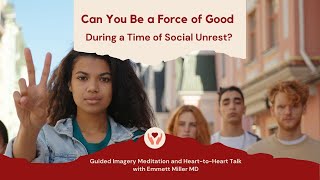
In this 2021 Life Meditations webinar, Dr. Emmett Miller MD explores how individuals can become agents of positive change amid the twin crises of the COVID‑19 pandemic and widespread social unrest. He frames the current moment as a convergence of three major stressors— the viral pandemic, lockdown‑induced economic and relational strain, and a pandemic of violence tied to systemic racism. Miller argues that collective trauma creates unconscious mental "filters" that shape perception and behavior, often leading to disease, dysfunction, and societal conflict. He traces the historical roots of racial oppression from slavery through Jim Crow to modern policing, highlighting how disinformation and media control have perpetuated these patterns. Using data on shifting public opinion, he identifies a societal tipping point and applies an innovation‑adoption model (innovators, early adopters, chasm, early majority) to illustrate the path toward lasting change. Interwoven with this analysis is a guided mindfulness practice rooted in Buddhist Tonglen, designed to help listeners cultivate present‑moment awareness, compassion, and the capacity to transform personal and collective suffering. The session concludes with concrete resources—books, newsletters, websites (c‑intelligence.org, drmiller.com), and actionable lists (e.g., "75 Things White People Can Do for Racial Justice")— encouraging participants to move from insight to action. Throughout, Miller balances a conversational, empathetic tone with moments of urgency, urging listeners to recognize their role in shaping the future.
Chapters
The show you're about to hear is a recording from Dr. Miller's webinar series titled Life Meditations. He began this series in response to the pandemic, and his goal has been to provide wisdom, practical tools, and comfort to people during these stressful times. Watch the entire series at drmiller.com/lifemeditations. That's drmiller.com/lifemeditations.
Hello everybody, this is Emmett Miller, or Dr. Emmett Miller for those who don't know who I am. I like to start off with a quote from Florence Luscombe, was an architect and suffragist. She died about 30, 35 years ago, but was around in the beginning. She said, "The tragedy in the lives of most of us is that we go through life walking down a high-walled lane with people of our own kind, the same economic situation, the same national background and education and religious outlook. And beyond those walls, all humanity lies, unknown and unseen and untouched by our restricted and impoverished lives.
Hmm.
So those who— those of you who know me know why that one is Certainly one of my favorites. And so today we're going to talk about how it might be possible for you or me to be a force for good during this time of social unrest and quite a bit of unrest. You know, people often tell me, "Don't comment on current events, stick to your knitting." 'You know how to help people individually, and that's good enough. Just stick to doing your individual work. Don't get people confused.' And then I remember what my wonderful model and teacher, Albert Einstein, said: 'The evil in this world is not done only by those who commit it, but by those who stand back and watch it happening.' And Martin Luther King, who said, "Our lives begin to end the day we become silent about things that matter." Long ago, I made a discovery about medicine after going through my traditional training as a physician. And I realized from working with people that people's life experiences create filters or algorithms which favor certain ways of thinking about and reacting to events in their lives, certain ways that then go on to produce disease, dysfunction, and misery. So my work has involved using states of consciousness that favor improved communication and relationships between the conscious and the unconscious parts of of the mind and nervous system. And it's the unconscious parts of the mind that are the domain of these filters and harmful algorithms. So we're all kind of being, we're being led around by our monkey mind. And if you've, if you watch the news, I think you know that that's true. At any rate, I began to realize that the same thing was true about families, organizations, and society, our culture, and the world as a whole. These past experiences that we've had color our experience of the present. And we think we know so much, but sometimes we don't. It's the story of Sherlock Holmes and Watson, or are out camping, and it's the middle of the night, and they're both snoring away. And Sherlock Holmes wakes up, and a few seconds later he wakes up Watson, and he said, tell me, Watson, look up and tell me what you see. And Watson says, I see stars, millions of stars. He says, and what does that tell you, Watson? He says, well, Astronomically, that tells me that there are billions and billions of other places, other stars and planets. And teleologically, it tells me that we are small in comparison to the vastness of the universe. Meteorologically, it tells me that we're probably going to have a sunny day tomorrow. But what does it tell you, Watson? I said, "What does it tell you, Sherlock?" He said, "Elementary, my dear Watson. Someone stole our tent." We know so much sometimes, and we know so little. Well, following 2001, I realized that it was important for me to begin to share what I was discovering with the world, what I was discovering about the world, with the world. And my daughter Erin urged me to share some of that sync thing with you out there on my webinar today. And so here we go. And we're going to be talking about the current social unrest. Uh, we're gonna talk about how it relates to our past social trauma and the functioning of our minds, and also to offer us some tools that that can help us make sure that this crisis does not go to waste this time. And by the way, happy Juneteenth. You all know about Juneteenth, right? It's also known as Freedom Day. It's an unofficial American holiday and an official Texas state holiday celebrated each year at this time to commemorate the Union Army General Gordon Granger, who read the federal orders in the city of Galveston, Texas, proclaiming that all slaves in Texas were now free. That was only 2 or 3 years after the Emancipation Proclamation, but it's celebrated, and today's the day. Yay! There are two pandemics now. and the lockdown that are producing the stress we're all experiencing in ourselves, in our nation, and in the world. And unless you've been living under a rock for the last 6 months, you're probably well aware that our world in general and our nation in particular is in a time of great crisis. Back in 2009, when I published my most recent book, Our Culture on the Couch: 7 Steps to Global Healing, I pointed out that we as a society really seem to be on the edge, on the cusp of a great change. And those of you who've signed up for my newsletter can get a free copy of this book if you sign up online. It's a full-color version of it, and I'm sure that at least some of you may have read at least some of it. Those of you who want a hard copy of it, at the end of the webinar, I'll put up the information as to how you can get that. But for more than 10 years since then, I've watched as the situation in the world and in our nation has deteriorated even further, with the forces of violence and domination very often, too often overwhelming the forces of love. And cooperation. Finally, now with the confluence of 3 major stressors, it appears that we may have reached the tipping point. Try as we might, it may not be possible to simply rock back to where we were before. You know, you can't get toothpaste back in a tube. And I for one think that this may be one of the greatest opportunities for us all. As you No, my approach is that when I see an obstacle, I approach it as a challenge. And I like challenges. And I realize that it's actually an opportunity in disguise. There may be some pain, there may be some loss, there always is, that's life. Live with it. But if we look at it right, we can discover that there's a silver lining, so to speak, on whatever cloud. We see there. Two pandemics and a lockdown. Obviously, we have the global pandemic that's caused by COVID-19, which is beyond anything that any of us have ever encountered in our lifetime. The fumbling ignorance of our elected leaders that has allowed this situation to explode into what looks like is going to be literally hundreds of thousands of American deaths, like, like quadruple what we lost in the Vietnam War because we didn't apply the simple rules that every medical student learns in his second year in medical school. 6 months in, here we are, and still the simplest and most basic of measures— adequate testing for infection and antibodies— is still beyond our reach. Fear is widespread in the face of a torrent, huge torrent, of conflicting and misguided information, appalling incompetence, and many people fear daily for their lives.
Who do you believe?
Click the channel and there's someone who tells you the other. Wear your mask. Don't wear your mask. Get tested. You don't need to be tested. Social distancing. No, we'll just get together and have a rally. We don't need social— on and on. We have been severely jolted out of our lives of complacent privilege. We're beginning to realize the world will never be the same again. This dawning awareness that we don't know where we're headed, but we're headed there with breakneck speed, is the very definition of stress. And then there's lockdown stress. Folks at the bottom of the socioeconomic scale are unable to earn a living, pay their rent, or provide food for their children. You might say they're having a crisis, hm? Meanwhile, those of us at the top, the wealthy, the knowledge workers who can easily telecommute, they face such challenges: relationship tension, and relationships are breaking up, out-of-control children who they can't get out of the house because there's nowhere to send them. Spousal abuse is on the rise. And then for those at the very top, there's the withdrawal symptoms of not being able to go to fine restaurants and tennis matches. And all with no clear end in sight. And finally, there's the other pandemic. It's what I call the pandemic of violence. The latest symptom: record-breaking crowds filling the streets protesting police violence have spread around the world. Many other countries are, are doing it now. And then there's the gratuitous violence of the police and now the military against peaceful demonstrators. Can another Kent State be far behind? These are, I believe, merely the most clearly visible symptoms of the societal and cultural illness that is at the source of all these issues that we're looking at today. Some of us are choosing not to pay attention. Those of us whose stores are not being firebombed and looted, or who are not being trapped between riot police, National Guard, peaceful protesters, and violent opportunists may simply change the channel or surf to some other corner of net— Facebook, porn, what have you. Why be bothered? But staying in denial may be a particularly dangerous choice this time. After all, in such matters. Silence is the voice of complicity. The protest movement is huge, overwhelmingly peaceful, sprinkled with violence, and many establishment voices are telling us that this is just another annoyance by spoiled Black people and Black terrorists and welfare queens, that we should bring the military into it. Bring forward the heavy weapons. But is this the right answer? In case you can't read this: My daddy plays with me. My daddy reads to me. My daddy tucks me in at night. Please don't kill my daddy. I promise to be a good girl. Now there's three kinds of people that we see in the streets. There are the peaceful protesters, and the last thing they want to do is to incite violence. In fact, that's really why they're out there, is to try to get us away from doing this violence to each other. And they say, we respect your lives, but we want you to understand and believe that black lives matter too, not only yours. There are the antifascists, appears to be a rather small group of radicals, and they're focusing on the fascistic qualities of our current society and that we— they should fight fire with fire. They believe that no government is better than the government that we have. And they're the ones throwing the firebombs. It's a small group. And thirdly, there's the looters, the unfortunate people from the underclass who, during their formative years, have been treated to a never-ending parade of expensive consumer items that they can never hope to be able to afford, unless they sell drugs. Who wants to take a chance and do that? So this is an opportunity. We'll break the window and go in there and— oh, a Gucci bag for my girlfriend! I mean, that's a score, right?
This is a small group of desperate people, and they're there.
And then, so As our government ponders labeling the protesters as terrorists and bringing the full military might of the US against its citizens, the protests still are seeming to gain steam. So there's something different this time. The celebrities are coming out by the dozens in support. They're giving money to causes that they believe in. People are actually paying money. To help change things. Political leaders are coming forth, and even state Supreme Court Chief Justices are coming out and speaking as supportive— supporters of the movement. And although most of— all of the banners that they're carrying, most of the banners are saying Black Lives Matter and things like that, most of the marchers are white. Very often? WTF! And on top of the whole thing, these antivirus masks that are being worn make everything seem more surreal and remarkable. And because of the virus, even though these are some of the biggest demonstrations we've ever seen and they're going worldwide, This is still only a fraction of the number of people who would be out there if so many of us were not following the rules and sheltering in place. But these young people are taking those risks because they believe. Well, when the protests started a while back, I thought to myself, maybe this is just déjà vu all over again. I mean, the shocking poverty in our land of The structural racism, the brutality of those whose job is supposed to be to serve and protect are not new issues. I've been beaten with billy clubs for doing nothing, just because I happen to live in New York and be walking around with a group of Black friends. The protests in the past didn't seem to convince enough people to make a difference, but I began to realize this one really may be different. Something has changed. I think one of the big things that's changed is the cell phone video. And that cell phone, I think, is, you know, maybe the most societal-changing invention since the Gutenberg printing press back in, what, 1440. And this may be enough actually to tip the scales. For me, I believe in people. 50 years of watching people go deep inside themselves and find a fundamental goodness, a loving spirit, and then to transform their lives with the wisdom that became available to them has convinced me that we all have the inner potential to to be good, kind, loving, and compassionate. And as I have taught many thousands of students, proceeding in therapy as if this is true gives the best results with your patients and your clients. And I believe in the fundamental goodness of Americans. We're still a democracy composed of overwhelmingly good, kind people. And once we become aware of the glaring inequity that flies in the face of our deep belief that we're all created equal and we're all endowed by our Creator with the unalienable, unalienable right to life, liberty, and the pursuit of happiness. Once we become aware of how we have been manipulated in the past because we did not know the whole story, once we become aware, we will swiftly act to heal our nation. And the cell phone camera is giving us a close-up look beyond anything that we've experienced in the past. Think about it. We can each go to our computer or cell phone anytime, anytime, 24 hours a day, click it on, and we can watch a video of a man dying. How many of us have watched someone die before? Over the course of 8 minutes, 8 long minutes, in 46 seconds while one of those sworn to serve and protect compresses his neck in a way almost pretty much would kill anybody and placidly listen to his dying gasps as he says, "I can't breathe," and pleads from— for help from his dead mother. You can't unsee that. Among the other remarkable things that's happened is the fact that the president of the NFL has apologized to Colin Kaepernick for kneeling. Maybe he had a point. Maybe there is a violence problem. Things are different now. At the NASCAR races, they won't be flying the Confederate flag anymore. They won't be flying the Confederate flag anymore. This is, this is different. This is different. And General Mills has retired Aunt Jemima. You know, our standard, um, image of what the Black woman looks like. Aunt Jemima is no longer going to be on the COVID Now, back in my book, Our Culture on the Couch, uh, as I mentioned a little bit ago, I proposed my theory that September 11th, 2001 was such a traumatic event, especially with the continuous experience of horror we had each time, right? We watched hundreds of videos of those planes flying into the World Trade World Trade Center has led to post-traumatic stress disorder, PTSD, on a nationwide basis. PTSD that led us to make, to make very poor decisions over the next several years, starting wars, etc., based on unconscious post-traumatic fears. And that, that in fact created the bizarre world that we have been confronted with recently. And now, as we look at this string of videos of unarmed and even handcuffed Black people being shot that are being shown to us and then go viral, to be honest and fair, we need to examine, ask the question, just how bad is the racism and the brutality against the powerless instead of thinking the police are going to police themselves. I know that there are a lot of people who believe that law enforcement is not biased, but, you know, then I would expect that somewhere there must be lots of cell phone videos of police strangling and shooting white subjects. Suspects as well. And that would say to me that maybe there isn't black bias, maybe it's just pure violence across the board. It's not hard to find intelligent, experienced observers, however, who are strongly convinced that police are brutal and that the school-to-prison pipeline for black youth is a major problem. And others who will just as vigorously argue that except for a few bad apples, the system is fine. Black people just need to pull themselves up by their bootstraps. And by the way, have you ever tried to do that? Reach down, grab your shoestrings, and try to lift yourself off the ground. Well, these folks can argue with each other all night long. Then there's this quote from, from Ingrid Newkirk, who's an animal rights activist, and she said, not until Black demonstrators resorted to violence did the national government work seriously for civil rights legislation. In 1850, white abolitionists, having given up on peaceful means, began to encourage and engage in actions that disrupted plantation operations and liberated slaves. Was that all wrong? Well, that's a conversation for another time. What my interest is, is that the basic problem is still there, and it all comes down to violence. Right now, whatever the cause is, public opinion is changing quite dramatically. American public opinion can sometimes seem stubborn. Voters, for instance, haven't changed their views on abortion in 50 years. Donald J. Trump's approval rating among registered voters has fallen within a 5-point range for just about every day of his presidency. But this time, something's different. American voters' support for the Black Lives Matter movement has increased as much as it has in the last couple of months, as it has in the last 2 years. And this graph shows us that by a 28-point margin, a majority of Americans support the movement, up from a 17-point margin before this recent wave of protests began. And as you can see, prior to 2018, the people who didn't support it outnumbered those who did. And what we're looking at is the percentage difference between those who don't support and those who support. And now we're up to 28%. So, There's big changes that are underway and I think we need to think about it. We have to pay attention to that. It's important. Of course, when we're looking back here in 2018 and before, everything was skewed by the Russian internet trolls and the misinformation spin doctors that had convinced many people that the Black Lives Matter Black Lives Matter movement was saying that only black lives matter, but this is not what I hear when I actually listen to what they're saying, rather than what Mr. Putin or the far right want me to hear. I don't hear them saying white lives don't matter. I don't hear anyone saying all lives don't matter. It should go without saying in our great nation, all lives matter. That's what the Declaration of Independence was all about, right? Indeed. Instead, what I hear is that the experience of the Black community is that law enforcement, the courts, and the penal system are acting as if they don't matter. And there are numerous independent studies that bear that out. Big, strong Black men are now afraid to go walking in white or mixed neighborhoods without their wives or children because people will think they're casing their houses and will come out and shoot them. And, you know, at least up until now they've been able to get away with it. I was standing my ground, or I felt threatened. Perhaps most significant that this graph by the Civics Group is not the only one. A Monmouth University poll found that 76% of Americans consider racism and discrimination a big problem, up 26 points from 2015. Polls show that the majority of Americans believe that police are more likely to use deadly force against African— against African Americans. So it may be that we are reaching the tipping point. Our tipping point, here's our little egg that we've pushed to the edge. If you've ever done this with an egg, or a nickel, you go just so far and little tiny bit further and then everything, everything changes.
It's time to realize that the future is not someplace you're going. The future is a place that you are creating, and you are creating it right now, in this moment, with every thought, with every word, with every action. Choose well.
For more information about Dr. Miller's work, his upcoming events, new programs, and how you can change your mind and change your life, visit his multimedia website at drmiller.com. That's drmiller.com. This webinar series is funded by your donations. Support their ongoing creation by visiting shop shop.drmiller.com/donate.
That's shop.drmiller.com/donate.
This is what it looks like in terms of making social change. As you can see, First, the first people who go for a new idea, those are the innovators. And then come the early adopters, those who say, "Hey, that makes sense to me," and then they go ahead and join. And then there's a chasm. Will we make it across the chasm? If we make it across the chasm to where the main early majority accepts it, That's the tipping point. From that point on, it's a one-way street. You're on your way down. It's like the egg is over the edge. And here's where we are now. We're at that, in that chasm. If we make it across the chasm, things can change. So, what's next? Where can we go from here? Well, I believe people are in the streets not only because of a single issue, even though that is the— you know, we always need something that's a symbol of for, you know, Anne Frank or Willie Horton or Jesse Owens. You know, we need a symbol, and that symbol is George Floyd at this point. But people are marching as a way of screaming, as a way of exhaling pain, as an enormous group catharsis. I can't breathe. And it's not only what's felt to be police brutality, it's about all the pain, the disrespect, the oppression, the insults going back through our ancestry and our children and our grandchildren. And it's true for all of us. If you're Jewish or Italian or Muslim or Chicano, it's true for all of us. It's just that the African-American race, especially with George Floyd, that's the poster child right now. That's just— you know the story about the fellow who said he would— he had taught his— he a farmer, and he had taken a course in philosophy, and he was telling his friend that he used— not philosophy, in psychology— and he was using psychology on his donkey and his friend said, "You're crazy, you can't use psychology on a donkey." And the farmer said, "I'll show you." So he calls the donkey over and hooks him up to a big wagon full of rocks and says, "Donkey, I'd really appreciate it if you would pull these rocks across the yard." And the donkey just looks at him, he said, "You know, my friend's going to think really bad things about you if you don't take those rocks across there." And the donkey doesn't do anything. He says, You know, it really would be upsetting to me and very disappointing after all my work if you didn't demonstrate how good you are. And the donkey just looked at him. At this point, he picks up a 2x4 and he whacks the donkey on the butt, and the donkey lurches and drags the cart across to the other side of the yard. And the farmer turns and says, there you go, psychology in action. And his friend said, "Psychology? What about the stick?" And the farmer said, "That was just to get his attention." Maybe there's enough going on that it will get our attention. Maybe that's what we need. Maybe we need to see a little violence, zillions of people marching, or think about it. The instruments of oppression and bondage were honed by America over many centuries, and every time some of those instruments were taken away, the oppression simply reemerged from a more subtle and diabolical form. Black slavery made possible the cotton and tobacco wealth of the South and the commercial and factory wealth of the North. Whites flourished while the kidnapped Africans were denied their their language, their music. They were denied marriage, and on top of that, masters and foremen were allowed to rape, whip, and kill them without punishment. The South did not respect slaves' marriages. They said slaves are property, like furniture, and how can a chair marry a table?
Hahaha.
And then, I mean, slaves weren't really human. They were more like property, like a chair. So it's okay if you cut a chair in half. Emancipation came, but attitudes changed little. Black codes were instituted, and they served to restrict Blacks in most of the ways that slavery did and forced them to continue as a source of cheap labor. To get slave labor, they would arrest a Black person on trumped-up charges, so such as slandering a white person, and then assign him to hard labor for 5 years, and then he would be a slave for the next 5 years, and on and on. White people did nothing, and Blacks had no power and no access to the public media. And then even after the Civil Rights Act of 1964, mass incarceration was instituted, which succeeded in extending Jim Crow's voter disenfranchisement, restricted housing and employment, continued abuse and disrespect. Wouldn't you be ticked off if you looked at that? And of course, the thing that strikes me is slavery was around, nobody did anything about it until the abolitionists made it clear what was going on. And Americans says, "Ah, we can't have this." And we went to war, we stopped the slavery. But then Jim Crow and redlining and Black Codes and Green Books and so forth. But nobody knew about it and we thought everything was fine. And then bang, along came the civil rights movement. You know, it really wasn't until 3 white guys got killed, the Freedom Riders, that suddenly America says, 'Oh, they're killing people?' Yeah, they are doing that to Black people all the time. But again, we woke up and we changed it. And so the trick has always been to feed us disinformation. You know, I've talked a lot about the disinformation and how disinformation has been perfected at this point. The goal is to keep us from seeing what's being done. And again, It's not only the Blacks, it's everyone. It's you, it's me too. And if you understand how this is being done, and if you do something to stop it— we can just begin with the Blacks, they deserve it— then we can continue. The same principles will set the rest of us free and get rid of those people who have been dominating us. And let's, let's take control of our country. I'm going to continue talking a little bit about this because I have more to say, but I'm going to relieve you of my diatribe and suggest that you participate with me in some imagery. If you've read Our Culture on the Couch: 7 Steps to Global Healing, you know that I believe that there are two fundamentally different ways of thinking, of conceptualizing the universe. One is in a black or white dualistic mode, and the other is the holistic mode. And this holistic mode is the one that allows us to discover love, oneness, and wholeness and healing. And the dualistic mode is the one that lets us go to war, that lets us fight, that lets us divorce people we love and kill other human beings. And so learning how to To think in the holistic way is a very important addition to the dualistic way that we've all learned to think from our culture and our schools. Love, shared values, integration, inclusiveness, both-and, caring, intimacy, balance, harmony, empathy, compassion, wholeness. And collective intelligence. The other way of thinking, the dualistic way, is violence. It's analytical, either-or, black or white. It's differentiating, fragmenting, good versus bad, exclusive, critical, judgmental, contemptuous, rejecting, debating, and attacking. These things are important But not if that's the only thing that you have going for you. So, so we've talked a lot about the suffering that's out there that many of us are feeling, many of others who we don't even know are experiencing. Let's see what we can do to start bringing some some heat, some healing to it. Find yourself a comfortable place to sit or lie. Prepare yourself to relax and take your awareness inside.
Bring yourself into the present moment. Be aware that there's no other place that you need to go, nothing that you need to do right now at this moment. There's no problem that has to be solved. Give yourself permission to be in touch with that part of you that knows that you are precisely the person that you're supposed to be at this moment in time. That you're exactly in that place that you're supposed to be in at this moment in time, and that you're doing exactly what you're here to do at this moment in time. Touch into that place that realizes that this moment in time is the only moment in time that exists. Everything else is make-believe. The past doesn't exist and can never exist again. All you can ever have is a distorted recollection of it, and so you don't need to pay any attention to it at this moment in time. The future doesn't exist either.
It never has.
So you don't need to focus any of your awareness on that, but to bring your awareness here into this moment, to come into your body and to notice where in your body there's any tension or tightness, coldness or extra heat. And simply accept what you find. No judgment, no criticism. Nothing needs to be changed. Your awareness is the key. Your awareness and your ability to choose to focus your awareness is your most powerful tool in this life. Good. And understand that any tension or pressure or an anxiety that you may feel within your body any of the symptoms of stress that you may notice, they're exactly where they're supposed to be at this moment in time. What you're experiencing is exactly the right outcome from everything that's gone before. That everything that's happened up until this moment in time is exactly what was supposed to happen. As if it was all predetermined, and so you can accept it. Think, I accept myself exactly as I am. I accept the world exactly as it is. I accept my emotions exactly as they are, exactly as they are at this moment, and I give myself permission to be present. And as you allow these things, you begin to notice a feeling of letting go. Your body letting go of unnecessary tension. And you can help by relaxing the muscles in your eyelids, behind your closed eyelids, picturing the word relax or whatever sacred word or image you want to see there on the back of your forehead. And as you gently test your eyelids, feel their relaxation flow throughout all the rest of your body.
Allowing.
And as it reaches your fingertips, take a deep breath in and draw the relaxation up into the center of your chest. And as you let it out, let yourself sink down deeply into that space after you breathe out and before the next breath begins itself. Breathing and relaxation with each breath in, breathing in relaxation, and with each breath out, breathing out tension. And as that relaxation flows down through your abdomen and your pelvis and your legs and your ankles and your feet, and as you sink ever more deeply into that pause after you breathe out and before the next breath that comes in, Notice that little spark of energy that starts each new breath in. Think of that spark as a spark of life, as that little bit of spirit that has determined that you will continue to live right now. And you don't have to do anything at all. And whenever any unnecessary thoughts come along, just let them flow by. You choose not to become engaged with them. They arise and they drift by, and then they disappear. That's the way your brain was designed. It doesn't understand that you don't live out in the savannas of prehistoric Africa. It doesn't understand how safe you are, so it generates these thoughts. But they become fewer as you let them pass, and there's more spaces between them as you let them simply pass by and sink deeply into the spaces between your thoughts.
Good.
And allow yourself to float on the magic carpet of relaxation through space time to an image of a very beautiful place— a beach, a mountaintop, a cloud— wherever you might like to be. The safest, most beautiful place you can imagine. Picture it. See the colors, hear the sounds around you, and feel the deep peace within. Good. Think to yourself the words, I accept myself exactly as I am. I am not in this world to live up to anyone's expectations. I am aware of those things that I am not here to change, and I accept them with profound serenity. I listen for guidance from within. A higher wisdom guides me to change those things that I am here to change. Now I am open to the guidance from within. Allow that guidance to come in with each new spark of life and energy. And now invite into your heart those that you love. Feel your capacity, your enormous capacity to love. That you're just beginning to fully appreciate. Feel that sense of gratitude within you as you invite in more and more of those beings that you love. And let the circle grow wider. Make room for family, for friends, friends of friends, and friends of friends of friends. All your teachers, your guides, invite into your circle circle of love, the animals, the plants that sustain your oxygen, produce your food, the rocks and gravel that support your body, the planet that spins around this small star. Omedakuyasa. There is room for you in our circle. Invite in the universe at whatever level you're willing to allow Allow yourself to experience the depth of your love right now and make room in your heart even for your suffering, for the pain that you've experienced and sometimes experience as a result of your own inner programming from the past. And no, you're not alone there either. Understand that Suffering is a guide. Feel grateful for it and become aware that there are thousands and hundreds of thousands of others throughout the world suffering in the same way. Breathe that suffering in and feel it being transformed in the love of your heart, and feel that love flowing out from your heart to all of them. Feel the healing, the acceptance flowing out to all sentient beings forgiveness, acceptance, gratitude, respect. And as well, let it flow to that person that is you, to that inner child that is you, and feel your love for that higher power, the spirit that moves through all things. And feel the love for your deeper self, which is connected in some mysterious, fantastic way with that power. Good. And now, before you bring yourself back to interacting with the outside world, think about how you want to come back? How do you want to bring this awareness with you back to deal with the challenge with which you have been gifted? Recall your talents as you understand them now. What are your talents? What are your gifts and your skills? And what are the opportunities that are there for you? Imagine yourself coming back with a commitment to serve your soul, your purpose, and gently When you're ready, when you've all— when you've learned all that you need to learn from within for this moment, bring yourself back with an awareness of how you want to deal with the current challenges in your life, to come back to be yourself and to bring into the world what you came here to bring into the world. Then gently guide yourself back to being wide awake and feeling alert, comfortable, energized, very grounded, enthusiastic about life, and really eager to see what this next chapter in your life is going to turn out to be.
And take a few moments and notice how comfortable you feel.
How was that?
That was a combination of selective awareness, deep relaxation, affirmations, mindfulness, and a little bit of a process that's called Tonglen, which is drawn from the Buddhist tradition, in which you transform not only your own suffering, but the suffering for the world, of the world, and the people around us.
Good.
And thank you for your chats. I'll be staying with the chats a little bit after I sign off, but let me just kind of remind you that, um, here are some of the suggestions for the future for the free imagery programs for dealing with and preventing the virus, blocking it using mind-body medicine techniques for yourself. And you're free to share these with everybody you know. Um, drmiller.com/covid Programs related to this presentation today can be found at shop.drmiller.com/force_for_good. Force for good. And here's a couple of other, a couple of other items that I mentioned or alluded to. I'll put them up on your screen so you can gain access. I particularly want to talk about the work that Dr. Atlee is doing. Do we have Tom Atlee's? Yeah, it's this one here, cointelligence.org, co-intelligence. Read what he has there. He's been working at this for a long time and he is spectacular in the items that he gives, the information that he gives there is stupendous. Get his newsletter, comes once a month, you know, send him a few dollars every once in a while and that's keeping him going. But he just gives so many resources, it's staggering. Like in his last newsletter, he gave about maybe about a dozen different connections. And here's a couple of them that I copied from him: 75 Things White People Can Do for Racial Justice. And it's amazing, the things that are there. You know, part of the plan of the overclass that has been ruling us, the 1/10 of 1% that's running the whole show, is because they control the media and they control the attention engineers, and because they control the propagandists, they control our attention and they keep us focused on what they want us to be focused on so that we will buy their products and vote for their candidates while we are getting astoundingly ripped off. And one of the ways they do that is by convincing us that we're helpless. As I said before, as I say so often, it's about learned helplessness. Well, here's 75 things you can do, and some of them are so obvious and simple, your eyes, your eyebrows will knock your hat off. Half off your head. It's so simple what you can do, and it will make a difference. You can make a difference. You are the only thing that can make a difference.
The only.
So check out some of these. I'll leave them up for a while. The other one that he put up there was access to ex-president— I guess you used to say President Obama— President Obama, yes, President Obama's Writing: How to Make This Moment the Turning Point for Real Change. And, well, it's beautiful what he has to say in it, and you'll recognize some of what he's written there has been included in what I presented you, to you this time, and what we'll talk about next week. As I said, at the very bottom Additional products that I have for doing, making deeper change in yourself so that you can really participate in making this change happen. Get over your shyness, get in touch with your soul. And then at the very top, there's Kimberly Latrice's clip. You just have to watch that. You watch that, if you don't cry when you watch that, then, you know, I want you to look up my programs on developing compassion. It's really beautiful. And for those of you who've forgotten what you read in Our Culture on the Couch, then you can get it by getting our newsletter. You'll get it as an ebook if you sign up for our newsletter, and your friends will get it as a gift along with a couple of other guided imageries if they sign up for the newsletter because you suggested to them that they do that. That would be wonderful. I don't know how much longer I'll be around, but I'll be working until the last minute, and the more help you can give me, the better. I thank you all for everything that you've done. Thank you for your comments. Thank you for your donations. I'll be around to read anything else in the chat, but for now, Namaste.
If you enjoyed this video and found its information helpful, please like, comment, and subscribe to Dr. Miller's YouTube channel. Doing this will help to get Dr. Miller's content to more and more people. If you'd like to watch the entire webinar series, you can do so at drmiller.com/life meditations. That's drmiller.com/lifemeditations. Be present, be kind, and be well.










