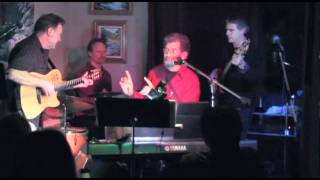
In this spoken‑word introduction, the presenter welcomes the audience and frames the evening as a celebration of life expressed through music. He argues that each person’s life is a story and that music functions as a conversational medium that can foster empathy, community, and compassion. Citing Humberto Maturana’s idea that we create worlds through the networks of conversation we join, he challenges the audience to move beyond isolated, ego‑driven perspectives toward a shared, listening stance. He emphasizes that musicians must play gently so they can hear each other, illustrating how music is a dialogue where every participant matters. An anecdote about an African diplomat at a communication conference underscores the inseparability of singing, dancing, and true communication. The speaker invites the audience to become active participants—hum, clap, snap, or sing—rather than passive observers, and cues the band into a D‑minor vamp to begin the musical experience.
Chapters
Again, another welcome to Michael Madigan, Ron Gerwitz, Kit Bailey, Tony Hardwick. Tonight is a celebration of life built around the experience of music. It's all about story, you know. Your life is a story. You write a new chapter every day, willingly, or else you're dragged dragged into it. We all have our song. Each of us has our own dance. Tonight the story is about our conversation in music, in song, in dance, in love. Humberto Maturana said, "We bring forth our worlds through the networks of conversation in which we participate." This evening can be one of conversation, but that's up to you, isn't it? The question is, will we see ourselves as individual warring camps, the old paradigm, or as members of a single community, guiding our choices and our relationships with empathy and compassion, because no community sustains without them. In this world where people spend most of their time looking at a two-dimensional screen, what happens if we look at the deeper dimension within ourselves and the dimension of those around us? Remember when you were a teenager and you used to write and say, "Listen to the words of this song," because it meant something? This can mean something too. Try to feel the state of mind that we place before you. Listen and feel. What did the composer want to say? What is the singer saying? What is the musician playing? Empathy. And so as the forces of the dark side continue to rip off the last little bits of this so-called global economy, we have another change, another choice. When we play as musicians, we're careful to always play so gently that we can hear every other musician because everyone is saying something important. There's a conversation going on because we open, we set aside ego and we feel love because that's what it's all about. Ah, what if we all did that? And so as you participate tonight, you may find yourself drawn to hum, clap your hands, or snap your fingers, or even sing. But listen and hear everyone. Bring yourself into balance. There's a story one time about a certain African diplomat who went to a conference. It was a global conference. On communication. And at a certain point in the second day of the conference, he raised his hands and he said, "When does the singing and dancing begin? When does the singing and dancing begin?" So the moderator said, "Singing and dancing? There won't be any singing and dancing." And the African said, "But you said this was a conference on communication. How can you communicate without singing and dancing?" So my invitation is that you do participate, not as a consumer, not as a voyeur, but as an experiencer. We have to get into our D minor vamp. [MUSIC] [MUSIC]