Life, Love and Healing – A Free Webinar on The Trinity of Being [Episode 18]
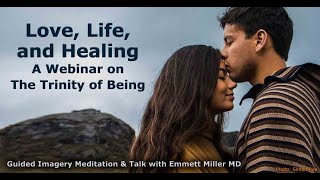
In this 60‑minute webinar Dr. Emmett Miller MD guides listeners through a deep‑relaxation meditation and then shares the philosophical and clinical framework that underpins his “Coherency Theory of Healing,” which he also calls a unified‑field or “new paradigm” of health. He begins with a step‑by‑step abdominal‑breathing exercise designed to quiet the “monkey mind,” release tension, and create a mental “empty space” where old, conflict‑driven thought patterns can be observed and re‑programmed. Miller then recounts his personal journey—from a high‑school environmental activist, through pre‑med mathematics studies, to psychiatric training—illustrating how his clinical observations led him to value the therapeutic relationship, compassion, and practices such as hypnosis, meditation, and prayer. He explains that stress is the root of most physical illness and that deep relaxation allows patients to revisit traumatic memories from a calmer perspective, thereby “rewiring” neural patterns much like changing software on a computer. The core of his model is the distinction between the “old paradigm” (dominance, blame, fragmentation) and the “new paradigm” (wholeness, acceptance, love with a capital L). He argues that when individuals, families, and societies adopt this love‑based, coherent mindset, healing occurs on physical, emotional, behavioral, relational, and spiritual levels. The talk concludes with a guided visualization of love, an invitation to carry this feeling into daily life and civic actions, and a reminder of oneness expressed in traditions such as namaste, the Golden/Platinum Rule, and the phrase “E pluribus unum.”
The show you're about to hear is a recording from Dr. Miller's webinar series titled Life Meditations. He began this series in response to the pandemic, and his goal has been to provide wisdom, practical tools, and comfort to people during these stressful times. Watch the entire series at drmiller.com/lifemeditations. That's drmiller.com/lifemeditations.
Good morning or afternoon or evening, depending upon where you are on this magnificent planet. I'm Emmett Miller, if you didn't know. And I'm really happy to see you here today. We're here every other week at this time doing this series of heart-to-heart talks which really represent, I would say, the more forward-looking aspects of my work about healing, healing at the individual level all the way up to healing at the global level through the use of, I would say, my version of a unified field theory, which has to do with a paradigm shift, a paradigm shift in our thinking that can bring about healing at every level. And every other week I'm presenting a different aspect and a different application of it. And this week we're talking about life, love, and healing, which I hope to show you are actually three different words for the same basic phenomenon. Life, love, and healing. And we're going to have quite a bit of opportunity to go into the deeply relaxed state, the to experience a meditation which is, which is a key to what it is that I teach and when I share with people. Many people teach different techniques of deep relaxation, meditation, prayer, autogenic training, on and on. They all take you to this basically relaxed state, but what's— and that's really important because it relieves tension, but it also gives you an opportunity to begin to reprogram your mind and your brain and to correct some of the errors that are going on at that level. So, in fact, why don't we begin with a little bit of relaxation. So allowing yourself to be in a very comfortable position, sitting or lying back, and become aware of the fact that at this moment in time there's no other place that you need to go, there's nothing else that you need to do, and there's no problem that you have to solve. And therefore, you can give yourself permission to relax. And by relaxing, I mean letting go, releasing and letting go. Take a deep breath in. As you let it out, let it be a feeling of releasing completely. Releasing completely. Good. Simply be aware of your breathing, the rising falling of your chest and abdomen with each breath in and out, and notice where the breathing takes place. Some people feel the breathing right up into their shoulders and that little area right next to your neck actually bulges up with each breath in For others, you can feel the breathing mainly in the middle of your chest, but I want you to notice the breathing that goes into your abdomen. Take a really deep breath in and feel your abdomen rises. Let that breath out, feel how your abdomen falls. With each breath, think to yourself the words It breathes me. It breathes me. Feel your abdomen rise and fall with each breath in and out. As you grow more and more relaxed, there's less and less breathing in your chest, in your shoulders, and soon it's mostly your abdomen that's rising and falling. And if you become very, very relaxed, it may take place completely in your abdomen. Abdominal breathing, when you achieve it, is an excellent guide into the state of deep relaxation. After each breath out, let yourself sink into that little pause before the next breath comes in, the quietest time of all for all your mind and body. Feel the little spark of energy that starts each new breath at the end of that pause. Releasing. Feel your entire body expand with each breath in and then collapse a little bit with each breath out. Releasing with each breath out all tension is flowing out of your body. It's growing more and more relaxation flowing throughout every cell of your body, throughout every organ. And as you continue to breathe comfortably, you notice unnecessary thoughts that come along from time to time— questions, doubts, concerns, thoughts about the past. Thoughts about the future, all kinds of thoughts you don't need. Give your mind permission to be quiet. This is your mind. You actually have the right and the power to empty your mind of unnecessary thoughts, but you need to learn how to do that. So each time an unnecessary thought comes along, as soon as you're aware that you're thinking an unnecessary thought, with your next breath out Breathe that thought out through your nose and let your next breath in. Breathe in cool, fresh air. Let it flow through your mind, relax you deeply and thoroughly, peacefully. Good. And you'll notice the thoughts hang around for shorter and shorter periods of time, and there are fewer thoughts and more spaces between your thoughts. Let yourself sink into the spaces between your thoughts. The silent stillness, the quiet and the presence. And notice how you feel and notice what's happening in your mind, just observing without doing. This is now. You are in the present moment. This is the only moment that actually exists, you know. And so everything that's actually happening is happening right now. Be right here. And I'm going to offer you the opportunity to choose to allow yourself to be open this morning, or this afternoon, to all positive thoughts, thoughts of love, thoughts of healing, thoughts of the beauty of life. Just choose to let yourself be open to that. As we continue this morning. And you allow yourself to come back to being wide awake, letting your body stretch and move, allowing your eyelids to open when you're ready. And take a few moments And notice how comfortable you feel. Good. I hope you enjoy that. So as I share what I share, I really like to share things in a chronological sequence. Just as when we look at life, I like to look at life starting at the beginning, not just what happened yesterday or what happened in the debates last night or what happened 6 months ago, but let's take a look back and kind of take a little journey with me through time. I'd like you to see how things introduced themselves to me. Now, I guess I have always been a visionary in some way. In my high school years, I became very concerned about the way human beings were negatively impacting the environment. That was 19— Ooh, '58. Not many takers back then. But it seemed obvious to me that the way that we were headed on this planet, we were going to end up in a catastrophe, whether it was going to be a nuclear war or environmental collapse or some other imminently avoidable disaster, even the ridiculous thought of a pandemic. I even wrote a poem describing how greedily we human beings were stealing from the planet. And my, my poem ended with the words, "Don't worry, Earth, he'll soon stop this pelf, for man is intent upon destroying himself." It's kind of bleak for a junior in high school, huh? And pelf, of course, means thievery. Man will soon stop this thievery. And when I learned about the mechanical way that doctors usually went about making diagnoses without thinking about the whole patient, it convinced me to add pre-med to my major course of study, which was in mathematics, uh, because I had a friend who was horribly misdiagnosed and had to miss a year of school. And I said, well, how did they reach that diagnosis? And when I looked I looked into it, I said, "Well, that's— that doesn't make sense mathematically." You know, I'm a seeker after the truth. So I decided to go to medical school to see if I could learn enough about human beings and humanity to help put an end to the disaster that seemed so imminent to my high school mind. Then in medical school, I realized that my relationship to the patient seemed to be a more important factor in their healing and yet very little attention was paid to it in the usual practice of medicine. Everyone thought that the drugs or surgery was what was responsible, but I found that my relationship with them had something magic in it. Then in my psychiatric training, I discovered that my patients would improve much more quickly and completely if I connected with them in a human and a compassionate way. Took off my white coat and sat close to people and felt with them and breathed with them, and magic started to happen. Just instead of seeing a patient as sort of a chemical experiment that we would dump various chemicals into to see, you know, which one would work. Then when I got into private practice, I expanded my medical practice from the usual primary care, uh, general practitioner, family practitioner model. And I expanded it to include the techniques of hypnosis and meditation and prayer because I noticed that in all of those techniques, people who practice all of those tools, um, have magic happen in their lives. And they all prove very effective at lowering people's level of stress and anxiety and tension. So by the '70s, I was clear that stress was underlying most of the physical illnesses that I was seeing. And all of these techniques—meditations, self-hypnosis, prayer—all of them involve what? Creating a physically comfortable environment for people to be in and then somehow inducing them to allow their bodies to relax, then guiding their thoughts away from any conflictual or anxiety-producing material towards images of relaxation, security, or beauty. And so depending upon what technique you're using, you might have the person looking at or visualizing a candle or in another technique, a beautiful garden, or praying in a lovely, beautiful, fantastic chapel, rich with incense and sacred images, saints all around, or perhaps a spirit guide is what you visualize, or imagine resting as a child in the arms of a loving grandmother. Or perhaps you'd picture Jesus. Well, whatever people chose to pick, because it was meaningful to them, it could guide them into that deeply relaxed state. Now, once the person had relaxed, their body would begin to heal, and after 10 or 15 minutes or a half hour of relaxation in my office, people would leave renewed and refilled, but it would only last a certain period of time because they walk straight back into this stress-laden world that we, that we live in. But once the person was in that relaxed position, I found that then we could begin to examine— examining conflictual material, traumatic past events, from a calmer wiser perspective. And then once we had looked back with a higher part of the mind— because in this relaxed state, and I made this point many times, I can't make it too many times— when you're anxious, tense, fearful, angry, frustrated, jealous, envious, all of those kinds of negative emotional states, because they represent actions of the monkey mind that believes that you are in a life-or-death emergency and you're going to be dead in 5 seconds if you don't react. So it pours out these emotions. You don't say, "Gee, I think I'll be relaxed," or "I think I'll become depressed today," or "Hmm, I think I'll become furious." You don't. It comes. Where does it come from? "You made me angry." Mm-mm. "I made me angry." My monkey mind made me angry. It makes you angry. It makes you dispirited and depressed, anxious, fear, all those feelings. But when those feelings happen, then here's the point: your cognitive ability is decreased. That's why you make so many stupid decisions, you know, like another drink before you drive home, or I'm just gonna have an affair, or I'll just buy this and that'll make me happy. Why the hell did I buy— you know? So when you act under tense circumstances, you do not make wise decisions. In fact, the decisions you make often— and you end up in even more of the same problem. So in this state of relaxation, a person can look at those things that they've been having trouble looking at. If you know somebody who has a bad habit, let's say drinking or or losing their temper or blaming, and you say, "You know, you have a bad habit of drinking or losing your temper or blaming," they resist you. It's so obvious. And you say, "Here, I've made a video of it." And they say, "Don't, what are you trying to do, manipulate me?" Or it's like, they're in defense of it. What that is, is the monkey mind. The monkey mind knows that if you discover your role in the mess you've made of your life, of the symptoms that you created in your body, of the relationships that you destroyed, of the poor decisions you've made when you went to vote— if you ever looked at that, it would be painful. But your monkey mind doesn't want you to feel pain because it thinks pain means you're going to die. So it defends you against seeing what you really need to see. But once you're deeply relaxed, then you can look at the things that's otherwise hard to look at. You can look back at things— early childhood abuse— it's all there, it's all bright and clear. And until you've dealt with that, you'll continue to be led astray, and you'll see why in a few moments. Okay. —back from my digression—I found that when people relax deeply, we can look at those situations and we could rewrite the person's script, basically reprogram the mind, basically rewire the brain the same way as you may go on your computer or your phone from one app to another. This app lets you make a phone call, this one lets you dictate something. This app over here lets you unlock the door. This one over here tunes you into a radio show. It's the same computer. What's different? It's just got a different configuration. And then that's how you are. These are different configurations that are possible. And if we find a configuration for your mind, a way of thinking, of feeling, a way of believing— those are all behaviors. Thinking, feeling, behaving— your emotions are behavior— if you find a more effective way to think and feel and behave, in other words, a different algorithm, a different program, enter that into your mental computer, into this empty space that we've produced, we begin to see amazing changes physically, emotionally, mentally, behaviorally, relationally, spiritually. Remarkable. That's what's kept me in it. I always felt I could do anything I wanted to. I was brilliant, I was strong, I had some connections, and I was clever enough to know how to get where I wanted to go. This was delightful to me because I felt that I was now in touch with my Unified Field Theory, and at the time I called it the Coherency Theory of Healing. Because our illnesses and our dysfunctions and our unhappiness, our failure, etc., are due to incoherent behavior of your brain. And the Coherency Theory talks about how we can become coherent. That's sort of an overall picture of what we're talking about here. And I gradually began to see that, uh, in other words, what was happening with people was awfully similar. There's this overall pattern that emerged the kind of thinking that focused on blame, on guilt, on shame, fear, anger, resentment, opposition, prejudice, fragmentation, suspicion, us versus them, either-or ways of looking at the world, prejudice— those kinds of thinking were going on, no matter what the subject was, you know, if it had to do with your workplace, if it had to do with your sport, if it had to do with a friendship, if it had to do with a spiritual challenge or an existential question, to the degree that we were having that kind of thinking, we would be unhappy and it created illness in the body. And then it became clear that when we create an external and an internal atmosphere of acceptance, of embracing, of peace, a both-and attitude, when that happened, we began to see deep healing, which means deep healing not only on the physical level but on the mental, the emotional, the behavioral, the spiritual, and the relational, all levels That's why I called it Deep Healing. That's the title of the book I wrote in, in the '90s, um, for the purpose of introducing the world to this new kind of healing that's becoming pretty well known, I think, throughout our culture now, but still pretty far behind where I find myself being. I also found that when you create that same kind of atmosphere in the relationships between people in couples and families that I was counseling, that created healing at the group level. Just as you can heal— healing means returning to a state of greater wholeness, right? If you cut off my finger, I bleed, bleed, bleed, bleed. But healing means that part of me closing, growing a new layer of skin over a scar over it. Now my body's whole. Until my body's whole, I'm going to be getting weaker and weaker as I bleed. In the same way, when families and relationships aren't whole, then they bleed constantly. Everybody gets happier— gets more and more unhappy. But getting happier, having the attitude of acceptance, gratitude toward each other, patience, feeling secure in the relationship, that brings about healing at the group level. And so I gave this coming together and healing in this way at every level, because of the quality of those feelings, I gave them the title of Love with a capital L. And that's really what we're going to be exploring today is how, how this works. So I began to call this new paradigm of thinking the new paradigm. The old paradigm of thinking, where you think is you walk into the situation, you see opposition, you look for dominance, you try to avoid being dominated, or else you dominate, control, violence, conflict, name-calling, criticizing. That's what I'd call the old paradigm. And the new paradigm had to do with looking at wholeness and creating within that peaceful structure that I've been describing to you. So, and then of course it goes beyond that to the environment as a whole, and we love our planet, it will love us back. I'd like to close by asking you to take your awareness inside for a moment. Just close your eyes. I ended that by talking about the dark force. We'll get into that and how to transform the dark force, Forces, it's nothing compared to the power of love. And we're going to talk about how to do that later, but because of that, how that was produced, that particular show, I went into that. But for now, I want you to just touch into that concept of love with a capital L and become aware specifically of when you felt it. Maybe with a puppy or a kitten, maybe with a fantastic grandparent or a parent, maybe with a lover, maybe a beautiful symphony, or listening to Ravi Shankar tune his sitar, or a beautiful sunset, a fantastic poem, whatever it might be. But I want you to feel it, picture it in your mind, any of those things. If you can go from one to another, whatever makes you feel inside that powerful feeling of love. The desire to care for another, feeling of compassion, a sense of oneness, celebrating the joy of another person. And to think about that greeting from the Buddhists and the Hindus, namaste, which means within me there's a place of love and light and beauty and harmony. And within you there's a place of love and light and beautiful beauty and harmony. And when you're in that place in you and I'm in that place in me, as we are now, there's only one of us. Don't let appearances fool you. I am you and you are me, and we are all together. That oneness is a truth. It's the truth that Jesus talked about, that Gandhi talked about. Notice Jesus wasn't saying an awful lot about, well, you know, let's send the migrants back at the border and break up their families to teach them a lesson to not come. No, he didn't say that. Gandhi didn't say that. Martin Luther King didn't say that. The healers didn't say that. The healer says we are all one. Do unto others as you would have them do unto you. The Golden Rule, or the Platinum Rule: do unto others as they would have you do unto them. What can I do for you? How can I serve you? And so What if we took that into everything that we did? And you know, if into even things that it doesn't seem— when you're walking down the street or when you're going through the grocery stores, you pass each person, you know, I am you, you are my consciousness, we are one, I love you. I may not like your ideas, I might not like how you dressed, I might not like your politics, but I love you. We are part of one meta-organism. And if we could get to know each other, we could discover the truth that there is in that. And if this were at a time when people were, let's say, going out to vote, I would say to try to carry that love with you. Even as you see these people who are stuck in their cages of anger and blaming each other and negativity, Go beyond that and be loving and cast your vote with love and cast your vote for those who you believe in your heart are most likely to bring us together as a compassionate whole. E pluribus unum. Out of the many 'Let us become one.' Imagine you can carry that love with you now and share it with each person that you meet in whatever way is appropriate. See if you can make it last for a half hour or an hour or day. So keep practicing this imagery. Use whichever ones of the imageries that you have, either on the island of peace or there's a love imagery. And I'll try to send you a, send you a follow-up note and let you know what specific imagery experiences might help you get in touch with and sustain that love. That's what 50 years of studying this have taught me. It's bound to be a little bit of truth in it. Give yourself the openness to discover how much truth there is in it for you. So until next time, namaste, much love.
If you enjoyed this video and found its information helpful, please like, comment, and subscribe to Dr. Miller's YouTube channel. Doing this will help to get Dr. Miller's content to more and more people. If you'd like to watch the entire webinar series, you can do so at drmiller.com/lifemeditations. That's drmiller.com/lifemeditations. Be present. Be kind. And be well.










