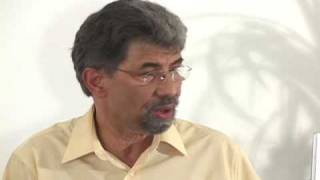
In this reflective talk, Dr. Emmett Miller illustrates how stepping outside conventional thinking can resolve conflict and foster compassion. He opens with a French‑Revolution anecdote where a captain, faced with orders to fire on rioters, creatively orders his troops to fire into the sky, creating a deafening sound that disperses the crowd without bloodshed. Miller then shares a poem by Thich Nhat Hanh, “Call Me by My True Names,” emphasizing the unity of joy and pain and the importance of recognizing all aspects of self. Building on this, he proposes a dual‑energy model: a violent, differentiating force that fragments and a unifying, love‑based force that pulls together. He traces these forces back to evolutionary history, from single‑celled organisms to predators and prey, arguing that humanity’s modern global interdependence requires a shift toward the love energy. The talk concludes with a call to apply this unifying force for personal mind‑body health, compassionate relationships, and societal transformation, directing listeners to his mind‑body resources at drmiller.com.
Chapters
Another story that I like of how we can solve problems if we step beyond is the story that took place back during the during the French Revolution. There was a captain who had lived in this town for some time. The people in the town had come to the town square and they were rioting. So the general got word that this was happening and so he sent a message back to the captain and he says, "Have your men fire into the rabble." And the captain goes, "My goodness." I mean, he knew these people and, you know, the thought of shooting and killing them, which would only make them riot even more. And yet, you know, you didn't, you can't disobey a direct order, so he's stuck. But he was clever. So he told his soldiers, "Point your guns at the sky, ready, aim, fire," and they all pulled the trigger at the same time. So of course there was this deafening sound that echoed through the town square. And the rioters stopped. "What was that?" And in that moment he said, "I have just received orders to fire into the rabble. However, as I look out into the crowd, I see that there are some fine, upstanding citizens of our town. So I will allow 2 minutes for those citizens to leave the town square, and then I will commence firing into the rabble." And 2 minutes later, the town square was empty. And the riot was over. There are solutions, but you won't find it unless you're able to step outside of the box. And one of the boxes we find ourselves in— and again, this is what we've been taught to feel by the system that we've grown up into— we found ourselves to be separate. Back in, I think it was probably about 1977, '78, '79, I met a fellow and I was looking at his journal. He was traveling through, he had a logbook. I said, "Can I look at your journal?" He said, "Yeah." I was there reading the journal and he wrote in there things that he had found and I found a poem in there that changed my life because I was looking, how can I understand things better? And the poem was written by a fellow named Thich Nhat Hanh, and he wasn't very well known at that time. I didn't know who it was, but I copied the poem and it's been very important to me, and I'll share it with you. It's called "Call Me by My True Names." Do not say that I'll depart tomorrow, because even today I still arrive. Look deeply, I arrive in every second. To be a bud on a spring branch, to be a tiny bird with wings still fragile learning to sing in my new nest, to be a caterpillar in the heart of a flower, to be a jewel hiding itself in a stone, I still arrive in order to laugh and to cry, in order to feel and to hope. The rhythm of my heart is the birth and death of all that are alive. I am the mayfly metamorphosing on the surface of the river, and I am the bird which, when spring comes, arrives in time to eat the mayfly. I am the frog swimming happily in the clear water of a pond, and I am also the grass snake who, approaching in silence, feeds itself on the frog. I am the child in Uganda, all skin and bones, my legs as thin as bamboo sticks, and I am the arms merchant selling deadly weapons to Uganda. I am the 12-year-old girl, refugee on a small boat, who throws herself into the ocean after being raped by a sea pirate. I am a member of the Politburo with plenty of power in my hands, and I am the man who has to pay his so-called debt of blood to my people dying slowly in a forced labor camp. My joy is like spring, so warm it makes flowers bloom in all walks of life. My pain is like a river of tears, so full it fills up the four oceans. Please call me by my true names so I can hear all my cries and all my laughs at once, so I can see that my joy and pain are one. Please call me by my true names so I can wake up and so the door of my heart can be left open, the door of compassion. I'm sure all of us have felt empathy, all of us have felt compassion, and all of us have felt love. What I'm trying to say is that the core of every one of us is love. What— and by love, you know, I don't mean necessarily hearts and flowers. There's different kinds of love. There's the love of a mother for a child. There's a love of a brother for a sister. There's the love that a man or a woman may have for the work that they do. There's a love that you can feel for your pet. There's a love that you can feel for your community. These boys and girls who are off at war, you know, willingly running into dangerous situations and being killed because they love their home, their country. All of these are forms of love. But how are they alike? They're alike because it's the energy that pulls together. So there are two forms, there are two forces, two forms of energy. There is that kind that wants to break things apart. To fragment things. It's the energy of differentiation. It's the either-or. It's the black or white. And then there's another energy, another kind of force, and that's the kind of force that will pull things together. That is the vo— the energy of unity, the energy of merging, of attractiveness, of holding together. And so I call that the energy of love. And that's what I mean, just what it is that causes us to want to pull together and be whole. And so if you meet a person, instead of thinking about that person, how can that person hurt me, or how am I better than that person? Or if you're in a conversation with someone, how can I win? How can I make my point? How can I prove them wrong? Instead, you're much more interested, what do I share with this other person? What might that other person have to offer me? What might I have to offer this other person? A different way of coming together. And one of the things that we're going to do as we go forward into the next presentations that I give, we're going to do more about connecting with each other. And it'll all be based upon the things that we've talked about now, about these two forces. It's not that we shouldn't differentiate. There are dangerous things in the world. And if there's a car coming at me down the road at 60 miles an hour, it's not by saying, hmm, wonder what this car can give me. That's not what it is. I have to get out of the way. And there are times, you know, you need to eat. And so in order to eat, you need to pull that carrot out of the ground, which kills that plant. You're going to die if you don't eat. You have to do that. So some of the things that you do in your life are violent, and that's what I call this other energy—violence with a capital V. It's that one that sets up a difference between us, as opposed to that one that looks for what we have, what we have together as a as a community. And in looking at— as our interplanetary leader, when he looks at this development of the life force and all of this community, there's a dark force that comes along at the same time. In the beginning, all these little one-celled animals, they just swam around and eat whatever chemicals were there. And then you had multicellular animals and they kind of ate whatever was there, but pretty soon animals discovered, hey, I don't have to go out and eat all day long. I can catch another animal and eat it. And so all of a sudden, tooth and claw became the name of the game. And so you had predators, and now you had victims. And so this is really how the world developed. We developed out of that. And so there's an ancient history within each of us that is aggressive, it is defensive, It feels anxiety, it feels anger, and it looks for differentiation. And it produces the kinds of conflicts that we see, it produces the fears that we have, it produces anger, it produces the resentment, and ultimately gives rise to all of that— all of this dysfunction and all of the imbalances that we see around us. As I said, It was okay if we had that energy, we loved each other, and maybe we didn't like those guys out there, and we could be angry with them. The problem is now because we're— we've become a globalized planet, we need to shift. We need to rise up to this next level where we understand what it is to We understand that force that is within us that I call love, that we understand how to use it, that we understand how to use it within our own bodies to heal ourselves, and that we learn how to create relationships with it. For more information on mind-body health and Dr. Miller's CDs, DVDs, and books, go to drmiller.com. That's drmiller.com.