The Magic of Forgiveness – Guided Imagery Meditation & Talk [Episode 28]
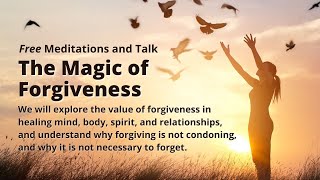
In this episode of Dr. Emmett Miller’s Life Meditations series, Dr. Miller presents a comprehensive exploration of forgiveness, blending scientific evidence, spiritual perspectives, and practical techniques. He begins by defining forgiveness and distinguishing it from condoning or forgetting, emphasizing that harboring resentment harms the individual’s mind, body, and spirit. Drawing on research linking forgiveness to lower blood pressure, reduced depression, stronger immunity, and improved heart health, he argues that forgiveness is a self‑gift rather than a favor to the offender. Dr. Miller outlines a step‑by‑step framework for forgiving others—making a conscious commitment, recognizing the value of forgiveness, identifying who and what needs healing, seeking support, processing underlying emotions, and finally choosing forgiveness while releasing the victim identity. He then shifts to self‑forgiveness, guiding listeners through a detailed guided imagery meditation that moves from body relaxation to visualizing a loving inner child, extending love and forgiveness to oneself, and then outward to parents, friends, and broader groups. Throughout, he references Buddhist teachings, the “monkey mind” versus the higher mind, and the importance of grieving loss before letting go. The episode concludes with calls to explore related Dr. Miller programs (Accepting Change and Moving On, I Am: Awakening Self‑Acceptance, Writing Your Own Life’s Script), donation information, and encouragement to share the content.
The show you're about to hear is a recording from Dr. Miller's webinar series titled Life Meditations. He began this series in response to the pandemic, and his goal has been to provide wisdom, practical tools, and comfort to people during these stressful times. Watch the entire series at drmiller.com/lifemeditations. That's drmiller.com/lifemeditations.
Hello, this is Dr. Emmett Miller. Welcome to today's webinar on forgiveness. Although we often hear about forgiveness in a religious context, such as in the Bible where you'll read, "If you forgive other people when they sin against you, your Heavenly Father will also forgive you." That's Matthew 6:14. There are actually very good scientific reasons to forgive yourself and others, not only spiritual ones. Harboring blame and resentment do far more damage to the vessel that holds these destructive humors than it does to their target. We'll explore the value of forgiveness in healing mind, body, spirit, and relationships, and understand why forgiving is not condoning, why it is not necessary to forget in order to forgive. I'll share with you some of my thoughts about forgiveness and also some guided imagery and meditation to enable you, if you wish, to embody these principles and taste the freedom that results. We'll begin in a moment. Prepare to relax. And enjoy. Thank you so much for your donations. They really are, you know, helping us defray the cost of providing these programs for you. I'll be discussing more a little bit later on. I'll try to talk about some of the programs that I've done that you might use to follow follow-up on what we do today. And that's another way that you can help support us. The audios, the videos, the books, and other things that are on drmiller.com, drmiller.com, or shopdrmiller.com. Such things as accepting change and moving on which would be a really good program for this. Your purchase of those are always helpful. The third thing that you can do to help support this program are to tell other people about it. That's really the— would be the best thing, is if we can get ourselves a nice good-sized audience, and then we'll be, as they say, in the black. So without further ado, let's begin to explore something about, something about forgiveness. Webster's Third New International Dictionary defines forgiveness as to cease to feel resentment against someone or something on account of a wrong committed to cease to feel resentment against someone because they did something you feel is wrong. And of course, we're going to be making the point that perhaps feeling resentment is worthwhile for a little time, maybe, but certainly over the long run it's very, very harmful. There's a well-known Buddhist story about two monks who encounter each other some years years after having been released from prison where they had been tortured by their captors. "Have you forgiven them?" asks the first. And the other responds, "I will never forgive them. Never." And the first responds, "Well, I guess they still have you in prison, don't they?" So forgiveness has to do with letting go of grudges and bitterness. When somebody you care about hurts you, you can hold on to the anger and the resentment. You can harbor and nurture thoughts of revenge, or you can choose to embrace forgiveness and move forward. Now, that's a choice. The resentment and the anger, they kind of come automatically. These have you know, much to do with the monkey brain. This is a monkey brain trying to defend itself against the world by being on guard and being angry. And I mean, we've all been hurt by someone many times, in my systems, by groups, by friends, by loved ones, and have felt quite physically or emotionally abused in that way and left with anger and bitterness and even feelings of vengeance. But if you hold on to those, you will make yourself sick. By embracing forgiveness, you can instead also embrace peace and hope, gratitude and joy. And to kind of see how the lack of forgiveness can continue to hurt us, just think about if you went to a play or a concert or gathering, a dance or something like that, and the first half of the play or whatever, you're really enjoying it, just as free and happy as you can be. You're there with somebody you're close to. and then comes the intermission. And while you're in the intermission, you look and who do you see but that guy, that guy that you've never forgiven. And you haven't seen him in 5 years, but there he is. And he looks like he's having fun. And you just get ticked off. And then all that resentment comes up and the anger. "Oh, Christ, God!" And then Dong! It's time to go back into the play. Guess who's not going to enjoy the play? I mean, you've just stolen from yourself an hour or two of enjoyment, perhaps the rest of the day. You may even be talking about it the next day at work. You tell your colleague, "Can you believe it that I had to—" So just think about it. That's those ways that you can be emotionally hurt by hanging on to it. As they say, that resentment— and of course it is resentment that keeps you from forgiving— resentment is a poison that eats away and destroys the very vessel that contains it. And remember, forgiveness doesn't mean forgetting. It doesn't mean excusing the harm done. To you. And it doesn't mean you have to make up with that person that caused the harm. Instead, forgiveness is a gift that you give yourself. People say, well, I'm angry at him, I'm resentful, and he deserves that resentment, he doesn't deserve to be forgiven, right? And of course, what you're doing is continuing to punish yourself. And We won't have time to look back into each of our individual histories, but if we have a tendency to not forgive others, it's often because we've come from an environment where we weren't forgiven, and we learned to not forgive. We learned to hold on to— learn to hold on to resentment. In addition, we often find out that it is we who have been— who have not been forgiven. It's other people have had resentment for us, particularly in, in earlier years of our lives, and often we've learned from them to not be forgiving of ourselves. You know, and when you registered for our program today, um, and I asked you to, if you had any questions concerning this presentation today, and many of you talked about, how can I forgive myself? How can I stop blaming myself? And feeling guilty over past actions. And it's true that it is self-forgiveness that's very, very important. And so we're going to talk a little bit about self-forgiveness and have an experience to initiate and embody that self-forgiveness in just a few moments. So You can let yourself find a comfortable place to lie down or relax, be comfortable. And meanwhile, think about it, that letting go of grudges and bitterness can make way for health and peace of mind, can lead to healthier relationships, improved mental health, less anxiety and stress, and hostility, it's been proven to lower your blood pressure. You'll have fewer symptoms of depression in your life, and you'll have a stronger immune system. Like if you want to fight off, oh, I don't know, viruses or things like that. Yeah, this is one of the ways you can help your immune system be stronger. As you notice in the free programs I've given for preventing and Dealing with Coronavirus, I talk a lot about reaching that place of peace within and empowering your immune system. This is another factor in empowering the immune system. It also improves your heart health. Your cardiac health is also improved by letting go of resentment than by forgiving. And of course, you'll tend to have improved self-esteem. So those are the kinds of things that you can look for. And again, I've just been speaking of things from a scientific background, and I haven't, haven't even gone into the religious justification for Letting go of a grudge. So let's go ahead and have some experience related to self-forgiveness. And of course, when we carry around guilt and shame and anger at ourselves and are having trouble forgiving ourselves for things that have happened in the past, then this will be particularly important. You can begin by letting your body be in a comfortable position and be aware there's no other place that you need to go at this moment in time. Our goal will be to focus as much attention as possible on healing that child within by forgiving that child within. Allow yourself to be aware that there's no other place that you need to go at this moment in time. There's nothing else that you need to do There's no problem that you have to solve, and therefore you can give yourself permission to relax, to relax deeply and thoroughly, and be aware there's no problem that you have to solve at this moment in time. Therefore, you can relax. See, we begin by looking at things from the higher part of the mind that knows there's no need to think about the past at this moment in time. Right now. There's no reason to look for questions to answer, look for problems that you have to solve at home or at work. You don't need to look forward and guess what's going to happen tomorrow. Be here in this moment because this is the only moment that actually exists, and therefore your body can relax into this safe place of peace, to allow your body to just sink into the surface beneath you. Let each breath breathe out unnecessary thoughts. Imagine you're standing beneath a warm shower of pure relaxation. The relaxation flows over your body and sinks deeply into your scalp and your face, your neck and your shoulders and arms, into your chest, your abdomen, your pelvis and thighs and knees, your legs and your ankles and your feet. More and more relaxed with with each breath. And now you can bring your awareness completely into this special moment right now and feel the peace and the tranquility of this moment, knowing that you are totally safe. And therefore you can let go. Let go of unnecessary stress and tension. Allow yourself to be in this moment. That's it. Good. Because as you relax and come into the present, the higher levels of your mind are able to think more clearly, are able to analyze, to understand, to see the truth of this moment and of the world at this moment. By coming into the present, you allow the lower parts of your mind, the monkey mind, to be at peace, to be calm, because the higher part of your mind knows there is beauty within you at your essence. There is good in you, and the higher part of your mind realizes that the world does not always recognize the truth of who you are, and that you have been injured with words spoken and written, with actions. You've been treated unfairly. And at times you may have learned from the world to be unkind to yourself. And the higher part of your mind can understand here in this moment as you take a deep breath in and let that breath out, releasing any tension in your body, emptying your mind. So the higher part of you understands that those negative experiences are just like, like barnacles that attach themselves to the hull of a great ship, and that right now you've reached the point where you can choose to let go of all those false learnings. To go past the blindness of the world, the blindness of the past. Now you can go deep within to discover the essence of yourself and to allow yourself to travel. And as you travel, continue erasing unnecessary thoughts as they come along, erasing doubts or questions or concerns, letting them go. This is your mind, and now you are present to guide yourself gently back to a very special place of peace and calm, a time when you are feeling really happy, joyful, free. Relaxed, maybe on vacation, maybe during a meditation or a deep prayer. Imagine going to that place, your island of peace, wherever it might be. Travel there now on your magic carpet of imagination. And allow yourself to be in this safe place and let it represent total relaxation, this island of peace. Good. Great. And now allow yourself to make contact with that essence of your being. As you recall in your mind's eye a time of feeling love, perhaps you were with someone that you feel really close to or felt really close to. Perhaps with a pet or an animal that you love and felt love from. Maybe being with a child. Whatever works for you. That place of love that you can allow yourself to feel. Now, at this moment in time. And give yourself permission to feel that love now, because it lives always within you. Sometimes you might forget it or be distracted from it. Feel that love, the openness the vulnerability and the totality of love at this moment in time. In love at this place, as if you're surrounded by a warm cloud of love. Safe. And let yourself know that at the center of you at your essence is love. And as you allow the air to continue to breathe you and sink down into that little pause after each breath leaves and before the next breath begins itself, feel that little spark of life that begins in each new breath in And think of that spark of life as a spark of love from the spirit that moves through all things, rekindling your essence and your life. And with each breath out, think to yourself, I am this love. I am this love. Good. And notice where you feel that love most strongly in your body and give yourself a physical signal, maybe squeezing your thumb and one of your fingers together or holding your hand in a certain position. Perhaps placing your hand on your chest over your heart as you think to yourself, "I am this love." And let this touch anchor the love within you. And anytime you need to remember the truth of you are, the truth of who you are, come back to this place inside. Give yourself this signal again, placing your hand on your heart, or whatever signal you've given yourself. That's it. And even as you're in touch with that truth of who you are, the higher levels of your mind can understand the confusion that you had as a child, the confusion that this youthful part of you had in trying to deal with a world that wasn't kind and that didn't honor and recognize this essence within you. And so you can understand, fully understand, the mistakes that you've made, some of the anger and resentment that you carried away from those experiences. You can understand and forgive even the ugly thoughts that you may have had back at that time. Maybe there are even things that you did, but you are love and you can understand them now as the natural reaction of this essence of your being. Trying to keep itself alive and defend itself against the world. And you can forgive that child that you were. Picture in your mind's eye that child that you were when you experienced that abuse, and forgive that child. And forgive yourself for believing the names that you were called. Forgive yourself for calling yourself those names. Forgive yourself for believing the unkind things that were done to you. Forgive yourself for thinking that it was okay that they were done to you. And know that you are love, and forgive yourself for any of the unkind things that you did to yourself or to others as a result. Complete forgiveness is complete freedom. Good. Forgive that part of you that learned to be unkind. This is not the truth of who you are. Forgive yourself for unkind things you may have done to others as well as yourself. And experience within right now your willingness to be the truth of you, who you are, beyond anyone else's words or projections or ideas, and accept yourself deeply, forgiving yourself and knowing that you are beyond all of that now, and willing to be the truth of who you are, and to recognize that you have a purpose, a mission in being here, and you are gradually discovering that. Mission and committing yourself to following that path that is yours. Good. And in your mind's eye, see that child that now you've been forgiving and giving love and acceptance to. Allow yourself to feel the love and forgiveness and acceptance that swirl around you. Feel the gratitude for having the gift of seeing and knowing the truth that you are. Feeling a deep sense of gratitude For knowing this essence and being able to choose to let it be with you always. Gratitude. Good. Knowing that you are love and feeling within yourself the capacity to forgive yourself and whenever you choose to forgive others. And know that you have the capacity to understand now, and that even though you may need to protect yourself from others, you can still understand that their actions come from their own internal pain and abuse the programming they got by being tortured in ways that you'll probably never know. But you know that it's there, and you can forgive them and wish them health and happiness. You can honor that place of love within you and even wish them love. And as you feel that love within you once again, give yourself your signal, whatever it is. Squeeze those fingers or place your hand on your heart. Feel that love that you are, giving yourself permission to express this love in kind, loving ways in your life, in ways that are creative. And imagine yourself becoming fully the person you really want to be, that person that you came here to be. Picture yourself doing that, allowing that beautiful spirit that you are to come into reality, to allow yourself to be love, to give love and express your truth in so many ways. And anytime you need to remember the truth of who you are, remember this signal. And come back to this place within with the ability to express the truth of who you are in whatever way you possibly can at every moment in time. Good. And now just gently bring yourself back to a full and complete wide awake awareness of the space around you. Good. And take a few moments and notice how comfortable you feel, and realize that you feel that comfort because you have given yourself permission to. You feel the love because you have intentionally and consciously, with the higher levels of your mind, given yourself permission to feel it, to be it, and know that you have the power to do this anytime that you want to. The important thing is knowing when you need it and taking those few moments to allow it. Good. And you know that the opposite of being forgiving is being unforgiving, which means that you will always bring a little anger and bitterness and negative expectation into every relationship and every new experience, as if By being resentful and suspicious, you can protect yourself. What you protect yourself from is ever being able to feel love. You can become so wrapped up in the wrong that you can't enjoy the present moment. You can become anxious and depressed, begin to feel like your life lacks meaning and purpose, and you lose valuable and enriching connectedness with others. That's why it's important to let it go. And when you think about it, what do you gain from hanging on to resentment? It kind of feels natural, sure, because you've been trained to believe in it. But understand that now you have the ability to let go of that tension, and to be in the serenity of acceptance. So, reaching a state of forgiveness. First of all, you have to decide with your higher mind that it makes sense to do this. That this, it not only makes sense, it makes wisdom. To do this. This is a wise thing to do. And so, you make a commitment to a personalized process of change, forgiveness. Then you recognize the value of forgiveness. What are the 5 things, the 10 things that you would hope to gain through forgiveness, that you have learned that you can gain through forgiveness? That's how you motivate your mind to do something. Think of how valuable it will be. And then identify what needs healing, who needs to be healed— sorry, who needs to be forgiven. What needs healing? Who needs to be forgiven? What do they need to be forgiven for? It's really worthwhile if you have a friend, or counselor, or support group, or a spiritual guide who can be with you in this, particularly if it's a deep and troubling resentment that you hold. Think of getting some help with it. And then you need to deal with emotions. Now, that lack of forgiveness. Something's happened. It's not what you wanted to happen. And so, there's what you wanted, and there's what that no-good dirty rat did, quite different from what you would have wanted or expected. So, you have two pictures in your mind at the same time, what happened and what you wanted to happen, and they're different. So, there's cognitive dissonance, between the two of them. And when there's cognitive dissonance, that's experienced by your monkey mind as a conflict, and it thinks, "Conflict? Attacking saber-toothed tiger! Everybody on guard here! We're gonna have to struggle with this." So, there's anxiety, and there's stress, and there's anger, that is triggered just by those thoughts that you're having. And you're fighting the monkey. The monkey mind is fighting because it wants this to not be true. But there's no way to make it not be true. It is simply true. But if you confront the fact that it's true, that what you might have gained, you didn't gain. What you had hoped for didn't happen. What you had contributed to fell through. What do you have to deal with? What's the emotion there? It's a big loss, a loss to your psyche. You may have lost money, you may have lost friends, but you certainly lost. And when you have loss, you have to deal with the loss by going through the process of letting go. And that's why that program I did that's called Accepting Change and Moving On, or even the one called the Serenity Prayer, deal with giving you tools to strengthen your ability to do this. You have to grieve the loss. But if instead you can resent that person for doing it, argh! You see, it's like the monkey mind thinks that if it resents hard enough, if it hates hard enough, if it wishes evil, maybe if it even does something vengeful— revenge is a dish best served cold— because it thinks that it can undo it. And make this disappear, and so you'll only have the thing that you wanted. And of course it's impossible. What it's really doing is shielding you from having to deal with the grief. As Carl Jung said, the cause of most of our suffering is not allowing ourselves to experience legitimate emotions. Like loss. Go through the grieving when you really— it didn't happen. I've cried. I've let it go. And now it's a bright new day. There's no part of me still clinging to the past. So now I'm free. And that's how we set ourselves free from resentment. And that's how we forgive. We have to grieve whatever the loss is. So know what the loss is and grieve that loss, or whatever other emotions are hidden underneath there. In other words, the resentment and not forgiving are escapes. You know, they're like a drug that allows you to not stop and deal with your legitimate emotion. That's how you get rid of them. And then you forgive that person in yourself. You don't have to tell them. You could if that's part of your process, okay, but don't expect that they're going to accept it in the right way. It doesn't make any difference if they know or not. If you're doing a 12-step program, you may go and make amends to someone and say, you know, I've hated you for a long time and I've really given up. Like that, I'd like to forgive. I'd like to let you know that I'm letting go of that and I forgive you for all the things I hated you for before. And it doesn't make any difference what the other person's reaction to that is. Even if you make amends, it's for you. The other person can make what they want of it. They can grow from it. And in so doing, you're moving away from your role as the victim. The resentful person is the victim. Now sometimes you'll see politicians, people who are in politics, who hold office, you know, always feeling they're the victim. People are out to get them. And they're resentful of it and they're fighting back and they deserve to fight back. Playing that role of the victim, it's not healthy. That's bad for your health too. And when you move away from your role as a victim, then you're releasing the control and the power that the offending person and situation have had in your life. So those are the steps: make the commitment, recognize the value of the forgiveness, identify what needs to be healed and who needs to be forgiven, get whatever help you need, deal with your emotions— again, a therapist or guide or coach can help you deal with that— and then choose to forgive the person who's offended you and move away from your role as the victim. Good. And all forgiveness best would start with forgiving yourself, because once you've forgiven yourself, then it makes it easier to totally forgive others. Good. And now I'm going to close with a little more imagery, but First, I just want to remind everybody that you've been sharing time here with me. I am Dr. Emmett Miller. You can, you can find out more, learn more about how to deal with the issues we've been exploring today by trying these programs that, that I've created for this purpose. If you want to watch this show or listen to this show again, you can go to drmiller.com/watch— watch-life-meditations. drmiller.com/watch-life-meditations. Life-meditations. Watch life meditations. The programs that would be really valuable for you to work with related to today's work, you can get by visiting shop.drmiller.com. If you go to drmiller.com, in the menu you'll see a way to go to The shopping. Accepting Change and Moving On. It's about loss and letting go, which are really a number of meditations which are based on the Tao Te Ching. You wouldn't know it by listening to it, but that's part of what's threaded through there. The second is I Am: Awakening Self-Acceptance. And self-acceptance also takes you beyond that self-blame and is part of self-forgiveness. And finally, Writing Your Own Life's Script, which is the master program. There are 4 different experiences on there for changing any pattern in your life that you want to change. This is a way to use your mind to help you do that. Those of you who care to donate, I love you. Donations at shop.drmiller.com/donate. shop.drmiller.com is, um, it's really the store that has been making available the products that I've put together over the last 50 years. I'd like to leave you with one more, one more experience. And again, let yourself be in a comfortable position. And this is imagery based upon the Buddhist principles which I like because the basis— Buddhism is not a religion, it's really a mode of thinking. It's a scientific mode of thinking, actually. The Buddha was an incredible scientist. The essence of Buddhism is the source of all suffering is wanting things to be different from how they are. So it starts with acceptance of now, then you can change it. So put your attention on your breath. Bring up that feeling of love by putting your hand on your chest or giving yourself the signal. And feel the forgiveness in your heart for anything that you think you've done wrong. Forgive yourself for all past omissions commissions as if they're many, many years away. Know that you were a different person. The person you are now is a forgiving person. And feel that forgiveness filling your entire body. Breathe deeply into that love and that forgiveness and feel yourself surrounded with warmth and comfort. And in that spirit of forgiveness, think of your parents and forgive them for any grudges you have— may have held against them. Forgive them for anything that they have done or that you have blamed them for. Understand they too are different from who they were then, and imagine that forgiveness can flow out of you as if there's a fiber of light that extends from your heart to their heart, and let that forgiveness flow through that fiber. Think of your nearest and dearest friends and relatives and forgive them for anything that they may have done wrong or even are doing wrong right now. Fill them with your forgiveness. Let them feel your acceptance. Imagine their being surrounded by and filled with your forgiveness and your love. Extend that forgiveness to your friends, to all the people that you know. Imagine your forgiveness fills their hearts and surrounds them. And expresses your love to them. Take a deep breath in, and as you let it out, think of any special person that you now need to forgive. Someone with whom you have felt resentment and rejection and dislike. Full forgiveness now. Let the forgiveness flow from your heart to reach out and surround them. Think of any group of people that you may have been condemning or disliking, blaming or criticizing. Forgive them. Forgive them as a way of demonstrating your ability to feel unconditional love. Good. One more deep breath, and as you let it out, bring your attention back to yourself, back to the goodness, the love, the beauty, the sweetness that is at the core of your being. Tune into it. Feel it. Feel the love that you are. And gradually bring yourself back up to feeling wide awake, tuning into the space around you. Good. Okay, I hope you're all signed up, um, and you will know what my next presentations will be. I don't have them written down. I have a couple of more decisions to make about them, but they will be— they will be very interesting. I promise you. So make sure you're on our mailing list by what, coming to drmiller.com? If you go to drmiller.com, um, and you will be able to sign up. I think there's a little screen that pops up and that tells you, and that way you'll get an email that tells you what we're covering. Once again, keep those delicious donations coming in. Keep spreading the word to people who need to know, because there are many who need to know in this world of division and polarity, um, and from the political world right down to the personal world. Be a part of this love. Join with all of us. Who are moving in a loving direction. By all means, stay tuned. Namaste.
If you enjoyed this video and found its information helpful, please like, comment, and subscribe to Dr. Miller's YouTube channel. Doing this will help to get Dr. Miller's content to more and more people. If you'd like to watch the entire webinar series, you can do so at drmiller.com/life-meditations. That's drmiller.com/life-meditations. Be present. Be kind and be well.










