Your Two Brains – Meeting the Looming Crisis. Talk & Guided Meditation [Episode 16]
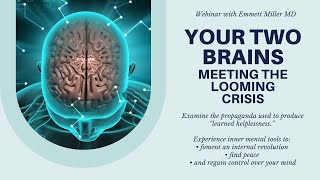
In this 2021 Life Meditations webinar, Dr. Emmett Miller opens with a brief announcement of the series and then launches into a wide‑ranging diagnosis of the cultural‑psychological crisis amplified by the COVID‑19 pandemic. He cites alarming statistics on rising self‑harm among girls, increasing anxiety, and a generation that is less able to self‑soothe because the ancient "monkey mind" (the paleomammalian brain) has been hijacked by modern technology and "attention engineers". Miller explains the dual‑process model of thinking – fast, automatic System 1 (driven by the limbic system) versus slow, reflective System 2 (pre‑frontal cortex) – and argues that over‑reliance on System 1 produces personal and collective dysfunction (illness, addiction, violence, polarization). He describes historical paradigm shifts (hunter‑gatherer → agriculture, Ptolemy → Copernicus, Newton → Einstein) and proposes a new holistic paradigm that integrates analytical and creative logic, love, and cooperation. The talk includes a guided meditation to help listeners relax, access inner safety, and begin the internal work needed for the paradigm shift. The session ends with practical invitations to donate, revisit past webinars, and attend the next session on propaganda, mass hypnosis, and tools for personal and planetary healing.
The show you're about to hear is a recording from Dr. Miller's webinar series titled Life Meditations. He began this series in response to the pandemic, and his goal has been to provide wisdom, practical tools, and comfort to people during these stressful times. Watch the entire series at drmiller.com/lifemeditations. That's drmiller.com/lifemeditations.
Good day, this is Dr. Emmett Miller, and so happy to have you here with me today. First of all, I'd like to make sure that at least somebody out there is able to hear me. So you have at the bottom of your screen a chat button. If you select that and when you add something on the chat, would you send it both to the panel as well as to the participants? And that way everybody's able to see it. Good. Glad to hear that you're able to receive my voice. It's very interesting compared with the first decade of this century. Hospital admissions for girls who are self-harming, a really, really awful thing to think about, the kinds of harming that's being done, children scarring themselves and cutting themselves, but the hospital admissions for girls who are doing this self-harming and for girls committing suicide, young girls, are both up around 70%. For preteens, it's up 169%. A whole generation is more anxious, fragile, and depressed, less comfortable taking risks. Kids are getting fewer driver's license, and the numbers who have been out on a date or had any of any kind of personal or romantic interaction is radically dropping. And for every one of these kids, there's a family who's horrified and traumatized. Saturday morning shows used to have protections for kids. None of that is there anymore. Throughout our culture, when we're uncomfortable or lonely or uncertain or afraid, we have a digital pacifier. And a whole generation is growing up with that and an inability to self-soothe. That ability to care— take care of oneself is atrophied in our culture. Why? Technology has evolved millions of times in the last few hundred years, but our brain hasn't. You have a million-year-old brain on one side of the screen And on the other side of the screen are hundreds of thousands of engineers figuring out how to control it. Well, this is the culmination of something that's been happening now for really the last couple of hundred years, and we've talked a little bit about that in the past, and about how that failure of our brain to keep up with the changing world is really at the base of most of our illnesses and most of our diseases and our slowed-up healing. It's also at the basis of our emotional angst. It's at the basis of the violence and loneliness and separation that we see all around us. It's at the base of this failure that we're having to, to address the kinds of situations that are highly likely to destroy civilization as we know it. And more currently, we're looking at danger to our very democracy. So we're going to be talking about that, and we're going to be talking about a new paradigm that we need to move to. I've been actually studying this since I've been 16 years old, so, so we've got a whole bunch of decades of work by someone who's been very dedicated It's very important what I have to say, and I want you to listen carefully. So I want you to really let yourself come into the present moment. I'm going to talk about things that are maybe not so pleasant to talk about, not so pleasant to hear, and yet it's important because there is an answer. No matter how bleak it may sound at some point, you need to realize that there really is an answer, because that's something, something that I, something that I deeply, that I deeply believe. So I want to begin with a little meditation. That is for you to take a moment and allow yourself to relax, to come into the present moment to realize that there's no other place that you need to go at this moment in time. There's nothing else that you need to do. There's no problem that you have to solve. You can give yourself permission to relax. Be aware that right now you're in a safe place. Therefore, all the muscles of your body can let go. Experience the safety. Experience your breathing. Take a deep breath in. As you let it out, let it be a feeling of letting go. You may continue to watch this surface of the water, these beautiful reflections, or allow your eyelids to close. Whatever you do, go to a very safe and comfortable place within yourself. Allow yourself to be in this moment. Let go of thoughts of the past or the future. Tune into the safety. And no matter what you hear and no matter what you see for these next minutes and this next hour or so, allow yourself to continue to feel the relaxation and safety. Because that will give you the ability to learn what you need to learn. Be in touch with the deepest part of you that you're able to make contact with. Whenever any unnecessary thoughts come along, just let them float by like dandelion fluffs in the wind. Good. [FOREIGN] Breathe that peace and relaxation throughout the rest of your body, breathing in pure white light. And then gently guide yourself back to an awareness of the space around you, reawakening as though you've been asleep for a while. But stay in that safe place inside. It's a very important place to be. Good. Hmm. Let me say once again, thank you for all of you, especially for those of you who have been kind enough to send in donations. As you know, this is a a program that's— we don't have an admission charge, but for those who can afford it, to be able to send some amount our way as a donation will help to keep the technology flowing here. If you— our connection up here in the woods is a little difficult, so sometimes the audio or video can cut out. If so, just comment on our chat screen and be patient, sometimes it takes a minute or two, sometimes the computer just decides to boop, crash on me. So when that happens, just comment and I always do come back. And this is a part of a series of webinars that we're doing and I'll show you a little bit later how you can see all the ones that you may have missed because I do build on past webinars with each thing. So, we're at a very strange and a very, very important time in our individual lives and a very important time in the life of our planet, indeed in the life of our democracy. Have you noticed, I'm sure, I'm sure that you have noticed some of the same things that I have noticed out there in the world, and sometimes it can be even, even a little bit disturbing. We can just begin with our, with our lockdown that we've experienced, the social distancing, the whole problem with, with COVID We're approaching a social and a personal catastrophe unlike any before. The quarter of a million unnecessary deaths from a virus that we've experiencing in this country alone, and many times that number of people who are going to live with long-term health damage. Most of it didn't need to happen. We are confronting an invisible enemy that has had us locked down in our homes for the past 6 months, blocked from our friendships, and blocked from being able to earn an income. And then there's this situation of this surreal mask wearing, running around with all these people wearing masks of, of all kinds. And here we are approaching a quarter of a million deaths. Now, we're in the midst of a heat wave that's on track to set an all-time record. These are just a few of the extremes, the ratio of the extremes in recent years, and we can see how it's beginning to look awfully exponential. Someone once said, "Mankind's greatest failure will be its inability to understand the significance of the exponential curve. All you scientists know what I'm talking about. That here we are with the West Coast of the United States blazing on, on the fire. Uh, there's political violence going on in the streets around us. Highly contentious situation with people carrying weapons, walking the streets with weapons and confronting each other. And then at the highest level of the government, the political violence, this highly contentious and ugly election campaign. I'm a tolerant liberal. Agree with me or else, racist, sexist, homophobic, Islamophobic, xenophobic, inbred, redneck, Bible-thumping, NASCAR-loving, gun-toting, America-loving bigot. And there's the Q and QAnon that is providing the substance for what we're hearing from our government. Whoever heard of that being the conversation that's going on out there? And according to the experts, we're really looking at the possible collapse of the greatest democracy that the world has ever known— ours. And I'm asking you to be relaxed, not because things are great all around us, but because there is beauty and stillness and calm within, and becoming Tense and fearful are not helpful. If you've been following along, you know why. I want to ask you to remain at this moment calm, at that peaceful place within, and to realize that maybe, just maybe, we do have the power to change all of that. Anxiety, although it may seem like a reasonable response or reaction, in fact Anxiety simply creates thoughts and feelings and behaviors that actually paralyze us. Like, it's like struggling when you're in quicksand. You just go in deeper. And what we really need is to realize that all of this that's going on out there is and was completely preventable if we but choose to use the incredible intelligence that lies dormant within our minds. But before we begin treatment, we have to have kind of a diagnosis. We have to have some sense of what we're dealing with. And that which we're dealing with is the fact that we've been doubly hijacked. We've been hijacked by the monkey mind. The monkey mind is what I call that area of the brain, the paleomammalian cortex, the part of the mind that lives in that cortex that evolved a half million years ago and hasn't changed, even though the world's changed incredibly. The monkey mind has not kept up with civilization. All the problems with stress that we see are simply the result of this, and that is really at the basis of most of our illness, as we've discussed. Ah, in a way we've evolved, but in a way, you know, one's hard put to say this really is an evolution. Then the second hijacking has taken place as a result of the craven inventions of the so-called attention engineers, scientists financed by our financial overlords. That are exploiting weaknesses in the human brain that are the result of this delayed evolution. The result is the anxiety and the violence and the polarized tribalism that we see all around us, as well as this massive amount of illness due to this imbalance inside of us, inside of each of us. I want to mention that at this point now, a movie that you can see on Netflix, extraordinary movie, you just have to watch it. It's a fascinating and stunning documentary, and it's entitled "The Social Dilemma." And it features people from Silicon Valley, those who have been working with these tools that I talk about, with the, what the attention engineers are doing. There's people in there such as the Google design ethicist Tristan Harris, who's a pretty remarkable person. Justin Rosenberg, who created Facebook's like button. Harvard University professor, Shoshana Zuboff, the former president of Pinterest, Tim Kendall, and Anna Lemke, Stanford University's Addiction Medicine Fellowship Program Director. It's a remarkable movie. That's, that's Tristan Harris. And I mentioned to you before the book, it's called Mindf— and it's by Christopher Wiley, and it's absolutely mind-blowing as well. What I'm talking about is how our minds have been manipulated, why little girls are killing themselves, why husbands are beating their wives, why there's so much, um, addiction and deaths from addiction that's going on out there. And in this movie— in this book And Philip Wiley talks about how he helped create Cambridge Analytica and how they dramatically influenced numerous elections around the world, including Brexit, and including our last presidential election. And you'll also learn how other countries, Russia, and Iran, and China, are also chiming in because it's nothing for them to create 10,000 or 100,000 bots. Every one of those bots is pretending to be a human being, and people's inboxes are being filled with propaganda, and people are believing it, and that's how they're changing the world. And one of the most important ways that this is done is through creating within us something called learned helplessness. It's the work of Dr. Seligman. He He talks about learned helplessness, uh, it's wonderful information there. A little bit about, a little bit how learned helplessness takes place. If you take a baby elephant and you nail a little peg into the ground with your, the hammer in your hand, and tie a little rope to it, and tie the other rope around the elephant, the elephant tries to move but it can't because it pulls on the rope and it can't move the peg. So pretty soon it stops trying. Well, then the elephant grows up and pretty soon it weighs several tons, but that same little rope continues to hold the elephant. The elephant, of course, could just give it the tiniest yank and it would come out of the ground, but the elephant's brain doesn't understand that. It's been trained to believe that it's helpless against that peg in the ground. We all get trained in that way, and that's part of the skill of how people are manipulated. We're trained to feel helpless. We're trained to believe in conspiracy. We're trained to believe you can't fight City Hall. We're trained to believe that we have to have this, that, or the other thing before we can do anything, and of course those things never help us. Yeah, I mean, let's, let's just kind of take a look at what's done to women. Every woman feels she's got to have this complexion right here. She's really, she's not a 10 if she doesn't have this, this body. I mean, even, even the president of the country will tell you that if you're not a 10, you're really just not worth as much as anything else. And of course, if that's what you want then, you know, we have some ways that you can get some help in clearing up your complexion, maybe getting rid of your wrinkles. And you don't get away if you're a guy, because unless you look like this, you're not a hunk. We all know what the good women out there want. And what happens is they create anxiety. Their goal is to create anxiety, because when you feel anxious, I can make this point a thousand times. When you feel anxious, that reaction of your paleocortex, that reaction of your ancient limbic system, in addition to making you sick and tense, it shuts off your ability to think rationally. And then they can get us to buy whatever product they stick in front of us. You know, you look at TV and the commercials go by and you go, "Ah, that's a stupid commercial. Oh, that's a cute girl in the commercial. Ah, I don't—" And meanwhile, your unconscious mind is being programmed and you don't know it. But that anxiety is what they create. But in order for us to get out of it, we need to upgrade the way we think about the world, to develop what Seligman calls learned optimism. He has a book by that name. Learned optimism. Well, I mean, I know it feels really good to, to bitch and moan and blame others. It feels good to argue and, and get angry at that, those others, or that other group of people, or that other person, you know, you know, Biden or Trump or Obama or Whoever it is, we can be angry with them. It feels good, but it doesn't help, not really. It adds to the problem. As the economist calls it, America's blame game. Why are we doing this? It wasn't always this way. Yeah, and it feels really good to get together with other people and have a pity party. Isn't it awful? 'Oh no, have you heard what's happened now? Oh no, my goodness.' Ah, that doesn't help, it makes it worse. Well, I guess of course you could stick your head in the sand, but that won't protect you, won't protect you at all. We have to do something. Now, back in 2009, I published a book called 'Our Culture on the Couch.' I've been providing it free to those who signed up for my newsletter. I don't know if anybody's bothered to read it. I didn't think they would read it because people didn't believe back at that time that we were at a crisis, the crisis of the violence in our society and how we've been made to be helpless. In that book, I warned that the polarization in our nation and in the world was increasing at a rate that might lead us really to destroy ourselves within a decade or two, if we did not recognize the importance of upgrading our mental operating systems. Well, maybe you didn't read the book, but I do get to say, "I told you so," because it's happening exactly as predicted, if you look at it through the lens that I'm trying to share with you now. I had spent many decades trying to discover what was making people sick. I knew that modern medicine was not dealing with it. Modern medicine basically deals with symptoms, with the exception of surgery, or when you have an infection and you have the specific antibiotic to treat it. Those are the only two cures that we have. Everything else is symptomatic treatment. In medicine. I began to realize that what went deeper in terms of healing was when we took a look at how our dominant thoughts, emotions, and feelings, and behaviors were responsible for so many of the illnesses that we were having. And the way that it got to us was through what's called System 1 thinking. We've talked a little bit about, more about that in the past, system 1 thinking. Basically, system 1 thinking, which is primarily guided for us by the paleomammalian brain, something in the brain called the amygdala, the hypothalamus, the hippocampal complex, and the cingulate cortex, is responsible for motivation and emotion reproductive behavior, parental behavior, things like that, but very basic mammalian behavior. And it's not much different in the human being than it is in a dog or a monkey or a squirrel. And the kind of thinking that it's really good at is for making quick decisions where speed is more important than accuracy. It uses heuristics, shortcuts, rules of thumb, so-called common sense, to decide what to do. And it's very fast, boom, like that. It's like you had experience of sitting at a stoplight one day on a busy street, listening to the radio and just kind of humming along with the music, and somebody comes up against my side window and knocks on the window, and I look and they're wearing a gorilla mask. Ah! Ah! Well, I'm in the middle of a city street. How can it be a gorilla? I don't have— it's got to be somebody in the mask, right? No, because System 1 takes over at times like that, and all the reactions in my body— my held breath, tension, withdrawing from it, speeding up my heartbeat, increasing my blood pressure, quickening the speed of the clotting time of my blood and so forth and so forth, the shunting of blood away from my gut and into the muscles of my body to respond with fight or flight. That's the result of System 1 thinking. It simplifies the information and makes a quick gut decision, and it's all done unconsciously. I didn't think, oh, there's a gorilla. Unfortunately, It is System 1 that does most of our thinking and deciding about incredibly important situations. We're on autopilot, and this leads to illness, and at the collective level, great destruction and death are in the offing. Okay, so here's how it works. System 1 operating in concert with the monkey brain worked fine half a million years ago in the world that we lived in at that time, because it was really good for protecting us from a landslide. Whoa, landslide, run! Or suddenly, if you're attacked by a giant snake, wah, swing at it, push it away. Or if a saber-toothed tiger comes after you, you can fight, meef, meef light. Or if you're fighting off a huge monster who's attacking you, you know, or maybe back in those days, that's how you got the girl you wanted. So, so System 1 thinking. Is what we're talking about here. Fight, flight, freeze, and faint. Chemicals produced by the limbic system: adrenaline, um, cortisol. All those kinds of emotionally based responses are all congruent with the physical challenge that we faced at those times, and it prevented our deaths. Because the kinds of stresses we had back in those days were physical challenges. They were— it was easy to see where the source is coming from, right? There's no question if a bear is attacking you and you're threatened with imminent death, and it can be dealt with by these kind of physical reactions. Well, today we have the same body, we have the same nervous system as we had back then, It hasn't changed much, but our society, our culture, the world that we live in— just think of how things were 10,000 years ago. I mean, it's like, you know, we're hunters and gatherers out there. Now our challenges are very, very different here, you know, as modern-day cavemen. They're very different kinds of situations. The stressors that we have now are much more subtle. Like, think of some of our major stressors now, like, do we have enough toilet paper? Or what about, shall I get this 30-year mortgage or not? You know, is Tommy gonna ask me to the prom? You know, are we gonna suffer climatic damage? You know, is there a coming depression that's going to wipe us out? What about the virus? Maybe there's going to be a second wave that's coming through. What about the economy, the trade wars, the tumbling markets, the profits going down, all of the layoffs, you know, that are coming, the panic that's out there? Think of them all. But those are not physical threats. It's difficult to see where the true source of that is, and they don't threaten us with imminent death in the next 10 or 20 seconds. And all those physical responses within us do not help us to deal with those social challenges, challenges to our status, long-term challenges. Of this kind. Doesn't help. And so we have all of these symptoms because we're not able to do anything. We're frozen. We're stuck with all of this going on within our body. And so we feel anxiety and anger and frustration and helplessness, a lack of joy and happiness and sadness and depression, huh? And mental symptoms, irritability, feeling excessively tired, trouble sleeping. And we develop all kinds of mechanisms. And so we smoke, and we drink, we procrastinate, overeat, compulsive gambling, we're critical of ourselves and others. All those things are escape behaviors, because the monkey mind is trying to protect us from confronting the crisis, confronting the conflict. Because when we look at the conflict, the monkey mind just reacts to it as if it's a physical threat. That creates pain, and now our subconscious mind is going to give us a way to escape from that pain so that we never have to feel it. And that's exactly wrong, because every one of these habits ends up creating more problems than it solves. Short-term gain for long-term pain. But especially important in this regard is that this kind of limbic system arousal inhibits our thinking. It inhibits our cortex. It stops us from being able to respond intelligently, and we go off the deep end and shoot somebody, you know, or, you know, a Black person hears a cop say, "Stop!" And the Black person goes, "Oh my God, you know, he's going to grab me and put his knee on my neck and kill me, and I think I have a chance to get away, so I'm going to run away." So he starts running, and the cop thinks, "Aha! You know, there goes a Black person running, he's probably stolen something." Boom, boom, boom. And so he shoots them instead of stops it. No, wait a minute, let's be logical. It's not like every day there's every single person that gets stopped gets shot. We get— we can be logical about this and decide to do things differently. That's just a simple example of how we can use our mind if we don't submit to going into this emotional state. So again, when something happens in the world that we don't like, then the monkey mind responds to that as if it's a physical conflict, creates tension and anxiety and all of the illnesses and diseases that's there. And that's the result of our using this System 1 kind of thinking. System 2 kind of thinking is the kind where we stop and we think about things, where we're more focused. We compare the two types. System 1 is fast, unconscious, automatic, everyday decisions like you step on the brake when you get to the red light, but it's very error-prone because it's a monkey, it's a chimpanzee that's making the decision. System 2 is slow, conscious, effortful, but it's fantastic at making complex decisions. It's reliable. System 1 has no sense of time. Everything's in the present, you know, so if someone yells at you, that's also your mother yelling at you when you were 5 years old for System 1. But System 2 has an idea of the past and the future. It can recall things from the past and it can imagine things into the future. So it leads to these, the wrong behaviors at the individual level, and at the collective level, this kind of thinking leads people to make very poor decisions based on getting rid of short-term pain, such as the pain that's created by a commercial that scares you. So what we're looking at is how our overall system works. There's that System 1 and System 2, and when something sudden happens or when we feel stress, System 1 jumps in there far before System 2. How many times have you reacted to something and then look back and say, oh no, I can't believe I did that. Oh, why did I do that? You know, why did I do that? Ah, so that in that way, System 1 hijacks our thought processes. And what we would rather do is to slow it down so that our prefrontal cortex can be making the decisions for us. And here's why. Because our system is designed like this. We have our mind at the top, uh, and our emotions are in the middle, and then comes the body. So you think something, you think about a conflict, it triggers an emotion of fear, anger, and that is expressed in the body in terms of chemistry and tension and so forth. The way we're designed to function Because this is a systems, what's called systems logic, control and guidance come from the mind down to the body. You don't want the reptilian brain deciding, you know, it feels tired, it wants to go to sleep. You just happen to be driving a car, but the reptile brain says, ah, let's go to sleep, and you go to sleep. Not a good idea. You know, or if the boss calls you in and blames you something that is not true, And the monkey mind, your limbic system, says, "Punch the sucker in the nose." Well, you don't want that part of you making the decision. You want to come up to that part of your mind that can go to System 2 and say, "What makes sense?" Control and guidance come down. The role of the lower systems is to feed back, feed information from the body through the emotions and up. To the mind. The reason for that is that there's a hierarchy, and as you go up in terms of the hierarchy, there are qualities, there are abilities that emerge that are not possible at the lower levels. If you cut a chicken's head off, it will run and run and run. Its legs will run around the farmyard. I've seen that happen. The head's lying on the ground and the thing's running. 'Cause the legs can run, but the legs can't decide where to go. The legs can't say, "Wait a minute, this is stupid. I don't have a head. Where am I running to?" So each level of our multi-level system of brains within brains, like Russian dolls, is designed so that that conscious level of the mind needs to be able to take control. Our conscious minds have not been in control. We have been operating out of an old paradigm, and that old paradigm tends to see things as black and white. That's what John Wayne said, "If it's not black and white, why is it?" It divides us into us versus them, us Republicans versus them Democrats. It believes in the zero-sum game. In order for me to win, you have to lose. And that's the way capitalists and warriors and competitors so often tend to think these days. This kind of thinking is brutal, unkind, non-empathetic. It's non-compassionate. It's a dualistic, either-or kind of logic, and it's unfortunate how our world seems to specialize in this kind of low-level thinking. That's how we think and that's how our decisions are made, unfortunately. Again, at the individual level, it gives rise to internal conflict, cognitive dissonance, friction, stress, inflammation, disease, illness, and dysfunction. And this is what we see being at the basis of the majority of our illnesses today. At the collective level, it also leads to dysfunction. It shows up as racism, nationalism, sexism, ageism, panic decisions, mob violence, civil discord, misguided revolutions, and war. That's the kind of thinking that leads to it. And of course, that's what we're seeing in our nation and in the world as a whole. Now, there's nothing wrong with the old paradigm of thinking. It's crucially important at certain times. You should always use it if you see a Mack truck coming toward you on the highway, or a cougar about to leap upon you, you know, or a landslide coming your way. No, it's okay. There's certain times when you need to go back to that kind of thinking, but you're going to have much better luck with modern-day stressors, if you can shift to System 2 thinking and to the new paradigm. And that's— we're going to touch on that today, and we'll follow up on it more significantly next time. I sometimes call the old paradigm the dark force. It's selfish. It's not kind and tender. It's predatory, dominating, and uncaring. I often think of this salmon, after all those days of struggling all the way up all of those waterfalls, and what's it have to look forward to? For the bear, "Hey, great meal!" I feel sorry sometimes for the fish. The dark force is predatory, dominating, uncaring. It's abusive and disruptive. Disharmonious. There's no soul, no spirit, no empathy in that way of thinking. This is a great little newspaper article that I ran into: The Jews killed Jesus. God hates Jews. Your rabbi is a whore. Israel is doomed. God hates fags. She's actually serious about these signs that she's holding on to. And I say that there is this— it leads to this kind of thinking that I call Violence with a capital V. Sometimes that violence is criticizing someone or telling someone that they're a loser. You're saying that your wife is only a 7 and my wife is a 10. Those are all violent, or telling a little girl that she's not as good as as a boy, or saying that any man whose penis is not at least 10 inches long, you know, really doesn't deserve to be paid any attention to, or all the other kinds of judgments, contemptuous statements, rejections, debating, attacking. It's all a kind of— you can call it a soft violence. But after working for so many decades in psychology helping people. This violence destroys people's lives. The earlier it comes into your life, the more destroyed your life tends to be, and you don't even know it because it happens at this subconscious level. So we have reached a crisis point in terms of our illnesses, in terms of our culture, in terms of our society, in terms of our planet as a whole. And what we need is a paradigm shift. A paradigm shift is a change from one way of thinking to another. It's a revolution, a transformation, a metamorphosis. A paradigm shift doesn't just happen. It is driven by agents of change. What we call catalysts. Let's talk a little bit about past paradigm changes so you can get an idea of what— people use the word, most people don't know what it means. They think they do, and that's too bad. System 1 thinking, in System 1 thinking, what I believe to be true is true and nothing else exists. I don't have to consider your point of view, it's like, ugh. The challenge to shift the paradigm— once upon a time we were hunter-gatherers. When we became agricultural, the whole world changed. Our life wasn't about traveling all the time and eating just for today, but we had to take time to plant and to cultivate and then to sow and then to purify and then to starve, then to to store it so that we wouldn't starve during the winter. Very different world we were in. Another paradigm shift was when Ptolemy's way of seeing the world shifted to that of Copernicus. According to Ptolemy, all the planets and the sun revolved around the Earth. We were created by God and we were created at the center of the universe and everything revolved around us. And Copernicus came along and said, "No, all the planets revolve around the sun." Well, let me tell you, the mathematics for determining, you know, where a planet would be were horrendously difficult if you take the Earth as a center. If you take the sun as the center, it turns into simple ellipses, a paradigm shift. The shift from Newton's laws of motion the world was made up of little tiny billiard balls that bounced off of each other, to Einstein's model of the universe, a completely different shift. Newton said gravity was a force that pulled things together. Einstein said, no, you know, objects have mass, huge masses distort the time-space continuum, and that causes masses to roll toward each other. Like a ball rolling down the hill, so to speak, and so many other things, a completely different shift. Classical mechanics shifting to quantum mechanics, these are all paradigm shifts. Creationism, you know, people used to believe in the day of, in the days around Pasteur's time, they believed that if you had rotten meat that flies emerged from the rotten meat. And of course, what they showed was that if you cover the meat with a screen, you don't get flies. Instead, you get a lot of fly eggs laid on the outside of the screen. There was a shift from creationism to Darwin's evolution that kind of went right along with that. Shifts. And there's a shift that these two guys came up with, a couple of dropouts from Harvard, Steve Jobs and Bill Gates, helped to change the whole paradigm about how we live our lives. So, we talked about the old paradigm, the new paradigm, and I want to focus on the fact that the new paradigm does not replace the old paradigm any more than Einsteinian physics replaced Newtonian. If you're shooting pool, then you're not interested in interatomic forces. So shooting pool, Newton's laws are, he's gay, ah, she's a lesbian, ah, She's an immigrant, ah, he is a cop, and so forth. You sort people into those categories, then you don't have to pay any attention to them anymore. You know, so we have so many families that are breaking up because the husband's a Democrat and the wife is a Republican. What? That's really happening because there's no— because it's an either-or, win or lose, and that's why things are falling apart. Now, we compare the old to the new. The old paradigm focused specifically on violence. The new paradigm adds love to it, in fact suggests that you consider loving first before you act violent. And I'll say more in our next sessions about love and what I mean by that. But I mean the same thing as the difference between fragmentation and unification, dominance versus cooperation, defensive approaches versus creative ones, differentiation as opposed to integration, you know, prejudice as opposed to integration, either-or way of looking at the world or the both-and, the us versus them as opposed to all of us together. So then, that new paradigm is not so much about figuring out which pigeonhole a particular observation goes into. Instead, it changes the whole shape and structure and framework of the pigeonholes. And again, it's not about opposition, but collaboration. Not atomistic but holistic. It's not about debate, it's about dialogue. It's not yin versus yang, but is to see them as two parts of a whole and we find the middle way. It's the old fixed mindset versus a growth mindset, particle versus wave in terms of light. You can look at it as a particle or you can look at it as a wave. Accommodation versus assimilation, catabolism versus anabolism. So what I'm saying again is that we need to upgrade our mental operating system, and you can be the catalyst that transforms your thinking to achieve greater understanding of our frenetically changing world and the greater creativity that we need in order to deal effectively with it. And to use the biocomputer analogy, our operating systems need an upgrade. This is what I refer to as software for the mind. And software for the mind, which is actually what I began to call the work that I was doing back in the 1970s. Of course, people didn't know what software was. At that point, but I think we understand it better now. That was the logo that I think I still use that sometimes. And this was back in the '70s. This was the set of audio cassettes that was published nationwide and was my attempt at that time to do some guerrilla marketing of these concepts of dealing with stress bringing mindfulness, meditation, and guided imagery into the mainstream in those days. So, we're talking about this new paradigm, which for me, it was kind of obvious, you know. I was a mathematician, I was well-steeped in logic, I was one of the first medical doctors who had ever been trained in how to program computer, computers before I went to medical school. So when I, I could quickly see when I studied the human mind and the brain that it behaved very much like a biocomputer. What we call learning is actual programming. I realized that a paradigm shift would be needed to advance beyond the system that we were working with. So the new paradigm is a holistic systems approach to our life. And to our life challenges that employs not only analytic forms of logic differentiation, but also a form of logic that is organic and creative, integrative form. The essence of it is to see wholes, holons, as well as differences, and to allow one's thinking to be guided by this kind of logic. By this new paradigm for looking at things. And my conclusion was that unless enough of us took the step of shifting to this new paradigm of wholeness and integrity and love and balance, civilization as we know it, or knew it, was doomed. Unfortunately, that whole old paradigm continues to hold sway, violence creeping into every aspect of our lives. And yet many of us have begun to realize the shift that we have to make. Let me give an example. You probably tend to think more like a Democrat or more like a Republican. Think about it. Are you right or left of whatever the center might be, and think about those people that you agree with. Now I want you to think about the opposing political party. I want you to think about those people who are different from you, who see the world differently. Can you see how wrong-minded their beliefs are? Look how unfair they are in what they say. Look at the lies they tell about your candidate and how brutal they are and unfair. And look at the fake news they're putting out there. You know, they're trying to get you to believe things that aren't true. And look at how their followers are creating all of that violence out in the street. And you can look and see, look at them, they're no good. Look at them, corrupted liars. Yeah, how can they claim to believe what they believe? But I don't— are they either believe that? Are they crazy? Or are they just going for power? That's how we see each other. And as a result, relationships are freaking out, just as individuals are freaking out all over the place. Everybody's on the edge of their seats these days. There's this edge wherever you go. It's like people are just waiting to launch an attack. You know, we all stay in our own silo. We all stay in our own echo chamber. The internet cleverly reinforces your faith in what you already believe in, and you think that what you believe is true because you believe it. A big error. Just because you believe something doesn't make it true. And unless you can step back and be willing to look at the other side, you simply will become more extreme, just as your opponents are. And so you can see how crazy those people are on the other side, but you know what? They feel the same about you. And you're both right, and you're both wrong. But until we are willing to see our own blindness— much of what you believe about your way of looking at things is certainly true and you're coming from your heart, but a lot of what you believe is based upon illusions that have been laid into you, programmed into your monkey mind by the attention engineers. And we can see all around us the problems that's creating in our families and in the world. That's always been true to a certain degree, but never as wildly as it is now. And it's time that we learn a new way to do things. Then that's where we're going to start on our next webinar, how we can begin to have those conversations where we join together, even with people who have different ideas. And there's a way to get there. The way to get there is very strongly related to our being able to heal ourselves from inside. And so when we begin again, um, in our next webinar, which apparently is happening next week, so you won't have to wait long, um, this is important information. Feel free to go back and listen to it again. It will be available for you, um, because we record everything and put it online for you. Here's a little information about where you can see our past webinars, and here's a little information about the next webinars that we'll be putting on. And my beloved daughter wasn't here, so Things didn't work as smoothly as usual, so I had to make a sticky to go on top of our display that tells you. But in our next webinars, we're going to look more deeply into how propaganda, or what I call mass hypnosis, works. Anyone who's a good hypnotist or hypnotherapist can see right through the propaganda that's out there. And how people's unconscious minds are being trained. Uh, we're going to look at how it has flipped elections, how it has gotten us into a world war, how it convinced women to smoke and get lung cancer, how it tricked Americans into eating eggs and bacon for breakfast, and how it empowered Adolf Hitler in his diabolical campaign in its primitive form, and the propaganda these days is far more powerful. We're going to explore the astounding work of Dr. Daniel Kahneman and Dr. Tversky, who has demonstrated how we are profoundly affected by messages that convince our subconscious mind of things that are absolutely false, but that serve our overlords and those who are in control of our elections and our computers and our media and so forth. And we will focus on practical ways to foment within ourselves an internal revolution and seize control of our own minds and how we can begin to awaken to the truth of the world we live in. We will explore the role of negative bias, of how social media manipulates us in a more detailed way, and we'll look at how we can use the tools of deep relaxation, meditation, guided imagery, and positive affirmation to heal ourselves and to heal our planet. And the other is next week when we come, I'll have an— we'll have an opportunity to chat back and forth a little bit with each other. And again, thank you, thank you so much for your positive comments, for your donations that are keeping us going. So far so good. And I'd like to close just with a little more relaxation and imagery, just so we can take the things that we've been thinking about and shift into a quiet place within. So for a moment, allow your body to be in a comfortable position. Take a deep breath in. As you let it out, Giving yourself permission to let go. Simply breathe. Sink into that little space, that little pause after you breathe out and before you breathe in again. Let the air breathe you. And in that little pause, feel a sense of peace and calm. And allow yourself to believe that there is a deep wisdom within you, that as you learn to relax, to let go of unnecessary anger, of fear, of frustration, envy, jealousy, Let go of resentment. You don't need them. They're all primitive responses. You are love. Your body is an expression of love, and it was produced by an expression of love. And you have a purpose in life. You have a mission. Your life is not meaningful. It's not meaningless, but it is meaningful. And your purpose is not to injure or hurt or reject or dominate or defeat or kill. It is to love and to learn how to love at a higher and higher level. To see the oneness. Imagine just for a moment that that's true. You can stop imagining it anytime you want, but just for a moment, I want you to imagine that there's some value in what you've heard me say, and think back to some of the things that I said, or that went through your mind as I was speaking, that have meaning and value for you now. Think of the value of empathy and acceptance, compassion and love. Remember that when we work together, when we care together, When we find common purpose, we unlock an even higher level of the system. We unlock our collective intelligence, a higher order intelligence, and we're able to access a higher level of wisdom, collective wisdom, but only by being at peace. Finding the music and the love in your heart, and allow your body to dance in time with that music of love. In fact, listen to that music from deep within you. Let it flow through your body and allow yourself to rise up moving smoothly in a coordinated way. Let your body dance in accordance with that music from within. Let every movement express that love that you are. That everything that you touch feel the love in your touch. And let yourself hear the music and love in every word that you say, in everything that you express. Be well, and please stay safe.
If you enjoyed this video and found its information helpful, please like, comment, and subscribe to Dr. Miller's YouTube channel. Doing this will help to get Dr. Miller's content to more and more people. If you'd like to watch the entire webinar series, you can do so at drmiller.com/lifemeditations. That's drmiller.com/lifemeditations. Be present. Be kind. Good night and be well.










