Airbnb COVID-19 Arbitration - Monday Update April 27
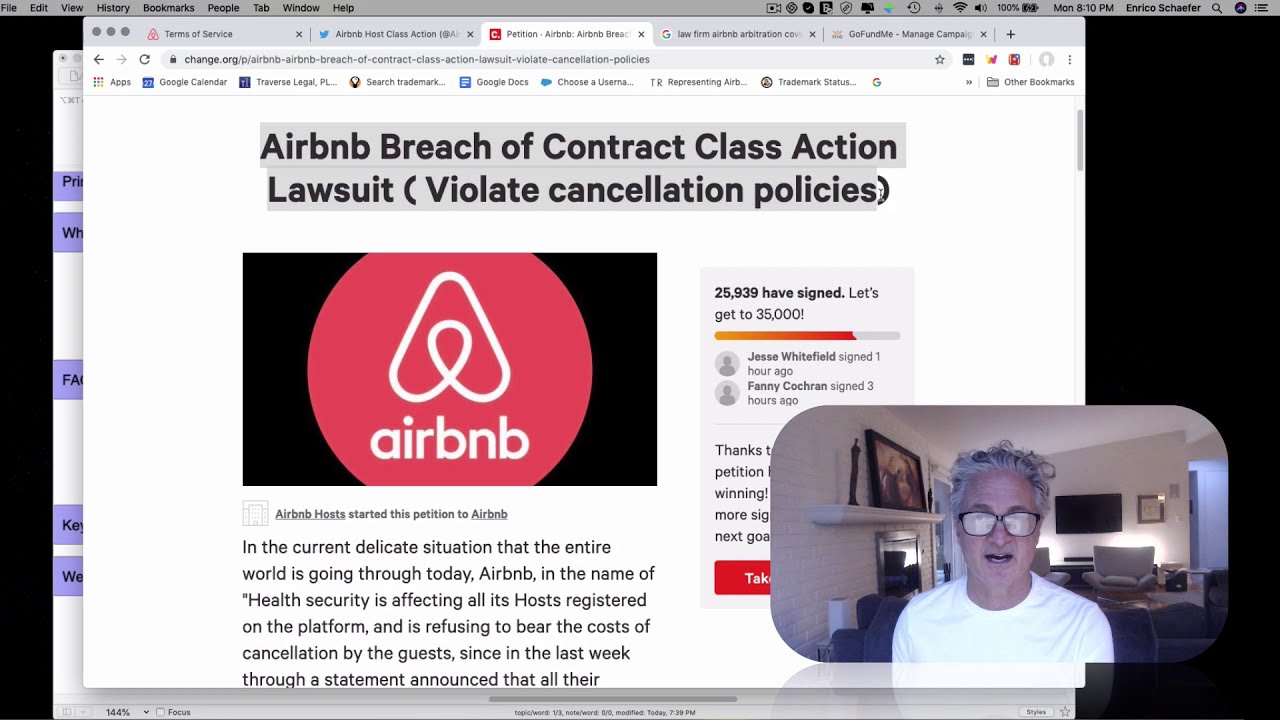
Attorney Enrico Schaefer outlines a strategy to challenge Airbnb's COVID-19 policy changes through thousands of individual arbitrations under AAA rules. The plan, called the
Chapters
Welcome to the Monday update. I'm gonna try and do this each week at least in order to bring everyone up to speed as to what's going on and where we are and our latest thinking about our representation of clients in these Airbnb individual arbitrations. So the goal today is to kind of answer a bunch of questions that that we are getting from the hosts that we're speaking to. And we're talking to hosts, we're talking to property managers who are the hosts, we are talking to property managers who are the co-hosts, we're talking to channel managers, we're talking to platforms that integrate with Airbnb in order to relist those properties on their platforms. All of these different folks have slightly different interests and slightly different approaches to the arbitration Proceeding, but we all have something in common, and that is that we believe that what happened here was wrong and that there should be an outcome favorable to hosts if Airbnb is held accountable. So let's just kind of take a look at some things I think are important to share. The first I want to, I want to go through is just this principle of involvement. So we had a video, Why Are We Involved? Why Are We Doing This? And so we went through the motivations. As you already know, I'm an attorney with 30 years of complex litigation experience. I've represented some of the largest companies in the world, some of the largest software platforms in the world. I've done class action lawsuits on terms of service against platforms. I've represented consumers against platforms in a variety of different situations, and I've done both sides of the fence. So for 30 years, this has been my bread and butter. I happen to be a host, so I was also brought into this. this in the same position as you, wondering why it is that, that my strict cancellation policy was being voided by Airbnb and why my guests who I'd already been in contact with and was managing the situation with were told to simply go ahead and cancel. So here are our principles of involvement. The first is transparency. In any sort of situation like this, it's really important to know who you're dealing with and There is always going to be a lot of folks who are going to come into this space. Other law firms will eventually come in. Just from my point of view, we try and be transparent as to who we are, what we're doing, why we're doing it. We have these videos that we put out to help everyone who's involved, including other lawyers, understand how all this might work. So transparency is key. I am encouraging every other attorney out there, every other law firm, every other person that's running a Facebook group or a platform, a Twitter account, to say who you are so we know who you are, so we know that you're legitimate, so that we know that you know what you're talking about. Transparency is really important in situations like this. Second principle of involvement is one that is just simply unique to me, which is a rising tide lifts all boats. I have been best friends with my most ardent competitors in internet and technology law for a long time. And for 15 years, we all get together twice a year to share all of our best things with each other, even though we're litigating against each other in cases, even though we're competing against each other for clients. And when I started that effort, the question was always, why are you doing this? Why are you showing us everything that you're doing? Why are you showing us your platforms and how you go about the business of law, and the answer is simple: a rising tide lifts all boats. The same thing is going to be true here. There are hundreds of thousands of hosts. There are lots of room for lots of people to contribute here, from lawyers to law firms to hosts to reporters. Everyone has their role, and we all should be working together towards that common, common goal. All right, the 3rd principle of involvement is one I probably have shared with you, which is 10,000 times 10,000. We are bringing individual claims on behalf of the different stakeholders in this matter, but where we really gain leverage, where we flip the table on Airbnb, where we actually, you know, as you know, Zen and the Art of War, you know, you turn your client's biggest offense into defense. You turn it against them. So here we have a terms of service where Airbnb says, hey, We're going to undercut you hosts by saying you can never act collectively. You can only act individually. We're going to take away all of your collective power. Well, guess what? The average cost of arbitration to defend an arbitration for Airbnb in these cases is going to be $4,000 in expenses with AAA, which is the arbitration authority, They certainly are going to have transactional costs with their attorneys. They may have to pay for travel of arbitrators. They're going to have discovery. It's going to cost them tens and tens of thousands of dollars to arbitrate these cases. But let's just say it costs them $10,000, just transaction fees, in order to participate. 10,000 hosts bringing arbitration times $10,000 in transaction fees is $100 million in cost to Airbnb. What if it was 100,000 hosts who brought arbitration? That's $1 billion in costs. We know their overall exposure here is north of $1 billion, but why would they want to spend $1 billion to still remain liable for $1 billion? Our goal isn't to handle all the arbitrations for everyone. In fact, it just won't make sense if the claims are too small, but we're going to empower those people to bring claims. We're going to show them how to get a ball in play and give them the minimal tools they have to get through the process and some of the basic arguments they need to understand in order to win. We're also representing hosts with larger claims who want representation and want a more sophisticated approach to protecting their interests. But let's say we did both. Let's say we had these individual claims that are going into play on behalf of the larger players, and we inspire the smaller players to also file. 10,000 of them gets us $100 million plus in transaction costs to Airbnb. At that point, Airbnb, it would not surprise me, would come to the table to try and do a group collective action to be able to try and solve all the claims so they can move forward, get rid of their exposure. If you have individual claims, you're gonna, in all likelihood, if it's a class action that, that it's an arbitration that goes through us, then you will have an opt-out so you can pursue Your individual claim or you can pursue the group settlement. Your choice. So get your individual claim in so you have both options. That's going to be important. All right, what's going on right now with our clients and the clients that we're handling? So we're handling and filing individual arbitrations on behalf of hosts. We're finishing our analysis of the filings by co-hosts, which we think we have theories by which not only property managers But platforms can bring a collective action as you under the policy, and I'll go through that with you, as you under the policy who could only bring an individual action, individual action for your account, for your listings. There are things that you're going to have to understand about how to do that, and we know how to do that, but we may have found some room within the terms of service so that you can bring an action on behalf of all the listings in your account. We're continuing to do research on a variety of issues related to causes of action beyond breach of contract, tortious interference, breach of fiduciary duty. You know, the goal here is to file arbitrations, but the goal is also to win the arbitrations, to send a message to Airbnb that they have to follow their own policies. All right, so let's do a few quick FAQs that I think are important. These are questions that we're getting from clients, hosts, platform providers, property managers just like you. Okay, who else is handling these cases? Honestly, I don't know. I'm still shocked that I can't find through Google search any other law firms who are doing this. I know there must be some out there, but I can't find them by Google search or otherwise. And that's important because we want to find those other law firms to coordinate with them. Rising tide lifts all boats. There are a couple of things that we keep getting questions about, and one is this Twitter account, the other is this change.org. So let's just go ahead and take a look at this Twitter Airbnb host class action. If you know who is behind this, please let us know. We have tried to contact them, we have posted asking them to contact us. We don't know if they're a lawyer, a law firm, or a host. Probably just a host who's aggrieved and wants inspire action, which is great, but they're spreading misinformation. There is no host class action and there won't be a host class action in this matter, except for maybe a law firm that wants publicity. Right. But it is a mistake to suggest that there's going to be a host class action in court for all these cases. So we'd like to coordinate with these folks to help make sure that people understand their rights. We don't We don't appreciate it when people are being misinformed, and we really have a problem when people are doing things that you can't see who they are. And so the same thing with this petition. We've reached out to folks. This is a great effort here in general. Breach of contract class action, again, there will be no class action in court. There could be a collective action in arbitration if our strategy works. But it's only going to be by consent of Airbnb. So 25,000 people have signed this, but we don't know who they are, and they don't respond to any of our requests to find out who they are. If you know who they are, we just want to reach out to them, make sure they're not providing misinformation, and we also would like to— rising tide lifts all boats approach— with them as well. So if you know of any other lawyers, feel free to send them our way. We are talking to other lawyers who represent Airbnb hosts in a variety of zoning and municipal law issues, zoning issues, etc., what have you. But they're so far sending their clients to us. We haven't found anyone who's actually filing these arbitrations. Let's get it together and let's all bond together over our common cause. Okay, what's better for hosts? We've talked about this before. I've talked about this with many of you who I have spoken to. There's 100+ people I haven't spoke to. I haven't spoken to you except through these videos, but let's just talk generally about the different things. Global resolution, individual resolution, what's better? The answer, here's the spoiler, both, okay? Global resolution would be great. You can't do it through class action, but the best thing about a global resolution is there's no way to lose the legal arguments because you never actually go all the way to the end. And as I tell everyone, there's no guarantee that we or anyone else will win in these cases. Airbnb has defenses. We have really good arguments to get beyond those defenses, really good equities on our side, but whenever you step into arbitration or court, you don't know what's going to happen. So global resolution solves the problem of who wins. There's a settlement. The other part about global resolution that we are trying to achieve is that non-financial terms are available. So what if we could have a settlement by which they had to change the terms of service? That they had to abide by their terms of service, that they had to change their 30-day notice BS change of policy provision, which is meaningless because you can't walk away after 30 days if you don't like the terms. You've got a whole bunch of travelers in the platform who are relying on you who might not be coming for months. It's ridiculous, right? So there's a lot of things to be achieved if we can get a seat at the table with Airbnb. Thank you. Individual resolutions, only way to gain real leverage is 10,000 arbitrations plus. That is my goal, whether filed by me, whether filed by someone else, another law firm, whether filed individually. If we can hit that number, I am telling you, we are going to have a horse in this race. So individual resolution, if you file for arbitration, chances are you're going to have a chance to either participate in a resolution that is a universal resolution A, you know, a joint resolution which you can opt into or proceed with your own action. Now, the timing has to work out well on that, but we are recommending file your arbitrations through us or someone else or on your own behalf, because at the end of the day, you don't want to be at the end of that very long line. And 2, chances are if we can achieve a situation where we're bringing Airbnb to the table, We can put your matter on hold while we try and achieve a global resolution and give you the choice: take the global settlement, proceed forward with your individual action. I've been doing class action work since 1990. I understand the vagaries of how all this works, the legal and non-legal leverage that comes into play in these cases. All right, so definitely you want to speed ahead of the logjam if you can, and if it makes All right, so what we want to do is basically pursue both the individual and global resolutions and really try and make both of those happen simultaneously. Should you file now? We've talked about this. Yes, my opinion is in most situations the answer is yes. Get your ball in play so you're seated at the table. Key things to think about. All right. There's a weasel in the wood stack. We, you know, Airbnb says, oh, we did this to protect, to protect people. I don't think anyone really believes that. There are bean counters that are always involved in these decisions. They did a calculation to shift the risk to make the hosts the insurers of this event, and they not only decided to do that but to preempt hosts from, from managing their, their reservations with their travelers, from finding a reasonable outcome, and Trumping the cancellation policy in order to protect themselves. And so what is the weasel? Were they catering to credit card companies, to the traveler insurance who would have potentially otherwise had to cover this risk? Were they making a calculation that the cost to them would be too great unless they forced it onto hosts? We're going to get into discovery and we're going to find out exactly what those emails, those memos say. say in order to use that as leverage. And I'm telling you, that could be the biggest thing that happens in this case. That's this discovery bullet point here. Okay, these are complex issues. And so, I just wanna quickly kinda run through some of the issues that are in play here. Let me see if I can pull up terms of service. You know, there's just a lot of things that we need to think about. Let me just— I can't even begin to tell how many issues we've analyzed, but this Section 19 dispute resolution, who does it apply to? It applies to you and your— you are your— you and your are members. Members are every category of people who use the platform, from the host to the co-host to the platform providers who are offering services on top of the Airbnb platform. You are all Required to use arbitration and you all can bring individual actions, but it doesn't say on behalf of so many listings or it doesn't say you have to be the owner of the property. It just says yours. So there are theories by which we can bundle up claims on your behalf. All right, so this is, is really important. You've got a process you've got to go through here. We will walk this through for you if you hire us. If not, we're going to be putting some training videos out there for hosts to know how to get their ball in play in arbitration if you happen to have a smaller claim. We're working under the Consumer Arbitration Rules, okay? There's a whole process for the Consumer Arbitration Rules which, you know, I can get into with you. We are working with AAA Arbitration. We have a case processor that we're working with on these arbitrations. We know how it's going to go. We know what the timeline's on. You're looking at 6 to 12 months to get them resolved, so get them in now. It's going to take some time. Here's some good news. Initial filing fee is capped at $200. That is your exposure for costs. in this matter. It doesn't matter how big your claim is, right? And guess what? Airbnb has to pay everything above that $200. If you have a claim for under $25,000, you got to be doing it by video conference or by phone, but by the submission of documents. So the concept here is that consumer gets to elect the hearing location and can elect to participate by live, by phone, or video conference. For claims under $25,000 by submission of documents. Everything over that, then you get to pick the location. If you are in the EU and the arbitrator is in the US, Airbnb has to pick up all that travel cost for that arbitrator to go to your location. Now, we talked about a $4,000 or $10,000 cost to Airbnb. You can see the number could be drastically greater using their policies against them. Arbitrator can grant any remedy the parties could have received in court to resolve the party's individual claim. That means the arbitrator can do whatever they want. This is probably the most magical clause in this whole document that I just love. That means that we are going to get an arbitrator that can grant whatever relief that they see fit, and that includes the attorney's fees incurred in order to bring the action. Okay, so here's you. You are a member, which means you are logging into the platform because they're just a platform provider. They have nothing to do with rentals, right? Just a platform provider. So you agreed to arbitrate and individual arbitration. You, individual arbitration. You, you don't say anything about listings here. So if you happen to have 100 listings under you, then there is an argument that you can bring all of those listings in a single arbitration, whether you're the owner or you are not the owner. All right, there's some other really interesting things in here. You and Airbnb agree that Airbnb will be responsible for the payment of the balance of the filing fees for claims of $75,000 or less. Okay, get some questions about this. Does this mean you could end up paying more if you have a claim for $75,000 or more? And we have clients who have claims over $700,000. The answer is no. This is legacy language that became obsolete 4 or 5 years ago when that $75,000 limit used to trigger you into commercial litigation. It no longer does. $200 to get in the door. And we're handling cases right now on a contingency fee basis, $200 to get through the door. Okay. Green, you may be entitled to seek an award of attorney's fees and expenses if you prevail in arbitration. So in addition to all your damages, we'll be keeping track of the time that we spend on your matter. We'll be putting that time in as part of your damages, and that could be part of the recovery. And you'll see You'll see that that could add to the top of the pile. It could help with the overall recovery in your matter, okay? We can get declaratory relief. We can get a special master assigned for discovery. There's so many different things that can happen here. Paragraph 19.1, no class actions, representative proceedings. You're waiving your right to a class action. Get out of all this class action nonsense, okay? You're just misleading people about what's gonna happen. Causing hosts to sit on the sidelines thinking there's going to be a class action is not a good and valuable thing, okay? So you're going to see that the arbitrator has this universal right to be able to basically interpret the contract, to be able to find out what's enforceable. Here's one of my other favorite clauses. Uh, arbitrator is gonna be able to determine the applicability, breach, termination, validity, enforcement, and interpretation of these terms of services. Arbitrator will be God, and there won't be anything Airbnb can do about it if the arbitrator holds against them. So, again, this is just one small piece of the puzzle. Uh, let me just do a quick— What's the name of the arbitrator? A quick little show and tell on what you need to be thinking about in terms of service. So number one, terms of service are going to be applicable as of the date of the reservation. This was last updated November 1st. If it was prior to that, there's a prior version for you. Take it and pay attention to the left-hand margin. These are all the different things that are going to go into the terms of service. The 2 that are applicable to you guys are terms of service And payment terms. And payment terms are going to be important because there's also information about refunds in there. Okay? So you're going to want to, you know, understand that one. Guest refund, this is typically going to be something where the host doesn't perform, so it shouldn't be applicable in our particular situation. Now, what you don't see in here is the extenuating circumstances policy, but you will find it In the document, and it's here. And so it's incorporated in the document as part of the help center. It's amazing that it wouldn't be part of the contract, but it's help center. And this is where you'll see, if you get deep into it like we are, this epidemic and disease and illness that didn't exist. It said endemic until March. Endemic. It didn't say epidemic, and that was for a reason, because it wasn't an extenuating circumstance. Did they tell you about this change in policy 30 days before? No. Are they telling you that this policy applies? Yes, it doesn't. The policy that was in place at the time of the reservation is the one that applies. And what they are telling you here is that this article does not address circumstances for COVID. Yes, it does. Yes, it does. It addresses right here in the new one epidemic and the old one endemic. They can't now say that's not what's controlling. So now all of a sudden in March, they're going to come up with this new policy that never existed before that they're trying to force down your throat that is not going to, in all likelihood, hold up in an arbitration. All right. So here's the thing. We could use your help. Right, we talked about transparency, we talked about a rising tide lifts all boats, and I know this video is long, but this is an important one. We would ask you to go to the GoFundMe page and just make any donation— $10, $20, $50. What if you think you're getting value out of the things I'm sharing with you? Share back by funding it. Probably in the next week or so, we're going to be doing a press release and really formally launching the page. The more people that contribute, the better. We've got, you know, we've got a petition here that's got 25,000 people, many of whom have contributed money to this thing. We should be able to provide enough value from Travis Legal's point of view to get some contributions to our page and get that ball rolling for it. It's important because it allows us to work with our companion counsel in Ireland On the Irish law issues. Don't worry about that now, we'll get to it in a later video. And to be able to do the group push that we want while we're also doing the individual arbitrations. Honestly, we will have well into 6 figures or potentially 7 figures of our own money and time into this matter. All risk. That's our contribution to what's happening here. We would ask you to contribute, not only give us just a donation of any amount, But also inspire other hosts, co-hosts, owners, property managers to act. Okay? If you like what you've seen, please feel free to email us back your comments. Indicate whether you are okay with us using your first name only and posting as an anonymous thing what you, what you think about, about Travers Legal, what you think about what we're doing here, what we shared with you, the phone calls that we've had with you, the videos we shared with you. This is gonna help other hosts understand who it is they should be dealing with, and I'm not saying it should be us, but at least it— you know, you guys have ratings. I have ratings as a host. I wish we could have ratings as attorneys. It would really help. But at least give us some feedback, good or bad, so we know how we're doing for you. All right, so that's, that's it for today. I know this was a long one. I really appreciate your time. I wish I could do more of these, but as you can imagine, we're, we're pushing hard on a lot of, a lot of different fronts, and we're talking to a lot of people. I'm on a listening tour right now of hosts. I am hearing from you, your stories, and I'm learning a lot. That information is going to be critical in terms of strategy moving forward. All right, Enrico Schaefer signing off for today. Thank you. Stay safe and keep your chin up. It's, it's tough rowing out there, but we're gonna all get through this together.
More from Enrico




How to fix the most common problem with ChatGPT. #ai #chatgpt #personaldevelopment





If you want to learn about ChatGPT 5., Follow Nate B. Jones. @chatgpt #ai #lawfirms


Build Your Project's Ground Truth: Reliable AI Results Start with a Strong Foundation Thread