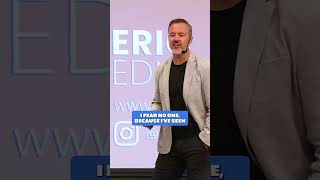
Eric Edmeades advises how to start a talk: arrive early and observe prior speakers to match the established tone; use a sensory-balanced approach (approx. one third kinesthetic, one third auditory, one third visual); begin softly then gradually build volume and emotion, running a roller-coaster of dynamics through the talk to improve storytelling. He cites examples from famous speeches to illustrate crescendo and emotional range.
Chapters
You should always be in the room for the speakers that were on before you, because they have set the tone already. When I was touring with Tony Robbins, I would always start visually. They always put me on right after Tony. And so if I walk up and I'm all quiet and soft after Tony, I'm going to lose the audience. But generally speaking, your assumption is one third kinesthetics, one third auditory, one third visual. All the great speeches that you've ever seen, the famous speeches, they all use this system of soft to medium to loud. They all do. John F. Kennedy did it. Barack Obama did it. Winston Churchill did it. Martin Luther King, Jr. Did it. Like in his mountaintop speech, he says, I may not get there with you, but I am fearing no man. I fear no one, because I have seen, because the Lord has allowed me to see the glory. And you see what's going on. He's building it, and he's building it into crescendo. So when you start your talks, I generally recommend you start softly and you warm up. And then through the rest of your talk, you run a bit of a roller coaster, like that. You. You go up and down. When you understand this range of emotion, then it makes you an infinitely better storyteller.