Thrive Time with Eric Edmeades Live Stream
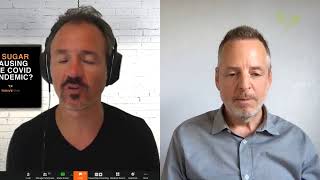
Eric Edmeades argues sugar is a keystone driver of COVID-19 severity by worsening comorbidities like diabetes and heart disease. He traces how the Sugar Research Foundation shifted blame to fat in the mid-20th century, then interviews a caller who tested antibody-positive but had mild symptoms after switching to a low-sugar diet.
Chapters
Sam, It's.
Good morning, good afternoon, good evening, wherever you are in the world. It's Eric Edmeads. I'm back with another episode of thrivetime. I'm really excited about today's episode because we get to talk about something that I am incredibly passionate about. Incredibly passionate about, and I hope you will be, too, by the end of this. And the question that I really want to ask this time around the question I really want to ask this time around is, is sugar causing the COVID pandemic? Yes. I want to throw another conspiracy theory out there into the world. And let me be clear about the question. I want you to hear it properly. I am not suggesting that sugar causes the virus. I'm not suggesting that. I'm not suggesting that bats ate sugar in a cave in China and caused the virus. I'm not suggesting that a bunch of scientists in a lab in China ate too much sugar and created the virus. That's not what I'm talking about. I'm talking about something rather more simple, and that is that anytime a series of events take place that cause a problem, it's always interesting to go in and look at what you might call keystone influences. As in, is there a single influence that you can take a look at and say, wow, if that influence was not present, is it possible. Is it possible that the entire thing could have been averted? And I want to suggest to you that sugar may well be a keystone influence relative to the COVID 19 situation, relative to the entire lockdown, relative to the economic devastation that we're facing in the world today. It might be. It might be because of sugar. And so in order to make this presentation or in order to present this argument to you effectively, I want to share some things that are pretty fascinated about what's going on right now. Pretty fascinating, I should say, about what's going on at the moment. One of the things that we're really clear about is, is that we've seen a tremendous spike over the last several years, the last several decades, in the growth of type 2 diabetes around the world and in the United States in particular. We know that those statistics exist, and we know that they're causing significant stress, pain, suffering, and financial devastation to our economies around the world and a great deal of personal suffering. But how does that relate. How does that relate to COVID 19 and the lockdown? And so what we would need to do to evaluate that is look at a couple of other influences. For example, we can see that the mortality risk of COVID 19 is tied to Other things. In other words, if you have cardiovascular disease, you are 10%. You have a 10% risk of dying. If you contract disease. If you have diabetes, you have just less than 10%. If you have chronic respiratory disease, you have about seven percent. If you have hypertension, you're about seven percent. If you have cancer, you're about seven percent. If you don't have one of those diseases, the odds of COVID 19 killing you are 0.3%. Incredibly small. So I think it's important for us to take a look at the fact that each of the conditions that we're talking about here, each of those conditions, relate in some way to sugar. Every single one of them. Every single one of them. And then the question has to be asked. At least I feel that has to be asked. Did the sugar industry know this? Was there a point in time where maybe they were aware of the damage that they were doing? And if they became aware, what did they decide to do about it? And I think this is a very important conversation for us to be having right now because it's entirely possible that this entire situation could have been averted with some corporate responsibility and proper governmental regulation. In the 1950s, there was credible science that was beginning to suggest that there was a direct correlation and perhaps a cause relationship between the consumption and the increased consumption of sugar and the development of heart disease. In the 1940s, during the great World War II, there was a change in the American diet. And that change was stimulated largely by the economic growth and explosion that happened post World War II. People started eating sugar. They started eating it like they'd never eaten it before. And by the 1950s, it was clear then that there was a direct relationship between this increased consumption in sugar and the development of heart disease. The sugar industry, wanting to do something about this, decided that they would. They decided that they would do something about this. And what they did about it was they just. They engaged two Harvard researchers and they commissioned them to undertake a study to find out what was really going on here. Except that the study wasn't so much about finding out what was really going on here, as it was a study to instead frame fat, to instead blame fat for the damage that they were really doing. And this taking place is a moment in our history that changed everything. It absolutely changed everything. At the time, there were a number of campaigns going on where the sugar industry was making statements. They were saying that most of the focus in popular media and the scientific press is that, oh my gosh, they're eating too much. They're eating too much and ultimately that they started blaming sugary drinks. And the group's president, Stephen Blair, says as an exercise scientist that this. There's virtually no evidence that that's true. There's virtually no evidence that that's true. But of course we all know that it is true. And we now know that health experts are telling us that this message has been misleading and that this message was specifically created by a particular company in order to divert the blame for the role that they played in creating these problems around our world and around our country. We are in a place where the sugar industry and many of the sugar giants knew what was going on. And rather than change their food and rather than change their products in a way that would support us and make things better, they decided instead to attack the principles that would have helped people and to blame fat for the damage that they were doing. And in case you have any doubt about their intention behind this, Mr. Henry Haas, the president of the Sugar Research foundation, which you can find@sugar.org and is just a big lobbyist for the sugar industry, said this Leading nutritionists are pointing out the chemical connection between Americans high fat diet and the formation of cholesterol which partly plugs our arteries, capillaries and restricts the flow of blood causing high blood pressure and heart trouble. There's something you need to know about those leading nutritionists. They were bought and paid for. They were bought and paid for. They were the Harvard researchers that they paid in Today's money, about $50,000 to say those things. They were bought and paid for. They continue. Henry Haas continued to say this at a conference in 1954 of the Sugar Beets Growers Association. If you put the middle class, midd, middle aged man on a calorie restriction diet, on a low fat diet, I should say it takes just five days for the blood cholesterol to get down to where it should be. If the carbohydrate industries were to recapture this 20% of the calories in the US diet, the difference between the 40% which fat currently holds and the 20% which it ought to hold then, and if sugar maintained its present state of the carbohydrate market, this would mean an increase in the per capita consumption of sugar or more than a third with a tremendous improvement in general health. No, that's not what it was going to mean. What it was going to mean is that if we could trick people into eating less fat, we could do them damage. And then if we could trick them into eating more profit, we could or more sugar, we could generate even more profit and cause devastation. So then let's take a look again at the graph that I showed you a little bit earlier. This is the growth of diabetes since the mid-50s to today. It is absolutely astronomical. In the 1970s, there was virtually nobody under the age of 40 years old that had type 2 diabetes. In fact, they called it adult onset diabetes in order to make that distinction, in order to be clearer that there's a difference between type one, which was something that children got, and type two, which is something that adults got only now, today, adults, you don't have to wait to be an adult to get type 2. In fact, we're now dealing with something in the realm of 20 million young Americans dealing with type 2 diabetes. Now, I want to go back to this other conversation about, wait a minute, what are the comorbidities? What are the other diseases that people are facing and suffering with when they're dealing with this issue? What are the other diseases that they're dealing with? Well, what we know, what we absolutely know is that the diseases that people are suffering with that are contributing to morbidity are cardiovascular disease, diabetes, hypertension, respiratory disease, and cancer, all of which are, at the very minimum, influenced by excessive sugar consumption. And so what I want to put to you is that if COVID 19 had struck in the 1960s, if COVID 19 had happened in the 1960s, we wouldn't even know about it. We wouldn't even know about it. Because in order to get sick from COVID 19, you need to have another disease. And that disease just about has to be a sugar influenced disease. As it stands today, a number's coming out which will improve over time. You've noticed the numbers change, right over time. When they started this whole thing, they said 10% mortality, then it was 3% mortality, then it was 1% mortality. And you will start to see even this week, that they're going to start reporting it. At 0.2 and 0.3% mortality. It's not nearly as dangerous as they originally said it was, but it is incredibly dangerous In a population that has a major sugar addiction problem. The average American is eating 154 pounds of sugar a year, and that is contributing to the development of a variety of different diseases. Now, in order to pass away, in order to die as a result of COVID 19, these are the conditions that pretty much have to exist. 50%, almost 50% of the people that are dying from COVID 19 have three other major diseases, all influenced by excess sugar consumption. Excess carbohydrate consumption and then another 25% of them have two diseases and another 25% of them have one disease. And almost nobody without those diseases is adversely affected by this virus. And so again I ask you, if COVID 19 happened in the 1960s, would we even know? I don't think so. I don't think we would know because it wouldn't have had enough of the population. There wouldn't have been enough people in the population that were susceptible to it for it to take root. And so today we're going to talk about diet food rules and sugar and the fact that sugar might have been the keystone influence to trigger the COVID 19 pandemic. Okay, welcome back everybody to thrivetime. You've had my little rant on the sugar industry and I want you all to know that you're welcome to join me in the conversation. The team will be posting the link with you. And I am fascinated by this topic and I'm fascinated about your opinions of that topic. In fact, I think we're going to jump right over in a minute here. We're going to jump right over to have a conversation with. I think it's going to be Marcia. Marcia. Marcia. It's got to be Marcia. You are live. Jump on in. Welcome to thrivetime. Glad to have you here. Yes.
Can you hear me? Yes. Okay, I wasn't listening to you. How are you?
Good. How are you?
Good. So yeah, so my question was how did you think that sugar could influence also people on COVID 19 if they don't have any of those, you know, pre existing conditions? I actually was just, I did my antibody test because I was in contact with someone who had it and I realized that I'm positive. I did the WildFit diet to two years ago and I cut sugars and, and I'm really thankful for the effect that it has in my life. But, but I saw, you know, some friends around me had it and they had a bit of consequences. Although they do also a bit of healthy diet, let's just say they don't cut on so many things like sugar and stuff like that. But they were all okay basically. But I would like to know because here in New York there was even some cases of people like I think was somebody from Broadway that was supposed to have a good, you know, a healthy food. We don't, we never know what people consider healthy when they say they have a healthy food diet. Right. But supposedly it was in shape and, and it kind of like affected more like in the brain. I think he had a stroke or something like that. So what do you think could be triggering that? And what is the relationship with sugar there?
Okay, so I think that sugar influences us in a number of different ways. There's the long term systemic ingestion of sugar. So, you know, when somebody starts as a child getting introduced to sugar and they're eating too much of it, then of course we go in the obvious directions. For example, obesity, diabetes, and those things. And those create the obvious comorbidities. Those create the things that are clearly an influence. Then there's the next conversation, and that is, what if somebody is generally healthy, but they do have a sugar issue? In other words, their blood sugar management isn't perfect. Or maybe they're pre diabetic and they don't yet know it, because, by the way, one third of Americans are either pre diabetic or diabetic at this point. So we're dealing with the fact that even people who look relatively healthy may well be dealing with blood sugar off the scale. And so it appears that COVID 19 also likes healthy people with high blood sugar. Now, it doesn't seem to kill them the same way, but it seems to influence their likelihood to end up in hospital or get sick. But there's something else that's really important to discuss here, Marcia, and that's this. I am not suggesting that somebody, if they don't eat sugar, that they won't get sick. I'm not suggesting that if they don't eat sugar, they won't catch the virus. That's not how immunology works. Immunology, the best way I can describe it to you, works like this. If you have immunity from prosecution, then what that means is you cannot be prosecuted. You have immunity from prosecution. So somebody who has the antibodies for smallpox can't get smallpox. They have immunity from smallpox. But somebody who doesn't have immunity from prosecution needs a powerful defense team. And then the defense team has to defend them. And that's your immune system. So you have immunity established by your memory B cells being able to create antibodies for a given virus. And then you have your immune system which is defending you while you try to develop this. These antibodies or the ability to manufacture them. And so what that means is somebody can be unbelievably healthy and they can still get COVID 19. It's just that it's entirely likely that they won't have a great deal of symptomology. Now, Marcia, did I hear you say that you had the antibody test and you Tested positive.
Yes. Yes.
So you have. So you've had COVID 19.
So the interesting thing about it is that when I did Wild Fit, I cut also on dairy and I had a lot of infection of my sinuses before and that really helped me come down. That doesn't mean that I don't get sinuses. I still get some now and then, but I don't suffer like before. Before I used to get really infected. And so what I felt actually was a bit of a cough following, you know, being with that person. Because that was right around my birthday and was just before we start the lockdown here in New York. And then I felt a bit of a cough, but I just did some vapors with some eucalyptus oil and like three to four days it was gone. Right. So no infection, nothing. And so I didn't relate that to COVID 19 because I didn't have really like fevers or any of the other symptoms. And I really think it had to do with my immune system and how I have been treating myself with my diet.
Exactly. So let me understand. What happened is you've tested positive for the antibodies, so you have had COVID 19, but you really didn't have much in the way of symptoms. Am I hearing you correctly? Then you're the perfect case study for exactly what I've been talking about. I couldn't aligned you up as the better first guest. Again, everybody, I want you to know that the idea here is not to suggest that sugar or not eating sugar is going to affect whether or not you encounter or contract the virus. It just might have everything to do with your ability to fight the virus. And so now here we are. Marcia's been through it. It wasn't so bad for her. Now she has the antibodies, now she has immunity from prosecution and Marcia. So what I want to suggest is that there's two different ways that we want to be looking at sugar at this point. One is the long term systemic ingestion of sugar that's causing people serious diseases that are making them incredibly susceptible. And then there's people that are more or less healthy at this stage that should probably be being careful about allowing their blood sugar to get absolutely crazy. Because it appears that having high blood sugar makes it easier for the virus to propagate and cause problems. So I think that answers your question. And I'm so glad that you were the first guest on the show. What a fascinating conversation.
Well, I actually, I decided to join the WildFit coaching program.
Oh, good deal.
Because I really want, you know, people to be more aware that they can take better care of themselves. And I actually started doing some Instagram posts before, you know, about sugar and COVID 19, how people should not be baking at this point and should be taking better care of themselves. And I had a bit of backslash from some of of my friends saying that I was shaming them when it was not my intention. So I'm learning a lot. So hopefully, you know, we can do better.
Absolutely. I am so excited to have you. Are you in the current coaching class now?
Yes.
Oh, good deal. Well, congratulations on that. Super glad to have you on the team. And I'll just offer you one thought about that idea that people feel shamed. The industry has been built to create shame in people. The food industry and the diet industry, because both of them work very well. Look, if you constantly feel a sense of shame, you're going to need to be on a million diets. And if you constantly feel a sense of shame, you're going to want to eat a lot of garbage. So it kind of suits the industry to work on a model of shame in our case. One of the things that I always want to make people clear of and really clear about is that anybody who's dealing with what we consider today to be a lifestyle disease does not have a lifestyle disease. It is my contention that even the phrase lifestyle disease is a disgusting misinterpretation. It's a disgusting shifting of the blame from the food industry and the government onto the consumer for their disastrous food manufacturing processes, their disastrous food marketing policies, and the unbelievably disgusting lobbying practices and terrible governmental regulation. And so I don't think of them as lifestyle disease at all. I believe that nobody is to blame for the health conditions that they're dealing with in this moment. If they're food related, if somebody's obese or type 2 diabetic, it's not their fault. The challenge is that it's their responsibility to do something about it, because nobody else will ever care as much about their health as they will. Not even a wildfit coach. I know they will, but everybody's got to be in charge of their own health as best possible. Marcia, thank you so much for coming on the show and being our first guest today. Thank you.
Thank you.
All right. Fast. What a great start. What a great start. And again, I want to make this point that I am not suggesting that Sugar is causing COVID 19 itself. I'm suggesting that sugar could be a keystone influence. And had we removed it as a major staple food if we had corrected our relationship with carbohydrates or if we'd even left them as they were, we may not be under a lockdown of any kind. I want to tell you that the science. A science advisor to the Ministry of Health in Italy examined a thousand of the early COVID deaths and found that 88% of them were already sick. 88% of them were already sick. And of course, now that they're diving more into that data, it's turning out that it's more like 98% or more. So I just think this is a really important conversation for us to be having because this is not likely to be the last virus to make its way around the world. And so what we want to do is make sure that we are in the best possible condition. And I am curious to know what Debbie has to say about that. Debbie, welcome to the show. Good to have you here. Hey, Debbie, you're going to need to mute your other screen because we can get the feedback. Hi.
So sorry about the lighting. It's very bad here in my house.
Debbie, can you turn your volume off, please?
Okay. Okay.
And everybody that's in the waiting room, if you're watching the show separately, when you come into the waiting room, very important you turn the other screen off. Okay? Debbie, you can work on that. We're gonna have to go to another guest while we figure out what's going on there with your sound. Okay. I am going to be going over to Lily as soon as I can get Lily cued up, and hopefully the sound there is a little better. Debbie, we will come back and give you another try in a moment. Moment. Lily, you are live. Welcome to the show.
Oh, hi, everyone. Hey, it's great to see you.
Well, I just came.
More from Eric



Eric Edmeades: The Speaker Your Audience Will Still Be Talking About Next Year

Eric Edmeades: The Speaker Your Audience Will Still Be Talking About Next Year


A free class on Stop Style Profiles, habit cessation and behavior change by Eric Edmeades.




