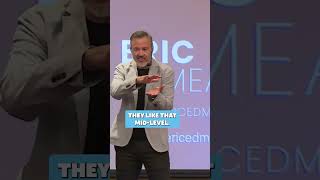
Short video/transcript of Eric Edmeades explaining how different audience members prefer to receive information—kinesthetic (feeling/touch, slow, pauses), auditory (sound/cadence, mid-level volume), and visual (fast, loud, image-driven)—and advising speakers to begin talks kinesthetically by establishing connection. The clip focuses on identifying these three processing styles and recommending opening with connection to reach all types.
Chapters
In any audience, you have some people that are much more feeling based in the way they perceive the world and the way they communicate. And these people, we might call kinesthetic, they're touch based. These people are very quiet. They feel their words before they say them. So they speak quite slowly and they leave long pauses. And equally, that's how they want the information given to them. Then you have people that are more auditory or more sound based. They talk with a more predictable cadence and a regular rhythm. They would prefer that I spoke like this the entire time. In fact, they prefer this voice. And when I get all loud, they like that mid level. And they use words like that. Sounds good to me. And then there's another group of people that process the world more visually. And these people would be considered more visual. And they talk more loudly and they say more words more quickly. Because a picture is worth a thousand words. And I have so many pictures in my head, I have to get them all out. And we have to talk about vision and destiny. All three of those people are in the audience. Where should I start? I actually want to start kinesthetically. When you start your talk, you start off with connection.