600,000 Monthly Visitors, Zero Revenue: The Marketing Metric That Lied
Neil Patel and Eric Siu break down why 600,000 monthly visitors to a single keyword generated zero revenue, then shift to what actually works: product-led growth, free tools as lead magnets, and autonomous conversion testing. They explore how influencers embed affiliate links in tutorials and why LTV and churn matter more than traffic.
Chapters
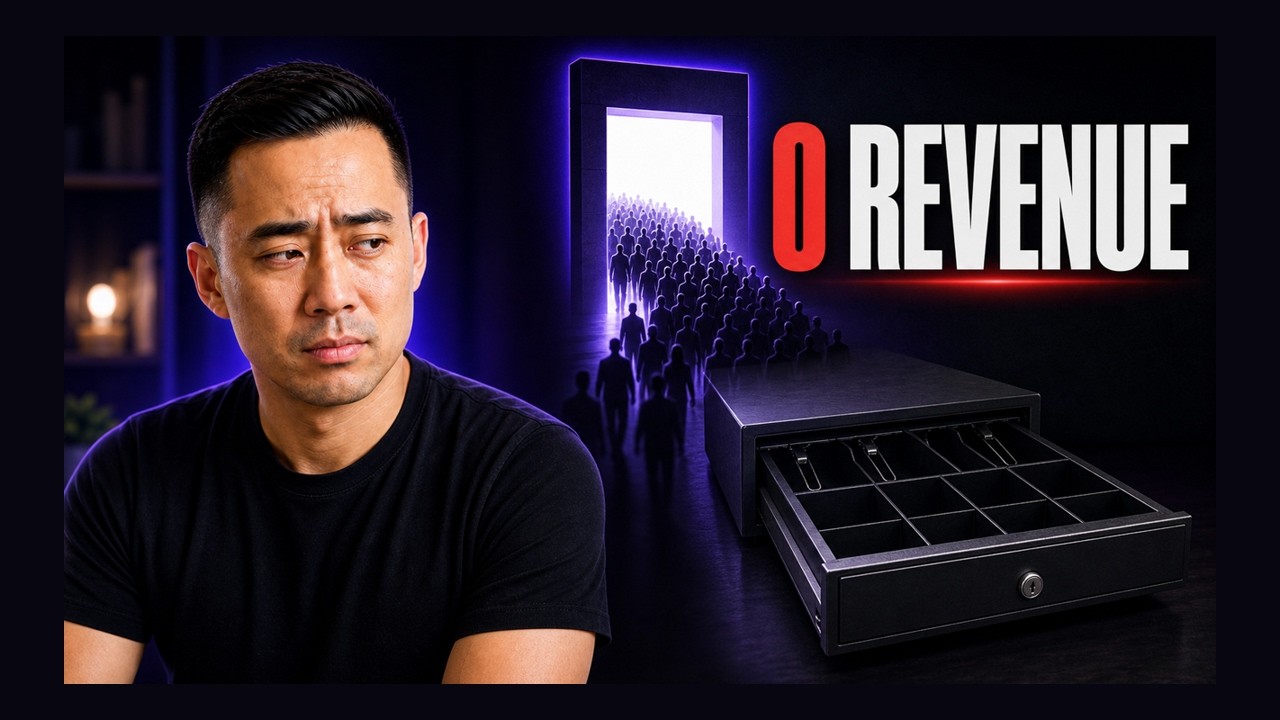
The keyword I got more traffic than anything else from on Google in my life for my own website was how to get more Instagram followers. Zero revenue from that. I think at the peak from that one keyword, I believe I was getting something like 600,000 visitors or, and it could be variations of that keyword, like how to get more Instagram followers.
Plus.
And it didn't drive any revenue. And it's just like, it quickly taught me that more traffic doesn't mean more revenue.
This is So I want to talk about this new concept that software is becoming marketing. So really the question is, what if your product is your best ad? So this isn't necessarily anything new, but I think with the proliferation of anything that you can vibe code now, almost your software becomes the lead magnet. So it used to be back in the day, your lead magnet could be your It could be like an email opt-in, like a PDF, right? It could be a PDF, it could be something like a quiz or something like that. But now you actually get software. So when I look at Neil's software, Ubersuggest, I look at that as a software that's kind of becoming marketing in its own right. Same thing with AnswerThePublic, with ClickFlow, with Carrot. We kind of look at it at the same one on our end. And the cool thing is within each piece of software, every time you have an interesting feature that you launch, each feature becomes a marketable moment. So like Clay, they're doing, they're launching like every week, I think they're doing like a launch of a new feature with their product. And it's something that people are asking for, but they're putting a lot of fanfare around it. And so we actually have a mutual friend. He was always launching one marketable moment per month. I think now you can probably launch one marketable moment per week.
Yes.
And so I think software now is becoming marketing and I think The job of someone like Anil or myself is we can prototype something and get it 60, 70% there, but then you can hand it off and then go from there, right? And then if you do have a product out there and there's a repo, you can just submit a bunch of pull requests and then your developers can decide if whatever you're building is garbage or not.
Yeah, no, look, I'm with you. I think you can end up creating a lot of marketing Just through products. I started doing this back in the day, maybe around 7, 8 years ago with NP Digital. And the whole premise was we're going to release software. At that time it was Ubersuggest. We bought it for, I think it was like $120,000 plus or minus, but somewhere around there. I spent millions in the product over years after, so not instantly. That was a choice because it was gaining traction. Keep in mind, everything's way cheaper now because of AI, and we didn't just release marketable moments, we released product for free when our competitors were charging for it. That made it much more marketable because everyone wanted to share something that was free, whether it's better, whether it's worse, whether it's the same. Free goes a very long way, and I think Doing that with product is super effective as long as it's pretty much free. If you release a marketable moment every single week that's a new feature, but people have to pay more for it, it doesn't mean that you can't still use it and generate buzz around it. We just see it not working as well.
Yeah, I think the, I mean, back in the day, and back in the day was not that long ago, but you, in SaaS, you call it product-led growth, right?
Yes.
Where you have a freemium feature and then you can upsell, cross-sell, and grow accounts. So if you don't have a free version into your product, it's not going to be that helpful because there's too much friction to get people in the door. And so when I look at ClickFlow, our version of ClickFlow right now, we have an API and an MCP for it. There's a free version people can opt in for and the agents can find it, right? But more importantly, we just launched something and we kind of look at this as like a new AEO SEO autopilot system of 2026. And so what it does is like, let's use this podcast as an example. It will ingest the spikes from this podcast. It'll also use some skills and it'll look at what's happening in my topic, for example, or you can look at even some of my competitors as well, look at what they're putting out. and then it'll combine with our ClickFlow API MCP. It can also pull in your Google Analytics. It can pull in a lot of these different connectors. And then what happens is it starts to draft things, top of the funnel, middle of the funnel, bottom of the funnel. But that's something that we give away for free. And so, but because it's free, like it becomes interesting, right? So literally clickflow.com, you can pick that up if you want to. But that's how we look at this stuff. And I'm sure that's how you look at Ubersuggest too.
Yeah, and I believe it works really well. Although I don't think it works as well as it used to because so many people build product now. It is very competitive. It is much harder to get traction and noise than it used to be.
Well, there's a lot of noise now in terms of just overall marketing. What I would say is there are people on X that do a good job with their marketing and then some of their marketing, like these little— Anthropic does a good job, for example. Obviously they have a lot of reach. Claude, like whenever they launch a new frontier model, obviously there's going to be a lot of reach. But I saw this, so I interviewed this guy, Matt Van Horn, just to talk about loops. And he launched a video talking about one of his new products. And it's like a, this, it's called something, it helps you make CLIs basically, like command line interfaces. And that video got, it got 2 or 3 million views or so. And so I think if you do it well on Twitter, because Twitter doesn't penalize you for posting too much, You know, it can be really good for you and especially if it's the right audience hanging out there. So I think it's fine. I think it's also if your product is novel, it tends to kind of help itself as well. Again, when you look at OpenAI and Anthropic.
Yeah. Question for you is what products are you creating this year that you'll end up using to leverage for marketing, if any, or like from a free perspective or—
The one I just mentioned.
So it'll be free?
Yeah, it's free and it's free. And then obviously if you want to use it a lot more, there's going to be usage-based pricing. So yeah.
Cool. Yeah. And I also look at traffic and revenue as 2 different things.
Exactly.
Our traffic has gone down some due to people click less from organic Google results. I would say even before all that AI stuff, our traffic started going down because we were ranking number 1 on Google for broad terms like digital marketing. We were ranking high up on page 1 for search engine optimization and SEO and terms like that, but it wasn't driving revenue. from our ideal customers. And we found that doing some of the things I've talked about earlier on how we're marketing drive a lot more revenue for our business in the long run. And it's been super effective, but it's, you know, time-consuming. It's a longer play. And does it mean ranking on Google is bad? No, I think it's great. It's just going after very specific terms. The keyword that I got more traffic than anything else from on Google in my life for my own website was how to get more Instagram followers. Never—
Zero.
Yeah, zero revenue from that. I think at the peak from that one keyword, I believe I was getting somewhere like 600,000 visitors or, and it could be variations of that keyword, like how to get more Instagram followers. Bless you. How to get more followers on Instagram, right? So switching around, but it's the same thing. But I was getting somewhere around like 600,000 visitors a month from that keyword.
And keep in mind, this is one blog post, guys.
One blog post. And not even the total amount of visits to that blog post, just those kind of terms. And it didn't drive any revenue. And it's just like, it quickly taught me that more traffic doesn't mean more revenue. This was a long time ago that I learned that. So I switched the strategy to focus more on enterprise. Yeah, dude, I just think that all this stuff that's happening with marketing, Now that when I go to events, people are starting to come to the realization that they need to start looking at more bottom of funnel. And you just mentioned it, you're just like, hey, do you look at your social media? They're like, I bet you look at revenue reports. Or you're like, Neil looks at revenue reports, which is very accurate. And I look at them quite frequently and I get them pretty much daily, or at least bank balances I get daily. And I can quickly see pipeline and all that kind of stuff and deals closed. And I get email alerts on a lot of this kind of stuff. But what we found is, or what I found when I go to conferences now, before people used to be like, oh, how do I get more traffic? What's the best traffic source? What's the best hack? Now people are slowly starting to shift to, hey, I really need to grow my revenue. I need to increase the LTV of my customers. I need to reduce churn. They're still talking about marketing, but they're starting to think in the right quote unquote mindset. Because they're starting to optimize for the numbers that really matter. And for the longest time, when you talk to marketers, even though finance people and executives working at organizations still optimize for the bottom line numbers, marketers still mainly focus on top of funnel.
You know why? Partly because we're in a zero interest rate environment for so long where money was free. Just go, go, go, go, go. So you hear from the finance people, just go, go, go. And then the marketers assumed it's supposed to be like that forever. But it's, by the way, speaking about all these websites, speaking about security, I just think in general, if you're talking about a website now, I feel like your website has to become a, your website needs to become a revenue agent, right? It's no longer just a brochure. Even if you look at it like what a year or two ago, your website is like a brochure, but now there's, because you can, it can become like a revenue agent, you can, whatever leads it has or whatever visitors are coming in, maybe you can spawn lookalikes off of it. Whoever's visiting, maybe you can figure out, you can figure out how to create, you know, customized outbound campaigns for these people, right? Or you can like create these landing pages that are customized too. So I'm just like, why, why? We're going to see a lot more of it. Like literally I have a loop running right now for the Single Brain website. It's running CRO tests every week. And basically I said, hey, raise the conversion rate by 30%. So I'll let you know in 4 weeks what happens, but it's actually doing it autonomously right now.
I'm, yeah, I'm curious to see the results from that.
So I'm curious to hear from you how that's panning out. Like how fast is that segment growing for you?
It's growing pretty well. What we see as the biggest, if you want to actually look at creators specifically in B2B, when we look at most software as a service companies, the creators and influencers that do the best are creating videos on very specific things. So let's use SEO tools as example. Eric and I both have SEO tools. So they may end up saying how to drive, how to rank number 1 on Google, and they do a whole video tutorial on how to do that. And then they'll do another one on how to optimize your WordPress site to show up on ChatGPT, and they'll do a whole tutorial that shows you how to do that with the tool Ubersuggest or Eric's tool or someone else's tool out there. And they're plugging the tool and they're like, oh, If you buy from my link, you'll also get X, Y, and Z that helps you get ramped up faster or helps you do X, Y, and Z faster. And that usually helps push people over the line because they're giving them something extra to sign up through their link. And those videos don't generate a lot of views, but people are creating hundreds of those videos and then you're getting a lot of influencers to do it and it adds up in mass quantity and you're giving people 10, 20, 30, 40, 50% commissions. It adds up fast.
And you just need someone to manage it for you. So if you have like an NP Digital, for example, they can manage it for you. We don't do it. I can say for my YouTube channel, I might not get the most views right now on my YouTube channel, but even if I get 1,000, 2,000, 3,000, like we're getting legit leads that come from the YouTube videos, like legit companies.
Yes.
Yeah. So you could, I would recommend, yes, you become the creator. If you're watching right now, your employees become creators as well. And you need someone that, someone good managing your influencer program could be









